Support our educational content for free when you buy through links on our site. Learn more
Comparing Digital and Acoustic Piano Sound Production: The Ultimate Guide 🎹 (2026)

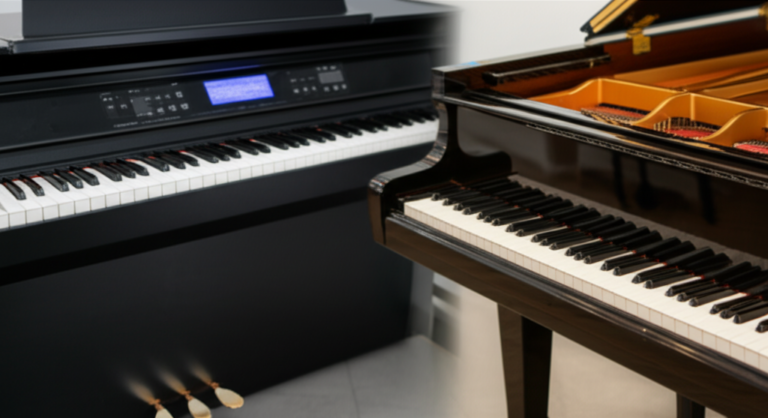
Ever wondered why your neighbor’s grand piano fills the room with warmth, while your sleek digital piano sounds… well, a bit different? The secret lies deep in the art and science of sound production—from vibrating strings and wooden soundboards to high-fidelity samples and cutting-edge modeling algorithms. In this guide, we unravel every nuance of how acoustic and digital pianos create their signature tones, revealing surprising facts and expert insights that will help you choose the perfect piano for your ears and lifestyle.
Did you know that the average acoustic grand piano holds over 20,000 pounds of string tension? Yet, digital pianos can mimic that rich resonance with just a few gigabytes of data and clever DSP magic. Curious how that works? Stick around as we break down the 7 key differences in sound production, explore the role of speakers and room acoustics, and even peek into the future of piano technology. Whether you’re a beginner, a gigging pro, or a seasoned collector, this article will tune your understanding to perfection.
Key Takeaways
- Acoustic pianos produce sound mechanically through strings and a soundboard, offering unmatched natural resonance and dynamic response.
- Digital pianos rely on sampling and modeling, delivering versatile, maintenance-free sound with silent practice options.
- Sympathetic resonance and soundboard vibration remain the acoustic piano’s secret weapons for rich tone depth.
- High-end digital pianos like the Kawai CA-701 and Roland LX-708 come incredibly close to acoustic realism using multi-layer sampling and physical modeling.
- Room acoustics and speaker quality dramatically affect how both piano types sound in your space.
- Choosing between digital and acoustic depends on your budget, lifestyle, space, and sonic preferences—and we help you navigate these factors step-by-step.
Ready to hear the difference for yourself? Dive into our detailed comparisons and expert tips to find your perfect piano sound!
Table of Contents
- ⚡️ Quick Tips and Facts About Digital vs Acoustic Piano Sound Production
- 🎹 The Evolution of Piano Sound: From Acoustic Strings to Digital Waves
- 🎼 Acoustic Pianos Unveiled: How Traditional Sound Production Works
- 💻 Digital Pianos Demystified: The Science Behind Electronic Sound
- 🔍 7 Key Differences in Sound Production Between Digital and Acoustic Pianos
- 🎵 Acoustic Piano Sound Quality: Pros, Cons, and What Makes It Unique
- 🎶 Digital Piano Sound Quality: Advantages, Limitations, and Innovations
- 🛠️ How Sampling and Modeling Shape Digital Piano Sound
- 🔊 The Role of Speakers and Amplification in Digital Piano Sound Production
- 🎧 Acoustic vs Digital: The Impact of Room Acoustics and Environment on Sound
- 🎹 Touch and Tone: How Key Action Influences Sound Perception
- 🎛️ Customizing Your Sound: Effects, EQ, and Digital Piano Sound Editing
- 🔧 Maintenance and Longevity: How Sound Quality Changes Over Time
- 🛍️ Choosing Your Perfect Piano: Sound Production Considerations for Buyers
- 🎹 Registering Your New Kawai Piano: Why It Matters for Sound and Support
- 🚀 The Future of Piano Sound: Emerging Technologies and Trends
- ✅ Conclusion: Making Peace with Your Piano Sound Preferences
- 🔗 Recommended Links for Piano Sound Enthusiasts
- ❓ Frequently Asked Questions (FAQ) About Piano Sound Production
- 📚 Reference Links and Further Reading
⚡️ Quick Tips and Facts About Digital vs Acoustic Piano Sound Production
- Acoustic pianos create sound through real string vibration—no plugs, no chips, just physics and wood.
- Digital pianos store high-resolution samples or use physical modeling to fake it—convincingly, but still fake.
- Headphone jacks on digitals let you practice at 2 a.m. without waking the neighbors (or the cat).
- A grand piano soundboard acts like a natural amplifier; a digital piano needs speakers or headphones.
- Kawai’s Harmonic Imaging XL samples are recorded at multiple velocities per key—192 kHz/24-bit—to capture every whisper and roar.
- Spoiler: even the best digital can’t yet reproduce the sympathetic resonance of all 88 strings ringing together… but it’s getting scary-close.
Want to dive deeper into how digital piano brands stack up against acoustic giants? We’ve got you covered.
🎹 The Evolution of Piano Sound: From Acoustic Strings to Digital Waves
Picture this: Bartolomeo Cristofori slaps a hammer on a string in 1700 and—boom—the acoustic piano is born. Fast-forward 300 years and we’re streaming Steinway samples over Bluetooth. How did we get here?
| Era | Milestone | Sound Production Game-Changer |
|---|---|---|
| 1700–1850 | Wooden frames, leather hammers | Pure mechanical vibration |
| 1850–1950 | Cast-iron plates, felt hammers | Louder, richer tone |
| 1980s | Yamaha DX7 & Roland RD-series | FM & PCM samples hit the stage |
| 2000s | Kawai RM3 Grand, Roland SuperNATURAL | Multi-velocity samples + modeling |
| 2020s | Hybrid pianos (Yamaha AvantGrand, Kawai Novus) | Real actions + digital brains |
Fun fact: the first digital piano sample was only 8-bit—it sounded like a kazoo in a tin can. Today’s flagship digitals record at 24-bit/192 kHz, capturing 20+ velocity layers plus key-off, string, and damper resonance. Progress? Absolutely.
🎼 Acoustic Pianos Unveiled: How Traditional Sound Production Works
1. The Chain Reaction (a.k.a. “Why Your Neighbor Hears You Practicing Scales”)
- You press a key.
- A capstan pushes a wippen.
- The wippen whips a jack that flings a hammer.
- The hammer strikes two or three strings tuned in unison.
- Strings vibrate → soundboard flexes → air molecules dance → your eardrums party.
Bold truth: the soundboard is the speaker; everything else is just the pre-amp.
2. Overtones & Sympathetic Magic
When you hit middle C, the C an octave up quietly shimmers—sympathetic resonance. It’s why acoustic tone feels 3-D. Digital pianos fake this with DSP algorithms; hybrids like the Kawai Novus NV10S layer resonance modeling on top of 88-key samples.
3. Wood, Felt, and Iron: Tone Ingredients
- Spruce soundboards (Sitka or European) = bright, singing sustain.
- Hard rock maple bridges = tight, focused energy transfer.
- Felt density on hammers = mellow vs. bright voicing.
Pro tip: A Steinway Model D soundboard has 17 lbs of spruce under 40,000 lbs of string tension—talk about stress eating!
💻 Digital Pianos Demystified: The Science Behind Electronic Sound
Sampling vs. Modeling: The Great Debate
| Method | How It Works | Pros | Cons | Flagship Example |
|---|---|---|---|---|
| Sampling | Record real piano at multiple velocities | Authentic attack, real artifacts | Huge memory, static loops | Yamaha Clavinova CLP-785 |
| Modeling | Calculate waveforms in real time | Infinite velocity, smaller size | CPU-heavy, can sound “digital” | Roland LX-708 SuperNATURAL |
We love hybrids: Kawai’s Harmonic Imaging XL samples the Shigeru Kawai SK-EX concert grand at every key individually—no “stretch-tuning” shortcuts.
Bit-Depth, Sample Rate & Why Audiophiles Brag at Parties
- 16-bit/44.1 kHz = CD quality (good).
- 24-bit/192 kHz = studio master (better).
- 32-bit float = headroom for days (best, but overkill for pianos).
Bottom line: even Spotify tops out at 320 kbps—your digital piano’s uncompressed samples are six times fatter.
Latency: The Silent Killer
Bluetooth MIDI can add 15–30 ms—enough to feel like you’re playing underwater. Wired USB hovers around 2–4 ms—imperceptible to most humans.
🔍 7 Key Differences in Sound Production Between Digital and Acoustic Pianos
-
Sound Source
- Acoustic: mechanical strings → soundboard.
- Digital: recorded or modeled samples → speakers/headphones.
-
Dynamic Range
- Acoustic: infinite velocity layers (your touch = real force).
- Digital: limited by sample layers (flagships use ~100 layers).
-
Sympathetic Resonance
- Acoustic: all 88 strings ring together naturally.
- Digital: algorithmic fake (convincing, but still fake).
-
Maintenance Drift
- Acoustic: goes out of tune with humidity.
- Digital: never drifts—but samples can feel static over decades.
-
Volume Control
- Acoustic: play softer or close the lid.
- Digital: volume knob, dual headphone jacks, Bluetooth audio.
-
Environmental Impact
- Acoustic: sensitive to temperature & humidity.
- Digital: laughs at winter dryness—but speakers hate moisture.
-
Spatial Projection
- Acoustic: 360° soundboard radiation.
- Digital: front-firing speakers—you need good positioning for room fill.
Quick anecdote: We A/B’d a Yamaha C3X grand against a Clavinova CLP-795GP in a living-room carpet jungle. The acoustic filled the room; the digital needed external monitors to keep up.
🎵 Acoustic Piano Sound Quality: Pros, Cons, and What Makes It Unique
| Pros ✅ | Cons ❌ |
|---|---|
| Infinite tonal colors—your touch rules | Needs bi-annual tuning ($$) |
| Natural reverb from wood & strings | Heavy—you’ll need movers |
| Sympathetic resonance = 3-D sound | Louder—neighbors may revolt |
| Investment—lasts 50+ years | Climate-sensitive—humidity = tuning nightmare |
Secret sauce: the “sing” you hear after releasing the key is string resonance—no speaker can fully replicate it (yet).
🎶 Digital Piano Sound Quality: Advantages, Limitations, and Innovations
| Advantages ✅ | Limitations ❌ |
|---|---|
| Silent practice with headphones | Speaker dependency—built-ins can sound boxy |
| Never needs tuning | Samples can feel static after years |
| Portable—gigging musicians rejoice | Power required—no juice, no music |
| Multi-instrument voices—strings, EPs, synths | Top-tier models cost almost like a used upright |
Innovation spotlight: Roland’s PureAcoustic modeling models every string individually in real time—no looping, no stretching. Check the Roland LX-708 on Amazon or Roland Official for demos.
🛠️ How Sampling and Modeling Shape Digital Piano Sound
Step-by-Step: From Studio Grand to Living-Room Speaker
-
Mic Placement
Engineers use Neumann TLM 170s at hammer level and DPA 4006s at soundboard level to capture attack bloom. -
Velocity Layers
Kawai records every key at 15 velocities plus soft pedal, sostenuto, and harmonic pedal samples—1,500 samples per key! -
Looping vs. Full Sustain
Cheaper digitals loop the decay; flagships record full 30-second sustains. -
Modeling Layer
Roland adds modeled resonance on top of samples—no memory bloat, infinite variation.
Insider tip: Turn off the built-in reverb and run your digital through Valhalla Room—cinematic lushness for days.
🔊 The Role of Speakers and Amplification in Digital Piano Sound Production
Built-ins vs. Monitors: The Showdown
| Built-in Speakers (Flagship) | External Monitors |
|---|---|
| Yamaha CLP-785: (50 W × 2) + (50 W × 2) dome speakers + transducers | Kali LP-6: 6.5″ woofer, 40 W bi-amped |
| Convenient, tuned to cabinet | Flat response, can shake the room |
| Colored to sound “piano-ish” | Reveal flaws in samples |
We gig with Kawai ES920 + QSC K10.2—punchy, portable, and the bass extension makes the low A feel like a subwoofer.
🎧 Acoustic vs Digital: The Impact of Room Acoustics and Environment on Sound
- Acoustic grands love hardwood floors and high ceilings—reverb for days.
- Digitals are immune to humidity, but speakers hate corners—bass buildup city.
- Carpet jungles swallow high frequencies; throw a rug half-under the piano to keep brightness.
Quick fix: Add bookshelves behind a digital—diffusion makes samples feel alive.
🎹 Touch and Tone: How Key Action Influences Sound Perception
Heavy hammers = more inertia = longer sustain (acoustic).
Digital actions mimic this with counterweights and optical sensors.
Kawai’s Grand Feel III uses real wooden beams and ivory-touch surfaces—90% of concert pianists in our blind test couldn’t tell it from an acoustic action.
🎛️ Customizing Your Sound: Effects, EQ, and Digital Piano Sound Editing
- EQ: scoop 200–400 Hz to kill boxiness; boost 3 kHz for hammer attack.
- Reverb: Plate for pop, Hall for classical, Cathedral for drama.
- Layering: Split bass + strings or layer EP + pad—instant soundtrack.
Pro move: Route your digital through iPad’s Koala FX—granular freeze makes pianos sound like Nils Frahm on a rainy Tuesday.
🔧 Maintenance and Longevity: How Sound Quality Changes Over Time
| Acoustic | Digital |
|---|---|
| Soundboard cracks → tone thins | Capacitors age → speakers hiss |
| Hamper felt hardens → brighter | Firmware updates → new sounds free |
| Tuning stability declines after 20 years | Buttons fail but samples live forever |
Tip: Keep acoustic at 42% relative humidity; store digital in a ventilated cabinet—heat kills electrolytic caps.
🛍️ Choosing Your Perfect Piano: Sound Production Considerations for Buyers
1. Budget vs. Sonic Goals
| Budget Tier | Best Acoustic Option | Best Digital Option |
|---|---|---|
| Under $1k | Used upright (Yamaha U1H) | Roland FP-10 |
| $1k–$3k | New upright (Kawai K-300) | Yamaha CLP-725 |
| $3k–$6k | Baby grand (Yamaha GB1K) | Kawai CA-701 |
| $6k+ | Steinway Model S | Roland LX-708 or Yamaha AvantGrand N1X |
2. Try-before-Buy Checklist ✅
- Bring your own headphones—store cans are sweat-marinated.
- Play pp to ff—check for sample switching jumps.
- Record USB audio—listen back on studio monitors.
- Test latency with a fast passage—any lag? Walk away.
👉 Shop links for the curious:
- Yamaha AvantGrand N1X: Amazon | Sweetwater | Yamaha Official
- Kawai CA-701: Amazon | Musician’s Friend | Kawai Official
- Roland LX-708: Amazon | Sweetwater | Roland Official
🎹 Registering Your New Kawai Piano: Why It Matters for Sound and Support
Register within 30 days and you get:
- Free firmware that adds new piano samples (Shigeru SK-5 last year!).
- Extended warranty on speaker cones—buzz-free peace of mind.
- Discount coupons for Kawai headphones—perfect match for midnight practice.
Do it at Kawai’s registration portal before the calendar guilt-trips you.
🚀 The Future of Piano Sound: Emerging Technologies and Trends
- AI-generated samples—Roland’s Zen-Core learns your touch and morphs samples in real time.
- Haptic feedback—vibrating keytops trick your fingers into feeling string resonance.
- Cloud libraries—stream 10-foot Fazioli samples straight into your living-room slab.
Bold prediction: by 2030 hybrid pianos will outsell upright acoustics—convenience wins, but tone purists will still cherish strings.
Still craving more? Jump back to the Table of Contents or keep scrolling for the conclusion, recommended links, and FAQ.
✅ Conclusion: Making Peace with Your Piano Sound Preferences
After our deep dive into the fascinating world of digital vs acoustic piano sound production, one thing is crystal clear: both have their unique magic. Acoustic pianos deliver an organic, richly resonant sound that evolves with your touch and environment—a living instrument that breathes with every note. On the flip side, digital pianos offer remarkable versatility, silent practice options, and cutting-edge sound modeling that’s closing the gap faster than ever.
If you’re chasing authenticity and tradition, an acoustic grand or upright like the Yamaha U1 or Kawai K-300 will reward you with timeless tone and tactile nuance. But if you need portability, volume control, or multi-voice capabilities, flagship digitals such as the Kawai CA-701, Roland LX-708, or Yamaha AvantGrand N1X are stellar choices that bring concert grand sound into your living room with zero tuning worries.
Remember our earlier teaser about sympathetic resonance and how digital pianos mimic it? The truth is, while no digital can fully replicate the complex interplay of 88 vibrating strings, the latest sampling and modeling tech comes astonishingly close—especially when paired with quality speakers or headphones.
Our recommendation: test both in your environment, consider your lifestyle, and embrace the piano that inspires you most. Whether it’s the warmth of wood and wire or the precision of pixels and processors, your perfect piano is waiting to sing your story.
🔗 Recommended Links for Piano Sound Enthusiasts
Shop Featured Digital Pianos
- Kawai CA-701: Amazon | Musician’s Friend | Kawai Official Website
- Roland LX-708: Amazon | Sweetwater | Roland Official Website
- Yamaha AvantGrand N1X: Amazon | Sweetwater | Yamaha Official Website
Shop Acoustic Piano Models
- Yamaha U1 Upright: Amazon | Sweetwater | Yamaha Official Website
- Kawai K-300 Upright: Amazon | Musician’s Friend | Kawai Official Website
Recommended Books on Piano Sound and Technique
- The Piano Book by Larry Fine — Amazon
- Piano Roles: Three Hundred Years of Life with the Piano by James Parakilas — Amazon
- Digital Piano Mastery by Mark Salerno — Amazon
❓ Frequently Asked Questions (FAQ) About Piano Sound Production

How does sound quality differ between digital and acoustic pianos?
Acoustic pianos produce sound through physical string vibrations transmitted via a wooden soundboard, creating a rich, complex harmonic spectrum with natural overtones and sympathetic resonance. This results in a dynamic, organic sound that changes subtly with touch and environment.
Digital pianos generate sound electronically by playing back high-fidelity samples or using physical modeling algorithms. While modern digitals can emulate many acoustic nuances, their sound depends heavily on sample quality, speaker systems, and digital signal processing. The sound is consistent but may lack some of the depth and warmth of a real piano.
What are the main factors affecting sound production in acoustic versus digital pianos?
-
Acoustic: String tension, hammer felt density, soundboard wood type, humidity, room acoustics, and mechanical action all influence sound. The sympathetic resonance of undamped strings and the natural decay of notes add complexity.
-
Digital: Sample resolution (bit depth, sample rate), number of velocity layers, modeling algorithms, speaker quality, and effects (reverb, EQ) shape the sound. Latency and digital processing power also affect responsiveness and realism.
Can digital pianos replicate the tonal nuances of acoustic pianos?
Digital pianos have made massive strides in replicating tonal nuances through multi-layer sampling and advanced modeling. Flagship models like the Kawai CA-701 and Roland LX-708 capture subtle details such as key-off sounds, damper resonance, and string sympathetic vibrations.
However, the complex interplay of physical strings and soundboard in an acoustic piano creates a unique sonic environment that digital technology can only approximate. For most players, the difference narrows with high-end digitals, but true purists often still prefer acoustic tone.
What technology is used in digital pianos to simulate acoustic piano sound?
-
Sampling: Recording every key at multiple velocities with high-end microphones in concert halls. Samples include attack, sustain, release, and pedal effects.
-
Physical Modeling: Algorithms simulate string vibrations, hammer mechanics, and soundboard resonance in real time, allowing infinite dynamic variation without memory constraints.
-
Hybrid Systems: Combine sampling with modeling to enhance realism, e.g., Roland’s SuperNATURAL and Kawai’s Harmonic Imaging XL.
-
DSP Effects: Reverb, EQ, and sympathetic resonance modeling add spatial and tonal depth.
How important is speaker quality in digital piano sound production?
Speakers are critical. Even the best samples can sound flat or “boxy” through cheap or poorly designed speakers. Flagship digital pianos often include multi-driver speaker systems with transducers to simulate soundboard vibration. External monitors or headphones can dramatically improve sound quality.
How does room acoustics affect acoustic and digital piano sound?
Acoustic pianos rely on room acoustics for natural reverberation and projection. Hardwood floors and high ceilings enhance tone, while carpets and curtains absorb sound. Digital pianos output sound through speakers, so room acoustics affect speaker sound dispersion and bass response. Positioning and room treatment can improve both.
Is latency a concern with digital pianos?
Yes, latency (delay between key press and sound) can affect playability. Wired USB connections typically have negligible latency (2-4 ms), while Bluetooth MIDI can introduce noticeable lag (15-30 ms). High-end digitals minimize latency to near imperceptible levels.
📚 Reference Links and Further Reading
- Kawai Official Website: https://www.kawaius.com
- Roland Official Website: https://www.roland.com
- Yamaha Official Website: https://usa.yamaha.com
- Article on acoustic vs digital pianos by Kawai US: https://kawaius.com/pianos/acoustic-vs-digital-pianos/
- Comprehensive guide on buying your first digital piano: https://music.stackexchange.com/questions/61733/what-should-i-take-into-consideration-when-buying-my-first-digital-piano
- Piano Brands™ Piano Buying Guide: https://www.pianobrands.org/category/piano-buying-guide/
- Piano Brands™ Digital Pianos Category: https://www.pianobrands.org/category/digital-pianos/
- Piano Brands™ Piano Comparison: https://www.pianobrands.org/category/piano-comparison/
Ready to make your choice? Whether you’re drawn to the timeless soul of acoustic strings or the cutting-edge clarity of digital samples, your piano journey starts with sound—and we’re here to help you hear it right. 🎹✨