Support our educational content for free when you buy through links on our site. Learn more
🎹 10 Types of Piano Brands and Their Unique Characteristics (2025)

Ever wondered why a Steinway sounds so majestic while a Yamaha feels like a trusty companion? Or why Bösendorfer’s imperial bass notes resonate differently than Fazioli’s sparkling clarity? Welcome to the fascinating world of piano brands, where craftsmanship, history, and innovation collide to create instruments with distinct personalities. In this article, we unravel the 10 most iconic piano brands and dive deep into their signature sounds, touch, and design philosophies. Whether you’re a budding pianist, a seasoned pro, or just piano-curious, this guide will help you find the brand that truly speaks to your musical soul.
Here’s a teaser: Did you know that Bösendorfer’s Imperial grand has 97 keys instead of the usual 88, adding a whole new dimension to its sound? Or that Kawai’s revolutionary carbon fiber action keeps its pianos playing perfectly even in the most humid climates? Stick around, because by the end, you’ll not only know the brands but also which one fits your style, space, and budget like a glove.
Key Takeaways
- Steinway & Sons reigns supreme for concert pianists with its powerful, rich tone and unmatched legacy.
- Yamaha and Kawai offer versatile, reliable pianos blending tradition with cutting-edge technology, perfect for all skill levels.
- European brands like Bösendorfer, Fazioli, and Schimmel provide unique tonal colors ranging from warm orchestral to brilliant clarity.
- Hybrid and digital pianos from these brands bring innovation to your fingertips, offering silent practice and digital connectivity.
- Choosing the right brand depends on your musical goals, space, and personal touch preference—playing before buying is crucial!
Ready to explore your perfect piano match? Check out these top brands and start your musical journey today:
- 👉 Shop Steinway & Sons: Sweetwater | Steinway Official
- Explore Yamaha Pianos: Sweetwater | Yamaha Official
- Discover Kawai: Sweetwater | Kawai Official
Dive in and find the piano brand that will inspire your music for years to come!
Table of Contents
- ⚡️ Quick Tips and Facts: Your Essential Piano Brand Cheat Sheet
- 🎶 The Grand Overture: A Brief History of Piano Manufacturing and Brand Evolution
- 🔍 Decoding Piano Brand Characteristics: What Makes Each Unique?
- 🌟 Unveiling the Maestros: A Deep Dive into Renowned Piano Brands and Their Signature Sounds
- 💰 The Price of Perfection: Understanding Piano Brand Value and Investment
- 🎹 Acoustic vs. Digital: Brand Offerings in the Modern Piano Landscape
- 🤔 Which Piano Maker Is Right for You? Navigating Your Personal Piano Journey
- 🛠️ Crafting Excellence: The Art and Science Behind Piano Brand Construction
- 💡 Beyond Tradition: Innovation and Technology in Modern Piano Brands
- 🧼 Nurturing Your Investment: Care and Maintenance for Your Chosen Piano Brand
- 📜 The Legacy Lives On: Brand Reputation, Heritage, and Resale Value
- ✅ Smart Buying Strategies: Tips from the Piano Brands™ Experts
- Conclusion: Your Grand Finale in Piano Brand Knowledge
- Recommended Links: Dive Deeper into the World of Pianos
- FAQ: Your Most Pressing Piano Brand Questions Answered
- Reference Links: Our Sources and Further Reading
⚡️ Quick Tips and Facts: Your Essential Piano Brand Cheat Sheet
Welcome, fellow music lovers! Before we embark on our grand tour of the piano world, let’s hit the high notes with a quick cheat sheet. Think of this as the espresso shot you need before a long practice session—potent and straight to the point. Ever wondered how many brands of piano are there? The answer is staggering, but we’re here to help you navigate the most important ones.
Here at Piano Brands™, we’ve spent countless hours with these magnificent instruments, and we’ve distilled our key takeaways for you.
- The “Big Three”: Steinway & Sons, Yamaha, and Kawai are often considered the dominant forces in the global piano market, each with a distinct philosophy and sound.
- European vs. Asian Tone: Generally, European brands like Bösendorfer, Schimmel, and Fazioli are known for a rich, complex, and often warmer tone. Asian brands like Yamaha and Kawai are often characterized by a brighter, clearer, and more precise sound. Of course, this is a generalization, and every piano has its own voice!
- Handmade vs. Factory-Made: Brands like Fazioli and Steingraeber & Söhne produce a very small number of pianos per year, almost entirely by hand. Brands like Yamaha masterfully blend traditional craftsmanship with cutting-edge manufacturing technology to produce instruments on a larger scale.
- Action Matters: A piano’s “action” is its engine—the complex mechanism of levers that transfers the energy from your fingers to the hammers. Kawai’s Millennium III action, with its carbon fiber components, is a prime example of modern innovation designed for stability and speed.
- Investment Value: A piano isn’t just a musical instrument; it’s an investment. Steinway & Sons pianos are famous for their ability to hold or even increase in value over time, a testament to their enduring legacy and craftsmanship.
Here’s a rapid-fire comparison of some of the titans we’ll be discussing:
| Brand | Origin 🌍 | Known For | Typical Sound Profile | Best For… |
|---|---|---|---|---|
| Steinway & Sons | USA/Germany | The concert hall standard; investment value | Powerful, rich, “the Steinway sound” | Professionals, institutions, serious amateurs |
| Yamaha | Japan | Versatility, reliability, technology | Bright, clear, consistent | All levels, from beginners to pros; studios |
| Kawai | Japan | Innovative action, warm tone | Mellow, warm, full-bodied | Players seeking a less bright alternative to Yamaha |
| Bösendorfer | Austria | Extra bass keys, Viennese heritage | Warm, singing, orchestral | Classical purists, connoisseurs |
| Fazioli | Italy | Modern luxury, unparalleled clarity | Brilliant, clear, powerful, responsive | Concert artists, recording studios, aficionados |
Ready to dive deeper? Let’s go!
🎶 The Grand Overture: A Brief History of Piano Manufacturing and Brand Evolution
Every great piece of music has a backstory, and the piano is no different. The journey from Bartolomeo Cristofori’s first gravicembalo col piano e forte around 1700 to the gleaming concert grands of today is a tale of innovation, artistry, and fierce competition. For a deeper dive, check out our Piano History section.
Initially, pianos were one-off creations by individual artisans. But as the Industrial Revolution roared to life in the 19th century, so did the piano industry. This was the golden age of piano manufacturing, where legendary names like Steinway (founded 1853 in New York), Blüthner (1853, Leipzig), and Bechstein (1853, Berlin) were born. It’s no coincidence they all started in the same year—the demand for pianos was exploding!
These pioneers didn’t just build instruments; they built brand identities.
- Steinway & Sons aggressively pursued the American market, patenting innovations and securing endorsements from top artists like Anton Rubinstein. Their strategy was to become synonymous with the concert stage.
- Bösendorfer in Vienna became the official pianist to the Emperor of Austria, cementing its association with European royalty and the rich tradition of classical music.
- In Japan, after World War II, companies like Yamaha and Kawai emerged. They embraced modern manufacturing techniques, allowing them to produce high-quality, reliable pianos at a more accessible price point, ultimately bringing the piano into millions of homes worldwide.
This evolution from a single workshop to a global industry is why today we don’t just talk about “pianos”—we talk about the distinct personality and legacy of each brand.
🔍 Decoding Piano Brand Characteristics: What Makes Each Unique?
So, you’re in a showroom, surrounded by beautiful pianos. You play a chord on a Yamaha, then the same chord on a Bösendorfer. Why do they sound and feel so different? It’s not magic; it’s a combination of four key elements that define a brand’s soul. Understanding these is the first step in our comprehensive Piano Buying Guide.
Tone and Timbre: The Sonic Signature of a Brand
Tone is the piano’s voice. It’s the color, the character, the very essence of the sound.
- Bright vs. Dark: A Yamaha is often described as having a bright tone—think of a clear, sunny day. It cuts through a mix, which is why it’s a favorite in pop music and recording studios. A Bösendorfer, on the other hand, has a darker, warmer tone—more like a rich, velvety night. It’s complex and enveloping.
- The “American” vs. “European” Sound: This is a classic debate! The “American” sound, epitomized by Steinway, is powerful, with a strong fundamental tone and a long sustain. The “European” sound, found in brands like Bechstein or Blüthner, is often more complex, with a rich palette of overtones, sometimes described as more “lyrical” or “singing.”
Action and Touch: The Feel of the Keys
If tone is the voice, the action is the conversation. It’s the physical connection between you and the music. A brand’s action determines how responsive the piano is to your touch.
- Weight: Some actions are heavier, requiring more effort from the player, which can help build finger strength. Others are lighter and faster, preferred by pianists who play technically demanding pieces. Fazioli pianos are renowned for their incredibly fast and responsive actions.
- Materials: Traditionally, actions were made entirely of wood. However, wood can swell and shrink with changes in humidity. This led Kawai to pioneer the use of ABS-carbon composites in their Millennium III action. This innovation provides greater stability and consistency, a point of pride for the brand.
Craftsmanship and Materials: The Heart of Durability
A piano is made of thousands of parts, and the quality of those parts—and how they’re put together—is paramount.
- Wood Selection: The soundboard is the piano’s speaker, and the wood it’s made from is critical. Most high-end brands use solid Sitka or European spruce, prized for its strength-to-weight ratio. Fazioli famously sources its soundboard spruce from the same forest in Val di Fiemme, Italy, where Antonio Stradivari got the wood for his legendary violins.
- Hand-Crafted vs. Precision-Manufactured: There’s a spectrum here. A Steingraeber & Söhne is built by a small team of master artisans over many months. A Yamaha is built on a state-of-the-art production line that combines robotic precision with the discerning touch of human craftspeople. Neither is inherently “better”—they simply represent different philosophies of construction.
Design and Aesthetics: Visual Appeal and Legacy
Let’s be honest: a piano is also a stunning piece of furniture. Brands cultivate a distinct visual identity.
- Classic vs. Modern: A Steinway Model B in polished ebony is the quintessential classic grand piano. But then you have brands like Sauter, who collaborate with designers like Peter Maly to create strikingly modern uprights that are as much art pieces as they are instruments.
- Signature Features: Some brands have unique visual cues. The “open-pore” wood finish on some Schimmel models, the iconic shape of a Steinway’s lyre (the pedal structure), or the extra keys on a Bösendorfer Imperial are all part of the brand’s story.
So, which brand’s characteristics will speak to you? Let’s meet the contenders.
🌟 Unveiling the Maestros: A Deep Dive into Renowned Piano Brands and Their Signature Sounds
Alright, it’s time for the main event! We’re pulling back the curtain on the most revered names in the piano world. We’ll explore what makes each one tick, from their signature sound to the philosophy that guides their hands. This is more than just a list; it’s a tour through the hearts of the world’s greatest piano workshops. For more head-to-head analysis, visit our Piano Comparison page.
1. 👑 Steinway & Sons: The Enduring Legacy of the Concert Grand
You can’t talk about pianos without saying “Steinway.” It’s like talking about cars without mentioning Mercedes-Benz. For over 150 years, Steinway has been the benchmark, the instrument that over 97% of concert pianists choose. Why? In a word: power.
A Steinway doesn’t just play music; it projects it. The sound is rich, full, and has an unmistakable presence that can fill the largest concert hall. I remember the first time I played a Model D Concert Grand. The sheer dynamic range was breathtaking. You can whisper the most delicate pianissimo, and then unleash a thunderous fortissimo that feels like it could shake the walls. That’s the Steinway experience.
- Signature Tone: Powerful, rich bass; clear, bell-like treble; and a famously long sustain. It’s often described as the “quintessential” piano sound.
- Action/Touch: Substantial and responsive. It has a satisfying weight that allows for incredible control over dynamics.
- Known For: Dominance on the concert stage, being a long-term financial investment, and its handcrafted process (each piano takes nearly a year to build). As Muex.com notes, their pianos are handcrafted with over 12,000 components, ensuring an “intricate design.”
- Drawback? ✅ The prestige comes with a premium price tag, and the “Steinway sound” might be too powerful for smaller living spaces.
👉 Shop Steinway & Sons on:
2. 🌸 Kawai: Innovation, Technology, and a Balanced Touch
If Steinway is the established king, Kawai is the brilliant innovator. Hailing from Hamamatsu, Japan, Kawai has never been afraid to challenge tradition in the pursuit of perfection. Their biggest claim to fame is the revolutionary Millennium III Action.
A friend of mine, a professional piano teacher, recently replaced her old upright with a Kawai K-300. She lives in a region with wild humidity swings, and her old piano’s wooden action was a constant headache. The K-300’s carbon fiber action, she says, is “rock-solid.” It plays the same on a dry winter day as it does in the humid summer. That’s the kind of practical innovation Kawai is known for.
- Signature Tone: Often described as warmer and more mellow than its main rival, Yamaha. It has a full, rounded tone that is particularly beautiful for romantic and impressionistic music.
- Action/Touch: The Millennium III action is famously fast, light, and consistent. The use of carbon composites makes it less susceptible to climatic changes.
- Known For: Technological innovation, a more affordable price point than European brands, and being a favorite among educators and institutions. Their high-end Shigeru Kawai line competes with the best European makers.
- Drawback? ❌ Some purists argue that composite action parts lack the “soul” of traditional wood, though many players find this claim debatable.
👉 Shop Kawai on:
3. 🎵 Yamaha: Versatility, Reliability, and Global Reach
Yamaha is the world’s largest manufacturer of musical instruments, and their pianos are a cornerstone of that empire. The key to Yamaha’s success is consistency. Whether you’re playing their entry-level b-series upright, a workhorse U1 studio upright, or the magnificent CFX concert grand, you know you’re getting a well-made, reliable instrument.
I’ve played Yamahas in countless recording studios, school auditoriums, and church halls. They are the ultimate musical workhorse. Their bright, clear tone cuts through a band or orchestra with ease, and their durability is legendary. As Muex.com highlights, the CFX is praised for its “profoundly rich tone and responsive action.”
- Signature Tone: Bright, clear, and precise. Excellent for pop, jazz, and any music that requires clarity and punch.
- Action/Touch: Smooth, consistent, and reliable. It’s a very balanced action that feels comfortable to a wide range of players.
- Known For: Incredible versatility (from digital pianos to concert grands), exceptional quality control, and a massive global presence. Their Disklavier and Silent Piano technologies are industry-leading.
- Drawback? ❌ The characteristic “brightness” isn’t for everyone. Players seeking a warmer, more complex European tone might look elsewhere.
👉 Shop Yamaha on:
4. 🇦🇹 Bösendorfer: Austrian Artistry and the Imperial Sound
Playing a Bösendorfer is like stepping into a Viennese concert hall from the 19th century. Founded in 1828, this Austrian maker is steeped in the tradition of Haydn, Mozart, and Schubert. While now owned by Yamaha, they operate independently, preserving their unique identity.
Their most famous creation is the Model 290 Imperial Concert Grand, which features 97 keys instead of the standard 88. Those extra bass notes aren’t always played directly, but their strings resonate sympathetically, adding an incredible depth and richness to the entire piano. It’s an orchestral sound, a “singing” tone that is utterly unique.
- Signature Tone: Warm, rich, and “orchestral.” It has a deep, sonorous bass and a lyrical, singing treble. It’s less percussive than many other brands.
- Action/Touch: Meticulously crafted and highly responsive, designed to translate the most subtle nuances of the player’s touch.
- Known For: The 97-key Imperial Grand, a rich Viennese heritage, and an extremely limited, handcrafted production (only a few hundred pianos per year).
- Drawback? ❌ Their unique tone and feel may not be as versatile for genres like jazz or rock, and they are among the most expensive pianos in the world.
👉 Shop Bösendorfer on:
5. 🇮🇹 Fazioli: The Italian Masterpiece of Modern Piano Building
Fazioli is the wunderkind of the piano world. Founded in 1981 by Paolo Fazioli, a pianist and engineer, the company burst onto a scene dominated by centuries-old brands and redefined what a modern piano could be. They produce only grand pianos, and each one is a masterpiece of precision and artistry.
The Fazioli sound is one of unbelievable clarity. Every note in a complex chord is distinct. Their flagship, the F308, is the longest piano in production and features a fourth pedal that brings the hammers closer to the strings, allowing for a softer sound without changing the timbre—a feature pianists dream of.
- Signature Tone: Brilliant, powerful, and incredibly clear. It has a sparkling treble and a commanding bass.
- Action/Touch: Extremely fast, light, and responsive. Many artists feel it’s the most responsive action available today.
- Known For: Being a modern luxury brand, the F308 and its fourth pedal, and using exquisite materials like Red Spruce from the same forest as Stradivarius violins.
- Drawback? ❌ Exclusivity and price. Fazioli produces only around 150 pianos a year, and they are among the most expensive on the market.
👉 Shop Fazioli on:
6. 🇩🇪 Schimmel: German Precision and European Elegance
Schimmel represents the best of German piano building: precision engineering combined with a rich, musical soul. For many years, they were Germany’s best-selling piano brand, known for producing instruments with a “high-quality tone that’s rich and clear,” as noted by Muex.com.
Their Konzert series is particularly impressive, designed to offer a grand-like experience in a smaller form factor. They achieve this through innovative scale designs and construction techniques. Schimmel pianos have a wonderful balance—the power is there when you need it, but the tone is never harsh. It’s a refined, elegant sound.
- Signature Tone: Rich, clear, and balanced with a powerful voice. It’s a versatile European tone that suits a wide range of repertoire.
- Action/Touch: They use actions designed by both Renner and their own in-house designs, which are known for their precision and reliability.
- Known For: Being a family-owned German company for generations, pioneering computer-aided design (CAD) in piano manufacturing, and their beautiful “Art Collection” pianos.
- Drawback? ❌ While highly respected, they don’t have the same level of global brand recognition as Steinway or Yamaha outside of Europe.
👉 Shop Schimmel on:
7. 🇩🇪 Steingraeber & Söhne: Handcrafted Excellence and Unique Innovation
Nestled in Bayreuth, Germany (the city of Wagner), Steingraeber & Söhne is a boutique manufacturer that is revered by piano connoisseurs. Since 1852, this family-run business has been building pianos by hand, focusing on quality over quantity.
They are famous for their unique innovations. For example, they offer a “Sordino” pedal on their uprights that inserts a strip of felt between the hammers and strings, perfectly recreating a sound specified by Beethoven. They also developed a carbon fiber soundboard and actions for players in extreme climates. This is a brand for someone who wants not just a piano, but a piece of musical history built by true artisans.
- Signature Tone: Transparent, singing, and incredibly nuanced. It’s a very “personal” sound that responds to the player’s every intention.
- Action/Touch: They offer various actions, including classic Renner actions and modern magnetic-accelerated actions for incredibly fast repetition.
- Known For: Being a small, family-owned company; unique historical features; and bespoke customization options.
- Drawback? ❌ Very low production numbers and a high price point make them rare and exclusive.
👉 Shop Steingraeber & Söhne on:
8. 🇩🇪 Grotrian: A Rich Heritage of German Tone and Craftsmanship
The Grotrian-Steinweg story is intertwined with Steinway’s own (the “Steinweg” part of the name comes from the same family), but the brand has forged its own distinct path in Braunschweig, Germany. Grotrian is celebrated for its treble.
The Grotrian sound is often described as having a “sustained treble, a powerful bass, and a light sound of attack.” Their patented star-shaped back-frame on their uprights is a testament to their engineering prowess, designed to handle the immense tension of the strings and contribute to the piano’s stability and tonal quality.
- Signature Tone: A singing, lyrical treble and a strong, clear bass. The tone is known for its long sustain and rich overtones.
- Action/Touch: They use high-quality Renner actions, meticulously regulated to provide a sensitive and controlled playing experience.
- Known For: Its exceptional treble register, the star-shaped back-frame, and a long-standing reputation for quality among European pianists.
- Drawback? ❌ Less common in the North American market, making them harder to find and service in some areas.
👉 Shop Grotrian on:
9. 🇩🇪 Sauter: The Oldest German Piano Manufacturer’s Distinctive Voice
Sauter holds the distinction of being the oldest continuously-operating piano company in the world, founded in 1819. Located in the heart of the Black Forest, they are known for their “bell-like” tone and innovative designs.
Their most significant innovation is the R2 Double Escapement action in their uprights, which uses an additional spring to allow for faster repetition, mimicking the feel of a grand piano. This makes their uprights a favorite among serious pianists who lack the space for a grand. As Musical Pursuits notes, their pianos are described as “bell-like,” offering a “lush and warm sound.”
- Signature Tone: Clear and bell-like, with a warm, lush character. It’s a very distinct and beautiful sound.
- Action/Touch: The R2 action in their uprights is a major selling point, offering grand-piano-like speed and responsiveness.
- Known For: Being the oldest piano maker, the R2 action, and their striking modern designs in collaboration with designer Peter Maly.
- Drawback? ❌ Their unique aesthetic and sound profile are very specific and may not appeal to all players.
👉 Shop Sauter on:
10. 🇬🇧 Blüthner: The Golden Tone of Leipzig and Aliquot Stringing
Blüthner pianos, hailing from Leipzig, Germany, are famous for their “Golden Tone.” It’s a warm, romantic, and lyrical sound that has captivated composers like Debussy, Rachmaninoff, and Tchaikovsky.
Their secret weapon is the patented Aliquot Stringing System. In the treble section, a fourth, un-struck string is added to each note. This string is tuned an octave higher and vibrates sympathetically, adding a shimmering layer of overtones that creates Blüthner’s signature rich and complex sound. It’s a sound you can get lost in.
- Signature Tone: Warm, romantic, and dark, with a shimmering, “golden” quality thanks to the Aliquot system.
- Action/Touch: Blüthner actions are known for being fluid and responsive, allowing for a very expressive and lyrical playing style.
- Known For: The Aliquot stringing system, a “Golden Tone” favored by classical and romantic composers, and their stunning transparent “lucid” pianos.
- Drawback? ❌ The rich, overtone-heavy sound can be less suitable for music that requires a very clean, percussive attack.
👉 Shop Blüthner on:
💰 The Price of Perfection: Understanding Piano Brand Value and Investment
Let’s talk money. A piano can be one of the most significant purchases you’ll ever make, after a house or a car. But unlike a car, a high-quality piano from a reputable brand can last a lifetime and even become a cherished family heirloom. Understanding the value proposition is a key part of our Piano Buying Guide.
Entry-Level vs. Premium Brands: What’s the Difference?
Why does a premium German grand piano cost so much more than a good-quality Asian upright? It boils down to three things: materials, labor, and time.
| Feature | Premium Brands (e.g., Fazioli, Bösendorfer) | Entry/Mid-Level Brands (e.g., Essex, Boston, some Yamaha/Kawai models) |
|---|---|---|
| Wood | Sourced from slow-growth, high-altitude forests (e.g., Val di Fiemme Spruce). Seasoned for years. | Good quality spruce, but less selective. Often kiln-dried more quickly. |
| Labor | Primarily handcrafted by master artisans. Hundreds or thousands of hours per piano. | A blend of skilled human labor and automated, high-precision machinery. |
| Time | A single piano can take over a year to build, allowing parts to settle and be refined. | Production is much faster, often measured in weeks or a few months. |
| Result | Unparalleled tonal complexity, touch sensitivity, and longevity. A unique work of art. | Excellent performance, reliability, and consistency. A superb musical tool. |
It’s not that one is “good” and one is “bad.” A Yamaha U1 is a phenomenal instrument that has launched countless musical careers. A Fazioli is a different beast entirely—it’s a pinnacle of the craft, an instrument for a connoisseur.
Resale Value and Brand Reputation: Protecting Your Investment
Here’s where brand name really matters. A well-maintained piano from a top-tier brand can be a surprisingly stable investment.
- ✅ High Resale Value: Steinway & Sons is the undisputed champion here. It’s not uncommon for a 20- or 30-year-old Steinway to sell for more than its original purchase price. This is due to their “built-to-last” philosophy and the steady increase in the price of new models.
- ✅ Good Resale Value: Brands like Yamaha and Kawai also hold their value well, especially their professional-grade uprights and grand pianos (like the U-series and C-series from Yamaha, or the K-series and GX-series from Kawai). Their reputation for reliability makes them a safe bet on the used market.
- ❌ Lower Resale Value: Pianos from lesser-known or discontinued brands, or “stencil pianos” (where a factory puts a different brand name on a generic piano), tend to depreciate much more quickly.
Expert Tip: When buying a used piano, the brand name gives you a baseline for quality, but the piano’s condition and maintenance history are even more important. Always have a qualified piano technician inspect a used instrument before you buy!
🎹 Acoustic vs. Digital: Brand Offerings in the Modern Piano Landscape
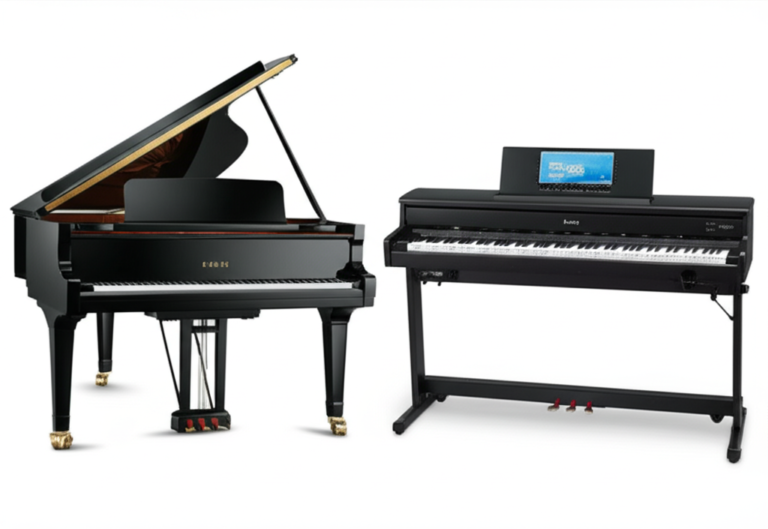
The 21st century has given us an incredible choice: the timeless soul of an acoustic piano or the mind-boggling versatility of a digital one. The best brands don’t see this as a battle; they see it as an opportunity to serve every type of musician. Let’s do a quick Piano Comparison of how brands approach this divide.
Leading Acoustic Piano Brands: Grand Pianos and Uprights
These are the traditionalists, the keepers of the flame. Their focus is on wood, felt, and steel.
- The Purists: Brands like Bösendorfer, Fazioli, and Steingraeber & Söhne focus exclusively on acoustic pianos. Their mission is to perfect the art of the acoustic instrument, and they don’t divert their resources into the digital realm.
- The Full-Spectrum Masters: Steinway, Yamaha, and Kawai have a commanding presence in the acoustic world. Steinway offers its main Hamburg/New York lines, plus the more affordable Boston (designed by Steinway, manufactured by Kawai) and Essex (designed by Steinway, manufactured by Pearl River) lines to cover different market segments.
- The German Powerhouses: Schimmel, Sauter, Grotrian, and Blüthner are giants of German acoustic piano manufacturing, each with a unique voice and a legacy of quality.
Top Digital Piano Brands: Innovation and Versatility
Digital pianos offer a world of possibilities: silent practice with headphones, recording capabilities, and access to hundreds of instrument sounds. For more, check out our guides to Digital Pianos.
- The Digital Giants: Yamaha and Roland are arguably the two biggest names in the digital piano space. Yamaha’s Clavinova series is legendary, known for its realistic touch and sound sampled from their own CFX concert grand. Roland’s SuperNATURAL sound engine is praised for its incredibly detailed and expressive modeling technology.
- The Contenders: Kawai also produces exceptional digital pianos (the CA and CN series), often lauded for their wooden-key actions that provide a more authentic touch. Casio, once seen as a “keyboard” company, has made huge strides with its Celviano and Privia lines, offering incredible value and collaborating with C. Bechstein for some of their sound samples.
- The Specialists: Brands like Nord (famous for their red keyboards) are favorites among professional gigging musicians for their top-tier sounds and stage-ready durability.
Hybrid Pianos: Blending the Best of Both Worlds
What if you want the authentic touch of an acoustic piano but the versatility of a digital? Enter the hybrid piano.
- Yamaha’s AvantGrand & Silent Pianos: Yamaha is the leader here. The AvantGrand series features a real acoustic piano action in a digital body, offering the best of both worlds for touch. Their Silent Piano™ technology is even more ingenious: it’s a full acoustic piano that, with the flip of a switch, engages a hammer shank stopper and becomes a digital piano for silent practice through headphones.
- Kawai’s AURES & ATX: Kawai offers similar systems. The AnyTimeX (ATX) is their silent system, and the AURES is a “transacoustic” system that can play digital sounds through the piano’s own acoustic soundboard, effectively turning the soundboard into a high-quality speaker.
The lines are blurring, and the ultimate winner is you, the player, with more choices than ever before.
🤔 Which Piano Maker Is Right for You? Navigating Your Personal Piano Journey
Okay, we’ve met the stars of the show. Now for the most important question: which one belongs in your home? Choosing a piano is a deeply personal decision, like choosing a life partner. It needs to fit your personality, your goals, and your living space. Let’s walk through the process with our expert Piano Brand Guides.
Considering Your Skill Level and Musical Goals
- For the Beginner (or a Family with Young Beginners): You need an instrument that is encouraging, reliable, and won’t break the bank.
- Our Recommendation: A high-quality digital piano like a Yamaha Arius YDP or Kawai CN series, or a durable upright like a Yamaha b-series or Kawai K-15. These provide a great touch and tone to build proper technique without the massive investment of a grand.
- For the Serious Amateur or Advancing Student: You’re past the basics. You need an instrument that can keep up with your growing skills and allow for nuanced expression.
- Our Recommendation: A professional upright like the Yamaha U1 or Kawai K-300, or a baby grand like a Boston GP-156 PE. These instruments offer a level of touch and tonal complexity that will inspire you for years.
- For the Professional or Connoisseur: You demand the best. Your piano is your artistic partner.
- Our Recommendation: This is where the sky’s the limit. A Steinway Model B, a Fazioli F212, a Bösendorfer 200, or a high-end Shigeru Kawai SK-3. The choice here is purely about which “voice” speaks to you.
Space, Aesthetics, and Acoustic Environment
A 9-foot concert grand might be your dream, but will it fit in your apartment? Be realistic!
- Measure Your Space: Don’t just measure the footprint. Remember you need space for the bench and for the pianist to sit comfortably. For a grand piano, you also need to consider how the lid will open.
- Consider the Room’s Acoustics: A piano with a bright, powerful tone (like a Yamaha) in a small room with hardwood floors and lots of windows can sound harsh and overwhelming. A warmer, darker piano (like a Blüthner) might be a better fit. Rugs, curtains, and furniture can help tame a “live” room.
- Aesthetics: Do you prefer the timeless elegance of a polished ebony Steinway, or the striking modernism of a Sauter designed by Peter Maly? The piano will be a centerpiece of your home, so choose a design you love.
Budgeting for Your Dream Piano: Beyond the Purchase Price
Remember to budget for more than just the piano itself!
- Delivery: Moving a piano, especially a grand, is a specialized job. Factor in professional delivery costs.
- Tuning and Maintenance: A new acoustic piano will need to be tuned several times in its first year as it settles into its new environment. Plan for at least 2-4 tunings in the first year and 1-2 tunings per year after that.
- Accessories: You’ll need a good adjustable bench, and you may want a cover, a lamp, and a humidity control system like a Dampp-Chaser.
The Importance of Playing Before Buying: Your Personal Connection
I cannot stress this enough: you must play the pianos. You can read a thousand articles (even brilliant ones like this 😉), but you won’t know which piano is for you until you sit down and feel its keys under your fingers and hear its voice in person.
Visit multiple dealers. Try brands you’ve never heard of. Play the same short piece on every piano you’re considering. One of them will just… feel right. The action will feel like an extension of your hands. The tone will inspire you. That’s the one. That’s your piano.
🛠️ Crafting Excellence: The Art and Science Behind Piano Brand Construction
Ever wonder what’s actually inside that polished ebony case? A piano isn’t just a box with strings; it’s a marvel of engineering containing over 12,000 individual parts, all working in harmony. The choices a brand makes in its construction define its character.
Soundboard Materials and Design: The Voice Box
The soundboard is the soul of the piano. It’s a thin sheet of wood that amplifies the vibration of the strings, turning a tiny whisper of energy into a rich, room-filling sound.
- The Wood: The undisputed king of soundboard wood is solid spruce. Its high stiffness-to-mass ratio allows it to vibrate freely and efficiently. The very best brands, like Fazioli and Steingraeber, use spruce from specific high-altitude regions like Italy’s Val di Fiemme or the Alps, where the cold climate leads to slow growth and an incredibly tight, straight grain—perfect for transmitting sound.
- The Crown: A soundboard isn’t flat; it has a slight, convex curve called a “crown.” This crown pushes against the strings, ensuring a clean, efficient transfer of energy. Crafting and maintaining this crown is one of the most difficult aspects of piano building and a hallmark of a quality instrument.
Action Mechanisms: The Engine of Expression
The action is the intricate mechanical linkage between the key you press and the hammer that strikes the string. It’s the piano’s transmission, and its design is a closely guarded secret for many brands.
- Renner Actions: For decades, the German company Louis Renner GmbH & Co. KG has been the premier supplier of actions and hammers to the world’s finest piano makers. Brands like Steinway (in Hamburg), Fazioli, Bösendorfer, and Schimmel all rely on Renner’s precision and quality. If a piano has a Renner action, it’s a sign of high quality.
- Proprietary Actions: Other top brands design their own. Yamaha’s actions are renowned for their incredible consistency and reliability. Kawai’s Millennium III action, with its carbon fiber parts, is a modern marvel of stability and speed. The choice of action design profoundly impacts the piano’s “feel”—whether it’s light and fast or heavy and powerful.
Stringing and Voicing: Fine-Tuning the Soul
Once the piano is built, the real artistry begins.
- Stringing: The bass strings are thick copper-wound steel, while the treble strings are high-tensile steel wire. The specific “scale design”—the length, thickness, and tension of each string—is a mathematical formula unique to each model and brand, determining its fundamental tonal character.
- Voicing (or Toning): This is the final, crucial step. A master technician, called a voicer, adjusts the density and shape of the hammer felts using special needling tools. This subtle art fine-tunes the piano’s tone. Is it too bright? The voicer can soften the felt to make it more mellow. Is it too dull? They can add lacquer to the felt to give it more brilliance. This is how a brand’s signature sound is dialed in, one note at a time.
💡 Beyond Tradition: Innovation and Technology in Modern Piano Brands
While the core design of the acoustic piano has been stable for over a century, the 21st century has brought a wave of technological innovation that is changing how we play, practice, and perform. The leading brands are not just preserving tradition; they’re inventing the future.
Silent Systems and TransAcoustic Technology
This is the holy grail for many pianists: the ability to practice silently on a real acoustic piano.
- Yamaha’s Silent Piano™ and TransAcoustic™: Yamaha is the pioneer and leader in this field. Their Silent Piano™ system uses optical sensors to detect every nuance of your key and pedal movements. When activated, a “hammer shank stopper” moves into place, preventing the hammers from hitting the strings. The sound is then routed to your headphones. Their TransAcoustic™ technology takes it a step further: it uses transducers to turn the piano’s own soundboard into a speaker, allowing you to play digital sounds (like an organ or strings) through the acoustic body of the piano, or to control the volume of the acoustic piano sound itself. It’s pure magic.
- Kawai, Schimmel, and Bechstein: Other major brands offer their own versions. Kawai’s AnyTimeX (ATX) system is highly regarded, and European makers like Schimmel (TWIN-TONE system) and C. Bechstein (Vario system) offer similar high-end silent options on their acoustic instruments.
Digital Integration and Connectivity
Modern pianos are becoming smarter. Bluetooth and Wi-Fi are now common features, allowing you to:
- Stream music from your phone or tablet through the piano’s speakers to play along with.
- Connect to educational apps like Piano Marvel or Yamaha’s own Smart Pianist app, which can display sheet music and provide interactive lessons.
- Use the piano as a high-quality MIDI controller for music production software on your computer.
Sustainable Practices in Piano Manufacturing
As environmental awareness grows, top brands are taking sustainability seriously.
- FSC-Certified Wood: Many manufacturers are increasingly using wood from forests certified by the Forest Stewardship Council (FSC), which ensures responsible forest management.
- Lead-Free Keys: Yamaha was a pioneer in developing lead-free key weighting systems, eliminating a potential environmental hazard from the manufacturing process.
- Longevity as Sustainability: The most sustainable practice of all is building a product that lasts. A well-made piano from a brand like Steinway or Bösendorfer is designed to last for over a century, making it the antithesis of throwaway consumer culture.
🧼 Nurturing Your Investment: Care and Maintenance for Your Chosen Piano Brand
Congratulations, you’ve chosen your dream piano! But your journey isn’t over; it’s just beginning. A piano is a living, breathing thing made of wood, felt, and metal. To keep it singing beautifully for decades to come, it needs regular care and attention.
Tuning and Regulation: Keeping Your Piano in Top Form
- Tuning: This is the most basic and essential maintenance. An acoustic piano has over 200 strings under a combined tension of about 20 tons! Changes in temperature and humidity cause these strings to stretch and contract, putting the piano out of tune.
- How often? We recommend a minimum of twice a year for a piano in a stable home environment. A new piano needs more frequent tuning (3-4 times) in its first year as the new strings stretch and the structure settles.
- Regulation: This is the adjustment of the piano’s action. Over time, the thousands of felt, leather, and wood parts in the action can compact and wear, making the touch feel sluggish or uneven. Regulation restores the action to its original specifications, ensuring a responsive and consistent feel. This is typically needed every 5-10 years.
Environmental Control: Humidity and Temperature
This is the single most important factor in a piano’s long-term health. Pianos are happiest in a stable environment, just like humans.
- The Ideal Range: Aim for a temperature of around 68-72°F (20-22°C) and, most importantly, a relative humidity between 40% and 60%.
- The Enemy: Extreme swings in humidity are a piano’s worst enemy. High humidity can cause keys to stick, strings to rust, and the soundboard to swell. Low humidity can cause the soundboard and other wooden parts to crack—a very serious and expensive problem.
- The Solution: Keep the piano away from direct sunlight, heating vents, and drafty windows. Use a room humidifier or dehumidifier as needed. For the ultimate protection, we highly recommend installing a Piano Life Saver System from Dampp-Chaser. This device creates a micro-climate inside the piano, keeping the humidity perfectly stable year-round.
Professional Servicing and Longevity
Always hire a Registered Piano Technician (RPT) from an organization like the Piano Technicians Guild for all your service needs. These professionals have passed a series of rigorous exams and are dedicated to the highest standards of piano care. A good technician is your piano’s best friend and will be your partner in preserving your musical investment for generations.
📜 The Legacy Lives On: Brand Reputation, Heritage, and Resale Value
When you buy a piano from a great brand, you’re not just buying an instrument; you’re buying into a legacy. The name on the fallboard represents generations of craftsmanship, innovation, and a commitment to musical excellence. This heritage is not just a romantic notion—it has a tangible impact on the piano’s value and your ownership experience.
Iconic Brands and Their Historical Significance
- Steinway & Sons: Their history is the history of the modern concert grand. From patenting the overstrung scale to their brilliant artist endorsement program, they defined what it means to be a global piano brand. Owning a Steinway connects you to a lineage that includes Liszt, Rachmaninoff, and Lang Lang.
- Bösendorfer: The sound of Imperial Vienna. Their instruments were played by Brahms and Liszt and are synonymous with the golden age of European classical music.
- Blüthner: The “poet’s piano,” beloved by Debussy for its lyrical, romantic tone. Their Aliquot stringing system is a unique piece of piano history.
This heritage contributes directly to a brand’s reputation, which in turn supports its resale value. A piano with a storied history is more than just an instrument; it’s a piece of cultural heritage.
Understanding Brand Warranties and Customer Support
A strong warranty is a sign that a manufacturer stands behind its product.
- Typical Warranties: Most top-tier acoustic piano brands offer a 10-year warranty on parts and labor for new instruments. This covers manufacturing defects but not routine maintenance like tuning or damage from environmental neglect.
- Transferability: Some warranties are transferable to a second owner, which can be a significant selling point on the used market. Be sure to check the specific terms of the brand you’re considering.
- Dealer Support: Your relationship with your authorized dealer is crucial. A good dealer will not only help you choose the right piano but will also be your first point of contact for service, warranty claims, and advice for years to come. This is a major advantage of buying new from an authorized source.
✅ Smart Buying Strategies: Tips from the Piano Brands™ Experts
You’re armed with knowledge and ready to find your perfect piano. Let’s wrap up with some practical, road-tested strategies from our team to ensure your buying experience is a crescendo, not a clunker. This is the core of our Piano Buying Guide.
New vs. Used: What’s the Best Path for You?
This is a major crossroads in the piano-buying journey.
| Aspect | ✅ Buying New | ❌ Buying Used |
|---|---|---|
| Condition | Perfect, pristine condition. No hidden issues. | Condition varies wildly. Can have hidden structural or mechanical problems. |
| Warranty | Comes with a full manufacturer’s warranty (typically 10 years). | Usually sold “as-is” with no warranty. |
| Technology | Access to the latest innovations (e.g., silent systems, improved actions). | May have older, less reliable technology or none at all. |
| Cost | Higher initial investment. | Lower upfront cost, offering access to better brands for less money. |
| Selection | You can choose the exact model, finish, and features you want. | You are limited to what’s available on the market at that moment. |
Our Advice: If your budget allows, buying new from a reputable brand like Yamaha or Kawai offers incredible peace of mind and a fantastic instrument. If you’re looking for the character of a premium European brand on a budget, the used market can be a treasure trove—but only if you hire an independent piano technician to inspect the instrument first!
Authorized Dealers vs. Private Sellers
- Authorized Dealers: They have a direct relationship with the manufacturer. They offer warranties, expert advice, and often include services like delivery and the first tuning. Their staff is trained on the specific brands they sell. This is the safest route, especially for a first-time buyer.
- Private Sellers: You can find great deals on platforms like Facebook Marketplace or Craigslist, but it’s the “wild west.” You are entirely responsible for vetting the piano’s condition, arranging for inspection, and coordinating the move. High risk, but potentially high reward.
Questions to Ask Before You Buy
Whether you’re in a showroom or a living room, be prepared with these questions:
- For any acoustic piano: “What is the piano’s maintenance history? How often has it been tuned?” (Ask to see records if possible).
- For a used piano: “Are you the original owner? Has the piano ever had any major repairs, like restringing or soundboard work?”
- For a dealer: “What is included in the price? (e.g., delivery, bench, first tuning, warranty).”
- For any piano: “Can I have my own independent piano technician come and inspect it?” (If the seller says no, that’s a huge red flag. 🚩 Walk away.)
Finding the right piano is a journey of discovery. Take your time, trust your ears and your hands, and soon you’ll find the perfect musical partner to accompany you for years to come. Happy playing
🎼 Conclusion: Your Grand Finale in Piano Brand Knowledge
Well, we’ve journeyed through centuries of craftsmanship, innovation, and artistry, meeting the titans of piano manufacturing and uncovering what makes each brand sing in its own unique voice. From the regal power of Steinway & Sons to the cutting-edge innovation of Kawai, the warm orchestral charm of Bösendorfer, and the modern brilliance of Fazioli, each piano brand offers a distinct personality that can resonate with your musical soul.
Remember the question we teased earlier: Which piano maker is right for you? The answer lies not just in specs or reputation, but in the intimate connection you feel when you play. Whether you’re a beginner seeking a reliable digital companion, a serious student craving a professional upright, or a concert artist demanding the pinnacle of acoustic excellence, there is a piano brand that will fit your needs and inspire your artistry.
Our expert advice? Take your time, play as many pianos as you can, and trust your ears and fingers. A piano is more than an instrument—it’s a lifelong partner in your musical journey.
If you’re looking for a confident recommendation:
- For professional concert pianists and serious collectors, Steinway & Sons remains the gold standard, with Fazioli and Bösendorfer offering compelling alternatives for those seeking unique tonal palettes.
- For educators, students, and versatile performers, Yamaha and Kawai provide exceptional quality, innovation, and value across acoustic and digital lines.
- For those who appreciate handcrafted European artistry, brands like Schimmel, Steingraeber & Söhne, and Blüthner offer exquisite craftsmanship and distinctive voices.
No matter your choice, investing in a quality piano from a reputable brand is investing in decades of joy, growth, and musical expression.
🔗 Recommended Links: Dive Deeper into the World of Pianos
Ready to explore or shop? Here are direct links to the brands and products we’ve discussed, plus some excellent books to deepen your piano knowledge.
👉 Shop Piano Brands:
-
Steinway & Sons:
Sweetwater | Musician’s Friend | Steinway & Sons Official Website -
Yamaha:
Sweetwater | Musician’s Friend | Yamaha Official Website -
Kawai:
Sweetwater | Kawai Official Website -
Bösendorfer:
Bösendorfer Official Website -
Fazioli:
Fazioli Official Website -
Schimmel:
Schimmel Official Website -
Steingraeber & Söhne:
Steingraeber & Söhne Official Website -
Grotrian:
Grotrian Official Website -
Sauter:
Sauter Official Website -
Blüthner:
Blüthner Official Website
Recommended Books on Piano Brands and History:
-
The Piano Book: Buying & Owning a New or Used Piano by Larry Fine
Amazon Link -
Pianos and Their Makers by Alfred Dolge (Classic history and craftsmanship)
Amazon Link -
The Art of Piano Playing by Heinrich Neuhaus (Insights into piano technique and expression)
Amazon Link
❓ FAQ: Your Most Pressing Piano Brand Questions Answered
What are the most popular piano brands for beginners and professionals?
Beginners:
Brands like Yamaha and Kawai dominate the beginner market due to their consistent quality, durability, and affordability. Their entry-level digital pianos and uprights provide excellent touch and sound, making them ideal for developing proper technique.
Professionals:
For concert pianists and serious performers, Steinway & Sons is the preferred choice worldwide, prized for its powerful tone and expressive capability. Other premium brands like Fazioli, Bösendorfer, and Shigeru Kawai also attract professionals seeking unique tonal qualities or specific action characteristics.
How do Steinway and Yamaha pianos compare in terms of sound quality and price?
Sound Quality:
- Steinway pianos are known for their rich, powerful, and complex tone with a long sustain, often described as the “gold standard” for concert grands.
- Yamaha pianos tend to have a brighter, clearer, and more precise sound, which is versatile across genres and settings.
Price:
- Steinway pianos generally command a higher price due to their handcrafted construction, legacy, and concert-level quality.
- Yamaha offers a broad range of instruments from entry-level to professional, with prices typically more accessible, especially in their mid-range models.
Summary: If budget allows and you seek the ultimate concert instrument, Steinway is unmatched. For versatility, reliability, and excellent value, Yamaha is a top choice.
What are the key differences between digital pianos from brands like Kawai and Casio?
Kawai Digital Pianos:
- Known for their wooden-key actions, which closely mimic the feel of acoustic pianos.
- Use advanced sound sampling and modeling technologies for realistic tone.
- Targeted towards serious students and professionals seeking authentic touch and sound.
Casio Digital Pianos:
- Often feature plastic keys with weighted action, suitable for beginners and intermediate players.
- Offer a wide variety of sounds and features at a very competitive price point.
- Known for innovation in portable and budget-friendly models.
Summary: Kawai is preferred for authentic acoustic feel and professional-grade sound, while Casio excels in affordability and versatility for beginners and casual players.
Which piano brands are known for producing high-quality upright pianos with a small footprint?
Brands like Yamaha (especially the b-series and U1), Kawai (K-series uprights), and Schimmel (console and studio uprights) are renowned for producing compact, high-quality upright pianos that fit well in smaller spaces without compromising tone or touch.
Additionally, Sauter offers innovative upright designs with advanced action mechanisms that maximize performance in a smaller cabinet.
How important is the piano’s action compared to its tone when choosing a brand?
Both are crucial, but action is often the deciding factor for many pianists because it directly affects playability and expression. A piano with a beautiful tone but poor action can be frustrating to play, while a piano with excellent action but less ideal tone can still inspire great performances.
Brands like Kawai and Fazioli are celebrated for their superior action mechanisms, while Steinway and Bösendorfer balance both tone and action expertly.
Are hybrid pianos a good investment compared to traditional acoustic or digital pianos?
Hybrid pianos offer a compelling middle ground, combining the authentic feel of an acoustic piano with the versatility and silent practice features of digital technology. Brands like Yamaha AvantGrand and Kawai AnyTimeX are excellent examples.
They tend to be more expensive than standard digital pianos but less than high-end acoustics. For players needing silent practice or digital connectivity without sacrificing touch, hybrids are a smart investment.
📚 Reference Links: Our Sources and Further Reading
- Muex.com: Top 10 World’s Best Piano Brands
- Musical Pursuits: Types of Pianos
- Merriam Music: Types of Pianos: Understanding the Various Piano Types
- Steinway & Sons Official Website
- Yamaha Pianos Official Site
- Kawai Global Official Website
- Bösendorfer Official Website
- Fazioli Official Website
- Schimmel Official Website
- Steingraeber & Söhne Official Website
- Blüthner Official Website
- Piano Brands™ Piano History Category
- Piano Brands™ Piano Buying Guide
- Piano Brands™ Digital Pianos Category
- Piano Brands™ Piano Comparison Category
We hope this guide has been your perfect companion on the path to piano mastery. Now, go forth and make beautiful music! 🎹✨