Support our educational content for free when you buy through links on our site. Learn more
15 Sustainable Piano Manufacturing Companies to Know 🌿

The best sustainable piano manufacturing companies combine responsibly sourced materials, efficient factories, repairable designs, and decades-long product life. Our top all-round recommendation is Yamaha, thanks to its documented forestry initiatives, alternative materials, broad service network, and long-term acoustic and digital piano support.
A piano is an unusually interesting sustainability case: part forest, part foundry, part furniture, and part precision machine. A well-maintained acoustic piano can serve several generations, while a digital piano earns its environmental keep through efficient operation, quiet practice, repairability, and responsible electronics recycling.
We once inspected an old upright that looked ready for retirement. Its cabinet was battered, several hammers were worn, and the tuning was adventurous at best. Yet the soundboard and frame were healthy. After careful restoration, it returned to regular playing instead of becoming a very large piece of landfill. That is the central lesson: longevity is often a piano’s greenest feature.
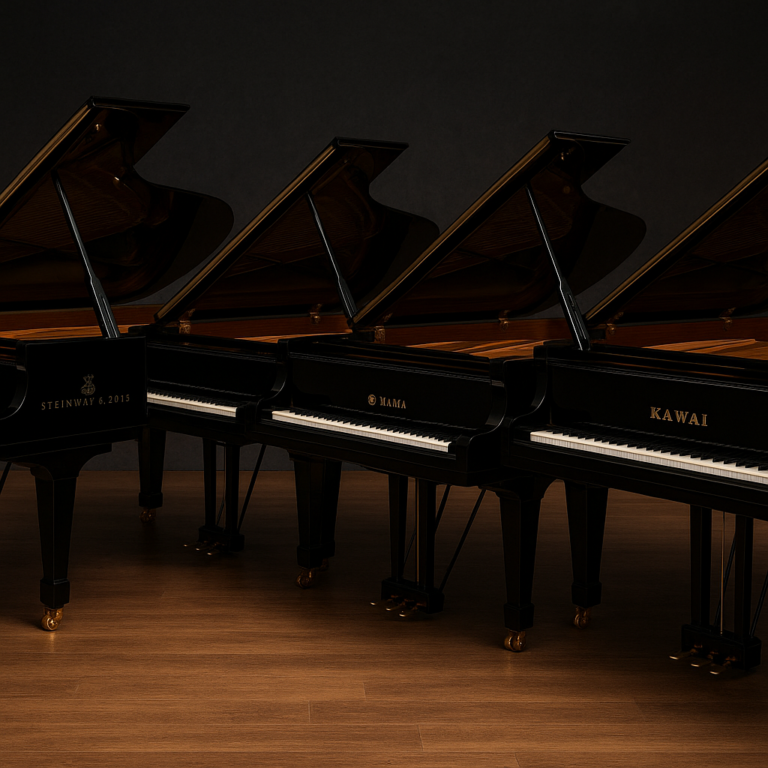
The most responsible choice may be a new Yamaha or Kawai, a restored Steinway, or a durable digital piano from Yamaha, Kawai, Roland, or Casio. The right answer depends on material sourcing, local service, repair potential, transport, and whether you will still be playing it years from now.
Key Takeaways
- Yamaha leads our overall sustainability shortlist through forestry projects, material innovation, production-efficiency initiatives, and extensive repair support.
- A durable, repairable piano is usually more sustainable than an inexpensive instrument that requires early replacement.
- Used and professionally restored pianos can be excellent eco-friendly choices because they reuse existing wood, metal, felt, and cabinetry.
- Look for FSC or PEFC timber certification, ISO 1401 environmental management, transparent emissions reporting, and clear supply-chain information.
- Sustainable piano production includes responsible wood sourcing, low-waste cutting, lower-impact finishes, efficient factories, recyclable packaging, and long-term parts support.
- Digital pianos offer sustainability advantages through compact design, headphone practice, low operating energy, and reduced tuning needs, but they must be repairable and responsibly recycled.
- Smaller instruments that fit your room and musical needs generally use fewer materials and are more likely to be played consistently.
- Ask manufacturers and dealers about wood species, certification, factory energy, replacement parts, restoration, packaging, take-back programs, and end-of-life recycling.
- Our strongest recommendations are:
- Best all-round choice: Yamaha
- Best for engineered stability: Kawai
- Best for heirloom restoration: Steinway & Sons
- Best circular-economy option: A high-quality restored piano
- Best digital approach: Choose the brand with the strongest local repair and parts support
Table of Contents
-
⚡ Quick Tips and Facts About Sustainable Piano Manufacturing
-
🌲 The History and Evolution of Eco-Friendly Piano Production
-
2. Steinway & Sons: Responsible Materials and Heirloom Longevity
-
3. Kawai: Forest Stewardship and Efficient Piano Manufacturing
-
10. Blüthner: Traditional European Craftsmanship with Sustainable Potential
-
12. Pearl River: Scalable Manufacturing and Environmental Improvements
-
14. Stuart & Sons: Australian Materials and Bespoke Piano Longevity
-
15. Phoenix Pianos: Sustainable Restoration and Recycled Piano Materials
-
Best Sustainable Piano Brands for Conservatories and Institutions
-
Repairable Keyboards, Modular Electronics, and Upgradeability
-
Yamaha, Kawai, Roland, Casio, and Other Digital Piano Manufacturers
-
♻️ Piano Longevity, Repair, Restoration, and the Circular Economy
-
🏫 Sustainable Pianos for Schools, Churches, Studios, and Concert Halls
-
Procurement Policies for Environmentally Responsible Institutions
-
❓ Frequently Asked Questions About Sustainable Piano Manufacturing Companies
Table of Contents
- ⚡ Quick Tips and Facts About Sustainable Piano Manufacturing
- What Makes a Piano Manufacturer Sustainable?
- Sustainable Piano Materials at a Glance
- How to Compare Environmental Claims
- 🌲 The History and Evolution of Eco-Friendly Piano Production
- From Traditional Craftsmanship to Circular Manufacturing
- Why Timber Sourcing Matters in Piano Building
- The Role of CITES, FSC, PEFC, and Other Standards
- 🏭 How Sustainable Pianos Are Manufactured
- Responsible Wood Procurement and Forest Stewardship
- Reclaimed, Recycled, and Alternative Piano Materials
- Low-Waste Piano Construction and Precision Cutting
- Non-Toxic Finishes, Adhesives, and Lacquers
- Energy-Efficient Factories and Renewable Power
- Water Conservation and Responsible Chemical Management
- Packaging, Shipping, and Carbon Reduction
- 🎹 15 Sustainable Piano Manufacturing Companies to Know
- 1. Yamaha: Long-Term Sustainable Piano Production
- 2. Steinway & Sons: Responsible Materials and Heirloom Longevity
- 3. Kawai: Forest Stewardship and Efficient Piano Manufacturing
- 4. Bösendorfer: Austrian Craftsmanship and Durable Design
- 5. Fazioli: Italian Luxury Pianos Built for Generations
- 6. Bechstein: Sustainable German Piano Craftsmanship
- 7. Grotrian: Resource-Conscious Piano Production
- 8. Schimmel: Sustainable Materials and Modern Piano Design
- 9. Sauter: Precision Manufacturing and Long Piano Lifespans
- 10. Blüthner: Traditional European Craftsmanship with Sustainable Potential
- 11. Estonia Piano: Efficient Baltic Piano Manufacturing
- 12. Pearl River: Scalable Manufacturing and Environmental Improvements
- 13. Ritmüller: Affordable Pianos and Responsible Production
- 14. Stuart & Sons: Australian Materials and Bespoke Piano Longevity
- 15. Phoenix Pianos: Sustainable Restoration and Recycled Piano Materials
- 🌿 Sustainable Acoustic Piano Brands Compared
- Best Sustainable Grand Piano Manufacturers
- Best Sustainable Upright Piano Manufacturers
- Best Sustainable Piano Brands for Conservatories and Institutions
- Best Sustainable Piano Brands for Home Musicians
- Luxury Versus Affordable Eco-Conscious Pianos
- 🎛️ Sustainable Digital Pianos and Hybrid Instruments
- Energy Consumption of Digital Pianos
- Repairable Keyboards, Modular Electronics, and Upgradeability
- Recyclable Plastics, Batteries, and Electronic Components
- Yamaha, Kawai, Roland, Casio, and Other Digital Piano Manufacturers
- Acoustic Versus Digital Piano Environmental Impact
- 🌳 Choosing Sustainable Woods for Piano Construction
- Spruce Soundboards and Responsible Forestry
- Maple, Bech, Mahogany, Ebony, and Other Piano Woods
- Alternatives to Rare Ebony for Piano Keys
- Why Wood Quality and Longevity Affect Sustainability
- ♻️ Piano Longevity, Repair, Restoration, and the Circular Economy
- Why the Longest-Lived Piano Is Often the Greenest Piano
- Our Sustainable Piano Restoration Process
- Rebuilding Versus Replacing an Acoustic Piano
- Refurbished, Reconditioned, and Pre-Owned Pianos
- Responsible Piano Recycling and Disposal
- How to Extend the Life of Your Piano
- 📊 Measuring Piano Sustainability and Environmental Impact
- Piano Carbon Footprint and Life-Cycle Assessment
- Embodied Carbon in Wood, Metal, Felt, and Electronics
- Factory Emissions, Scope 1, 2, and 3 Reporting
- Durability, Warranty Support, and Total Environmental Cost
- Sustainability Certifications and Third-Party Verification
- ✅ How to Identify Genuine Sustainable Piano Companies
- Questions to Ask a Piano Manufacturer
- Questions to Ask a Piano Dealer
- Greenwashing Warning Signs in Piano Marketing
- How to Read a Sustainability Report
- What Transparent Environmental Disclosure Looks Like
- 🛒 Buying Guide: How to Choose an Eco-Friendly Piano
- Set Your Musical, Space, and Sustainability Priorities
- New, Used, Restored, or Digital: Which Is Grener?
- What to Inspect on a Sustainable Acoustic Piano
- How Piano Origin and Transport Affect Your Choice
- Sustainable Piano Ownership Costs Beyond the Purchase
- A Practical Eco-Friendly Piano Buying Checklist
- 🏫 Sustainable Pianos for Schools, Churches, Studios, and Concert Halls
- Selecting Durable Pianos for High-Use Environments
- Maintenance Programs That Reduce Replacement Waste
- Procurement Policies for Environmentally Responsible Institutions
- Acoustic Treatment, Energy Use, and Piano Room Design
- 🔧 Sustainable Piano Care and Maintenance
- Eco-Friendly Piano Cleaning Products
- Climate Control for a Longer Piano Lifespan
- Tuning, Regulation, Voicing, and Preventive Maintenance
- Replacing Felt, Strings, Hammers, and Keytops Responsibly
- Finding a Qualified Local Piano Technician
- 💡 Quick Sustainability Tips for Piano Owners
- Buy Quality Once and Maintain It Well
- Choose Local Servicing and Consolidated Transport
- Donate, Sell, or Restore Before Disposing
- Use Energy-Saving Settings on Digital Pianos
- 📰 Sustainable Piano Industry News and Innovation
- Emerging Bio-Based Piano Materials
- Digital Manufacturing and Material Efficiency
- The Future of Low-Carbon Piano Production
- What Musicians Should Watch in Sustainable Piano Design
- 🏪 Finding a Trusted Sustainable Piano Dealer
- What an Environmentally Responsible Dealer Should Provide
- Delivery, Installation, Trade-In, and Take-Back Services
- How to Compare Dealer Sustainability Policies
- Questions to Ask Before Ordering a Piano
- ❓ Frequently Asked Questions About Sustainable Piano Manufacturing Companies
- What Is the Most Sustainable Piano Brand?
- Are Acoustic Pianos Environmentally Friendly?
- Are Used Pianos More Sustainable Than New Pianos?
- Which Piano Brands Use Sustainably Sourced Wood?
- Are Digital Pianos Better for the Environment?
- Can an Old Piano Be Recycled or Restored?
- How Can I Verify a Piano Company’s Sustainability Claims?
- What Is the Greenest Way to Transport a Piano?
- Conclusion
- 🔗 Recommended Links
- FAQ
- 📚 Reference Links
Quick Tips and Facts About Sustainable Piano Manufacturing
If you’re researching Piano Brands with sustainability in mind, here’s the short version: the greenest piano is usually the one that lasts, gets maintained, and avoids premature replacement. That answer sounds less glamorous than a bamboo key slip, but it is musically and environmentally sound.
What Makes a Piano Manufacturer Sustainable?
A genuinely responsible manufacturer considers the piano’s entire life cycle:
-
Forest and material sourcing
Is spruce, maple, bech, ebony, or another material legally and responsibly sourced? The Convention on International Trade in Endangered Species is particularly relevant to protected timber species. -
Factory efficiency
Does the company measure energy, water, emissions, chemical use, and production waste? -
Product durability
Can the piano be tuned, regulated, repaired, rebuilt, and supported decades after purchase? -
Material substitution
Does the company reduce pressure on scarce woods through composites, laminated woods, recycled material, or repurposed offcuts? -
Packaging and logistics
Is the instrument protected with recyclable or reusable packaging rather than a small mountain of single-use plastic? -
Transparency
Can the company provide evidence rather than simply attaching a green leaf to its brochure?
We recommend scoring these categories separately. A manufacturer may be excellent at responsible timber procurement yet vague about factory emissions. Another may use efficient digital-piano electronics but offer limited repair support. Sustainability is a portfolio, not a single badge.
Sustainable Piano Materials at a Glance
| Piano component | Traditional material | Lower-impact direction | What musicians should check |
|---|---|---|---|
| Soundboard | Solid spruce | Responsibly managed spruce, carefully laminated wood, experimental composites | Tone, repairability, forestry evidence |
| Bridges | Maple or bech | Certified hardwoods, efficient cutting, durable laminates | Structural longevity |
| Keys | Spruce, basswood, plastic, ebony | Recycled plastics, wood-plastic composites, alternative dark woods | Feel, wear resistance, source |
| Cabinet | Venered hardwood or engineered wood | FSC/PEFC timber, reclaimed veneer, low-waste panels | Adhesives and finish |
| Action parts | Hornbeam, maple, felt, leather | Efficiently cut hardwood, synthetic alternatives, replaceable parts | Regulation and serviceability |
| Finish | Polyester, lacquer, varnish | Waterborne or lower-emission coatings where suitable | VOC disclosure and durability |
| Digital electronics | Plastics, circuit boards, metals | Recycled plastics, modular components, efficient power supplies | Repair, firmware, e-waste pathway |
| Packaging | Foam, plastics, cardboard | Molded pulp, recyclable cardboard, reusable protection | Disposal instructions |
The Forest Stewardship Council explains that certification tracks forest management and supply chains. That helps, but FSC certification of one material does not certify an entire piano. A certified veneer does not automatically mean the instrument has low-carbon shipping, repairable electronics, or low-emission finishing.
How to Compare Environmental Claims
Use this quick evidence ladder:
| Claim | Evidence strength | Our view |
|---|---|---|
| “Eco-friendly piano” | 1/10 | Marketing until proven otherwise |
| “Uses responsibly sourced wood” | 4/10 | Ask for species, region, and certification |
| “Packaging contains recycled cardboard” | 5/10 | Useful, but limited to packaging |
| Published environmental targets | 7/10 | Better if progress is reported annually |
| Third-party certification or audit | 8/10 | Stronger evidence, check its scope |
| Full life-cycle assessment with boundaries disclosed | 10/10 | Rare, but the gold standard |
A useful rule from our workshop: specificity beats poetry. “We support the planet” tells you little. “Our soundboard timber comes from these managed forests, and our packaging target is measured by this date” gives you something to verify.
The History and Evolution of Eco-Friendly Piano Production

Pianos have always been hybrids of natural materials, metal engineering, chemistry, and human labor. The modern sustainability conversation asks a deceptively difficult question: how do we preserve the acoustic character musicians love without treating forests and factories as infinite?
From Traditional Craftsmanship to Circular Manufacturing
Traditional piano building relied heavily on:
- Long-seasoned spruce
- Maple and bech
- Ebony or ebony-like key surfaces
- Wool felt
- Leather
- Cast iron
- Animal or synthetic adhesives
- Solvent-based finishes
That recipe produced instruments capable of astonishing longevity. A well-built Steinway & Sons Model B or Yamaha C3X can remain musically useful through multiple generations. Yet traditional construction can involve resource-intensive timber selection, energy-heavy metal casting, chemical coatings, and international freight.
Circular manufacturing changes the question from “How cheaply can we make this?” to:
- Can offcuts become another instrument?
- Can a worn piano be rebuilt rather than discarded?
- Can a digital piano be repaired instead of replaced?
- Can packaging return to the supply chain?
- Can factories use renewable energy and reduce process waste?
The European Commission’s circular economy framework emphasizes keeping products and materials in use for as long as possible. That principle fits pianos unusually well: the instrument is large, repairable, and designed to produce music for decades.
Why Timber Sourcing Matters in Piano Building
Wood is not automatically sustainable simply because it grows on trees. A responsible wood policy should consider:
- Species vulnerability
- Forest regeneration
- Legal harvesting
- Biodiversity
- Local communities
- Transport distance
- Drying and storage energy
- Yield from each log
- Traceability through the supply chain
Soundboards are particularly demanding. Piano makers want spruce with a favorable balance of stiffness, weight, grain consistency, and resonance. The best acoustic result may depend on a narrow selection of boards, creating more offcuts than a simple furniture panel.
That is why Yamaha’s forestry initiative is worth examining. According to Yamaha’s account of its “Sustainable Production for the Next 100 Years” program, its group company Kitami Mokuzai helped establish the “Okhotsk Oto-no-Mori” forest in Hokkaido in 2016, linking managed spruce forests with local forestry and community development.
The phrase that caught our attention is Yamaha’s stated aim of “contributing to the development of local communities through the creation of sustainable forests.” That is broader than simply purchasing certified wood: it connects forest management, regional demand, and future piano production.
The Role of CITES, FSC, PEFC, and Other Standards
Several systems may appear in a manufacturer’s environmental documentation:
- CITES: Regulates international trade in listed species and products made from them.
- FSC: Certifies forest management and chain of custody.
- PEFC: Provides a forest-certification framework used in many regions.
- ISO 1401: Environmental management systems standard, not a claim that every product is carbon neutral.
- RoHS: Restricts certain hazardous substances in electrical and electronic equipment.
- WEEE: European framework for electrical and electronic waste management.
The FSC chain-of-custody explanation is helpful because it clarifies that certified material must be tracked through the supply chain. Still, certification scope matters. A factory’s ISO 1401 certification and a piano’s FSC veneer answer different questions.
How Sustainable Pianos Are Manufactured
A piano factory is a fascinating contradiction: part woodworking studio, part metalworks, part precision engineering lab, and part climate-controlled museum. Sustainability has to work across all four personalities.
Responsible Wood Procurement and Forest Stewardship
Manufacturers typically improve timber responsibility through:
- Approved supplier lists
- Legal-origin documentation
- Forest certification
- Species substitution
- Improved log yield
- Longer seasoning and storage strategies
- Local or regional forestry partnerships
- Reuse of short sections and offcuts
Yamaha’s Okhotsk Oto-no-Mori project offers a concrete example of regional forestry planning. Meanwhile, companies such as Kawai and Steinway & Sons publish information about materials and corporate responsibility, though the level of product-specific detail varies.
When we inspect a piano, we care less about whether a brochure says “natural” and more about whether the material performs consistently. A durable soundboard is sustainable partly because it does not need early replacement.
Reclaimed, Recycled, and Alternative Piano Materials
Alternative materials fall into four broad groups:
-
Reclaimed material
Wood rescued from old buildings, retired instruments, or factory stock. -
Byproduct material
Useful portions left over from another manufacturing process. -
Enginered wood
Laminated or composite timber designed for dimensional stability and efficient yield. -
Synthetic or hybrid material
Wood-plastic composites, carbon fiber, advanced polymers, and other engineered options.
Yamaha has described wood-plastic composite sharps designed to reproduce the appearance and touch associated with ebony while reducing reliance on scarce natural ebony. Yamaha has also presented the TORCH T01, a digital piano using wood from otherwise unused portions of African blackwood, also known as grenadilla, associated with clarinet and oboe production.
That is a clever form of industrial matchmaking: one instrument family’s leftovers become another instrument’s visible feature. 🎷➡️🎹
The trade-off? Alternative materials must satisfy musicians, technicians, and designers simultaneously. A material may be environmentally attractive but fail under repeated impacts, humidity cycling, polishing, or decades of regulation.
Low-Waste Piano Construction and Precision Cutting
Modern manufacturing can reduce waste through:
- Computer-aided design
- CNC routing
- Nesting parts tightly on stock
- Laser or digital measurement
- Automated inspection
- Reusing sawdust and wood chips
- Turning suitable offcuts into smaller components
- Designing parts for consistent replacement
A CNC machine does not automatically make a piano sustainable. It can cut efficiently, but it also consumes electricity and may encourage rapid production of disposable products. The best outcome combines precision equipment with long-lived design and skilled finishing.
In the first featured video, the speakers argue that piano manufacturing needs a “clean sheet” or “blank computer screen” approach to rethink traditional designs, materials, and instrument size. Their perspective is provocative: the industry may not need to abandon acoustic identity, but it may need to question every inherited dimension and material.
That leads to an unresolved tension we will return to: would a smaller, more repairable piano with an engineered soundboard be greener, even if some traditionalists prefer old-growth spruce and a larger cabinet?
Non-Toxic Finishes, Adhesives, and Lacquers
Finishes protect the cabinet from moisture, abrasion, ultraviolet exposure, and household grime. They also affect factory air quality and worker safety.
Manufacturers may explore:
- Waterborne coatings
- Lower-VOC lacquers
- More efficient spray systems
- Powder coating for selected metal parts
- Better solvent capture
- Longer-lasting finishes that reduce refinishing frequency
The U.S. Environmental Protection Agency’s overview of volatile organic compounds explains why VOC management matters for indoor air quality. However, “low VOC” does not mean “zero environmental impact,” and a fragile finish that needs frequent replacement may have a larger life-cycle burden than a durable finish with a more complex initial process.
Energy-Efficient Factories and Renewable Power
Piano factories use energy for:
- Kiln drying and climate control
- Wood machining
- Metal casting and forming
- Sanding and polishing
- Spraying and curing finishes
- Lighting
- Warehousing
- Electronics assembly
Meaningful energy improvements include:
- Heat recovery
- Efficient motors
- Improved kiln controls
- Renewable electricity
- On-site solar
- Factory-wide energy monitoring
- Reduced rework and rejected parts
- Better building insulation
The International Energy Agency provides broader context on industrial efficiency. For piano buyers, the practical takeaway is simple: ask whether a company reports absolute energy use, energy per instrument, or merely promises efficiency. Those measurements are not interchangeable.
Water Conservation and Responsible Chemical Management
Water may be used in:
- Wood processing
- Finishing
- Cleaning
- Cooling
- Metal treatment
- Employee facilities
Responsible factories can reduce impact through closed-loop systems, filtration, reuse, and careful chemical storage. Look for environmental reports that mention:
- Water withdrawal
- Wastewater treatment
- Hazardous waste
- Solvent recovery
- Spill prevention
- Supplier requirements
This is not the glamorous side of piano making. Nobody writes a sonata about wastewater filtration. Yet these systems often reveal more about a factory’s environmental maturity than a beautifully photographed spruce forest.
Packaging, Shipping, and Carbon Reduction
Pianos are heavy, delicate, and awkward. A grand piano is essentially a large wooden sculpture with a cast-iron skeleton that dislikes potholes.
Better logistics may include:
- Recyclable cardboard or molded pulp
- Reusable transport frames
- Reduced plastic film
- Consolidated freight
- Regional distribution
- Efficient container loading
- Local technician networks
- Take-back or trade-in programs
Yamaha has described efforts to reduce plastic packaging and replace Styrofoam with alternatives such as cardboard padding and pulp molds. The stated company goal included eliminating plastic packaging for newly launched small products by fiscal 2025, although buyers should distinguish corporate-wide packaging targets from piano-specific packaging results.
15 Sustainable Piano Manufacturing Companies to Know
There is no universally accepted ranking of “the greenest piano brand.” We therefore rate public sustainability visibility, repairability, material innovation, longevity, and transparency, not tone quality alone.
Sustainability Rating Method
| Category | Weight | What we evaluate |
|---|---|---|
| Material responsibility | 25% | Timber sourcing, substitutions, waste reduction |
| Product longevity | 25% | Build quality, serviceability, parts, repair culture |
| Factory and energy disclosure | 20% | Environmental systems and measurable targets |
| Circularity and packaging | 15% | Reuse, recycling, take-back, logistics |
| Evidence and transparency | 15% | Official documentation and third-party support |
These are editorial sustainability ratings, not laboratory carbon footprints. A brand’s score can change as public reporting improves.
1. Yamaha: Long-Term Sustainable Piano Production
| Aspect | Rating |
|---|---|
| Design longevity | 9/10 |
| Material innovation | 9/10 |
| Manufacturing efficiency | 8/10 |
| Repairability and support | 9/10 |
| Environmental transparency | 8/10 |
| Overall sustainability profile | 8.6/10 |
Yamaha’s official sustainability page provides the broad corporate context, while its dedicated piano story describes forestry initiatives in Hokkaido.
Why Yamaha Stands Out
Yamaha’s sustainability work includes:
- Certified or controlled timber sourcing
- Alternatives to scarce ebony
- Wood-plastic composite sharps
- Reuse of manufacturing byproducts
- Automation and production efficiency
- Regional forestry projects
- Packaging reduction efforts
- Long-lived acoustic and hybrid instruments
The Okhotsk Oto-no-Mori initiative is especially compelling because it connects future soundboard supply with local forest development rather than treating wood as anonymous inventory.
The company’s TORCH T01 also illustrates an unusual idea: using otherwise unused portions of African blackwood from woodwind manufacturing. It is not a universal solution, but it demonstrates how material streams can cross instrument categories.
Strengths and Drawbacks
✅ Strengths
- Broadest publicly described sustainability strategy among major piano companies
- Strong global service network
- Extensive range of acoustic, silent, hybrid, and digital instruments
- Practical material innovation
❌ Drawbacks
- Not every piano model has a model-specific environmental score
- Global manufacturing and shipping complicate carbon comparisons
- Corporate sustainability claims can be broader than piano-specific data
Models Worth Considering
Our recommendation: Yamaha is the strongest all-round starting point for buyers who want a mature manufacturer, long support horizon, material innovation, and credible forestry initiatives.
👉 CHECK PRICE on:
- Yamaha U1 Upright Piano: Amazon | Musician’s Friend | Yamaha Official
- Yamaha Clavinova Digital Piano: Amazon | Sweetwater | Yamaha Official
2. Steinway & Sons: Responsible Materials and Heirloom Longevity
| Aspect | Rating |
|---|---|
| Design longevity | 10/10 |
| Material innovation | 7/10 |
| Manufacturing efficiency | 7/10 |
| Repairability and support | 10/10 |
| Environmental transparency | 6/10 |
| Overall sustainability profile | 8.0/10 |
Steinway & Sons is not usually the first brand people mention in a sustainability search, but that misses a crucial point: an heirloom piano can have an extraordinarily long useful life.
Why Longevity Matters
A Steinway grand may be:
- Maintained by multiple generations
- Rebuilt with new hammers, strings, felts, and action parts
- Transported between homes, studios, and institutions
- Kept in service long after its original finish has aged
The Steinway restoration program shows how a high-quality instrument can return to active musical life rather than becoming bulky landfill. Restoration still consumes materials, but rebuilding an existing frame, rim, and soundboard can avoid manufacturing an entirely new piano.
Strengths and Drawbacks
✅ Strengths
- Exceptional long-term rebuild potential
- Strong technician ecosystem
- Valuable parts and technical knowledge
- Instruments can remain useful for generations
❌ Drawbacks
- Public product-level environmental reporting is limited
- New instruments use substantial hardwood, metal, felt, and finishing resources
- Global transport and climate-controlled facilities add impact
Our recommendation: Choose Steinway primarily for lifetime musical value, serviceability, and restoration potential. Do not assume the luxury label itself equals environmental leadership.
👉 CHECK PRICE on:
- Steinway & Sons Grand Pianos: Steinway Official
- Steinway Spirio: Steinway Official
3. Kawai: Forest Stewardship and Efficient Piano Manufacturing
| Aspect | Rating |
|---|---|
| Design longevity | 9/10 |
| Material innovation | 8/10 |
| Manufacturing efficiency | 8/10 |
| Repairability and support | 8/10 |
| Environmental transparency | 7/10 |
| Overall sustainability profile | 8.0/10 |
Kawai has built a reputation for combining traditional piano construction with modern materials and manufacturing. The company is also known for using ABS-based action components in selected instruments, which can improve dimensional stability and reduce sensitivity to humidity.
Why Enginered Action Parts Can Help
Kawai’s ABS action components are not “green” by default. Plastics have feedstock and end-of-life concerns. However, an engineered component that:
- Resists swelling and shrinking
- Requires fewer adjustments
- Performs consistently in challenging climates
- Lasts for decades
may reduce service-related replacement and premature disposal.
This is a classic sustainability trade-off. A natural wood part may be renewable, while a stable polymer part may extend the useful life of the entire instrument. The right answer depends on material quantity, durability, repairability, and eventual disposal.
Strengths and Drawbacks
✅ Strengths
- Strong engineering culture
- Durable acoustic and digital ranges
- Useful climate stability in selected components
- Broad dealer and service support
❌ Drawbacks
- Plastics require responsible end-of-life planning
- Public sustainability detail varies by market
- Component-level benefits do not equal full life-cycle certification
Our recommendation: Kawai is a strong choice for humid or variable environments where dimensional stability can prevent repeated repairs.
👉 CHECK PRICE on:
- Kawai K-300 Upright: Amazon | Kawai Official
- Kawai ES Series Digital Piano: Amazon | Sweetwater | Kawai Official
4. Bösendorfer: Austrian Craftsmanship and Durable Design
| Aspect | Rating |
|---|---|
| Design longevity | 10/10 |
| Material innovation | 6/10 |
| Manufacturing efficiency | 7/10 |
| Repairability and support | 9/10 |
| Environmental transparency | 6/10 |
| Overall sustainability profile | 7.6/10 |
Bösendorfer builds fewer instruments than mass-market manufacturers, and its pianos are intended for extremely long service lives. That low-volume, craft-heavy model can support quality and repairability, though it does not automatically prove a smaller carbon footprint.
Sustainability Perspective
Bösendorfer’s environmental advantage is primarily durability and heirloom use:
- Carefully selected materials
- High-level hand craftsmanship
- Long-term technical service
- Rebuild potential
- Strong resale and institutional use
The drawback is that large luxury grands require considerable material and transport. If a smaller piano meets your needs, choosing a smaller size may be the more direct environmental decision.
5. Fazioli: Italian Luxury Pianos Built for Generations
| Aspect | Rating |
|---|---|
| Design longevity | 9/10 |
| Material innovation | 6/10 |
| Manufacturing efficiency | 7/10 |
| Repairability and support | 8/10 |
| Environmental transparency | 6/10 |
| Overall sustainability profile | 7.2/10 |
Fazioli represents the “make it beautifully and keep it for decades” model. Its pianos are built with extensive handwork and sophisticated material selection.
Sustainability Perspective
Fazioli’s strengths are:
- Low-volume craftsmanship
- High expected service life
- Strong institutional and professional use
- Rebuildability relative to disposable instruments
Its main limitation is a lack of publicly detailed, model-specific environmental information. A piano can be sustainable through longevity without being a sustainability leader in factory disclosure.
6. Bechstein: Sustainable German Piano Craftsmanship
| Aspect | Rating |
|---|---|
| Design longevity | 9/10 |
| Material innovation | 6/10 |
| Manufacturing efficiency | 7/10 |
| Repairability and support | 8/10 |
| Environmental transparency | 6/10 |
| Overall sustainability profile | 7.2/10 |
C. Bechstein offers acoustic pianos designed for professional playing and long-term maintenance. German manufacturing traditions often emphasize precision, material control, and repairability.
Best sustainability argument: buy a Bechstein that fits your space, maintain it carefully, and keep it in service for decades.
7. Grotrian: Resource-Conscious Piano Production
| Aspect | Rating |
|---|---|
| Design longevity | 9/10 |
| Material innovation | 6/10 |
| Manufacturing efficiency | 7/10 |
| Repairability and support | 8/10 |
| Environmental transparency | 6/10 |
| Overall sustainability profile | 7.2/10 |
Grotrian is known for German acoustic piano craftsmanship. Its sustainability profile is best understood through product life: durable construction, technician support, and the possibility of extended use.
8. Schimmel: Sustainable Materials and Modern Piano Design
| Aspect | Rating |
|---|---|
| Design longevity | 8/10 |
| Material innovation | 7/10 |
| Manufacturing efficiency | 7/10 |
| Repairability and support | 8/10 |
| Environmental transparency | 6/10 |
| Overall sustainability profile | 7.2/10 |
Schimmel combines traditional German piano design with modern manufacturing approaches. Buyers should ask dealers about timber traceability, finish systems, replacement parts, and long-term service availability.
9. Sauter: Precision Manufacturing and Long Piano Lifespans
| Aspect | Rating |
|---|---|
| Design longevity | 9/10 |
| Material innovation | 6/10 |
| Manufacturing efficiency | 7/10 |
| Repairability and support | 8/10 |
| Environmental transparency | 6/10 |
| Overall sustainability profile | 7.2/10 |
Sauter focuses on precision acoustic pianos with distinctive design features. Its sustainability appeal lies in robust engineering and continued maintenance rather than highly publicized environmental programs.
10. Blüthner: Traditional European Craftsmanship with Sustainable Potential
| Aspect | Rating |
|---|---|
| Design longevity | 9/10 |
| Material innovation | 6/10 |
| Manufacturing efficiency | 7/10 |
| Repairability and support | 8/10 |
| Environmental transparency | 6/10 |
| Overall sustainability profile | 7.2/10 |
Blüthner pianos are designed as long-term musical instruments, and that matters. A piano that remains desirable, repairable, and playable is more sustainable than one replaced after a few years.
11. Estonia Piano: Efficient Baltic Piano Manufacturing
| Aspect | Rating |
|---|---|
| Design longevity | 8/10 |
| Material innovation | 6/10 |
| Manufacturing efficiency | 7/10 |
| Repairability and support | 7/10 |
| Environmental transparency | 5/10 |
| Overall sustainability profile | 6.6/10 |
Estonia Piano produces acoustic grand and upright pianos with a focus on European craftsmanship. Buyers should verify local service availability, parts support, and wood sourcing documentation.
12. Pearl River: Scalable Manufacturing and Environmental Improvements
| Aspect | Rating |
|---|---|
| Design longevity | 7/10 |
| Material innovation | 6/10 |
| Manufacturing efficiency | 8/10 |
| Repairability and support | 7/10 |
| Environmental transparency | 5/10 |
| Overall sustainability profile | 6.6/10 |
Pearl River operates at a scale that can make manufacturing efficiency meaningful. The potential sustainability advantages include:
- High-volume process optimization
- Standardized parts
- Improved cutting efficiency
- Broad availability of replacement instruments and parts
The challenge is evidence. Scale can reduce waste per unit, but only transparent measurements show whether that benefit actually occurs.
13. Ritmüller: Affordable Pianos and Responsible Production
| Aspect | Rating |
|---|---|
| Design longevity | 7/10 |
| Material innovation | 5/10 |
| Manufacturing efficiency | 7/10 |
| Repairability and support | 7/10 |
| Environmental transparency | 5/10 |
| Overall sustainability profile | 6.2/10 |
Ritmüller offers accessible acoustic instruments. From a sustainability perspective, the strongest case is buying an appropriately sized piano that can be maintained locally, rather than selecting a much larger instrument that strains your space and budget.
14. Stuart & Sons: Australian Materials and Bespoke Piano Longevity
| Aspect | Rating |
|---|---|
| Design longevity | 9/10 |
| Material innovation | 7/10 |
| Manufacturing efficiency | 6/10 |
| Repairability and support | 8/10 |
| Environmental transparency | 6/10 |
| Overall sustainability profile | 7.2/10 |
Stuart & Sons builds highly distinctive Australian pianos, including extended-range grands. Bespoke manufacturing can minimize unnecessary standardization, but shipping a specialized piano internationally may increase transport impact.
15. Phoenix Pianos: Sustainable Restoration and Recycled Piano Materials
| Aspect | Rating |
|---|---|
| Design longevity | 9/10 |
| Material innovation | 8/10 |
| Manufacturing efficiency | 7/10 |
| Repairability and support | 9/10 |
| Environmental transparency | 7/10 |
| Overall sustainability profile | 8.0/10 |
Phoenix Pianos is notable for restoration and creative use of materials. Restoration-focused companies deserve attention because they operate close to the circular-economy ideal: retain the valuable structure, replace only what is worn, and return an existing instrument to musical service.
Sustainable Acoustic Piano Brands Compared
Best Sustainable Grand Piano Manufacturers
| Best for | Manufacturer | Why we recommend it | Main caution |
|---|---|---|---|
| Broad sustainability strategy | Yamaha | Forestry, material innovation, service network | Limited model-specific footprint data |
| Heirloom restoration | Steinway & Sons | Exceptional rebuild ecosystem | Resource-intensive new production |
| Humid climates | Kawai | Stable engineering and strong support | Polymer components need end-of-life planning |
| Craft longevity | Bösendorfer | High-quality, long-service instruments | Large instruments use significant materials |
| Bespoke innovation | Stuart & Sons | Distinctive designs and long-term use | Specialist availability and transport |
For most households, smaller is usually better. A well-maintained Yamaha C1X, Kawai GL-10, or comparable compact grand may offer more responsible resource use than a large concert grand that spends most of its life unopened in a room too small for it.
Best Sustainable Upright Piano Manufacturers
| Brand | Strong candidates | Sustainability advantage |
|---|---|---|
| Yamaha | U1, U3 | Long service life and global support |
| Kawai | K-200, K-300 | Stable construction and repair network |
| Schimmel | Classic and Konzert uprights | European craftsmanship and durability |
| Bechstein | B series and Academy models | Long-term acoustic serviceability |
| Pearl River | Selected upright ranges | Standardized parts and manufacturing scale |
An upright piano typically uses less material and floor space than a grand. It may also require less packaging volume and lower transport energy. That does not make every upright automatically greener, but it is a meaningful starting advantage.
Best Sustainable Piano Brands for Conservatories and Institutions
Institutions should prioritize:
- Robust action components
- Replaceable hammers and felts
- Available strings and dampers
- Local technicians
- Manufacturer support
- Stable tuning behavior
- Resale and trade-in pathways
- Clear warranty terms
Our shortlist:
- Yamaha
- Kawai
- Steinway & Sons
- C. Bechstein
- Schimmel
A school that buys a slightly less fashionable piano with strong local support may achieve a lower environmental impact than one that imports a difficult-to-service instrument and replaces it early.
Best Sustainable Piano Brands for Home Musicians
For home use, we usually recommend:
- Yamaha U series
- Kawai K series
- A well-restored Steinway, Baldwin, Mason & Hamlin, or Knabe
- Yamaha Clavinova
- Kawai CA or ES series
- Roland HP or LX series when headphone practice is essential
Explore our Piano Buying Guide for room planning, acoustic versus digital comparisons, and service questions.
Luxury Versus Affordable Eco-Conscious Pianos
The most expensive piano is not necessarily the most sustainable. Compare these scenarios:
| Scenario | Likely sustainability outcome |
|---|---|
| New concert grand in an undersized room | High material use, poor practical fit |
| Used upright needing minor regulation | Often excellent |
| Carefully rebuilt professional grand | Potentialy excellent |
| Cheap digital piano with no repair pathway | Weak long-term profile |
| Durable digital piano used for 15 years | Stronger than repeated replacements |
| Custom piano shipped worldwide for occasional use | Mixed, depends on lifespan and freight |
The most responsible purchase is often the instrument you will genuinely play for many years.
Sustainable Digital Pianos and Hybrid Instruments
Digital pianos avoid some acoustic materials but introduce electronics, plastics, circuit boards, speakers, firmware, and e-waste. “Digital” is not a synonym for “green.” It is a different life-cycle equation.
Energy Consumption of Digital Pianos
Digital pianos generally consume electricity during use, while acoustic pianos require no operating electricity unless paired with climate-control systems or silent technology. Energy use depends on:
- Wattage
- Daily playing time
- Speaker volume
- Standby behavior
- Headphone use
- Power-supply efficiency
- Product lifespan
- Electricity generation mix
A simple calculation:
Annual energy use = watts ÷ 1,000 × hours used × playing days
For example, a 40-watt instrument used two hours per day for 300 days consumes approximately 24 kilowatt-hours annually. Actual consumption varies by model and operating mode, so check the manufacturer’s technical documentation.
The U.S. Department of Energy explains why standby power matters across household electronics. Turn off the instrument fully when appropriate, especially if it has a transformer or remains warm in standby.
Repairable Keyboards, Modular Electronics, and Upgradeability
A more sustainable digital piano should ideally have:
- Replaceable key contacts
- Serviceable key mechanisms
- Accessible power supplies
- Replaceable pedals
- Standard connectors
- Repair documentation
- Long software support
- Replaceable speakers
- A clear e-waste pathway
The frustrating part is that many digital pianos are not designed for extensive component-level repair. A failed circuit board can make an otherwise excellent cabinet, keyboard, and speaker system economically awkward to save.
When comparing digital pianos, ask dealers:
- Is the main board still available?
- How long are replacement parts stocked?
- Can the keybed be serviced independently?
- Is firmware updateable?
- Can the pedal unit be replaced?
- What happens after the warranty period?
Recyclable Plastics, Batteries, and Electronic Components
Digital pianos contain:
- ABS or other plastics
- Steel and aluminum
- Copper wiring
- Circuit boards
- Magnets
- Adhesives
- Foam
- Packaging
- Batteries in some accessories
The U.S. Environmental Protection Agency’s electronics recycling guidance explains why electronics should not simply enter ordinary waste streams. Choose a retailer or manufacturer with a take-back program where possible.
Yamaha, Kawai, Roland, Casio, and Other Digital Piano Manufacturers
| Brand | Digital strengths | Sustainability questions to ask |
|---|---|---|
| Yamaha | Large ecosystem, Clavinova, AvantGrand, long market presence | Parts availability by model and region |
| Kawai | Realistic actions, CA and ES ranges | Electronics service life and board availability |
| Roland | Hybrid actions and compact designs | Repair pathway for proprietary electronics |
| Casio | Efficient compact models and broad access | Long-term parts and upgrade support |
| Dexibell | Italian digital instruments | Regional service and electronics longevity |
| Nord | Stage and performance keyboards | Repairability and replacement modules |
Our practical favorite for sustainable digital ownership: choose a model with the best local service, not merely the most impressive specification sheet. A slightly less feature-heavy instrument that receives a replacement key contact in year eight is a better environmental citizen than a discontinued flagship that becomes unrepairable in year five.
👉 CHECK PRICE on:
- Yamaha Clavinova: Amazon | Sweetwater | Yamaha Official
- Kawai CA Series: Amazon | Sweetwater | Kawai Official
- Roland HP Series: Amazon | Sweetwater | Roland Official
- Casio Privia: Amazon | Musician’s Friend | Casio Official
Acoustic Versus Digital Piano Environmental Impact
| Factor | Acoustic piano | Digital piano |
|---|---|---|
| Primary materials | Wood, metal, felt, leather, finishes | Plastics, metals, circuit boards, speakers |
| Operating energy | Usually none | Electricity required |
| Maintenance | Regular tuning and regulation | Electronics and software service |
| Longevity | Can exceed many decades | Highly model-dependent |
| Repair pathway | Often strong for quality brands | Varies widely |
| Transport | Heavy and bulky | Usually lighter, but still packaged |
| End-of-life | Parts can be reclaimed; difficult disposal | Electronics recycling required |
| Quiet practice | Silent systems or acoustic treatment | Headphones built in |
| Best sustainability advantage | Heirloom longevity | Compactness, shared use, low operating noise |
The European Environment Agency provides useful context on electronic product waste. The answer is not “acoustic good, digital bad.” A durable acoustic piano used for 70 years and a repairable digital piano used for 20 years can both be responsible choices.
Choosing Sustainable Woods for Piano Construction
Spruce Soundboards and Responsible Forestry
Spruce is prized for soundboards because it combines low density with useful stiffness and acoustic responsiveness. Piano makers may use several spruce species depending on location, design, and supply.
The key questions are:
- Is the forest managed for regeneration?
- Is the timber legally documented?
- Is the species under conservation pressure?
- How much of each log becomes usable material?
- Are offcuts reused?
- Is the board dried efficiently?
- Can the soundboard be repaired or replaced?
Yamaha’s Hokkaido forest initiative is a valuable example of a manufacturer connecting its soundboard needs with planned spruce forestry. The company describes “the expansion of demand for man-made spruce forest timber” as part of its regional approach.
Maple, Bech, Mahogany, Ebony, and Other Piano Woods
Pianos may contain:
- Maple for rims, bridges, and structural components
- Bech or hornbeam for action parts
- Mahogany or other hardwoods for veneers and cabinetry
- Ebony or alternatives for sharps
- Spruce for soundboards and action components
- Birch and poplar in laminated structures
The sustainability of a wood depends on species, source, use, yield, and longevity. A small amount of responsibly sourced ebony used for a replaceable component may have a different impact from a large decorative veneer. Ask for specificity.
Alternatives to Rare Ebony for Piano Keys
Ebony is dense, attractive, and historically associated with black keys. Alternatives include:
- Ebony-style composites
- Stained or coated hardwoods
- Other dark natural woods
- Recycled or engineered materials
- Molded polymers
Yamaha’s wood-plastic composite sharps demonstrate that alternative key materials can be designed around touch and appearance rather than treated as an obvious downgrade.
Our advice is to judge the key by:
- Smoothness
- Grip
- Edge comfort
- Wear resistance
- Repairability
- Stability
- Material disclosure
A key does not become musically inferior merely because it is not ebony. Pianists care about feel; forests care about sourcing; both deserve attention.
Why Wood Quality and Longevity Affect Sustainability
A piano built from stable, well-seasoned, well-selected wood is less likely to suffer:
- Soundboard cracks
- Bridge splits
- Cabinet warping
- Loose pinblocks
- Repeated regulation problems
- Premature replacement
Material efficiency and durability are partners. Using less wood is not sustainable if the piano fails early. Using more wood can be justified when it creates an instrument that remains useful for generations.
Piano Longevity, Repair, Restoration, and the Circular Economy
Why the Longest-Lived Piano Is Often the Greenest Piano
Our workshop has seen this repeatedly: a tired upright arrives looking like a piece of furniture nobody wants, then leaves with a clean tone, responsive action, and another decade or two of usefulness. That transformation is rarely glamorous on social media. It is sustainability in work clothes.
Longevity reduces:
- New raw material demand
- Factory energy
- Packaging waste
- Freight
- Disposal
- Replacement learning curves for institutions
- Consumer disappointment
The United Nations Environment Programme emphasizes extending product life and reducing material throughput. A piano is a natural candidate for that strategy because many components are replaceable.
Our Sustainable Piano Restoration Process
A responsible restoration process should proceed in stages:
- Historical and structural inspection
- Identify make, model, age, and previous repairs.
- Inspect the soundboard, bridges, pinblock, frame, rim, action, and cabinet.
- Condition testing
- Measure tuning-pin security.
- Check string scale and corrosion.
- Assess hammer wear and action geometry.
- Test pedals and dampers.
- Repair-versus-replace decision
- Keep serviceable original parts.
- Replace only components that compromise performance or safety.
- Avoid cosmetic work that hides structural problems.
- Material recovery
- Reuse suitable hardware.
- Separate metal for recycling.
- Salvage wood components where practical.
- Dispose of felt, foam, finishes, and adhesives responsibly.
- Rebuilding
- Replace worn action parts.
- Repair or replace strings as required.
- Restore tuning stability.
- Refinish only when needed.
- Regulation and voicing
- Set key dip, let-off, drop, checking, and repetition.
- Shape hammers.
- Balance tone across registers.
- Long-term service plan
- Provide humidity guidance.
- Schedule tuning.
- Document replaced parts.
The most sustainable restoration is not always the most visually dramatic. A restrained rebuild that preserves a healthy original soundboard can be preferable to an invasive project that replaces everything.
Rebuilding Versus Replacing an Acoustic Piano
| Condition | Recommended path |
|---|---|
| Stable frame, worn hammers, decent pinblock | Recondition or partial rebuild |
| Loose pins but healthy structure | Pinblock or pin repair evaluation |
| Severe soundboard and bridge damage | Cost-benefit analysis with technician |
| Water damage and unstable rim | Replacement may be more sensible |
| Historic or rare instrument | Specialist conservation |
| Cheap, poorly built instrument with major failure | Responsible disposal or parts recovery |
Have a qualified technician inspect the piano before deciding. A dealer’s replacement recommendation may be reasonable, but it is not a neutral structural diagnosis.
Refurbished, Reconditioned, and Pre-Owned Pianos
These terms are not interchangeable:
- Pre-owned: Previously owned; may be unchanged.
- Serviced: Received maintenance such as tuning or cleaning.
- Reconditioned: Worn parts improved or replaced to restore function.
- Rebuilt: Major structural and action components replaced or restored.
- Restored: Often implies cosmetic and mechanical renewal, but scope varies.
Ask for a written list of work. “Fully restored” without documentation is a fog machine.
Responsible Piano Recycling and Disposal
Pianos are difficult to dispose of because they contain:
- Cast iron
- Steel strings
- Wood
- Felt
- Plastics
- Adhesives
- Finishes
- Electronics in hybrids and digital instruments
Possible pathways:
- Donation, if the piano is playable and transportable.
- Trade-in, if a dealer accepts it.
- Restoration, if the structure justifies it.
- Parts salvage, for technicians and restorers.
- Material separation, especially metals and electronics.
- Specialist disposal, when the instrument is unsafe or beyond repair.
Avoid abandoning a piano outdoors. Moisture can contaminate materials, and moving a 500-pound instrument into a ditch is not a recycling strategy. It is merely a bad afternoon.
How to Extend the Life of Your Piano
- Keep indoor humidity reasonably stable.
- Schedule professional tuning.
- Avoid direct sunlight and heating vents.
- Do not place drinks on the case.
- Use manufacturer-approved cleaning methods.
- Address sticking keys early.
- Repair pedals and dampers before secondary damage occurs.
- Keep service records.
- Move the piano with professional equipment.
- For digital pianos, protect connectors and update firmware when supported.
Measuring Piano Sustainability and Environmental Impact
Piano Carbon Footprint and Life-Cycle Assessment
A life-cycle assessment, or LCA, evaluates environmental impact across stages such as:
- Raw material extraction
- Timber harvesting
- Manufacturing
- Factory energy
- Packaging
- Transport
- Use
- Maintenance
- End of life
The International Organization for Standardization provides the ISO 140 framework for life-cycle assessment principles and framework.
For a piano, boundaries matter. Does the assessment include:
- Forestry equipment?
- Metal ore extraction?
- Employee transport?
- Dealer warehousing?
- Tuning visits?
- Replacement parts?
- End-of-life recycling?
Two companies can publish different numbers because they count different stages. A smaller number is not automatically more truthful if the boundary is narrower.
Embodied Carbon in Wood, Metal, Felt, and Electronics
Major contributors may include:
- Cast iron plate production
- Steel strings and hardware
- Kiln drying
- Cabinet finishing
- Long-distance shipping
- Electronics manufacture
- Plastic injection molding
- Packaging
Wood stores biogenic carbon while it remains in a product, but that does not cancel harvesting, processing, transport, or end-of-life emissions. The U.S. Forest Service provides background on wood products and carbon considerations.
Factory Emissions, Scope 1, 2, and 3 Reporting
The Greenhouse Gas Protocol defines:
- Scope 1: Direct emissions from owned or controlled sources.
- Scope 2: Indirect emissions from purchased energy.
- Scope 3: Other indirect emissions, including suppliers, shipping, business travel, and product use.
For piano companies, Scope 3 may be significant because timber, metal, electronics, packaging, and international freight involve extensive supply chains.
Durability, Warranty Support, and Total Environmental Cost
We recommend adding serviceability to your environmental calculation:
| Question | Why it matters |
|---|---|
| Are parts stocked? | Prevents full replacement |
| Is the instrument repairable? | Extends useful life |
| Is there local technician support? | Reduces long-distance service trips |
| Is the warranty clear? | Encourages responsible ownership |
| Can electronics be replaced? | Avoids premature e-waste |
| Does the brand support older models? | Builds long-term trust |
A piano that costs more environmental resources initially may still perform better over its full life if it remains playable for decades.
Sustainability Certifications and Third-Party Verification
Look for:
- FSC or PEFC chain-of-custody documentation
- ISO 1401 environmental management
- Energy and emissions reporting
- RoHS and WEEE compliance for electronics
- Supplier codes of conduct
- Audited sustainability reports
- Clear packaging targets
Certifications are valuable, but the scope and date matter. A certificate attached to a factory does not necessarily cover every model, supplier, or material.
How to Identify Genuine Sustainable Piano Companies
Questions to Ask a Piano Manufacturer
Send these questions by email:
- Which wood species are used in the soundboard, bridges, rim, and keys?
- Are those materials FSC-, PEFC-, or otherwise certified?
- What percentage of wood waste is reused or recycled?
- Does the factory measure energy per instrument?
- What are the company’s Scope 1, 2, and 3 emissions policies?
- Are finishes waterborne, low-VOC, or solvent-based?
- How long are replacement parts supported?
- Can digital models be repaired at board level?
- What happens to returned or defective instruments?
- Is packaging recyclable or reusable?
- Does the company operate a take-back program?
- Are sustainability claims independently verified?
A serious company may not have every answer immediately, but it should respond with specifics rather than tap-dancing around the question.
Questions to Ask a Piano Dealer
Ask:
- Where was this piano made?
- Is it new, used, reconditioned, rebuilt, or restored?
- What work has been documented?
- Can I have an independent technician inspect it?
- What is the local service network?
- Does the dealer take back the old piano?
- How is delivery packaged?
- What happens to packaging after installation?
- Are replacement parts available?
- What happens if the digital electronics fail?
A dealer who welcomes independent inspection is usually more trustworthy than one who insists that the glossy finish is proof of everything.
Greenwashing Warning Signs in Piano Marketing
Be skeptical of:
- “100% eco-friendly” without a definition
- “Carbon neutral” with no boundaries or offset details
- “Sustainable wood” without species or certification
- “Natural” used as a synonym for low impact
- A single recycled component presented as whole-product sustainability
- Claims supported only by stock photography
- No mention of durability or repair
- No end-of-life instructions
The Federal Trade Commission Green Guides explain how environmental marketing claims should be qualified. The principles apply well to piano advertising.
How to Read a Sustainability Report
Check five things:
-
Reporting year
Is the information current? -
Boundary
Does it cover one factory, one region, or the whole group? -
Measurement
Are claims quantified? -
Progress
Does the company report setbacks as well as achievements? -
Verification
Has an independent body reviewed the data?
A report full of colorful arrows but no baseline year is closer to a motivational poster than an audit.
What Transparent Environmental Disclosure Looks Like
Strong disclosure might say:
- “We reduced factory electricity use by X% against a defined baseline.”
- “This timber is certified under a named chain-of-custody number.”
- “We measured packaging weight by product category.”
- “We stock electronic parts for a stated period.”
- “We are still collecting supplier data for Scope 3.”
Admitting what remains unknown can be a sign of credibility. Sustainability is a long project, not a magical finish sprayed onto the cabinet.
Buying Guide: How to Choose an Eco-Friendly Piano
Set Your Musical, Space, and Sustainability Priorities
Start with the music:
- Classical repertoire?
- Jazz and pop?
- Teaching?
- Recording?
- Headphone practice?
- Occasional family use?
- Professional performance?
Then measure the room:
- Wall width
- Ceiling height
- Doorways
- Staircases
- Floor strength
- Sunlight
- HVAC airflow
- Humidity patterns
A piano that overwhelms the room often gets played less. The most sustainable piano is useless if it becomes expensive furniture.
New, Used, Restored, or Digital: Which Is Grener?
| Choice | Best sustainability argument | Main risk |
|---|---|---|
| New acoustic | Long service life and modern materials | New resource extraction |
| Used acoustic | Reuses existing instrument | Hidden structural problems |
| Restored acoustic | Extends life and preserves materials | Poor restoration quality |
| New digital | Efficient space and quiet practice | Electronics and e-waste |
| Used digital | Reuses electronics | Aging boards and discontinued parts |
| Hybrid | Combines acoustic feel and digital features | Complex service needs |
Our default recommendation is:
- Inspect a quality used or restored acoustic piano first if you want acoustic tone.
- Choose new if you need warranty, known condition, and long support.
- Choose digital if silent practice, compactness, or shared housing determines whether you will play regularly.
- Avoid buying an instrument whose service pathway is unclear.
What to Inspect on a Sustainable Acoustic Piano
Structure
- Soundboard cracks
- Bridge condition
- Pinblock security
- Frame integrity
- Rim separation
- Rust and water damage
Action
- Hammer wear
- Key bushings
- Repetition
- Let-off
- Regulation
- Damper lift
Cabinet
- Vener lifting
- Finish checking
- Warping
- Structural joints
- Toxic or poorly repaired coatings
Ownership evidence
- Service records
- Original documentation
- Restoration invoices
- Technician report
- Parts availability
How Piano Origin and Transport Affect Your Choice
Transport impact depends on:
- Distance
- Shipping method
- Instrument weight
- Consolidation
- Empty return trips
- Dealer warehousing
- Delivery route
Buying locally is not automatically greener if the local instrument needs extensive repair parts shipped internationally. Conversely, a well-built piano transported once and maintained for 60 years may compare favorably with several lower-quality replacements.
Sustainable Piano Ownership Costs Beyond the Purchase
Consider:
- Tuning
- Regulation
- Humidity control
- Replacement parts
- Moving
- Headphone or silent systems
- Digital power consumption
- Repairs
- Eventual disposal
A low-maintenance digital piano may suit an apartment, while a used acoustic piano may be the better long-term material choice for a family committed to maintenance.
A Practical Eco-Friendly Piano Buying Checklist
✅ Choose a brand with parts and technician support.
✅ Prefer a piano sized for the room.
✅ Ask for timber and finish information.
✅ Request service records for used instruments.
✅ Arrange an independent inspection.
✅ Compare repairability, not only sound and appearance.
✅ Ask how packaging is handled.
✅ Confirm take-back or disposal options.
✅ Consider headphones and quiet practice needs.
✅ Plan to keep the instrument for many years.
For broader comparisons, visit our Piano Comparison category.
Sustainable Pianos for Schools, Churches, Studios, and Concert Halls
Selecting Durable Pianos for High-Use Environments
Institutional pianos need:
- Stable tuning
- Durable hammers
- Replaceable action parts
- Strong pedals
- Impact-resistant finishes
- Local technician support
- Clear warranty terms
- Predictable parts availability
A piano in a teaching studio may receive more use in one year than a home piano receives in ten. Choose service infrastructure over decorative novelty.
Maintenance Programs That Reduce Replacement Waste
A good institutional maintenance plan includes:
- Regular tuning based on use.
- Seasonal inspections.
- Annual regulation.
- Hammer and voicing assessment.
- Humidity monitoring.
- Prompt repair of sticking keys and pedals.
- Written service history.
- Budget planning for staged rebuilding.
Preventive maintenance is rarely exciting until you compare it with a sudden institutional replacement. Then it becomes thrilling. Well, as thrilling as a spreadsheet can be.
Procurement Policies for Environmentally Responsible Institutions
Schools and institutions can require:
- Manufacturer sustainability documentation
- Certified timber where available
- Parts-support commitments
- Repair-first policies
- Reusable packaging
- Trade-in or take-back options
- Independent inspection
- Total life-cycle evaluation
Do not award a contract based solely on the lowest initial bid. Include cost per year of useful service and expected repairability.
Acoustic Treatment, Energy Use, and Piano Room Design
A piano room can improve sustainability through:
- Efficient LED lighting
- Stable HVAC rather than dramatic temperature swings
- Acoustic treatment that reduces excessive volume
- Good insulation
- Window shading
- Humidity monitoring
- Multi-use scheduling
For schools, one high-quality digital piano with headphones may support quiet practice for several students while the acoustic piano is reserved for lessons and performance. That is not a replacement for an acoustic instrument; it is a smart division of labor.
Sustainable Piano Care and Maintenance
Eco-Friendly Piano Cleaning Products
Use:
- Soft microfiber cloths
- Manufacturer-approved polish
- Minimal moisture
- Clean water on suitable finishes
- Separate cloths for keys and cabinet
Avoid:
- Household glass cleaner
- Abrasive sprays
- Silicone-heavy furniture polish
- Excess water
- Alcohol on unknown finishes
- Strong solvents
The Steinway care guidance and Yamaha care resources provide brand-specific examples. Always follow the finish manufacturer’s instructions.
Climate Control for a Longer Piano Lifespan
Wood responds to humidity. Excessive seasonal changes can contribute to:
- Tuning instability
- Soundboard movement
- Cracks
- Loose or tight pins
- Sticking keys
- Action regulation changes
Use a hygrometer and aim for a stable household environment rather than chasing one perfect number. Whole-room climate control is often preferable to aggressive local devices, though systems such as humidity-control units may help in difficult spaces.
The Piano Technicians Guild is a useful source for finding qualified technicians and learning about maintenance.
Tuning, Regulation, Voicing, and Preventive Maintenance
These services are different:
- Tuning: Adjusts string pitch.
- Regulation: Aligns mechanical action geometry.
- Voicing: Shapes hammer tone and dynamics.
- Maintenance: Includes cleaning, lubrication, inspection, and minor repairs.
A piano that is tuned but not regulated may still feel uneven. A piano that is regulated but neglected structurally may be a beautifully aligned problem.
Replacing Felt, Strings, Hammers, and Keytops Responsibly
Replace parts when they compromise:
- Safety
- Tuning stability
- Repetition
- Tone
- Playability
- Structural integrity
Where appropriate, preserve serviceable original components. When replacing, ask technicians about:
- Wool felt sourcing
- Recyclability
- Compatible replacement parts
- Local suppliers
- Disposal of removed components
Finding a Qualified Local Piano Technician
Look for:
- Piano Technicians Guild membership
- Manufacturer training
- References
- Written estimates
- Restoration photographs
- Clear explanation of what will and will not be replaced
A technician who explains the difference between “cosmetically improved” and “structurally rebuilt” is worth keeping.
Quick Sustainability Tips for Piano Owners
Buy Quality Once and Maintain It Well
A durable instrument with a service plan generally beats repeated replacement. Before buying, consider the next ten years, not only the first weekend.
Choose Local Servicing and Consolidated Transport
Schedule multiple service tasks in one visit when practical. Consolidate deliveries. Use professional movers to prevent damage that triggers unnecessary replacement.
Donate, Sell, or Restore Before Disposing
A piano that is unsuitable for your home may be useful to:
- A student
- A community center
- A church
- A school
- A theater
- A restoration workshop
- A parts supplier
Be honest about condition. Donating an unrepairable piano simply transfers the disposal problem.
Use Energy-Saving Settings on Digital Pianos
- Turn off when not in use.
- Disable unnecessary wireless functions.
- Use headphones when appropriate.
- Avoid leaving accessories permanently powered.
- Recycle electronics through approved programs.
Sustainable Piano Industry News and Innovation
Emerging Bio-Based Piano Materials
Researchers and manufacturers are exploring:
- Bio-based resins
- Natural-fiber composites
- Recycled polymers
- Laminated wood structures
- Low-impact coatings
- Alternative felt and leather substitutes
The challenge is not producing a material once. It is proving that it performs reliably through humidity changes, repeated impacts, temperature cycles, and decades of musical use.
Digital Manufacturing and Material Efficiency
Digital tools can improve:
- Part nesting
- Dimensional accuracy
- Prototype development
- Quality control
- Replacement-part production
- Inventory planning
The first video’s speakers suggest that modern piano design could use a “blank computer screen” rather than treating every historic proportion as sacred. We agree with the spirit, with one large caveat: innovation should be judged by musicians and technicians after years of use, not just by a compelling launch video.
The Future of Low-Carbon Piano Production
Promising directions include:
- Regional forestry partnerships
- More efficient engineered wood
- Repairable digital modules
- Recyclable packaging
- Instrument take-back systems
- Smaller acoustic designs
- Hybrid acoustic-digital instruments
- Factory renewable energy
- Product-level environmental declarations
The industry’s biggest opportunity may be less about one miracle material and more about designing every piano for a longer, more repairable life.
What Musicians Should Watch in Sustainable Piano Design
Watch for evidence of:
- Replaceable digital electronics
- Open service documentation
- Long-term software support
- Certified or traceable wood
- Lower-waste manufacturing
- Durable compact grands
- Rebuilt and certified pre-owned programs
- Transparent life-cycle studies
Carbon fiber soundboards may help in some designs, but they are not automatically superior. Traditional spruce offers a mature repair culture and familiar tonal behavior. Composite materials may offer humidity stability and efficient production. The right choice will depend on performance, longevity, repair, and evidence together.
Finding a Trusted Sustainable Piano Dealer
What an Environmentally Responsible Dealer Should Provide
A strong dealer should offer:
- Condition reports
- Independent inspection access
- Service history
- Manufacturer documentation
- Delivery and packaging information
- Trade-in or take-back support
- Local technician referrals
- Honest descriptions of used instruments
Explore our Piano Brand Guides when comparing manufacturers before contacting a dealer.
Delivery, Installation, Trade-In, and Take-Back Services
Ask whether the dealer:
- Reuses transport blankets and boards
- Recycles cardboard
- Removes protective packaging
- Accepts old pianos
- Coordinates technician visits
- Provides humidity guidance
- Offers future trade-in support
A dealer’s sustainability contribution often happens after the sale. Installation, maintenance, and future reuse can matter as much as the original showroom conversation.
How to Compare Dealer Sustainability Policies
| Dealer practice | Strong policy |
|---|---|
| Packaging | Reusable or recyclable materials |
| Old pianos | Inspection, trade-in, donation, or parts pathway |
| Delivery | Consolidated professional routes |
| Service | In-house or trusted local technicians |
| Used inventory | Written condition reports |
| Digital products | Parts and warranty guidance |
| Communication | Specific, documented claims |
Questions to Ask Before Ordering a Piano
- What happens to the packaging?
- Can you take back my old piano?
- Who services this instrument locally?
- Are parts available?
- Is this piano factory-new, used, rebuilt, or reconditioned?
- What wood and finish information is available?
- Can I have an independent inspection?
- How do you handle digital-piano disposal?
- Can the instrument be moved or serviced without replacing major components?
Frequently Asked Questions About Sustainable Piano Manufacturing Companies
What Is the Most Sustainable Piano Brand?
There is no universal winner because sustainability depends on what you measure. Yamaha is our strongest all-round recommendation because it combines extensive service support with documented forestry initiatives, alternative materials, manufacturing-efficiency efforts, and a broad product range.
For restoration and reuse, Steinway, Kawai, and specialist restoration companies can be excellent choices. For digital ownership, the most sustainable brand is often the one with local parts support and a realistic repair pathway.
Are Acoustic Pianos Environmentally Friendly?
They can be. Acoustic pianos use substantial wood, metal, felt, finishes, and shipping energy, but high-quality instruments can remain in service for many decades. Regular maintenance, repair, rebuilding, and responsible material sourcing determine the outcome.
A poorly built acoustic piano replaced repeatedly is not a sustainable choice. A durable used or restored piano may be.
Are Used Pianos More Sustainable Than New Pianos?
Often, yes, because purchasing used reuses an existing instrument and avoids some new manufacturing. However, a used piano with structural failure, severe moisture damage, or no parts support may require more resources than a durable new model.
Always obtain an independent technician’s assessment.
Which Piano Brands Use Sustainably Sourced Wood?
Yamaha publicly describes certified timber sourcing and its Hokkaido Okhotsk Oto-no-Mori forestry initiative. Other manufacturers may use FSC- or PEFC-certified materials, but documentation varies by company, factory, and model.
Ask for:
- Species
- Region
- Certification
- Chain-of-custody information
- Product scope
Are Digital Pianos Better for the Environment?
Digital pianos can use fewer natural materials, occupy less space, support headphone practice, and avoid tuning-related transport. They also contain electronics, plastics, and circuit boards that create e-waste concerns.
A digital piano is more sustainable when it is:
- Used for many years
- Energy-efficient
- Repairable
- Supported with replacement parts
- Recyclable at end of life
Can an Old Piano Be Recycled or Restored?
Yes. Many old pianos can be restored, rebuilt, donated, or dismantled for parts. The best route depends on soundboard condition, pinblock security, frame integrity, action wear, local labor, and historical value.
Do not rely on age alone. Some old pianos are excellent restoration candidates; others are not.
How Can I Verify a Piano Company’s Sustainability Claims?
Use this process:
- Find the manufacturer’s official sustainability or environmental report.
- Identify the reporting year and geographic scope.
- Look for named certifications.
- Ask whether claims apply to the piano division or the entire corporation.
- Request information about repairability and parts.
- Compare claims with third-party standards such as FSC, PEFC, ISO 1401, and the Greenhouse Gas Protocol.
- Ask direct questions and keep written responses.
What Is the Greenest Way to Transport a Piano?
Use a professional mover, consolidate the route when possible, avoid unnecessary long-distance transfers, and protect the piano from damage. A failed move can cause repairs, replacement parts, or disposal.
The greenest transport is usually one careful delivery followed by decades of local maintenance.
What Are the Benefits of Choosing a Sustainably Made Digital Piano?
Benefits include:
- Lower material pressure on certain natural woods
- Quiet practice with headphones
- Compact shipping and room requirements
- Potentialy lower operating energy than some hybrid setups
- Easy volume control
- Reduced need for frequent technician travel
- Better suitability for shared homes and apartments
These advantages depend on long service life, repairable electronics, and responsible e-waste recycling.
Can Sustainable Piano Companies Offer Custom Acoustic Piano Options?
Yes. Bespoke manufacturers such as Fazioli, Bösendorfer, Stuart & Sons, and others offer customization in finishes, dimensions, cabinetry, and sometimes technical specifications.
Customization can reduce waste when it prevents a mismatch between instrument and room. However, exotic materials, special finishes, and international freight may increase environmental impact. Ask for material sourcing and service details before ordering.
How Does Sustainable Manufacturing Affect the Price of Pianos?
Sustainable manufacturing can increase initial costs when it involves:
- Certified timber
- Factory upgrades
- Renewable energy
- Better waste systems
- Durable components
- More labor-intensive restoration
But it can reduce lifetime costs through durability, lower maintenance, and longer parts support. Do not assume the lowest initial cost is the lowest environmental cost.
What Certifications Should I Look for in Sustainable Piano Companies?
Useful certifications and standards include:
- FSC chain of custody
- PEFC certification
- ISO 1401
- RoHS for electronics
- WEEE compliance
- Audited emissions reporting
- Verified environmental product declarations
Check what the certificate covers. A factory certification may not apply to every piano component.
Are There Digital Piano Brands Comitted to Environmental Sustainability?
Yamaha, Kawai, Roland, and Casio all publish corporate or product information relevant to environmental management, energy use, packaging, or compliance. Their public detail varies.
For buyers, commitment should be judged by:
- Parts availability
- Product longevity
- Energy data
- Packaging
- Repair service
- Electronics recycling
- Support for older models
How Do Sustainable Practices Impact the Quality of Acoustic Pianos?
Responsible forestry and careful material selection do not inherently reduce quality. In some cases, precise seasoning, efficient cutting, and stable engineered components improve consistency.
The potential risk is using an alternative material before its long-term acoustic and structural behavior is proven. That is why experienced technicians and long-term owner reports matter.
Which Piano Manufacturers Use Eco-Friendly Materials in Their Production?
Yamaha has publicly discussed wood-plastic composite sharps, reuse of wood byproducts, and repurposed African blackwood portions in the TORCH T01 digital piano. Other manufacturers may use engineered wood, recycled plastics, low-emission finishes, or alternative key materials.
Ask for model-specific evidence rather than assuming a company-wide claim applies to every instrument.
Which Piano Manufacturers Use Sustainably Sourced Wood?
Yamaha provides one of the clearest public examples through its certified-material policies and Okhotsk forestry initiative. Steinway, Kawai, and European manufacturers may use controlled or certified timber, but buyers should request current documentation for the exact model and market.
Are There Eco-Friendly Acoustic Piano Brands?
Yes, although “eco-friendly” is best understood as a combination of:
- Responsible materials
- Durable construction
- Repairability
- Efficient production
- Long service life
- Reuse and restoration
Yamaha and Kawai are strong mainstream starting points. Steinway and other premium brands have exceptional longevity and restoration potential. Specialist restoration companies may offer the most direct circular-economy option.
What Makes a Digital Piano More Sustainable Than an Acoustic Piano?
A digital piano may be more sustainable when:
- The home cannot support acoustic maintenance
- Headphone use prevents replacement due to noise complaints
- The instrument is shared by multiple users
- It remains in use for many years
- Electronics can be repaired
- It is recycled properly
Its advantage is practical, not automatic.
Which Piano Companies Offer Environmentally Friendly Manufacturing Practices?
Yamaha has especially detailed public information about forestry, resource efficiency, alternative materials, and packaging. Kawai, Steinway, Roland, Casio, and other major manufacturers also publish corporate environmental information to varying degrees.
The strongest choices combine published environmental work with durable products and long service support.
How Can I Choose a Sustainable Piano for My Home?
Follow these steps:
- Measure the room and access route.
- Decide whether acoustic tone or quiet practice is essential.
- Compare new, used, restored, and digital options.
- Request service and material information.
- Arrange an independent inspection.
- Select the smallest instrument that genuinely meets your musical goals.
- Confirm parts, warranty, transport, and disposal support.
- Commit to maintenance.
Do Sustainable Piano Manufacturers Use Recycled or Reclaimed Materials?
Some use recycled packaging, manufacturing byproducts, engineered wood, composite key materials, or reclaimed components. Yamaha’s documented examples include reuse and upcycling initiatives.
Ask whether the recycled content is pre-consumer or post-consumer, how much is used, and whether it affects repairability.
Are Eco-Friendly Pianos as Durable and High-Quality as Traditional Pianos?
They can be. Sustainability and quality are not opposites. A stable composite action part, responsibly sourced soundboard, or durable low-emission finish may improve long-term performance.
The deciding factors remain:
- Design quality
- Manufacturing control
- Material testing
- Technician support
- Repairability
- Owner maintenance
Conclusion

The best sustainable piano manufacturing companies do not rely one dramatic invention. They combine responsibly sourced timber, efficient production, durable design, repairable components, transparent reporting, and long service life.
Our strongest recommendations are:
- Best all-round sustainable manufacturer: Yamaha
- Best for long-term restoration culture: Steinway & Sons
- Best for engineered stability: Kawai
- Best for luxury heirloom craftsmanship: Bösendorfer, Fazioli, Bechstein, and Blüthner
- Best sustainability strategy for many buyers: A quality used or professionally restored piano
- Best digital approach: Choose Yamaha, Kawai, Roland, or Casio based on repair support, energy use, and expected service life
The question raised by the featured video now has a clearer answer. Piano design may benefit from a “blank computer screen” approach, especially for smaller instruments, engineered soundboards, modular electronics, and lower-waste construction. But innovation should serve longevity and musicianship, not novelty alone.
If you want the most responsible purchase, choose an instrument that fits your room, your music, and your willingness to maintain it. A piano that is played, serviced, repaired, and passed on is doing far more good than a supposedly green instrument that spends three years looking handsome before heading to the curb.
Recommended Links
Explore piano buying and brand resources:
👉 Shop or research sustainable-minded piano brands:
- Yamaha Acoustic Pianos: Amazon | Yamaha Official
- Yamaha Digital Pianos: Amazon | Sweetwater | Yamaha Official
- Kawai Acoustic Pianos: Kawai Official
- Kawai Digital Pianos: Amazon | Sweetwater | Kawai Official
- Roland Digital Pianos: Amazon | Sweetwater | Roland Official
- Casio Digital Pianos: Amazon | Musician’s Friend | Casio Official
- Steinway & Sons Pianos: Steinway Official
- Bösendorfer Pianos: Bösendorfer Official
- Fazioli Pianos: Fazioli Official
- C. Bechstein Pianos: Bechstein Official
- Schimmel Pianos: Schimmel Official
- Stuart & Sons Pianos: Stuart & Sons Official
Recommended books:
- The Piano Book by Larry Fine
- The Pianist’s Guide to Standard Teaching and Performance Literature
- The Craft of Piano Making
FAQ

What are the benefits of choosing a sustainably made digital piano?
A sustainable digital piano can reduce demand for certain natural materials, support quiet practice, occupy less space, and avoid frequent tuning visits. Its environmental advantage improves when the model is energy-efficient, repairable, supported with replacement parts, and recycled properly at the end of its life.
Read more about “Unlocking the Secrets of Japanese Hybrid Piano Technology 🎹 (2026)”
Can sustainable piano companies offer custom acoustic piano options?
Yes. Luxury and specialist builders can customize cabinet finishes, dimensions, hardware, key materials, and other features. Customization may improve sustainability when it creates a better room fit and longer ownership, but rare materials, oversized designs, and long-distance shipping can increase impact.
Read more about “🎹 How Many Piano Brands Are There? (2026) The Shocking Truth”
How does sustainable manufacturing affect the price of pianos?
Certified materials, factory efficiency upgrades, renewable power, durable components, and detailed environmental reporting may increase initial manufacturing costs. However, longer service life and easier repairs can reduce lifetime environmental and ownership costs.
Read more about “🇺🇸 Is Steinway Owned by China? The 2026 Truth Revealed”
What certifications should I look for in sustainable piano companies?
Look for FSC or PEFC timber certification, ISO 1401 environmental management, RoHS and WEEE compliance for electronics, audited emissions reporting, and transparent supplier documentation. Always check the certification’s scope and date.
Are there digital piano brands committed to environmental sustainability?
Yamaha, Kawai, Roland, and Casio publish environmental or corporate responsibility information. Compare them by parts availability, energy data, packaging, repairability, firmware support, and electronics recycling rather than relying on brand reputation alone.
How do sustainable practices impact the quality of acoustic pianos?
They can improve consistency when manufacturers use carefully seasoned wood, precision cutting, stable engineered components, efficient quality control, and durable finishes. Alternative materials still need long-term testing to prove their acoustic and repair performance.
Read more about “🎹 10 Types of Piano Brands and Their Unique Characteristics (2025)”
Which piano manufacturers use eco-friendly materials in their production?
Yamaha has publicly described wood-plastic composite sharps, reused wood byproducts, and repurposed African blackwood portions in the TORCH T01 digital piano. Other manufacturers use engineered wood, recycled packaging, alternative key materials, and lower-emission finishes to varying degrees.
Read more about “Who Is the Largest Producer of Pianos? 🎹 Top 10 Makers in 2025”
Which piano manufacturers use sustainably sourced wood?
Yamaha publicly discusses certified timber sourcing and its Hokkaido forestry initiative. Other brands may use FSC- or PEFC-certified wood, but buyers should request model-specific supply-chain information from the manufacturer or dealer.
Are there eco-friendly acoustic piano brands?
Yes. Yamaha and Kawai offer strong mainstream choices, while Steinway, Bösendorfer, Fazioli, Bechstein, and other premium makers emphasize longevity and restoration potential. Specialist restoration companies may provide the most direct reuse-based option.
Read more about “🎹 Is Bösendorfer Owned by Yamaha? The 207 Truth Revealed (2026)”
What makes a digital piano more sustainable than an acoustic piano?
A digital piano may be more sustainable when it supports long-term use in a compact home, enables headphone practice, avoids noise-related replacement, consumes modest electricity, and has repairable electronics. It still requires responsible e-waste handling.
Read more about “🏆 Top 10 Most Expensive Piano Brands (2026): Who Rules the Million-Dollar Market?”
Which piano companies offer environmentally friendly manufacturing practices?
Yamaha has especially detailed public information on forestry, alternative materials, production efficiency, packaging, and regional sustainability projects. Kawai, Steinway, Roland, Casio, and other major companies also publish relevant environmental information, though disclosure varies.
How can I choose a sustainable piano for my home?
Select a size that fits the room, compare used and restored instruments, verify service support, ask about timber and finishes, inspect the piano independently, consider quiet-practice needs, and commit to regular maintenance.
Do sustainable piano manufacturers use recycled or reclaimed materials?
Some use recycled packaging, production offcuts, engineered woods, composite key materials, and reclaimed piano components. Ask whether the content is pre-consumer or post-consumer and whether it can be repaired or recycled later.
Are eco-friendly pianos as durable and high-quality as traditional pianos?
They can be. Sustainability does not require sacrificing musical quality. Durability depends on the design, material testing, factory control, technician support, replacement parts, and owner maintenance.
Read more about “🎹 Top 5 Hybrid Piano Brands for 2026: Real Feel, Silent Play”
Reference Links
- Yamaha: Sustainable Production for the Next 100 Years
- Yamaha Sustainability
- Yamaha Pianos
- Steinway & Sons
- Steinway Restoration
- Kawai Global
- Bösendorfer
- Fazioli
- C. Bechstein
- Schimmel Pianos
- FSC Forest Stewardship Council
- FSC Chain of Custody
- PEFC International
- CITES
- ISO 140 Life-Cycle Assessment
- Greenhouse Gas Protocol
- EPA Green Guides
- EPA Electronics Donation and Recycling
- EPA Volatile Organic Compounds and Indoor Air Quality
- European Commission Circular Economy Action Plan
- European Environment Agency: Electronics and Electrical Equipment
- Piano Technicians Guild
- Piano Technicians Guild Technician Directory
- Featured video perspective