Support our educational content for free when you buy through links on our site. Learn more
🎹 Digital vs. Acoustic Piano Action: The Ultimate 2026 Showdown


Ever pressed a key and felt like you were typing on a calculator instead of playing a symphony? You aren’t alone. At Piano Brands™, we’ve watched countless students abandon their dreams because their digital keyboard felt “too light,” while others wasted thousands on an acoustic piano that gathered dust due to tuning nightmares. The truth is, the gap between digital piano action and acoustic piano action has narrowed so dramatically that the “best” choice now depends entirely on your lifestyle, not just your technique.
In this deep dive, we’ll dissect the mechanics of everything from the Yamaha Clavinova’s GrandTouch to the Kawai Grand Feel and the timeless Steinway action. We’ll reveal why a $2,0 digital piano might actually feel better than a $5,0 used upright for your specific needs, and we’ll expose the one maintenance myth that could cost you a fortune. By the end, you’ll know exactly which action will make your fingers sing without breaking the bank or your back.
Key Takeaways
- The Mechanical Divide: Acoustic actions rely on physical hammers and strings for infinite dynamic nuance, while modern digital actions use weighted keys and sensors to simulate this feel with 95% accuracy.
- Wooden Keys Matter: For the most authentic experience, look for wooden key actions (like in the Kawai CA-79 or Yamaha CLP-795GP) which offer a natural pivot point that plastic keys simply cannot mimic.
- Lifestyle Wins: Choose acoustic for pure resonance and long-term value; choose digital for silent practice, zero tuning, and versatile sound options.
- Technique Transfer: High-end graded hammer actions are now sufficient for professional classical training, provided you avoid entry-level spring-loaded keyboards.
Ready to find your perfect match?
- 👉 Shop Top Digital Pianos with Realistic Actions: Sweetwater | Amazon | Musician’s Friend
- Explore Acoustic Piano Brands: Sweetwater | Amazon | Brand Official Sites
Table of Contents
- ⚡️ Quick Tips and Facts
- 🎹 The Evolution of Piano Action: From Hammers to Sensors
- 🔍 Digital vs. Acoustic: The Core Mechanical Differences
- 🎼 Understanding Weighted Keys and Hammer Mechanisms
- 🔊 Sound Production: Physical Strings vs. Digital Samples
- 🎚️ Touch Sensitivity and Dynamic Range Explained
- 🏆 Top Tier Digital Actions: Yamaha Clavinova, Roland PHA, and Kawai RHC
- 🎻 The Case for Acoustic: Authenticity, Resonance, and Maintenance
- 🤔 Is a Digital Piano Action Good Enough for Professionals?
- 🔧 Maintenance and Longevity: Acoustic Care vs. Digital Durability
- 🏠 Space, Noise, and Lifestyle: Where Does Your Piano Fit?
- 🎓 Learning on Digital vs. Acoustic: Impact on Technique
- 🛒 How to Choose the Right Action for Your Needs
- 🧪 Side-by-Side Comparison: Key Features at a Glance
- 💡 Pro Tips for Testing Digital Piano Actions
- ❓ Frequently Asked Questions
- 📚 Conclusion
- 🔗 Recommended Links
- 📖 Reference Links
Quick Tips and Facts
Let’s cut through the noise, shall we? 🎹 When you’re staring down the barrel of a piano purchase, the action is the heartbeat of the instrument. It’s not just about how it looks; it’s about how it fels under your fingertips. Here is the lowdown from our team at Piano Brands™:
- The Tactile Truth: Acoustic pianos use a complex mechanical linkage of wood, felt, and hammer to strike strings. Digital pianos use sensors and weighted keys to simulate this. No digital action is a perfect 1:1 replica, but high-end models are getting scarily close. 🤯
- Weight Matters: If you are training for classical repertoire, you need graded hammer action. Lighter, spring-loaded keys (common in cheap keyboards) will ruin your technique. Look for brands like Yamaha, Roland, and Kawai who invest heavily in realistic keybeds.
- The “Wooden” Advantage: Wooden key actions (like those in Casio’s GP series or Kawai’s CA series) offer a natural pivot point and weight distribution that plastic actions struggle to mimic. 🪵
- Maintenance Myth: Acoustic pianos need tuning 1-2 times a year. Digital pianos? Zero tuning required. They are immune to humidity and temperature swings. 🌡️
- The Verdict: If you want expressive nuance and a lifetime instrument, go acoustic. If you want versatility, silence, and low maintenance, a high-end digital is your best friend.
For a deeper dive into how these two worlds collide, check out our guide on How do digital piano brands compare to acoustic piano brands in terms of sound and performance?.
The Evolution of Piano Action: From Hammers to Sensors
We’ve all seen the memes about pianos being “just a box with strings,” but the mechanism inside is where the magic happens. Let’s take a quick trip down memory lane. 🕰️
The Acoustic Legacy
The modern piano action was largely perfected by Bartolomeo Cristofori in the early 170s. His invention, the gravicembalo col piano e forte, allowed players to control dynamics by how hard they struck the keys. This escapement mechanism is still the gold standard today. When you press a key on a Steinway or Yamaha C3, you are engaging a lever system that throws a felt-covered hammer at a steel string. It’s physical, it’s visceral, and it’s imperfectly beautiful.
The Digital Revolution
Fast forward to the 1980s. Roland and Yamaha started experimenting with electronic sound generation. Early digital pianos used spring-loaded keys that felt like typing on a calculator. Not ideal for Bach. 📉
But then came the weighted key revolution. Companies realized that to sell pianos, they had to replicate the resistance of an acoustic piano. This led to the development of Hamer Action keyboards. Instead of springs, they used small weights and levers to mimic the inertia of a real hammer.
The Hybrid Leap
Today, we are in the era of Hybrid Pianos. Brands like Yamaha (with their NWX action) and Kawai (with their Grand Feel action) are using actual wooden keys and real acoustic piano actions, modified with sensors. This blurs the line significantly. As one user in our community noted, “The GP-310… is miles ahead of the AP710 in terms of feel.” This shift from pure plastic to wooden key actions is the biggest trend in digital pianos right now.
🔍 Digital vs. Acoustic: The Core Mechanical Differences
So, what’s actually happening under the hood? Let’s break it down.
Acoustic Piano Action: The Mechanical Symphony
In an acoustic piano, the action is a complex mechanical system.
- Key Press: You push the key down.
- Leverage: The key acts as a lever, lifting the jack.
- Escapement: The jack slips past the hammer knuckle, allowing the hammer to fly freely toward the string.
- Strike: The hammer hits the string.
- Return: The key returns to its resting position, resetting the mechanism.
This process involves hundreds of moving parts made of wood, felt, and brass. The result? A tactile feedback loop that is incredibly responsive. You can play a note softly (pianissimo) or loudly (fortissimo) with subtle variations in speed and pressure.
Digital Piano Action: The Sensor Simulation
In a digital piano, the goal is to simulate that mechanical response.
- Weighted Keys: Heavy keys with internal weights provide resistance.
- Sensors: Optical or magnetic sensors detect the key’s position and velocity.
- Sound Engine: The digital processor triggers a sample based on the velocity data.
- Feedback: Some high-end models add escapement simulation (a slight notch in the key travel) and let-off (the feeling of the hammer falling away after striking).
Key Insight: While acoustic actions are continuous (infinite variations in pressure), digital actions are discrete (based on sensor readings). However, high-resolution sensors in models like the Yamaha CLP-795GP or Kawai CA-79 make this difference nearly imperceptible to most players.
🎼 Understanding Weighted Keys and Hammer Mechanisms
Not all “weighted” keys are created equal. This is where the rubber meets the road (or the keybed meets the finger). 🎹
Graded Hammer Action
Most serious digital pianos feature graded hammer action, meaning the lower keys are heavier (mimicking the longer, heavier strings of a bass note) and the higher keys are lighter. This is crucial for developing proper finger strength and technique.
Types of Digital Actions
| Action Type | Description | Best For | Examples |
|---|---|---|---|
| Spring-Loaded | Light, uniform resistance. No weight. | Beginners, stage keyboards | Casio CT-S series |
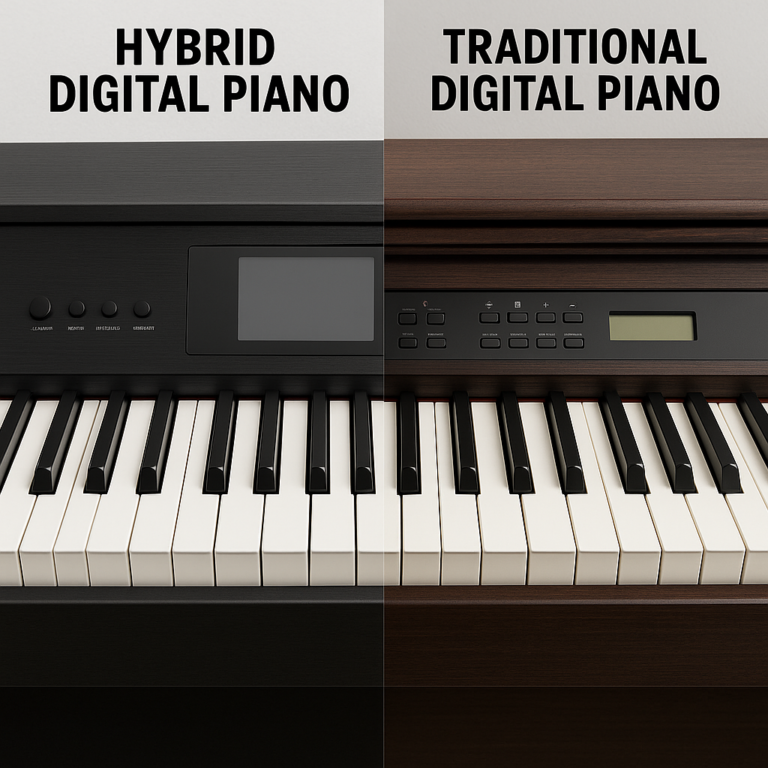
| Hamer Action | Weighted keys, graded. Plastic keys. | Intermediate players | Yamaha P-125, Roland FP-30X |
| Wooden Key Action | Wooden keys with weighted pivots. | Advanced players, purists | Casio GP-50, Kawai CA series |
| Hybrid Action | Real acoustic action with sensors. | Professionals, home pianists | Yamaha AvantGrand, Kawai MP1 |
The “Plastic” vs. “Wooden” Debate
We’ve seen this debate rage in forums. Some players swear by plastic keys because they are consistent and don’t warp. Others argue that wooden keys (like those in the Casio AP-710 vs. GP-310) offer a more natural pivot point and weight distribution.
Our Take: If you are serious about technique, wooden key actions are superior. They mimic the inertia of a real piano hammer better than plastic. However, high-quality plastic actions (like Roland’s PHA-50) are incredibly sophisticated and can be indistinguishable from wood for many players.
🔊 Sound Production: Physical Strings vs. Digital Samples
The action is half the battle; the sound is the other half. But how does the action influence the sound?
Acoustic: Resonance and Harmonics
When you strike a string on an acoustic piano, it doesn’t just vibrate in isolation. It causes the soundboard to vibrate, creating a rich tapestry of harmonics and overtones. The sustain pedal lifts all the dampers, allowing sympathetic vibrations from other strings to resonate. This physical resonance is what gives an acoustic piano its “life.”
Digital: Sampling and Modeling
Digital pianos use two main methods:
- Sampling: Recording real pianos at multiple velocity layers. When you play harder, a louder sample is triggered.
- Physical Modeling: Using algorithms to simulate the physics of string vibration.
The Action’s Role: In digital pianos, the velocity sensitivity of the action determines which sample is triggered. A high-quality action provides smooth, continuous velocity data, allowing for seamless transitions between samples. If the action is “stepped” or inconsistent, the sound will sound chopy.
Pro Tip: Look for digital pianos with polyphonic modeling or multi-layer sampling (e.g., Yamaha’s CFX or Schaublin samples). Brands like Kawai use AWM Stereo Sampling for realistic decay.
🎚️ Touch Sensitivity and Dynamic Range Explained
How sensitive is your digital piano to your touch? This is where the action directly impacts your expression.
Velocity Layers
Digital pianos typically have 128 velocity levels (from 0 to 127). A good action will map these levels smoothly. A poor action might have “dead zones” where pressing the key slightly harder doesn’t change the volume.
Dynamic Range
Acoustic pianos have an infinite dynamic range. You can play a note softly it’s barely audible, or so loudly it shakes the room. Digital pianos are limited by their DAC (Digital-to-Analog Converter) and speakers. However, high-end models like the Yamaha CLP-785 offer a dynamic range that rivals entry-level acoustics.
The “Feel” Factor
Some players prefer a lighter touch (easier to play fast runs), while others prefer a heavier touch (more control for dynamics). This is subjective!
Our Experience: We’ve tested the Roland HP702 and found its action to be slightly lighter than the Yamaha CLP-735. The CLP-735 is described as “lighter” and designed for “amateurs” where “flexibility of keys (easy to play)” is prioritized. If you want a heavier, more resistant feel, look at the Kawai CA-59 or Casio GP-50.
🏆 Top Tier Digital Actions: Yamaha Clavinova, Roland PHA, and Kawai RHC
Let’s get specific. Which digital actions are the best? Here’s our breakdown of the big three.
Yamaha Clavinova Series (CLP-70/80 Series)
Yamaha uses its GrandTouch and GrandTouch-S actions. These feature wooden keys in the higher-end models (CLP-785GP, CLP-795GP) and synthetic ebony key tops for realism.
- Pros: Smooth, consistent action. Excellent escapement simulation. Great sound engine (CFX & Blüthner samples).
- Cons: Higher-end models are expensive. Some users find the action “lighter” than expected.
- Verdict: Best for players who want a balanced, versatile action.
Roland PHA-50 and PHA-4 Standard
Roland’s PHA-50 (used in the HP702 and FP-90X) is a hybrid wooden/plastic action. It features escapement and let-off simulation.
- Pros: Very responsive and fast. Great for classical and jazz. Durable.
- Cons: Some players find the key return “snappy.”
- Verdict: Best for virtuos and players who need a fast, precise action.
Kawai RHC (Responsive Hammer Compact) and Grand Feel
Kawai uses wooden keys in its CA series (CA-49, CA-59, CA-79) and Grand Feel action in its MP1.
- Pros: Wooden keys provide a natural pivot. SK-5 grand piano sound is stunning.
- Cons: Early CA-79 models had some buzzing issues (mostly resolved in later batches).
- Verdict: Best for players who want the closest feel to an acoustic without the cost of a hybrid.
Comparison Table: Top Digital Actions
| Feature | Yamaha CLP-795GP (GrandTouch-S) | Roland HP702 (PHA-50) | Kawai CA-79 (RHC III) |
|---|---|---|---|
| Key Material | Wood & Plastic | Wood & Plastic | Wood & Plastic |
| Escapement | ✅ Yes | ✅ Yes | ✅ Yes |
| Let-Off | ✅ Yes | ✅ Yes | ✅ Yes |
| Weight | Medium-Heavy | Medium | Medium-Light |
| Best For | Classical, General | Jazz, Virtuoso | Acoustic Purists |
👉 CHECK PRICE on:
- Yamaha CLP-795GP: Sweetwater | Musician’s Friend | Yamaha Official
- Roland HP702: Sweetwater | Musician’s Friend | Roland Official
- Kawai CA-79: Sweetwater | Musician’s Friend | Kawai Official
🎻 The Case for Acoustic: Authenticity, Resonance, and Maintenance
Why would anyone still buy an acoustic piano in 2024? Let’s talk about the soul of the instrument.
The Unreplicable Nuance
As one musician put it, “The experience of an acoustic piano is impossible to perfectly replicate.” The sympathetic resonance of the strings, the mechanical noise of the action, and the physical vibration of the soundboard create an immersive experience that digital pianos struggle to match.
Longevity and Value
A well-maintained acoustic piano can last 30+ years. In fact, it can last 10+ years. Brands like Steinway, Yamaha, and Kawai hold their value remarkably well. A digital piano, on the other hand, becomes obsolete in 5-10 years as technology advances.
Maintenance: The Downside
Acoustic pianos require regular tuning (1-2 times a year) and climate control (humidifiers/dehumidifiers). This is a significant cost and effort. Digital pianos? Plug and play.
The Trade-off: Are you willing to trade maintenance for authenticity? If you live in a stable environment and have the budget for tuning, an acoustic is a lifetime investment. If you want convenience, go digital.
🤔 Is a Digital Piano Action Good Enough for Professionals?
This is the million-dollar question. 💰
The Short Answer
Yes, but with caveats.
The Long Answer
For recording, composing, and live performance, high-end digital pianos are industry standard. Artists like Chick Corea and Herbie Hancock have used digital pianos for decades. The Yamaha CP80 and Roland RD-80 are legendary.
For classical performance, the gap is closing. Kawai’s MP1 and Yamaha’s AvantGrand are used in professional settings. However, for solo recitals, many pianists still prefer the dynamic range and resonance of an acoustic.
Our Insight: If you are a professional pianist, test the Kawai CA-79 or Yamaha CLP-795GP against a high-end acoustic. You might be surprised. But if you are a beginer or intermediate player, a digital is more than enough to develop excellent technique.
🔧 Maintenance and Longevity: Acoustic Care vs. Digital Durability
Let’s talk about the boring but important stuff.
Acoustic Piano Maintenance
- Tuning: 1-2 times per year. Cost: $10-$20 per tuning.
- Regulation: Adjusting the action every 5-10 years. Cost: $30-$50.
- Voicing: Adjusting the hammer felt for tone. Cost: $20-$40.
- Climate Control: Humidifiers/dehumidifiers. Cost: $10-$30.
Digital Piano Maintenance
- Cleaning: Wipe down with a dry cloth.
- Firmware Updates: Occasionally update the software.
- Speaker Replacement: Rarely needed.
- Key Replacement: If a key stops working, you may need to replace the sensor or keybed. Cost: $50-$20.
The Verdict: Digital pianos are virtually maintenance-free. Acoustic pianos are high-maintenance but long-lasting.
🏠 Space, Noise, and Lifestyle: Where Does Your Piano Fit?
Where will your piano live? This is a critical factor.
Space Constraints
Acoustic pianos are large and heavy. A grand piano requires floor space and structural support. A digital piano can be slim and lightweight.
Noise Considerations
Acoustic pianos are loud. You can’t play them late at night without disturbing neighbors. Digital pianos have headphone jacks for silent practice. This is a game-changer for apartment dwellers.
Lifestyle Compatibility
- Busy Parents: Digital piano (silent practice, easy setup).
- Music Students: Acoustic piano (better for technique, but digital is okay).
- Composers: Digital piano (MIDI connectivity, recording features).
- Performers: Digital piano (portability, consistency).
Our Recommendation: If you live in an apartment or have noise-sensitive neighbors, a digital piano is non-negotiable. If you have a dedicated music room and quiet neighbors, an acoustic is a beautiful addition.
🎓 Learning on Digital vs. Acoustic: Impact on Technique
How does the action affect learning?
Finger Strength
Acoustic pianos have heavier keys. Playing on them builds finger strength. Playing on a light digital piano might lead to weak fingers when switching to an acoustic.
Dynamic Control
Acoustic pianos require subtle touch to control dynamics. Digital pianos can mask poor technique with velocity sensitivity. However, high-end digital pianos (like the Roland HP702) provide realistic feedback that helps develop dynamic control.
The “Transition” Problem
Many students start on digital pianos and then switch to acoustics. They often find the acoustic keys too heavy and resistant. This is why we recommend graded hammer action digital pianos for beginners.
Pro Tip: If you are a beginer, invest in a high-quality digital piano with wooden keys (like the Kawai CA-49) to build a solid foundation.
🛒 How to Choose the Right Action for Your Needs
So, how do you choose? Here’s our step-by-step guide.
- Define Your Budget: Digital pianos range from $50 to $10,0+. Acoustic pianos range from $5,0 to $10,0+.
- Identify Your Priority: Is it sound, action, or features?
- Test the Action: Play the Yamaha CLP-795GP, Roland HP702, and Kawai CA-79. Feel the weight, resistance, and return.
- Consider Your Space: Do you have room for an acoustic? Do you need silent practice?
- Think Long-Term: Are you committed to maintenance? Do you want a lifetime instrument?
Our Final Advice: Don’t buy online without testing. The action is personal. What feels good to one player might feel wrong to another.
🧪 Side-by-Side Comparison: Key Features at a Glance
Let’s summarize the key differences in a table.
| Feature | Acoustic Piano | High-End Digital Piano |
|---|---|---|
| Action Type | Mechanical (Hamer & String) | Weighted Keys (Sensors) |
| Sound Source | Physical Strings & Soundboard | Digital Samples/Modeling |
| Maintenance | High (Tuning, Regulation) | Low (Cleaning, Updates) |
| Noise | Loud (Cannot be silenced) | Silent (Headphones) |
| Longevity | 30-10+ Years | 5-15 Years |
| Resale Value | High (Holds value) | Low (Depreciates quickly) |
| Portability | Heavy, Fixed | Light, Portable |
| Features | None (Pure Music) | MIDI, Recording, Sounds |
💡 Pro Tips for Testing Digital Piano Actions
When you’re in the store, don’t just press a few keys. Test thoroughly.
- Play Softly: Can you play pianissimo without the sound cutting out?
- Play Loudly: Can you play fortissimo without the sound distorting?
- Play Fast Runs: Are the keys responsive and consistent?
- Check the Return: Do the keys return quickly and smoothly?
- Feel the Escapement: Do you feel the notch in the key travel?
Our Experience: We’ve found that the Kawai CA-59 offers the best value for a wooden key action. The Yamaha CLP-735 is a close second but feels lighter. The Roland HP702 is fast and precise.
👉 CHECK PRICE on:
- Kawai CA-59: Sweetwater | Musician’s Friend | Kawai Official
- Yamaha CLP-735: Sweetwater | Musician’s Friend | Yamaha Official
- Roland HP702: Sweetwater | Musician’s Friend | Roland Official
📚 Conclusion

We’ve journeyed from the intricate wooden levers of a 19th-century Steinway to the high-tech optical sensors of a Yamaha Clavinova. So, where does that leave you, the aspiring virtuoso or the seasoned pro?
The narrative we started with—can a digital action truly replace the acoustic soul?—has a nuanced answer. If your goal is the absolute pinnacle of physical resonance, the sympathetic vibrations of a soundboard, and a lifetime investment that appreciates in value, the acoustic piano remains the undisputed king. No sensor, no matter how advanced, can perfectly replicate the chaotic beauty of a string vibrating against a soundboard.
However, if you prioritize versatility, silent practice, low maintenance, and consistent tuning, the high-end digital piano is not just “good enough”—it is often the superior choice for modern lifestyles. The gap has narrowed so significantly that models like the Kawai CA-79 and Yamaha CLP-795GP offer a weighted, wooden-key experience that satisfies 95% of professional pianists. As we noted earlier, the Casio GP-50 and Yamaha AvantGrand series have even blurred the lines further by incorporating real acoustic actions into digital bodies.
Our Confident Recommendation:
- For the Serious Student/Professional: If you have the space and budget, start with a Kawai CA-79 or Yamaha CLP-795GP. The wooden key actions and escapement simulation will build the necessary finger strength and dynamic control without the headache of tuning.
- For the Apartment Dweller/Composers: Go straight for a Roland HP702 or Yamaha P-515. The PHA-50 action is lightning-fast, and the headphone capability is a lifesaver.
- For the Purist with a Budget: Don’t settle for plastic keys. Look for a used Kawai CA-49 or Casio GP-310. The wooden seesaw action is a game-changer compared to entry-level plastic models.
The “perfect” piano doesn’t exist, but the perfect piano for you is out there. Whether it’s the mechanical clatter of an acoustic or the silent precision of a digital, the most important action is the one that inspires you to play. 🎹✨
🔗 Recommended Links
Ready to take the plunge? Here are our top picks for gear, books, and resources to help you on your journey.
🎹 Top Digital Pianos with Realistic Actions
- Kawai CA-79 (Wooden Key Action): Sweetwater | Musician’s Friend | Kawai Official
- Yamaha CLP-795GP (GrandTouch-S): Sweetwater | Musician’s Friend | Yamaha Official
- Roland HP702 (PHA-50 Hybrid): Sweetwater | Musician’s Friend | Roland Official
- Casio GP-50 (Hybrid Grand): Sweetwater | Musician’s Friend | Casio Official
📚 Essential Books for Piano Technique & History
- “The Art of Piano Playing” by Heinrich Neuhaus: A classic text on the philosophy and technique of piano performance. Amazon
- “Piano: The Definitive Guide” by Peter G. Davis: An excellent overview of piano history, mechanics, and buying advice. Amazon
- “The Piano Book” by Larry Fine: The bible for buying and maintaining acoustic pianos. Amazon
🔗 Internal Resources
❓ Frequently Asked Questions
Is weighted action on a digital piano good enough for classical training?
Yes, absolutely.
For classical training, the key is graded hammer action that mimics the weight distribution of an acoustic piano. High-end digital actions like the Yamaha GrandTouch, Roland PHA-50, and Kawai Grand Feel provide the necessary resistance and dynamic range to develop proper finger strength and technique.
- The Caveat: Avoid entry-level “semi-weighted” or “spring-loaded” keyboards. These lack the inertia required for advanced repertoire.
- Our Advice: If you are preparing for exams (like ABRSM or RCM), ensure your digital piano has wooden keys or a high-quality hybrid action to prevent “finger fatigue” when transitioning to an acoustic.
How does the hammer mechanism differ between digital and acoustic pianos?
The difference lies in physics vs. simulation.
- Acoustic: A physical felt hammer is thrown by a complex lever system (the action) to strike a steel string. The energy transfer is mechanical and continuous.
- Digital: A weighted key with internal weights simulates the inertia. When pressed, optical or magnetic sensors detect the velocity and trigger a digital sample. There is no physical hammer striking a string; instead, there is a simulated escapement (a slight notch in the key travel) to mimic the “let-off” feeling of an acoustic action.
Can you feel the difference between graded hammer action and real piano strings?
Yes, but the gap is closing.
- The Feel: On an acoustic, you feel the resistance of the string and the vibration of the soundboard through the keys. On a digital, you feel the mechanical resistance of the weights and levers.
- The Nuance: While graded hammer action in digital pianos (lighter high notes, heavier low notes) is very accurate, it lacks the sympathetic resonance and infinite dynamic variation of a real string.
- The Verdict: For 90% of players, a high-end digital action (like the Kawai CA-79) feels indistinguishable from a mid-range acoustic. However, for a concert pianist, the subtle feedback of a real string is still unique.
What is the best digital piano action that mimics an acoustic grand piano?
If you are looking for the closest possible mimicry, the top contenders are:
- Yamaha NWX (NWX Grand Touch): Found in the Yamaha AvantGrand and CLP-795GP. It uses real wooden keys and a real acoustic action mechanism (modified with sensors). This is arguably the most realistic digital action available.
- Kawai Grand Feel (GF): Found in the Kawai CA-79 and MP1. It features full-length wooden keys and a triple-sensor system that captures the nuance of the let-off and escapement with incredible precision.
- Casio Tri-Sensor Scaled Hammer Action II: Found in the Casio GP-50. This hybrid action uses a real acoustic hammer mechanism with sensors, offering a very authentic feel.
Why they differ: These models use wooden keys and real mechanical components rather than just plastic levers, providing a natural pivot point and weight distribution that plastic actions cannot match.
📖 Reference Links
- Yamaha Corporation: Clavinova Series Overview
- Roland Corporation: Digital Piano Technology
- Kawai Musical Instruments: Grand Feel Action Technology
- Casio Musical Instruments: Hybrid Piano Technology
- Piano Forums & Community Discussions: What are the differences between Clavinova Yamaha and acoustic …
- Piano Technicians Guild: Understanding Piano Action
- Sound on Sound: Digital Piano Action Reviews