Support our educational content for free when you buy through links on our site. Learn more
🎹 The Ultimate Steinway Grand Piano Guide (2026): Models, Myths & Mastery


Have you ever walked into a concert hall, sat in the front row, and felt the floor vibrate before a single note was played? That is the Steinway grand piano effect. It’s a sound so rich, so complex, and so undeniably powerful that it has defined the sound of classical music for over a century. But here is the twist: not every Steinway sounds the same. In fact, the difference between a Model S and a Model D is as vast as the difference between a compact car and a Formula 1 racer.
We’ve spent decades in showrooms, concert halls, and restoration shops, listening to everything from the delicate whispers of a vintage Model M to the earth-shattering roar of a modern Model D. We’ve seen buyers get swept away by the logo and end up with an instrument that doesn’t fit their room or their playing style. That’s why we wrote this guide. We’re peling back the layers of the “Steinway mystique” to give you the honest truth about every model, the real costs involved, and whether this legendary instrument is truly the right fit for your life.
By the end of this article, you’ll know exactly which model to choose, how to spot a “Golden Era” gem versus a restoration nightmare, and why the Model B might just be the most underrated piano on the market. Ready to find your perfect match? Let’s dive in.
Key Takeaways
- Model Matters Most: The Steinway Model D is the concert standard, but the Model B and Model M often offer the best balance of tone and space for homes and studios.
- Craftsmanship Counts: A new Steinway takes nearly one year to handcraft, utilizing a unique diaphragmatic soundboard and one-piece maple rim for unmatched resonance.
- Investment Potential: Unlike most consumer goods, a well-maintained Steinway often holds its value or appreciates, especially vintage models from the 1920s–1960s.
- Size is Critical: Choosing the wrong size for your room can ruin the sound; a 9-foot Model D will overwhelm a small apartment, while a 5-foot Model S may lack bass in a large hall.
- Buy Smart: Whether buying new or pre-owned, always verify the condition with a qualified technician and consider authorized dealers or trusted specialists like Park Avenue Pianos.
👉 Shop Steinway Grand Pianos:
- New Models: Amazon Search | Steinway Official
- Pre-Owned & Restored: Park Avenue Pianos | Sweetwater Search
Table of Contents
- ⚡️ Quick Tips and Facts
- 📜 A Brief History of the Steinway & Sons Grand Piano Legacy
- 🎹 The Steinway Grand Piano Model Lineup: From the Petite to the Concert D
- 🔍 Deep Dive: The Steinway Model D Concert Grand Experience
- 🔍 Deep Dive: The Steinway Model B Professional Grand Piano Review
- 🔍 Deep Dive: The Steinway Model A and Model O Grand Pianos
- 🔍 Deep Dive: The Steinway Model S and Model M Grand Pianos
- 🛠️ Inside the Craft: What Makes a Steinway Grand Piano Unique?
- 🎨 Steinway Spirio: The High-Resolution Player Piano Revolution
- 💰 Steinway Grand Piano Pricing Factors: New vs. Pre-Owned vs. Restored
- 🏆 Why the Steinway Grand Piano Remains the Gold Standard in Acoustic Pianos
- 🆚 Steinway vs. The Competition: How It Compares to Bösendorfer, Fazioli, and Yamaha
- 🛒 Where to Buy a Steinway Grand Piano: Authorized Dealers and Trusted Sources
- 🔧 Essential Maintenance and Care for Your Steinway Investment
- ❓ Frequently Asked Questions About Steinway Grand Pianos
- 🔗 Recommended Links and Resources
- 📚 Reference Links and Sources
- 🏁 Conclusion: Is the Steinway Grand Piano Right for You?
⚡️ Quick Tips and Facts
Before we dive into the deep end of the Steinway ocean, let’s get the lay of the land with some hard-hitting facts that every aspiring Steinway owner needs to know. We’ve played hundreds of these beasts, from the cramped corners of New York apartments to the vast halls of Carnegie, and here is what we’ve learned:
- The “1-Month” Rule: Did you know it takes roughly 1 months to handcraft a single Steinway grand piano? That’s right, while you’re waiting for your delivery, a team of master craftsmen is spending nearly a year turning raw wood into a symphony. Source: Steinway & Sons
- The Concert Standard: If you walk into a major concert hall anywhere in the world, there is a 90%+ chance the piano on stage is a Steinway. It’s not just marketing; it’s the gold standard for a reason.
- Wood Matters: The soundboard isn’t just wood; it’s Sitka Spruce, selected for its specific density and grain to allow sound to flow freely. The rim? Hard Rock Maple, bent in a steam bath to create that iconic curve.
- The “Steinway Sound”: It’s not just one thing. It’s a combination of the diaphragmatic soundboard, the hexagonal rim, and the patented Accelerated Action.
- Investment Potential: Unlike most consumer goods that depreciate the moment you unbox them, a well-maintained Steinway often holds its value or even appreciates, especially vintage models from the “Golden Era” (1920s–1960s).
- Size Matters: A Model D (Concert Grand) sounds completely different from a Model S (Baby Grand) in the same room. Don’t buy a Model D for a 10×10 room, or you’ll drown out your own playing!
For those curious about the vertical cousins of these giants, don’t miss our deep dive into the 🎹 Steinway & Sons Upright Piano: The 2026 Grand Secret Revealed.
📜 A Brief History of the Steinway & Sons Grand Piano Legacy

Every great story has a beginning, and the Steinway story starts in a small workshop in Manhattan, 1853. Henry Engelhard Steinway, a German immigrant and master piano maker, arrived in New York with a dream and a saw. He didn’t just want to build pianos; he wanted to build instruments that could sing.
The Rise of a Dynasty
By the late 19th century, the Steinway name was synonymous with excellence. They won more awards at international exhibitions than any other piano manufacturer. But what truly set them apart? Inovation.
- The Diaphragmatic Soundboard (1870s): While others were using flat boards, Steinway introduced a curved soundboard that acted like a speaker cone, amplifying the sound naturally.
- The One-Piece Rim: Instead of gluing pieces together, they steam-bent a single piece of maple into a continuous loop. This created a stronger, more resonant body.
- The Patented Action: Their action mechanism allowed for faster repetition of notes, a game-changer for the virtuos of the Romantic era.
The Golden Era
Between the 1920s and the 1960s, Steinway produced what many collectors consider the best pianos ever made. These instruments, often referred to as “Pre-War” or “Golden Era” Steinways, are highly sought after today. Why? Because the wood was seasoned longer, the craftsmanship was meticulous, and the materials were of a quality that is hard to find today.
“The Steinway grand piano, the legend and gold standard of musical instruments…” — Steinway & Sons Official
If you want to trace the lineage of these instruments further, check out our extensive collection on Piano History.
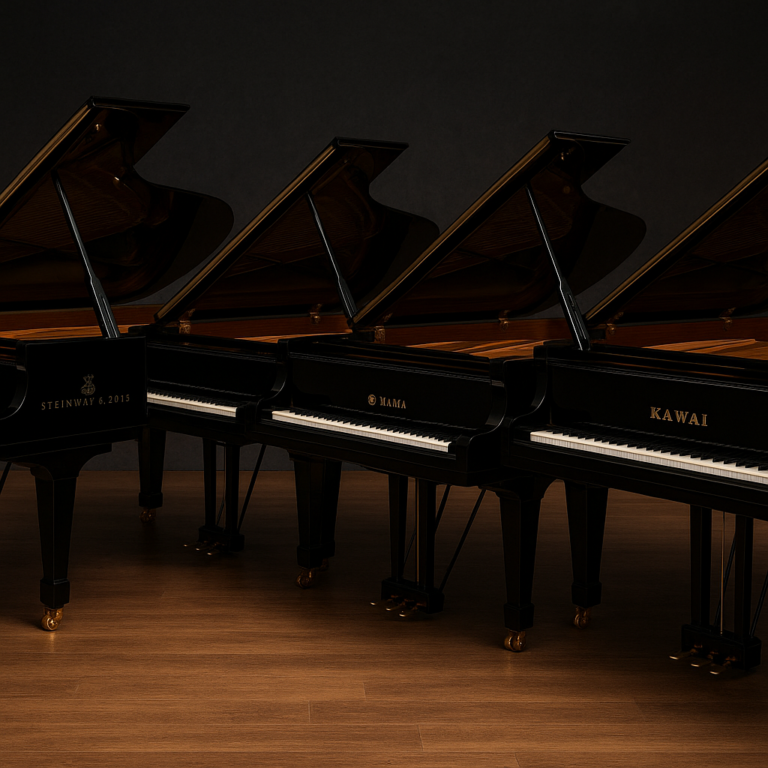
🎹 The Steinway Grand Piano Model Lineup: From the Petite to the Concert D
Choosing a Steinway is like choosing a car. You wouldn’t buy a semi-truck to go grocery shopping, and you wouldn’t buy a Mini Cooper to haul a circus. Steinway offers a lineup of six distinct grand piano models, each designed for a specific space and musical purpose.
Let’s break them down, from the smallest to the largest.
The “Baby” Grands: Model S and Model M
These are the entry-level Steinways, perfect for homes, studios, and smaller recital halls.
- Model S (5′ 1″): The smallest grand Steinway makes. It’s compact but still offers that grand piano action and tone. Great for apartments with high ceilings.
- Model M (5′ 7″): The “middle child” that everyone loves. It’s the most popular home grand piano size. It offers a fantastic balance of tone richness and physical footprint.
The Professional Grands: Model A and Model O
Stepping up a notch, these models bridge the gap between home and professional performance.
- Model O (6′ 2″): Often called the “Salon Grand.” It has a surprisingly powerful bass for its size.
- Model A (6′ 10″): A rare beast. It offers a fuller sound than the O but is still manageable in large living rooms.
The Titans: Model B and Model D
These are the heavy hitters.
- Model B (6′ 10″): The professional’s choice. Used in conservatories, recording studios, and smaller concert halls. It has a rich, singing tone that rivals the Model D but fits in more spaces.
- Model D (9′ 0″): The Concert Grand. The largest piano Steinway makes. It is the instrument of choice for virtuos and major concert halls. It has a massive dynamic range and a bass that shakes the floorboards.
Comparison Table: Steinway Grand Piano Models
| Model | Length | Best For | Tone Characteristic |
|---|---|---|---|
| Model S | 5′ 1″ | Small Apartments | Bright, responsive, compact |
| Model M | 5′ 7″ | Homes, Studios | Balanced, warm, versatile |
| Model O | 6′ 2″ | Large Living Rooms | Richer bass, singing treble |
| Model A | 6′ 10″ | Professional Homes | Full-bodied, powerful |
| Model B | 6′ 10″ | Recitals, Recording | Deep bass, complex harmonics |
| Model D | 9′ 0″ | Concert Halls | Massive dynamic range, orchestral power |
🔍 Deep Dive: The Steinway Model D Concert Grand Experience
Ah, the Model D. The king of the hill. The instrument that sits at the center of the stage at Carnegie Hall. If you’ve ever wondered why 19 out of 20 concert pianists choose Steinway, this is where the magic happens.
The Sound
The Model D is not just loud; it is orchestral. It can whisper a delicate melody in the treble and then roar with a bass that feels like a cello section. The diaphragmatic soundboard in a Model D is massive, allowing for a sustain that seems to go on forever.
The Feel
The action on a Model D is lightning fast. It allows for rapid repetition of notes, essential for the most difficult repertoire by Rachmaninoff or Liszt. The key dip is perfectly calibrated to give the pianist total control.
The Reality Check
Here is the catch: Space. A Model D requires a room of at least 20×20 feet to breathe. If you put it in a small room, the bass will be overwhelming and muddy. Also, the price tag is… well, let’s just say it’s an investment that requires a serious budget.
“The soundboard is the life of the instrument, the soul of the instrument.” — Craftsman at Steinway & Sons
For a visual breakdown of the craftsmanship, check out the perspective shared in the featured video earlier in this article, which details the 1-month journey of creating a Model D.
🔍 Deep Dive: The Steinway Model B Professional Grand Piano Review
If the Model D is the king, the Model B is the prince. It is arguably the most versatile Steinway ever made.
Why the Model B?
The Model B is the sweet spot for many professional pianists. It offers 90% of the power of the Model D but fits in a standard large living room or a university practice room.
Tone and Touch
- Tone: The Model B has a singing treble and a powerful bass that doesn’t overpower the mid-range. It’s perfect for Chopin, Debussy, and modern jazz.
- Touch: The action is incredibly responsive. It feels “alive” under the fingers.
The Verdict
If you are a serious student, a teacher, or a professional who performs in smaller venues, the Model B is often the best value in the Steinway lineup. It’s the piano that can do it all.
🔍 Deep Dive: The Steinway Model A and Model O Grand Pianos
These two models are the hidden gems of the Steinway lineup. They are often overlooked in favor of the M, B, and D, but they offer unique advantages.
Model O (6′ 2″)
The Model O is a powerhouse for its size. It has a longer bass string than the Model M, giving it a much richer low end. It’s perfect for those who want a grand piano sound but don’t have the space for a Model B.
Model A (6′ 10″)
The Model A is a rare find. It was produced in smaller quantities and is often sought after by collectors. It offers a fuller sound than the O and is a fantastic choice for a home studio or a large living room.
🔍 Deep Dive: The Steinway Model S and Model M Grand Pianos
Let’s talk about the home champions. The Model S and Model M are the most common Steinways you’ll find in private homes.
Model S (5′ 1″)
- Pros: Compact, fits in small spaces, still has the Steinway action.
- Cons: The bass is limited compared to larger models.
- Best For: Apartments, small studios, beginners who want a grand.
Model M (5′ 7″)
- Pros: The perfect balance of size and sound. Great bass response for its size.
- Cons: Can still be too large for very small rooms.
- Best For: Most homes, teaching studios, small recitals.
Pro Tip: If you are buying a used Steinway, the Model M is often the most abundant and offers the best value for money.
🛠️ Inside the Craft: What Makes a Steinway Grand Piano Unique?
So, what makes a Steinway a Steinway? It’s not just the logo on the fallboard. It’s the secret sauce of their construction.
1. The Diaphragmatic Soundboard
Unlike flat soundboards, the Steinway soundboard is crowned (curved). This allows it to vibrate more freely, producing a richer, more complex tone.
2. The One-Piece Rim
Steinway uses a continuous rim made of hard rock maple. This is steam-bent into shape, creating a rigid structure that enhances resonance and durability.
3. The Hexagonal Rim
The shape of the rim is not just for looks. The hexagonal shape helps to direct sound waves efficiently, enhancing the projection of the instrument.
4. The Patented Action
The Steinway action is designed for speed and control. It allows for rapid repetition of notes, which is crucial for advanced repertoire.
5. The Materials
Steinway uses only the finest materials:
- Sitka Spruce for the soundboard.
- Hard Rock Maple for the rim.
- Ebony for the keys (in most models).
- Bronze for the strings.
For more on the technical side of piano building, explore our Piano Brand Guides.
🎨 Steinway Spirio: The High-Resolution Player Piano Revolution
Imagine a piano that can play itself, but with the nuance and expression of a live human. That’s Steinway Spirio.
What is Spirio?
Spirio is a high-resolution player piano system that is integrated into new Steinway grand pianos. It uses 1,024 levels of velocity to capture the exact touch of a pianist.
The Experience
When you play a Spirio recording, you don’t just hear the notes; you feel the dynamics, the pedaling, and the articulation. It’s like having a world-class pianist in your living room.
Who is it for?
- Pianists: To practice and listen to master performances.
- Non-Pianists: To enjoy the beauty of a Steinway without needing to play.
- Collectors: As a modern addition to the Steinway legacy.
Note: Spirio is available on all new Steinway grand piano models, from the Model S to the Model D.
💰 Steinway Grand Piano Pricing Factors: New vs. Pre-Owned vs. Restored
Let’s address the elephant in the room: Price. Steinway pianos are expensive, but why? And is it worth it?
New Steinways
Buying a new Steinway means you get the latest innovations, a full warranty, and the pristine condition of a factory-fresh instrument. However, the price tag is steep.
Pre-Owned Steinways
The used market is where the magic happens. You can find Golden Era Steinways (1920s-1960s) that are often in better condition than new ones. These pianos have been “played in” and have a unique character.
Restored Steinways
A fully restored Steinway is like a new car. It has been disasembled, refinished, and rebuilt to factory specifications. This is a great option if you want a vintage look with modern reliability.
Factors Affecting Price
- Model: Model D is more expensive than Model M.
- Condition: A piano in mint condition is worth more.
- Age: Golden Era pianos often command a premium.
- Finish: Exotic wood finishes (like mahogany or rosewood) cost more than standard ebony.
- Location: Prices vary by region and dealer.
For a detailed look at the pre-owned market, check out Park Avenue Pianos, a trusted source for pre-owned Steinway grand pianos with original parts certification.
🏆 Why the Steinway Grand Piano Remains the Gold Standard in Acoustic Pianos
After 170 years, why is Steinway still the gold standard?
Consistency
Steinway maintains a high level of quality across all its models. Whether you buy a Model S or a Model D, you know you’re getting a Steinway.
Resale Value
Unlike other brands, Steinway pianos hold their value remarkably well. A well-maintained Steinway can be sold for a significant portion of its original price.
The “Steinway Sound”
The distinctive tone of a Steinway is instantly recognizable. It’s warm, rich, and powerful. It’s the sound of classical music history.
The Community
Owning a Steinway gives you access to a global community of pianists, collectors, and enthusiasts. You’re not just buying an instrument; you’re joining a legacy.
🆚 Steinway vs. The Competition: How It Compares to Bösendorfer, Fazioli, and Yamaha
Steinway isn’t the only game in town. Let’s see how it stacks up against the big three competitors.
Steinway vs. Bösendorfer
- Bösendorfer: Known for its extra bass notes (up to 97 keys) and a softer, more mellow tone. It’s often preferred for Romantic repertoire.
- Steinway: Known for its powerful projection and versatility. It’s the choice for concert halls.
Steinway vs. Fazioli
- Fazioli: An Italian brand known for its bright, crystalline tone and lighter action. It’s a favorite among modern virtuos.
- Steinway: Offers a warmer, more complex tone with a heavier action.
Steinway vs. Yamaha
- Yamaha: Known for its consistency, durability, and bright tone. It’s a great choice for schools and studios.
- Steinway: Offers a more nuanced tone and a richer bass. It’s the choice for professionals.
Verdict: If you want power and versatility, go Steinway. If you want mellow warmth, consider Bösendorfer. If you want brightness and precision, look at Fazioli. If you want reliability and value, Yamaha is a strong contender.
For more comparisons, visit our Piano Comparison section.
🛒 Where to Buy a Steinway Grand Piano: Authorized Dealers and Trusted Sources
Buying a Steinway is a major investment. You need to buy from a trusted source.
Authorized Dealers
Steinway has a network of authorized dealers worldwide. These dealers are certified to sell and service Steinway pianos. They offer warranties and support.
Pre-Owned Specialists
For used Steinways, look for specialists like Park Avenue Pianos. They offer warranties, certifications, and trade-up programs.
Online Marketplaces
Be cautious when buying online. Always inspect the piano in person or hire a qualified technician to do so.
Block-Level Shopping Links
- New Steinway Grand Pianos: Amazon Search | Steinway Official
- Pre-Owned Steinway Grand Pianos: Park Avenue Pianos | Sweetwater Search | Musician’s Friend Search
- Steinway Spirio Systems: Steinway Official
🔧 Essential Maintenance and Care for Your Steinway Investment
You’ve bought your Steinway. Now, how do you keep it sounding like new?
Humidity Control
Pianos are made of wood, and wood expands and contracts with humidity. Keep the humidity between 40% and 50%. Use a piano humidifier or dehumidifier as needed.
Tuning
A Steinway should be tuned at least twice a year, preferably four times. If you play frequently, you may need more frequent tunings.
Cleaning
Dust the piano regularly with a soft, dry cloth. Avoid using chemical cleaners or polishes that can damage the finish.
Regulation and Voicing
Every few years, your piano may need regulation (adjusting the action) and voicing (adjusting the tone). This should be done by a qualified technician.
Moving
Never move a Steinway yourself. Hire a professional piano mover who has experience with grand pianos.
For more tips on piano care, check out our Piano Buying Guide.
❓ Frequently Asked Questions About Steinway Grand Pianos
What is the most expensive piano in the world?
The most expensive piano in the world is a Steinway & Sons custom model, which can cost over $2.5 million. These are bespoke instruments with unique finishes and features.
How much is a Steinway grand piano worth?
The value of a Steinway grand piano depends on the model, age, condition, and finish. A new Model D can cost over $20,0, while a used Model M might be found for $30,0 – $50,0.
Are Steinway pianos worth it?
For serious pianists and collectors, yes. They offer unparalleled sound quality, durability, and resale value. For casual players, a less expensive brand might be more appropriate.
How much does a Steinway grand piano cost?
Prices vary widely. A new Model S starts around $70,0, while a new Model D can exceed $20,0. Used models can be found for a fraction of the price.
Which is better Yamaha or Steinway?
It depends on your needs. Yamaha is known for consistency and brightness, while Steinway is known for warmth and complexity. Try both to see which you prefer.
Why are Steinway pianos so expensive?
Steinway pianos are expensive due to the high-quality materials, handcrafting process, and 1-month production time. They are built to last a lifetime.
How much does a Steinway grand piano model a cost?
A new Model A typically costs between $10,0 and $120,0. Used models can be found for less.
What is the average price of a Steinway grand piano?
The average price of a new Steinway grand piano is around $10,0. Used models can range from $20,0 to $150,0.
How long does a Steinway grand piano last with proper maintenance?
With proper maintenance, a Steinway grand piano can last 10 years or more. Many vintage Steinways from the 1920s are still in use today.
What are the differences between Steinway Model B and Model D grand pianos?
The Model D is larger (9′ 0″) and has a more powerful sound, while the Model B (6′ 10″) is more versatile and fits in smaller spaces. The Model D is preferred for concert halls, while the Model B is ideal for studios and homes.
Is a Steinway grand piano a good investment for a beginner pianist?
For a beginner, a Model S or M might be a good investment if they are serious about learning. However, a less expensive brand might be more appropriate for casual players.
🏁 Conclusion: Is the Steinway Grand Piano Right for You?

So, we’ve taken you on a journey through the history, models, craftsmanship, and cost of the Steinway grand piano. But the question remains: Is it right for you?
If you are a serious pianist, a collector, or someone who dreams of owning the gold standard of musical instruments, then yes, a Steinway is absolutely worth it. The sound, the touch, and the legacy are unmatched.
However, if you are a casual player or on a tight budget, a Steinway might be overkill. There are many other excellent brands that offer great value.
Our Recommendation:
- For Concerts and Professional Use: Go for the Model D.
- For Homes and Studios: The Model B or Model M is the sweet spot.
- For Small Spaces: Consider the Model S or a high-quality upright.
Remember, the best piano is the one that inspires you to play. Whether it’s a Steinway or another brand, the most important thing is the connection you feel with the instrument.
If you’re ready to take the plunge, check out our Recommended Links below for trusted dealers and resources. And don’t forget to visit Park Avenue Pianos for a curated selection of pre-owned Steinway grand pianos.
Happy playing! 🎹✨