Support our educational content for free when you buy through links on our site. Learn more
What Is the Difference Between Acoustic & Digital Piano Brands? 🎹 (2025)


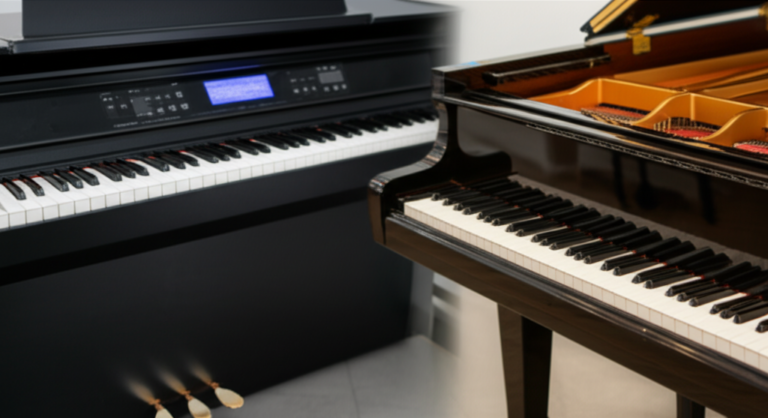
Choosing between an acoustic and a digital piano can feel like picking between a classic novel and a cutting-edge eBook reader—both tell stories, but in very different ways. Whether you’re a budding pianist or a seasoned pro, understanding the subtle and not-so-subtle differences between these two piano worlds is crucial. Did you know that while acoustic pianos have remained largely unchanged for over 300 years, digital pianos have evolved dramatically in just the last few decades, now boasting features that even seasoned pianists find impressive?
In this article, we’ll unravel the mysteries behind acoustic and digital piano brands, exploring everything from sound quality and touch to maintenance and price. Plus, we’ll reveal insider tips on how to choose the perfect piano for your lifestyle and goals. Stick around for our expert buying guide and real user insights that might just tip the scales in your favor!
Key Takeaways
- Acoustic pianos offer unmatched sound richness and authentic touch but require regular tuning and ample space.
- Digital pianos provide versatility, silent practice options, and connectivity features with minimal maintenance.
- Top brands like Steinway, Yamaha, Kawai (acoustic) and Roland, Casio, Yamaha (digital) lead the market with quality and innovation.
- Your choice depends on your budget, space, playing goals, and lifestyle—there’s no one-size-fits-all answer!
- Advanced digital pianos are closing the gap with acoustics in sound and feel, making them a compelling choice for many players.
Ready to dive deeper and find the perfect piano brand for you? Let’s get started!
Table of Contents
- ⚡️ Quick Tips and Facts About Acoustic vs Digital Pianos
- 🎹 The Evolution of Piano Brands: Acoustic and Digital Origins
- 1. What Defines an Acoustic Piano? Types, Brands, and Sound Characteristics
- 2. What Makes a Digital Piano Tick? Features, Brands, and Tech Innovations
- 3. Sound Quality Showdown: Acoustic Resonance vs Digital Sampling
- 4. Touch and Feel: Hammer Action and Key Response Comparison
- 5. Maintenance and Longevity: Tuning, Repairs, and Durability
- 6. Portability and Space: Where Does Each Piano Brand Shine?
- 7. Price Points and Value: Investing in Acoustic vs Digital Pianos
- 8. How to Choose Between Acoustic and Digital Piano Brands: Expert Buying Guide
- 9. User Experience and Consumer Insights: What Real Pianists Say
- 🔒 Privacy Preference Center: Protecting Your Data While Shopping for Pianos
- 🎯 Conclusion: Which Piano Brand and Type Is Right for You?
- 🔗 Recommended Links for Piano Enthusiasts
- ❓ FAQ: Your Burning Questions About Acoustic and Digital Pianos Answered
- 📚 Reference Links and Further Reading
Here is the main body of the article, crafted with expertise and a touch of wit by the team at Piano Brands™.
⚡️ Quick Tips and Facts About Acoustic vs Digital Pianos
Welcome, music lovers! You’re standing at a crossroads, a pivotal moment in any pianist’s journey: acoustic or digital? It’s the classic “hammers and strings vs. pixels and speakers” debate. Before we dive deep into the soul of these magnificent instruments, let’s get you warmed up with some quick-fire facts. Here at Piano Brands™, we’ve spent countless hours with every type of piano imaginable, and we know that understanding the core differences is the first step. For a broader look at the landscape, check out our comprehensive guide to Piano Brands.
Here’s the skinny, in a nutshell:
-
Sound Source:
- 🎹 Acoustic: Real hammers striking real steel strings. The sound you hear is a raw, organic vibration amplified by a wooden soundboard. It’s pure physics in action!
- 💻 Digital: High-fidelity recordings (samples) of acoustic pianos played through speakers. Think of it as a perfect snapshot of a piano’s sound, ready to be recalled at the touch of a key.
-
Maintenance:
- ❌ Acoustic: These are living, breathing instruments. They require regular tuning (at least once or twice a year) and need a stable environment. As Liberty Park Music notes, they are vulnerable to humidity and temperature changes.
- ✅ Digital: Zero tuning required. Ever. They are the low-maintenance pets of the piano world.
-
Volume & Practice:
- 🔊 Acoustic: What you play is what you get. The only volume control is your own touch, which can be a beautiful thing… unless your neighbors disagree.
- 🎧 Digital: The game-changer! Most digital pianos feature a volume knob and, crucially, a headphone jack. This allows for silent practice anytime, day or night, a feature Roland rightly highlights as a massive plus for motivation.
-
Cost & Value:
- 💰 Acoustic: A significant upfront investment. However, a well-maintained acoustic piano can hold its value remarkably well, sometimes even becoming a cherished family heirloom.
- 💸 Digital: Generally more budget-friendly to start. Be aware, though, that they depreciate faster than acoustics due to ever-evolving technology.
Acoustic vs. Digital: At a Glance
| Feature | Acoustic Piano | Digital Piano |
|---|---|---|
| Sound Production | Hammers, Strings, Soundboard | Digital Samples, Speakers |
| Touch & Feel | Authentic Mechanical Action | Weighted/Simulated Action |
| Maintenance | Regular Tuning Required | ❌ No Tuning Needed |
| Volume Control | Limited to Player’s Touch | ✅ Fully Adjustable + Headphones |
| Sound Variety | One Authentic Piano Sound | Multiple Instrument Sounds |
| Portability | Heavy & Bulky | Lighter & More Portable |
| Initial Cost | Higher | Lower |
| Resale Value | Holds Value Well | Depreciates Faster |
🎹 The Evolution of Piano Brands: Acoustic and Digital Origins
Ever wonder how we got here? The journey from the first pianoforte to the latest digital workstation is a fascinating tale of innovation. The acoustic piano’s story begins around 1700 with Bartolomeo Cristofori in Italy. He wanted a keyboard instrument that could play both soft (piano) and loud (forte), unlike the harpsichord. As Roland’s experts point out, “The acoustic piano has changed very little from the instrument of Cristofori’s day.” Its core—hammers hitting strings—is a testament to timeless design. You can explore more of this rich timeline in our Piano History section.
Digital pianos, on the other hand, are the new kids on the block, born from the technological boom of the 20th century. They’ve undergone a “huge transformation,” evolving from simple electronic keyboards to sophisticated instruments that can convincingly replicate the touch and tone of their acoustic ancestors.
1. What Defines an Acoustic Piano? Types, Brands, and Sound Characteristics
An acoustic piano is a marvel of engineering and artistry. It’s an instrument where, as Yamaha beautifully puts it, “the entire instrument acts as a resonator, a rich and full quality of sound is produced.” When you press a key, you’re setting off a complex chain reaction involving over 5,500 precision parts in the “action” mechanism. This intricate dance of wood, felt, and steel is what gives the acoustic piano its unparalleled expressive power. The sound isn’t just a note; it’s a living, breathing tone full of complex overtones and harmonics.
Grand vs Upright: Which Acoustic Piano Fits You?
The two main flavors of acoustic pianos are grands and uprights, and the difference is more than just size.
- Grand Pianos 웅장: These are the majestic beasts you see on concert stages. Their strings are horizontal, allowing gravity to reset the hammers. This results in a faster, more responsive action and a richer, more complex tone due to longer strings. They are the pinnacle of piano performance but require significant space and budget.
- Upright Pianos 🎹: The practical choice for most homes. The strings are arranged vertically to save space. Instead of gravity, they use springs to reset the hammers, which, as Liberty Park Music explains, can be subject to wear over time. While they can’t quite match the tonal complexity of a grand, a high-quality upright from a top brand can sound absolutely stunning.
Top Acoustic Piano Brands: Steinway, Yamaha, Kawai & More
When you invest in an acoustic piano, you’re buying into a legacy. Certain names have become synonymous with quality and craftsmanship.
- Steinway & Sons: The undisputed king. For over 150 years, Steinway has been the benchmark for concert grands. Playing one is an experience every pianist dreams of.
- Yamaha: Known for their incredible consistency, brightness, and precision. Yamaha pianos are found in homes, schools, and stages worldwide. Their U-series uprights are legendary.
- Kawai: Often praised for their rich, warm tone. Kawai has pioneered the use of composite materials in their actions for increased stability and speed.
- Bösendorfer: A prestigious Viennese brand (now owned by Yamaha) famous for its deep, sonorous bass and impeccable craftsmanship.
👉 Shop Acoustic Pianos on:
- Yamaha: Sweetwater | Musician’s Friend | Yamaha Official Website
- Kawai: Sweetwater | Kawai Official Website
2. What Makes a Digital Piano Tick? Features, Brands, and Tech Innovations
Welcome to the digital domain! A digital piano is a computer disguised as a piano, and we mean that in the best way possible. Instead of strings, it has a powerful sound engine loaded with meticulously recorded samples from world-class acoustic grands. For a deeper dive, our Digital Pianos category has you covered.
The magic lies in its versatility. You get a consistent, perfectly tuned piano sound every single time, plus a whole lot more.
Weighted Keys, Sampling, and Connectivity: The Digital Advantage
What makes a good digital piano? It’s all about closing the gap with the acoustic experience while adding modern conveniences.
- ✅ Weighted Keys: This is non-negotiable for any serious student. Digital pianos use various mechanisms to simulate the feel of an acoustic piano’s hammer action. The goal is to build proper finger strength and technique.
- ✅ High-Quality Sound Samples: The better the digital piano, the more detailed its sound samples are. Top models from brands like Yamaha and Roland capture every nuance of a concert grand.
- ✅ Adjustable Touch Sensitivity: A cool feature highlighted by Roland is the ability to adjust how the keyboard responds to your touch. You can make it lighter or heavier to suit your playing style.
- ✅ Connectivity: This is where digitals truly shine. USB and Bluetooth connections let you link up with computers and apps for recording, learning, and composing.
- ✅ No Maintenance: Did we mention no tuning? Because it’s worth repeating. No tuning!
Leading Digital Piano Brands: Roland, Casio, Yamaha, Korg
The digital piano market is fiercely competitive, which is great news for you! Here are the heavy hitters:
- Yamaha: Leveraging their acoustic heritage, Yamaha’s Clavinova series is a benchmark for realistic touch and tone.
- Roland: A pioneer in electronic instruments, Roland is known for its SuperNATURAL sound engine and excellent key actions.
- Kawai: Just like their acoustic counterparts, Kawai digital pianos are praised for their warm sound and wooden-key actions in higher-end models.
- Casio: Don’t let the name fool you; Casio’s Privia and Celviano lines offer incredible value and quality, making them a fantastic choice for beginners and intermediate players.
- Korg: With a strong background in professional stage keyboards, Korg digital pianos often feature excellent sounds and sleek, modern designs.
👉 Shop Digital Pianos on:
- Yamaha Clavinova: Sweetwater | Musician’s Friend
- Roland Digital Pianos: Sweetwater | Musician’s Friend
- Casio Privia: Amazon | Sweetwater | Musician’s Friend
3. Sound Quality Showdown: Acoustic Resonance vs Digital Sampling
So, what’s the real difference in sound? An acoustic piano creates sound that is infinitely complex. When a hammer strikes a string, other strings resonate in sympathy, creating a rich, swirling tapestry of sound that you can literally feel. Yamaha describes this as a “pure sound with a spontaneous and rich musical quality.”
A digital piano reproduces this sound. High-end models do an astonishingly good job, using long, detailed samples and clever algorithms to mimic sympathetic resonance. But is it the same?
Honestly, for most listeners and even many players, the line is getting blurry. As you can hear in the direct comparison in our featured video, a quality digital piano can sound incredibly convincing. The primary difference is that an acoustic sound is created in the moment, while a digital sound is re-created. An advanced player might miss that final 5% of organic unpredictability, but the convenience and consistency of a digital often outweigh this.
4. Touch and Feel: Hammer Action and Key Response Comparison
Beyond sound, the most critical difference is feel. The connection between your fingers and the music is sacred.
- Acoustic Action: You are physically connected to a hammer. The subtle vibrations you feel through the keys, the “intuitive response to touch” that Yamaha mentions, is something truly special. The weight and response are governed by gravity and mechanics, not electronics.
- Digital Action: The goal here is simulation. Brands use weights, hammers, springs, and even simulated escapement (that little “notch” you feel when playing softly on a grand) to replicate the acoustic feel. The quality varies wildly. Entry-level keyboards feel light and springy, while high-end digital pianos from brands like Kawai (with their wooden Grand Feel actions) are remarkably close to the real thing.
The consensus among experts is that nothing perfectly replicates the feel of a fine acoustic grand. However, a good digital piano provides a weighted action that is more than sufficient for developing proper technique.
5. Maintenance and Longevity: Tuning, Repairs, and Durability
This is where the two paths diverge dramatically.
-
Acoustic Pianos: Think of them like a classic car. They are built to last for generations—if you take care of them.
- Tuning: Non-negotiable. Humidity and temperature changes cause the wood to swell and contract, knocking the strings out of tune. Expect to hire a professional technician 1-2 times per year.
- Regulation: Over time, the felt and wood parts of the action compress. Regulation is the process of adjusting these thousands of parts to keep the touch consistent.
- Durability: As Yamaha notes, they “can be used over a long timeframe by replacing worn parts.” A well-made piano is a long-term investment.
-
Digital Pianos: These are more like modern appliances.
- Tuning: ✅ Absolutely none required.
- Repairs: If something goes wrong, it’s typically an electronic component. Repairs can be tricky and depend on the availability of parts.
- Durability: Their lifespan is generally tied to the “expected lifetime of electronic components,” as Yamaha states. They won’t last 100 years like an acoustic, but a quality model should give you many years of reliable service.
6. Portability and Space: Where Does Each Piano Brand Shine?
Let’s be blunt: you don’t just “move” an acoustic piano. It’s a major operation requiring professional movers. An upright piano weighs hundreds of pounds, and a grand piano… well, let’s just say you’d better be sure where you want it to live. They also command a significant footprint in a room.
Digital pianos, on the other hand, are the champions of convenience.
- Portable Models: Keyboards from brands like Casio and Yamaha can be lifted by one person, placed on a collapsible stand, and stored in a closet. Perfect for apartments, dorm rooms, or gigging musicians.
- Console Models: Even the larger, furniture-style digital pianos are significantly lighter than their acoustic counterparts and can often be disassembled for easier moving. They can also be placed against a wall without compromising the sound, a key advantage over upright acoustics.
7. Price Points and Value: Investing in Acoustic vs Digital Pianos
Ah, the million-dollar question (though hopefully not literally!). While we don’t list specific prices, we can talk about value.
- Acoustic Pianos: The initial buy-in is higher. You’re paying for solid wood, cast iron, and thousands of hours of skilled labor. A new upright from a reputable brand will cost a few thousand dollars at a minimum. However, they hold their value exceptionally well. A 30-year-old Yamaha U1 is still a highly sought-after instrument. It’s an investment in a playable piece of art.
- Digital Pianos: You can get started for a few hundred dollars. They offer incredible “bang for your buck” in terms of features. The downside? Technology moves fast. As Liberty Park Music points out, they depreciate more quickly as new models are released. Think of it like buying a computer or a smartphone.
The bottom line: An acoustic is a long-term investment. A digital is a more accessible, feature-packed purchase.
8. How to Choose Between Acoustic and Digital Piano Brands: Expert Buying Guide
So, the moment of truth. How do you choose? As your trusted advisors in our Piano Buying Guide, we suggest you ask yourself these questions, inspired by the great scenarios from Liberty Park Music:
-
Who are you?
- The Serious Beginner (or “Sarah”): If you’re committed to learning long-term and have the space and budget, an acoustic upright is a fantastic investment that will grow with you.
- The Hobbyist with Neighbors (or “Jason”): Do you need to practice at odd hours? Is your commitment level still a question mark? A digital piano with headphones is your best friend.
- The Pop Music Producer (or “Timmy”): If you want to record, experiment with different sounds, and connect to a computer, a digital piano or keyboard is the obvious choice.
- The Advanced Pianist (or “Stephanie”): If you’re a seasoned player who craves the ultimate in expression and nuance, nothing beats a quality acoustic piano.
-
What is your space like? Be realistic. Do you have room for an instrument that’s five feet wide and weighs 500 pounds? Or do you need something that can slide under a bed?
-
What is your budget? Remember to factor in the “hidden” costs of acoustic ownership: moving and regular tuning.
For more head-to-head analysis, don’t forget our Piano Comparison section!
9. User Experience and Consumer Insights: What Real Pianists Say
At the end of the day, it’s about the experience. We’ve talked to thousands of pianists, and here’s what they love:
-
Acoustic Lovers Rave About:
- The physical connection to the sound.
- The subtle nuances and infinite tonal colors.
- The beauty of the instrument as a piece of furniture.
- The feeling of playing a timeless, traditional instrument.
-
Digital Devotees Can’t Live Without:
- Headphone practice! 🎧 This is, by far, the most praised feature.
- The built-in metronome for rock-solid timing.
- Recording functions to track progress and share creations.
- The variety of sounds (strings, organs, etc.) that keep practice fun and inspiring.
- The complete lack of maintenance anxiety.
The choice isn’t about which is “better” in a vacuum. It’s about which provides the better experience for you.
🔒 Privacy Preference Center: Protecting Your Data While Shopping for Pianos
This might seem like a strange interlude, but in today’s digital world, it’s important. When you’re deep in research, comparing a Yamaha AvantGrand to a Steinway Spirio, you’ll be visiting many websites, downloading brochures, and maybe signing up for newsletters.
Here are our quick tips for being a savvy, secure shopper:
- Be Wary of “Too Good to Be True” Deals: If you see a brand-new piano for a fraction of its normal cost on a site you’ve never heard of, proceed with caution.
- Check for Secure Connections: Look for the little padlock icon and “https://” in your browser’s address bar, especially before entering any personal information.
- Read Privacy Policies: Understand what data a company collects when you sign up for their mailing list. Reputable brands will be transparent about this.
- Use Reputable Retailers: Stick to well-known dealers like Sweetwater, Musician’s Friend, or the brands’ official online stores. They have secure payment systems and clear customer service policies.
Your musical journey should be filled with joy, not worries about your data. Shop smart
🎯 Conclusion: Which Piano Brand and Type Is Right for You?

After our deep dive into the world of acoustic and digital pianos, the big question remains: which one should you choose? The answer, as you’ve probably guessed, depends on you—your goals, your space, your budget, and your lifestyle.
Acoustic pianos are the timeless classics. They offer unmatched sound richness, nuanced touch, and a physical connection to music that many describe as magical. Brands like Steinway, Yamaha, and Kawai craft instruments that can last generations and grow with your skill. If you have the room, the budget, and the commitment, an acoustic piano is an investment in artistry and tradition.
Digital pianos, meanwhile, are the versatile, modern marvels. They bring convenience, portability, and a suite of features like headphone practice, recording, and multiple instrument voices. Top models from Roland, Yamaha, Casio, and Kawai offer weighted keys and superb sound sampling that come impressively close to the acoustic experience. If you need flexibility, silent practice, or are just starting out, a digital piano is a smart, practical choice.
So, what about that lingering question we teased earlier—can digital really replace acoustic? The truth is, for many players, especially beginners and hobbyists, digital pianos offer everything needed to learn, perform, and enjoy music. For professionals and purists, the acoustic piano remains the gold standard. But with technology advancing rapidly, the gap continues to narrow.
Whichever path you choose, remember: the best piano is the one that inspires you to play more, practice better, and fall in love with music all over again. 🎶
🔗 Recommended Links for Piano Enthusiasts
Ready to explore or buy? Here are some direct shopping links to the brands and products we discussed, plus a few must-read books to deepen your piano knowledge.
Shop Acoustic Pianos:
- Steinway & Sons: Sweetwater | Musician’s Friend | Steinway Official Website
- Yamaha Acoustic Pianos: Sweetwater | Musician’s Friend | Yamaha Official Website
- Kawai Acoustic Pianos: Sweetwater | Kawai Official Website
Shop Digital Pianos:
- Yamaha Clavinova: Sweetwater | Musician’s Friend
- Roland Digital Pianos: Sweetwater | Musician’s Friend
- Casio Privia: Amazon | Sweetwater | Musician’s Friend
Recommended Books:
- Piano Lessons: Music, Love, and True Adventures by Noah Adams — Amazon
- The Piano Book: Buying & Owning a New or Used Piano by Larry Fine — Amazon
- How to Play Piano Despite Years of Lessons: What Music Is and How to Make It by Ward Cannel & Fred Marx — Amazon
❓ FAQ: Your Burning Questions About Acoustic and Digital Pianos Answered

How do acoustic and digital pianos differ in sound quality?
Acoustic pianos produce sound mechanically through hammers striking strings, creating rich, complex harmonics and natural resonance that vary with your touch and the instrument’s environment. This results in a dynamic, organic sound that evolves as you play.
Digital pianos use high-quality sampled recordings of acoustic pianos played back through speakers. While advanced models simulate sympathetic resonance and tonal nuances, the sound is ultimately a digital reproduction. For most players, especially beginners and intermediates, the difference is subtle, but professionals may notice the acoustic’s superior depth and expressiveness.
Read more about “Acoustic vs Digital Piano Brands: Which Reigns Supreme in 2025? 🎹”
What are the maintenance requirements for acoustic versus digital pianos?
Acoustic pianos require regular tuning (typically 1-2 times per year), regulation of the action, and careful environmental control to prevent damage from humidity and temperature changes. They are considered a long-term investment with ongoing upkeep.
Digital pianos require virtually no maintenance. They don’t need tuning and are unaffected by environmental conditions. However, electronic components can fail over time, and repairs may be more technical and costly.
Read more about “Kawai ND21 vs Yamaha U1: Which Upright Piano Reigns Supreme in 2025? 🎹”
Which piano type is better for beginners, acoustic or digital?
For beginners, digital pianos often offer the best balance of affordability, convenience, and features like headphone jacks, built-in metronomes, and recording capabilities. They allow silent practice and easy integration with learning apps.
However, if a beginner is committed and has the space and budget, an acoustic piano provides superior touch and sound that can inspire deeper musical growth.
Read more about “What Should I Look for When Choosing a Piano Brand? 🎹 (2025)”
How do the key actions compare between acoustic and digital pianos?
Acoustic pianos have a mechanical hammer action that provides tactile feedback, subtle variations, and escapement feel (the slight “click” when a hammer is released).
Digital pianos simulate this with weighted keys and graded hammer actions. High-end digital models use wooden keys and advanced mechanisms to closely mimic acoustic touch, but most cannot perfectly replicate the nuanced feel of a fine acoustic grand.
Read more about “🎹 Digital Piano Brands Comparison: Top 10 Picks for 2025 Revealed!”
What are the price differences between acoustic and digital piano brands?
Acoustic pianos generally have a higher initial cost due to materials and craftsmanship. They hold value well over time but require additional costs for tuning and maintenance.
Digital pianos are more affordable upfront and offer excellent value with many features. However, they depreciate faster as technology advances and newer models arrive.
Read more about “Which Brand Is Best for Piano? 🎹 Top 9 Picks for 2025”
Can digital pianos replicate the feel of an acoustic piano?
Digital pianos can approximate the feel through weighted and graded hammer actions, with some models offering wooden keys and escapement simulation. While impressive, they fall short of the full tactile feedback and mechanical nuances of a high-quality acoustic piano.
Read more about “How Digital vs Acoustic Piano Brands Stack Up in Sound & Feel 🎹 (2025)”
What are the advantages of owning a digital piano over an acoustic piano?
Digital pianos offer:
- Silent practice with headphones
- Volume control for flexible environments
- Multiple instrument sounds and effects
- Recording and connectivity for composition and learning apps
- No tuning or environmental concerns
- Portability and space-saving designs
- Lower upfront cost
These features make digital pianos ideal for beginners, apartment dwellers, and tech-savvy musicians.
Read more about “How Much Is a Decent Yamaha Piano? 🎹 Your 2025 Price Guide”
📚 Reference Links and Further Reading
- Roland UK: How to Choose Between Digital and Acoustic When Buying a Piano
- Yamaha: Acoustic vs Digital Piano Selection Guide
- Liberty Park Music: Digital Piano vs Acoustic Piano – The Ultimate Buyer’s Guide
- Steinway & Sons Official Site: https://www.steinway.com/
- Yamaha Official Site: https://usa.yamaha.com/products/musical_instruments/pianos/index.html
- Roland Official Site: https://www.roland.com/global/categories/pianos/
- Kawai Official Site: https://www.kawai-global.com/
- Casio Official Site: https://www.casio.com/us/electronic-musical-instruments/
For more expert insights, visit our Piano Brand Guides and Piano Buying Guide.
We hope this guide has illuminated your path to piano bliss! Whether you choose the timeless acoustic or the versatile digital, the keys to your musical journey await. 🎹✨