Support our educational content for free when you buy through links on our site. Learn more
Acoustic Piano Brands for Small Spaces: 10 Top Picks 🎹


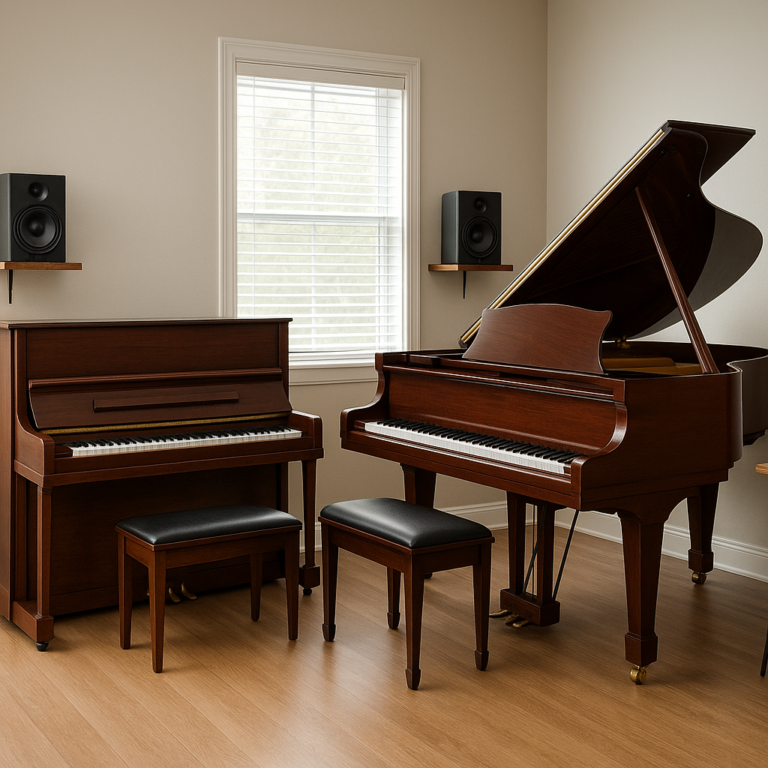
For most small homes, a compact upright from Yamaha or Kawai is the best place to start. These acoustic piano brands offer models that fit neatly against a wall while keeping the full-size keyboard, tactile action, and resonant sound that make playing an acoustic piano special.
But “small piano” doesn’t always mean “quiet piano.” We’ve heard a modest upright fill a reflective apartment with sound, while a taller instrument felt surprisingly comfortable in a room with rugs, curtains, and soft furnishings. The trick is matching the piano to your space, playing habits, and neighbors—not just measuring its cabinet.
Key Takeaways
- Start with a compact upright if preserving floor space is your priority; consider a baby grand only if you can accommodate its full footprint.
- Compare Yamaha and Kawai models such as the Yamaha b1, Kawai K-15, Yamaha U1, and Kawai K-300 by playing them in person.
- Choose a silent-equipped acoustic piano if you want headphone practice, but remember the instrument still needs room, tuning, and care.
- Measure the delivery route as carefully as the room. Doorways, stair turns, and elevators can make or break the plan.
- Have used pianos inspected by an independent technician before you buy.
- Try different models and finishes: Yamaha acoustic pianos | Kawai acoustic pianos | Compact upright piano options | Silent upright piano options
Table of Contents
- ⚡ Quick Tips and Facts
- 🏙️ How Acoustic Pianos Fit into Small-Space Living
- Upright, studio, or baby grand: which shape saves space?
- How much floor space does a piano actually need?
- Piano dimensions, room layout, and clearance
- 🎹 10 Acoustic Piano Picks for Apartments and Compact Rooms
- 1. Yamaha b1: a compact upright for tight budgets
- 2. Kawai K-15: a small upright with a warm tone
- 3. Yamaha U1: a versatile studio upright
- 4. Kawai K-300: a responsive upright for growing players
- 5. Yamaha U1 SH3: quiet practice with silent technology
- 6. Yamaha b1 SC3: a space-conscious silent piano
- 7. Sauter 122 Masterclass: a refined European upright
- 8. Schimmel K132 Tradition: a powerful concert upright
- 9. Kawai GL-10: a compact grand piano
- 10. Yamaha GB1K: a small grand for home settings
- 🔎 Acoustic Piano Brands for Small Spaces: What Sets Them Apart?
- Yamaha, Kawai, and other widely available brands
- European makers and premium compact uprights
- How piano height affects tone, touch, and space
- 💰 Choosing a Piano by Budget and Long-Term Value
- Entry-level acoustic pianos for small rooms
- Mid-range uprights with better touch and sound
- Premium compact uprights and small grands
- How much should you spend on an acoustic piano?
- 🏠 Room Acoustics, Neighbors, and Piano Placement
- Best placement for an upright piano
- Managing volume, echoes, and sound transmission
- Rugs, curtains, acoustic panels, and piano mats
- Apartment practice etiquette and quiet-hour strategies
- 🌡️ Climate, Heating, and Piano Care in Compact Homes
- Humidity and temperature: protecting tuning stability
- Avoiding radiators, windows, and direct sunlight
- Tuning, servicing, and routine maintenance
- 🎧 Silent and Hybrid Piano Technology
- How silent systems work on acoustic pianos
- Acoustic silent piano vs digital hybrid piano
- Headphones, Bluetooth, recording, and app features
- When a silent piano is worth the extra investment
- 🚚 Delivery, Stairs, and Piano-Moving Logistics
- Measuring doorways, hallways, elevators, and staircases
- Upright piano delivery vs grand piano delivery
- Floor strength, building rules, and insurance
- What to ask a piano dealer and moving company
- ♻️ Buying a Second-Hand Acoustic Piano
- Should you consider a used piano for a small space?
- Inspecting the action, soundboard, strings, and keys
- Why an independent piano technician’s inspection matters
- Used piano red flags and hidden costs
- ✅ Acoustic Piano Buying Advice for Small Homes
- Choosing between a compact upright and a baby grand
- Matching piano action and tone to your playing level
- How we evaluated small-space acoustic piano options
- Common buying mistakes to avoid
- ❓ Frequently Asked Questions
- What is the smallest practical acoustic piano?
- Can an acoustic piano work in an apartment?
- Is a baby grand better than an upright in a small room?
- How often does a home piano need tuning?
- Can I move an acoustic piano myself?
- Conclusion
- Recommended Links
- Reference Links
Table of Contents
- ⚡ Quick Tips and Facts
- 🏙️ How Acoustic Pianos Fit into Small-Space Living
- Upright, studio, or baby grand: which shape saves space?
- How much floor space does a piano actually need?
- Piano dimensions, room layout, and clearance
- 🎹 10 Acoustic Piano Picks for Apartments and Compact Rooms
- 1. Yamaha b1: a compact upright for tight budgets
- 2. Kawai K-15: a small upright with a warm tone
- 3. Yamaha U1: a versatile studio upright
- 4. Kawai K-300: a responsive upright for growing players
- 5. Yamaha U1 SH3: quiet practice with silent technology
- 6. Yamaha b1 SC3: a space-conscious silent piano
- 7. Sauter 122 Masterclass: a refined European upright
- 8. Schimmel K132 Tradition: a powerful concert upright
- 9. Kawai GL-10: a compact grand piano
- 10. Yamaha GB1K: a small grand for home settings
- 🔎 Acoustic Piano Brands for Small Spaces: What Sets Them Apart?
- Yamaha, Kawai, and other widely available brands
- European makers and premium compact uprights
- How piano height affects tone, touch, and space
- 💰 Choosing a Piano by Budget and Long-Term Value
- Entry-level acoustic pianos for small rooms
- Mid-range uprights with better touch and sound
- Premium compact uprights and small grands
- How much should you spend on an acoustic piano?
- 🏠 Room Acoustics, Neighbors, and Piano Placement
- Best placement for an upright piano
- Managing volume, echoes, and sound transmission
- Rugs, curtains, acoustic panels, and piano mats
- Apartment practice etiquette and quiet-hour strategies
- 🌡️ Climate, Heating, and Piano Care in Compact Homes
- Humidity and temperature: protecting tuning stability
- Avoiding radiators, windows, and direct sunlight
- Tuning, servicing, and routine maintenance
- 🎧 Silent and Hybrid Piano Technology
- How silent systems work on acoustic pianos
- Acoustic silent piano vs digital hybrid piano
- Headphones, Bluetooth, recording, and app features
- When a silent piano is worth the extra investment
- 🚚 Delivery, Stairs, and Piano-Moving Logistics
- Measuring doorways, hallways, elevators, and staircases
- Upright piano delivery vs grand piano delivery
- Floor strength, building rules, and insurance
- What to ask a piano dealer and moving company
- ♻️ Buying a Second-Hand Acoustic Piano
- Should you consider a used piano for a small space?
- Inspecting the action, soundboard, strings, and keys
- Why an independent piano technician’s inspection matters
- Used piano red flags and hidden costs
- ✅ Acoustic Piano Buying Advice for Small Homes
- Choosing between a compact upright and a baby grand
- Matching piano action and tone to your playing level
- How we evaluated small-space acoustic piano options
- Common buying mistakes to avoid
- ❓ Frequently Asked Questions
- What are the best acoustic piano brands for small apartments?
- Which acoustic piano brands make compact upright pianos?
- What is the smallest acoustic piano that still has a full-size keyboard?
- Are digital pianos better than acoustic pianos for small spaces?
- Can a silent acoustic piano be played quietly in an apartment?
- How much clearance should I leave around an upright piano?
- How do I know if a used piano is worth buying?
- Conclusion
- Recommended Links
- Reference Links
⚡ Quick Tips and Facts
- For most small homes, start with an upright. It uses the wall rather than the middle of the room, and a studio or compact upright can fit where a grand would turn the furniture plan into a game of Tetris.
- Measure the whole route, not just the piano corner. Doorways, stair turns, elevators, and hallway pinch points can rule out a piano before its footprint does.
- A smaller cabinet does not guarantee a quieter piano. Room size, flooring, wall construction, and playing dynamics all affect how much sound reaches neighbors.
- Try the actual instrument. Two pianos of the same model can feel and sound different after years of use, regulation, tuning, and room changes.
- Budget for delivery, tuning, and climate care, not only the instrument itself. The Piano Buying Guide covers the wider ownership picture.
- If quiet practice is essential, consider a silent acoustic model or digital piano. Our Acoustic vs Digital Piano Brands guide explains the feel, sound, and maintenance trade-offs.
- Keep the piano away from heat, direct sunlight, and damp. Stable conditions help protect tuning and wooden components; see the Piano Technicians Guild.
- A compact grand is still a grand. Its curved body, lid, and player clearance can take more usable room than its headline dimensions suggest.
| Quick check | What to look for |
|---|---|
| Best all-round shape for small rooms | Upright piano |
| Typical compact-upright width | Around 145–155 cm, depending on model |
| Full keyboard | Usually 88 keys, even on compact acoustic models |
| Apartment-friendly practice | Silent system, suitable practice hours, or a digital alternative |
| Biggest ownership surprise | Moving access and ongoing maintenance |
| Most reliable next step | Measure, visit a dealer, and play more than one instrument |
One note before we get attached to a particular finish: the right small-space piano is not simply the shortest one. It is the instrument that fits the room, the building, your hands, and your neighbors.
🏙️ How Acoustic Pianos Fit into Small-Space Living
An acoustic piano makes sound through strings, hammers, and a soundboard. That gives it a physical, responsive sound you feel in the room—but it also means its volume cannot be turned down like a digital piano’s. Our Piano Brand Guides compare makers and instrument types, while this guide focuses on the practical question: which acoustic pianos make sense when floor space is precious?
Upright, studio, or baby grand: which shape saves space?
An upright piano places its soundboard and strings vertically, so its body sits close to a wall. Grand pianos arrange the strings horizontally, with the lid opening into the room. That layout can give a grand a distinctive response and projection, but it generally asks for more clear floor area.
| Piano type | Space profile | Strengths | Trade-offs |
|---|---|---|---|
| Studio upright | Tall, relatively shallow cabinet | Small footprint; often practical for apartments | Less depth and tonal range than taller uprights |
| Console upright | Compact home instrument | Decorative cabinet; suitable for casual and developing players | Action and tonal resources vary by model |
| Professional upright | Taller cabinet, more substantial action | Greater potential for tone, power, and expressive control | Heavier; can sound strong in a small room |
| Baby grand | Broad, curved body extending into the room | Grand action geometry and visual presence | More difficult to place; lid can project sound |
| Digital piano | Slim cabinet or portable keyboard | Adjustable volume, headphones, no tuning | No acoustic strings or soundboard resonance |
Ogden Piano Gallery also recommends uprights for compact rooms, describing them as space-saving and often more mellow in small settings. That is useful general advice, but “mellow” is not a guarantee: voicing, regulation, model, room surfaces, and how enthusiastically you play all matter. See its small-space piano guide.
The upright advantage
For many homes, an upright’s practical benefit is simple: it can stand along a wall, leaving the center of the room open. A compact upright might be roughly 55–61 cm deep, but you still need room for the bench, the player, and access to the instrument.
A taller upright may also offer longer strings and a larger soundboard than a short upright. That can support a fuller sound, though construction and condition matter as much as height. A tall upright can sometimes make more musical sense than a small grand of similar size—but only if its sound suits the room.
When a baby grand can work
A baby grand may suit a compact room if the room has a clear corner or open area and the piano is a major part of how you use that space. But check the full outline, not just the keyboard width. Include the tail, bench, player position, lid, and a path around the instrument.
A grand is not automatically the “better” piano. It is a different shape, action, and sound projection. If your room is very small, a quality upright often gives you more piano per square metre—and fewer furniture negotiations.
How much floor space does a piano actually need?
A useful planning estimate cited by MusicRadar’s acoustic-piano guide is about 1.5 m² for an upright, including room for the player and bench. A grand may need a similar width but substantially more length, with room for the pianist and stool. Treat those figures as a starting point, not a universal blueprint: model dimensions and room layout vary.
| Planning item | Allowance to consider | Why it matters |
|---|---|---|
| Upright cabinet | Often about 145–155 cm wide and 55–67 cm deep | Verify exact model dimensions |
| Bench and playing position | About 60 cm or more in front, where practical | Lets the player sit and move comfortably |
| Access for tuning/service | Clear access to the front and, where needed, rear | Technicians need room to work |
| Grand piano body | Check manufacturer’s length and width | The curved tail takes meaningful space |
| Walking route | Keep a usable path around nearby furniture | Prevents the piano from becoming a room divider |
The National Piano Foundation and piano technicians can help with care and servicing questions, but for layout, the best tool is a tape measure and a little masking tape. Mark the piano’s outline on the floor. Add the bench. Then walk around it. If you have to turn sideways to reach the sofa, the piano has already won the room.
Piano dimensions, room layout, and clearance
Before shopping, record:
- Room length, width, and ceiling height.
- The intended piano wall, including nearby windows, radiators, outlets, and vents.
- The delivery route from the building entrance to the room.
- Door widths and turning spaces, measured with doors open.
- The bench area and walking path, not just the cabinet footprint.
Use the manufacturer’s published dimensions as a starting point, then ask the dealer or mover to confirm what the specific instrument requires. Dimensions are usually given as width × depth × height for uprights; for grands, the length and width may be listed differently by manufacturer.
A small room’s visual proportions matter, too. A dark, glossy cabinet can feel imposing in a narrow room, while a lighter finish or satin surface may blend more quietly into the space. That is a décor choice, not a sound-quality metric—but you will see the piano every day, so it counts.
🎹 10 Acoustic Piano Picks for Apartments and Compact Rooms
These suggestions span budget-friendly uprights, silent models, premium instruments, and small grands. Availability, configurations, and specifications can vary by country and year, so confirm details with the manufacturer or a local dealer before ordering.
Scores below are our guide-level ratings, not laboratory measurements. We weigh small-room practicality, musical performance, features, and ownership considerations. A piano earns no bonus points for being expensive; a piano earns points for making you want to play.
| Model | Small-space fit | Tone and touch | Quiet-practice options | Best suited to |
|---|---|---|---|---|
| Yamaha b1 | 9/10 | 7/10 | Optional, market-dependent | First acoustic piano, compact room |
| Kawai K-15 | 9/10 | 7/10 | Confirm regional configuration | Apartment or student use |
| Yamaha U1 | 8/10 | 9/10 | Silent version available | Serious home practice |
| Kawai K-300 | 8/10 | 9/10 | ATX system available in some markets | Growing and advanced players |
| Yamaha U1 SH3 | 8/10 | 9/10 | Integrated silent system | Players needing headphone practice |
| Yamaha b1 SC3 | 9/10 | 7/10 | Integrated silent system | Compact homes with noise limits |
| Sauter 122 Masterclass | 8/10 | 9/10 | Options vary by market | Premium upright buyers |
| Schimmel K132 Tradition | 7/10 | 9/10 | Twintone option may be available | Players seeking concert-upright scale |
| Kawai GL-10 | 5/10 | 8/10 | Silent option depends on configuration | Buyers committed to a small grand |
| Yamaha GB1K | 5/10 | 8/10 | Silent configuration varies | Compact-grand enthusiasts |
1. Yamaha b1: a compact upright for tight budgets
The Yamaha b1, a compact entry-level upright in Yamaha’s b Series, is a practical choice when the room and budget both say “let’s be sensible.” Published dimensions are around 148 cm wide, 54 cm deep, and 109 cm high, though local specifications should be checked.
Why consider it
- Compact depth compared with many full-size uprights.
- Familiar Yamaha service network in many markets.
- A full 88-key acoustic keyboard in a relatively small cabinet.
- Often offered in multiple finishes depending on region.
Potential drawbacks
- Its shorter cabinet offers fewer tonal resources than taller uprights.
- Players may find the action less refined than that of higher-tier instruments.
- Acoustic volume still cannot be reduced with a dial.
The b1 is worth trying if you want a new acoustic piano and a manageable footprint. But do not buy it by dimensions alone: sit down, play softly, then play loudly. That range tells you much more than a showroom’s polished finish.
Product links
- Yamaha b1: Amazon | Musician’s Friend | Yamaha Official Website
2. Kawai K-15: a small upright with a warm tone
The Kawai K-15 is a compact upright aimed at home and student use. It is frequently recommended for small rooms because its cabinet is designed to be relatively shallow while retaining a full keyboard.
Why consider it
- A practical footprint for a studio apartment or dedicated practice corner.
- Kawai’s responsive action design is worth auditioning if you prefer a slightly different feel from Yamaha.
- Often available through specialist piano dealers, who can set it up and support it locally.
Potential drawbacks
- Sound character is subjective: one pianist’s “warm” may be another’s “too soft.”
- Availability and silent-system options vary by market.
- As with any acoustic upright, it needs professional tuning and suitable environmental conditions.
We have heard pianists gravitate toward a piano because its midrange feels welcoming rather than flashy. That is a perfectly good reason to choose one—but bring music you actually play, not only a few showroom scales.
Product links
- Kawai K-15: Amazon | Kawai Official Website | Merriam Music
3. Yamaha U1: a versatile studio upright
The Yamaha U1 is a familiar professional and home upright with a taller cabinet than compact entry-level models. A height around 121 cm gives it more room for strings and soundboard than a small studio upright, while its wall-huging shape can still work in a compact room.
Why consider it
- Strong all-round choice for students, teachers, and experienced home pianists.
- A broad, clear sound that can suit many styles.
- Widely recognized, which can make local service and used-market research easier.
Potential drawbacks
- It is deep and heavy compared with the smallest uprights.
- Its volume may be too much for a very live room or thin-walled apartment.
- Used examples vary dramatically with age, maintenance, and condition.
The U1 can be a sweet spot: more musical headroom than a short upright without the floor sprawl of a grand. Still, in a small, reflective room, a bright or powerful U1 can feel like a brass band that has wandered into your reading nook.
Product links
- Yamaha U1: Amazon | Musician’s Friend | Yamaha Official Website
4. Kawai K-300: a responsive upright for growing players
The Kawai K-300 is a 122 cm upright often considered by serious students and home pianists. Its height can offer more soundboard and string length than smaller cabinets, while its upright footprint remains easier to manage than a grand.
Why consider it
- A capable action and tonal range for developing technique.
- Good balance of compact placement and performance potential.
- Silent-system configurations, such as Kawai’s ATX options, may be available in some markets.
Potential drawbacks
- Its sound may feel bright in some rooms or to some listeners.
- The cabinet is not as shallow as the smallest studio uprights.
- Silent options and included features differ by regional model.
Try it at both low and high dynamics. Small rooms reveal tonal excess quickly: the piano that sounds sparkling in a dealer’s large showroom may become a little too enthusiastic beside your bookcase.
Product links
- Kawai K-300: Amazon | Kawai Official Website
5. Yamaha U1 SH3: quiet practice with silent technology
The Yamaha U1 SH3, sold in certain markets, combines the familiar U1 acoustic piano with a Yamaha Silent Piano system. In silent mode, a mechanism stops the hammers from striking the strings, while sensors capture key movement and trigger digital piano sounds through headphones.
Why consider it
- Acoustic playing when you want the room-filling sound.
- Headphone practice when household or building noise is a concern.
- Digital features can include multiple voices and connectivity, depending on configuration.
Potential drawbacks
- Silent electronics add complexity and cost compared with a standard U1.
- Headphone mode does not make the key mechanism or pedals literally noiseless.
- The acoustic instrument still requires space, tuning, and maintenance.
A silent upright is a compromise in the best sense: one instrument for two kinds of practice. Before purchasing, test the transition between acoustic and silent modes and confirm exactly which system is fitted. Yamaha model suffixes matter.
Product links
- Yamaha U1 SH3: Amazon | Yamaha Official Website
6. Yamaha b1 SC3: a space-conscious silent piano
The Yamaha b1 SC3 pairs a compact b1-style cabinet with a silent-practice system in markets where this model is offered. It is aimed at players who want the acoustic piano experience but need a headphone option at certain hours.
Why consider it
- Smaller cabinet than a full-size professional upright.
- Silent-practice functionality can be useful in shared buildings.
- Preserves an acoustic instrument’s physical keyboard and hammer action.
Potential drawbacks
- It remains a substantial acoustic piano, not a portable keyboard.
- Feature availability differs by country.
- A silent system is not the same as turning down the acoustic piano; you must select silent mode.
If you love the feel of an acoustic piano but cannot practice freely, this category deserves an audition. The important question is not “Does it have headphones?” but “Does the silent mode feel and sound good enough that I’ll actually use it?”
Product links
- Yamaha b1 SC3: Amazon | Yamaha Official Website
7. Sauter 122 Masterclass: a refined European upright
The Sauter 122 Masterclass is a premium upright from the German maker Sauter. At about 122 cm high, it is not the smallest piano by height, but the upright design still makes it more room-efficient than a grand.
Why consider it
- Handcrafted European construction and expressive tonal character.
- A fuller, nuanced sound than many compact entry-level instruments.
- Premium details and options may appeal to demanding players.
Potential drawbacks
- Specialist availability can make comparison and servicing more dealer-dependent.
- Premium instruments call for careful auditioning and professional setup.
- “Small-space friendly” refers to shape, not necessarily light weight or low volume.
A finely voiced upright can bring surprising color into a small room. But luxury woodwork cannot repeal acoustics: if the room is lively, plan for rugs, curtains, and sensible placement before deciding the piano is at fault.
Product links
- Sauter 122 Masterclass: Sauter Official Website | Amazon search
8. Schimmel K132 Tradition: a powerful concert upright
The Schimmel K132 Tradition is a tall, performance-oriented upright. Its height and size can provide substantial tone and dynamic range, but it is a better fit for a compact room with good acoustic control than for the tiniest apartment.
Why consider it
- Large upright sound and broad expressive potential.
- A strong alternative for players who want serious acoustic performance without a grand’s footprint.
- Silent-system options may be available, including Schimmel Twintone configurations, depending on model and market.
Potential drawbacks
- Tall and heavy for a home piano.
- Can be sonically assertive in a small, hard-surfaced room.
- Not the choice for someone whose top priority is the shallowest possible cabinet.
The K132 makes a useful point: small-space suitability is not the same as compact dimensions. A tall upright can save floor area yet still deliver a lot of sound. That may be magnificent—or too much—depending on your room and playing habits.
Product links
- Schimmel K132 Tradition: Schimmel Official Website | Amazon search
9. Kawai GL-10: a compact grand piano
The Kawai GL-10 is a small grand, often described as a five-foot-class instrument. It offers the grand shape and action experience in a smaller package than a full concert grand—but it still occupies room length that an upright does not.
Why consider it
- Grand-piano action geometry and horizontal string layout.
- A satisfying option for a pianist who specifically wants a grand.
- Compact relative to larger grands, not necessarily compact relative to an upright.
Potential drawbacks
- Requires room for the tail, bench, lid, and circulation.
- Its open lid can project sound more strongly into the room.
- Moving and placement may require specialist planning.
A grand piano can fit in a modest room if the layout cooperates. Before falling in love with the curve, tape the whole outline on the floor and live with it for a day. If you keep stepping around the imaginary tail, the real one will not be more polite.
Product links
- Kawai GL-10: Amazon | Kawai Official Website
10. Yamaha GB1K: a small grand for home settings
The Yamaha GB1K is a compact grand designed for home use. It may appeal to players who want a grand’s shape and performance feel while keeping the instrument smaller than a studio or concert grand.
Why consider it
- Grand styling and playing experience in a relatively short grand format.
- A practical choice when the room has open floor area rather than a long clear wall.
- Yamaha’s dealer and service network is available in many regions.
Potential drawbacks
- A small grand still takes more usable room than many uprights.
- Its sound can be quite present in reflective spaces.
- Confirm the exact dimensions, finish, and local configuration with a dealer.
We recommend comparing a GB1K with a good upright in the same room, not only in a showroom. The “best” piano may be the one whose sound, body shape, and daily footprint feel right together.
Product links
- Yamaha GB1K: Amazon | Yamaha Official Website
🔎 Acoustic Piano Brands for Small Spaces: What Sets Them Apart?
Brand names offer clues about design, availability, and typical sound—not a substitute for trying the specific instrument. A piano’s condition, regulation, voicing, room, and your own touch can change the experience enormously. Explore our broader Piano Comparison and Piano Brand Guides for more maker-by-maker context.
| Brand | Small-space strengths | What to audition carefully |
|---|---|---|
| Yamaha | Broad dealer network; compact b Series and popular U uprights; silent models in some markets | Brightness, action feel, cabinet size |
| Kawai | Compact uprights and strong home/studio lineup; silent options on selected models | Tone preference, exact ATX configuration |
| Sauter | Premium European upright craftsmanship | Availability, voicing, service support |
| Schimmel | Performance-oriented upright models; optional silent technology on some models | Height, volume, room response |
| C. Bechstein | High-end upright instruments with expressive potential | Large cabinet, premium service needs |
| Steinway & Sons | Professional upright tradition and established maker | Size, condition if used, local support |
| Blüthner | Distinctive European sound and premium construction | Many upright models are tall and substantial |
Yamaha, Kawai, and other widely available brands
Yamaha is often a practical first stop because its upright range includes smaller home instruments and widely known models such as the b1 and U1. A broad dealer network can help with auditions, tuning, parts, and eventual resale research.
Kawai offers compact and mid-size uprights, including the K-15 and K-300, and selected models can be configured with silent-practice systems. Its action and tone may appeal if Yamaha feels too bright or firm—or it may not. Let your ears decide.
For either brand, compare the model, not just the logo. Ask the dealer:
- Is this piano new, used, or refurbished?
- What is included in the warranty?
- Has it been tuned and regulated for the showroom?
- Is the quoted instrument the exact configuration shown?
- Can you hear it at different dynamics?
European makers and premium compact uprights
European brands such as Sauter, Schimmel, C. Bechstein, and Blüthner offer premium uprights with distinctive tonal and touch characteristics. Some can provide impressive dynamic range in an upright format. Yet “European” is not a sound specification: each model has its own design, and the same model can feel different after setup and use.
The C. Bechstein Concert 8 is often praised as a top-tier upright, but its size and weight make it a serious choice for a small home. The Blüthner Model S145 is a tall, substantial upright rather than a truly compact one. These are examples of instruments that save floor shape compared with grands, not necessarily instruments that disappear into a room.
How piano height affects tone, touch, and space
Upright height is one useful clue, but not a simple quality ranking.
- Shorter uprights can be easier to place and may suit casual playing, but their string and soundboard dimensions can limit tonal depth.
- Mid-size uprights often balance space and musical performance.
- Tall uprights may offer greater scale and expressive potential, but can be heavy and sonically powerful.
Action quality depends on more than cabinet height. Design, materials, regulation, wear, and maintenance all affect response. A well-maintained smaller upright can feel more controlled than a neglected taller instrument.
💰 Choosing a Piano by Budget and Long-Term Value
We are intentionally avoiding price claims here because piano prices, delivery charges, and available models shift by country and dealer. Instead, think in ownership tiers: the purchase is only one part of the cost.
| Ownership tier | Typical choices | What to prioritize |
|---|---|---|
| Entry-level | New compact upright or inspected used piano | Reliable condition, service support, suitable sound |
| Mid-range | Better-built upright, silent configuration, or strong used instrument | Action, regulation, warranty, room fit |
| Premium | European upright, high-end professional upright, or small grand | Audition, dealer expertise, long-term service |
| Specialized | Silent system or hybrid setup | Quality of headphones, sensors, system support |
Entry-level acoustic pianos for small rooms
Entry-level compact uprights from Yamaha and Kawai can be sensible for beginners and families, especially when you want a new instrument with dealer support. Before choosing the smallest cabinet, ask whether its action and tone will remain satisfying as the player progresses.
A used piano can be another route, but only after an independent inspection. A low purchase cost can be misleading if the instrument needs major action work, strings, tuning, or soundboard repair. We cover the inspection process in Buying a Second-Hand Acoustic Piano.
Mid-range uprights with better touch and sound
Mid-range options such as the Yamaha U1 and Kawai K-300 often appeal to players who want a more capable instrument without moving to a grand. These models can offer more sound and control than short studio uprights, but their stronger projection may need attention in a small room.
If you are choosing between two instruments, bring a teacher or experienced pianist. Ask them to play your repertoire quietly and loudly. A piano that sounds impressive under a confident demonstrator’s hands may not be as easy for a beginner to control.
Premium compact uprights and small grands
Premium uprights from makers such as Sauter, Schimmel, C. Bechstein, and Steinway & Sons can provide expressive depth in a wall-oriented format. A small grand from Kawai or Yamaha offers a different playing and placement experience.
A premium piano earns its keep when you value its touch, tone, craftsmanship, or long-term musical role—not simply because it has an elegant badge. For very small rooms, a high-end upright can be more practical than a grand while still offering serious performance.
How much should you spend on an acoustic piano?
Set a total ownership budget that includes:
- The piano itself.
- Professional delivery and any stair or access charges.
- Initial tuning after the instrument settles.
- Ongoing tuning and maintenance.
- Climate-control measures, if the home is very dry or humid.
- A proper bench, if one is not included.
- Potential sound-softening materials, such as a rug or curtains.
The best budget is the one that buys a piano you will play and maintain. If you need a quiet instrument, include silent-practice functionality in your comparison rather than buying a standard upright and hoping a thin rug will do the work of headphones.
🏠 Room Acoustics, Neighbors, and Piano Placement
Small rooms can make piano sound feel close and intense. Hard floors, glass, bare walls, and low ceilings reflect sound; rugs, curtains, bookshelves, and upholstered furniture absorb or scatter some of it. This is why the same piano can feel restrained in one room and thunderous in another.
Best placement for an upright piano
For an upright, a stable interior wall is often a sensible starting point. Avoid placing it directly beside a radiator, fireplace, heating vent, or window with strong sunlight. Leave enough space for the lid, bench, and access required by your technician.
A simple placement checklist:
- Choose a wall with stable temperature and humidity.
- Avoid direct airflow from vents and air conditioners.
- Keep the bench area clear.
- Leave practical access for tuning and repairs.
- Do not wedge the instrument tightly into a corner if it causes awkward access or excessive sound reflection.
Ask a piano technician or dealer about the specific model’s service access. The piano should be positioned for the room and the instrument’s maintenance, not merely because the cabinet looks tidy there.
Managing volume, echoes, and sound transmission
There are two different problems: sound inside the room and sound transmitted to neighbors.
- To tame a bright or echoing room, add soft furnishings and reduce large bare reflective surfaces.
- To reduce vibration transmitted through a floor, a piano isolation platform or suitable floor protection may help in some situations, but it cannot make an acoustic piano silent.
- To manage neighbor disturbance, agree on practice hours and consider a silent system or digital instrument if sound limits are strict.
Thick walls do not guarantee silence, and a rug does not soundproof a floor. For serious building-noise concerns, consult a qualified acoustician or building professional rather than relying on improvised foam.
Rugs, curtains, acoustic panels, and piano mats
A rug can soften reflections in the room and protect flooring from the piano’s casters, but it does not replace proper moving or floor-load assessment. Curtains and upholstered furniture can reduce brightness; bookshelves can help break up reflections, though they are not a dedicated soundproofing solution.
Start with reversible changes:
- Add a rug or piano mat, ensuring the instrument remains stable.
- Close curtains during practice if the room sounds harsh.
- Add soft furnishings to bare rooms.
- Listen again before buying acoustic panels.
The goal is not to smother the piano. It is to make the tone comfortable enough that you enjoy practising without your living room sounding like a tiled station.
Apartment practice etiquette and quiet-hour strategies
If you share walls, be a considerate player—and a practical one.
- Ask building management about noise rules before delivery.
- Agree on predictable practice windows with nearby neighbors where possible.
- Keep windows closed during practice if sound carries outdoors.
- Use a silent system or headphones for late sessions.
- Consider placing the piano away from a shared bedroom wall.
- Remember that pedal and key noises may remain audible even in silent mode.
The first YouTube video, “🎹 Small Space, BIG Sound: The Top Pianos for Cozy Rooms!” by Merriam Music, discusses piano choices for compact rooms, including Kawai uprights and other space-conscious options. It may help you hear how dealers frame the trade-offs—but use it as a starting point, then audition instruments yourself.
🌡️ Climate, Heating, and Piano Care in Compact Homes
Pianos contain wood, felt, metal, and other materials that respond to changes in temperature and humidity. A small apartment can be especially challenging if the piano is near a radiator, a sunlit window, or a frequently opened exterior door.
Humidity and temperature: protecting tuning stability
Wood changes dimension as humidity changes. That movement can affect tuning stability and the piano’s action. The Piano Technicians Guild offers consumer information on maintenance and finding qualified technicians.
A practical routine:
- Keep the room’s conditions reasonably stable.
- Avoid placing the piano in a spot with strong seasonal swings.
- Use a hygrometer if the room is notably dry or damp.
- Ask a qualified technician before installing a piano-specific humidity system.
- Schedule service according to the piano’s condition and use.
Do not assume a humidifier is automatically the answer. Too much moisture can cause problems too; the aim is stability, not turning the room into a rainforest.
Avoiding radiators, windows, and direct sunlight
Keep the piano away from:
- Radiators and fireplaces.
- Heating and air-conditioning vents.
- Direct sun, especially through glass.
- Damp exterior walls or areas prone to leaks.
- Locations where cold drafts or rapid temperature shifts are common.
These placement recommendations are consistent with the general care advice in MusicRadar’s acoustic-piano guide. A piano should not sit where its cabinet bakes by day and chills at night.
Tuning, servicing, and routine maintenance
A new piano may need tuning after delivery and settling. After that, frequency depends on climate stability, age, use, and the piano’s condition. Ask a local technician for a schedule suited to your instrument rather than relying on a one-size-fits-all calendar.
Routine care includes:
- Keeping food and drinks off the piano.
- Dusting with a soft, clean cloth.
- Avoiding household sprays on keys or cabinet surfaces.
- Having sticking keys or unusual noises checked promptly.
- Maintaining a record of tunings and repairs.
For broader history and craftsmanship context, visit our Piano History section.
🎧 Silent and Hybrid Piano Technology
“Silent piano” and “hybrid piano” sound similar, but they describe different approaches. A silent acoustic piano begins with a traditional acoustic instrument and adds electronics for headphone practice. A digital hybrid generally uses digital sound generation but may include a more substantial acoustic-style action.
How silent systems work on acoustic pianos
In silent mode, a stop rail prevents the hammers from hitting the strings. Sensors detect key movement, and the instrument plays a digital piano sound through headphones or speakers.
Benefits
- Keep the acoustic action and cabinet.
- Practise with headphones when room sound is not suitable.
- Some systems provide extra voices, recording, and connectivity.
Limitations
- The action and pedals can still make mechanical noise.
- The acoustic instrument remains heavy and needs tuning.
- Electronics may require service or eventual updates.
- Silent mode depends on the exact system and its setup.
Examples include Yamaha Silent Piano configurations and Kawai systems such as ATX on selected models. Confirm the current system name and options on the Yamaha or Kawai site for the specific model and market.
Acoustic silent piano vs digital hybrid piano
| Feature | Silent acoustic upright | Digital hybrid |
|---|---|---|
| Strings and soundboard | Yes | Usually no traditional acoustic soundboard |
| Acoustic practice | Yes | No, unless it has a separate acoustic mechanism |
| Headphone practice | Yes, in silent mode | Usually |
| Tuning required | Yes | No |
| Weight and delivery | Heavy; specialist moving | Varies, often easier than an acoustic |
| Sound control | Headphones in silent mode; full acoustic volume otherwise | Adjustable volume and headphones |
| Best for | Players wanting acoustic and quiet modes in one piano | Players prioritizing control, convenience, and quiet practice |
Yamaha’s AvantGrand range is an example of a digital hybrid approach, combining digital sound with a substantial piano-style action. For details on how these categories compare, see our Digital Pianos guide and Acoustic vs Digital Piano Brands.
Headphones, Bluetooth, recording, and app features
Silent systems vary. Depending on model and generation, you may find:
- One or two headphone outputs.
- Different sampled piano voices.
- Metronome and recording functions.
- MIDI or USB connectivity.
- Bluetooth audio or app integration.
Do not infer features from the brand alone. Ask for the exact product documentation and test the system with headphones you like. If you want to record, check what outputs are available and whether the system records audio, MIDI performance data, or both.
When a silent piano is worth the extra investment
A silent system is worth considering when:
- You practise at times that would disturb others.
- Your household has conflicting schedules.
- You want an acoustic keyboard but need digital conveniences.
- You plan to use headphones regularly, not just once in a blue moon.
It may not be worthwhile if you rarely need quiet practice or if the added complexity and maintenance outweigh the benefits. If most of your playing must happen at very low volume, compare the total ownership and room needs with a quality digital piano before committing.
🚚 Delivery, Stairs, and Piano-Moving Logistics
A piano may fit the room and still fail the hallway test. Acoustic uprights often weigh well over 150 kg, and many larger models exceed 200 kg. Grands require specialized handling because their legs and pedal lyre are removed for transport.
Measuring doorways, hallways, elevators, and staircases
Before placing an order, measure:
- Front door clear width and height.
- Interior doorways, including trim and handles.
- Hallway widths and sharp turns.
- Staircase width, ceiling clearance, landings, and handrails.
- Elevator door and interior dimensions.
- Any narrow outdoor access or shared entrance.
Take photos and send them to the piano mover or dealer. A professional can advise whether the piano can be moved upright, needs special equipment, or will not fit without a different route.
Upright piano delivery vs grand piano delivery
| Delivery issue | Upright | Grand |
|---|---|---|
| Main body shape | Tall, narrow cabinet | Broad case with removable legs |
| Typical handling | Specialist piano doly and straps | Legs and lyre often removed; body secured on a skid |
| Access challenge | Height, turns, staircases | Width, tail, turns, lift access |
| Setup after delivery | Position and inspect; tuning after settling | Reassemble, level, inspect; tuning after settling |
| DIY suitability | Not recommended | Absolutely not recommended |
Do not move a piano yourself with friends and a rented van. Pianos are heavy, awkward, and delicate; injuries and damage are real risks. Use experienced piano movers and confirm insurance coverage in writing.
Floor strength, building rules, and insurance
For most ordinary residential floors, a piano can be placed safely when it is positioned sensibly, but older buildings, unusual floor systems, upper floors, or very heavy instruments deserve professional assessment. Ask building management about delivery access, lift reservations, insurance requirements, and noise rules.
A piano’s weight is concentrated through its feet or casters. A piano mover, building professional, or structural engineer can advise if you have specific concerns. Do not rely on internet rules of thumb for a questionable floor.
What to ask a piano dealer and moving company
Use this checklist:
- Is delivery included, and what access assumptions apply?
- Are stairs, tight turns, or long carries extra services?
- Is the instrument insured during delivery?
- Who handles the piano if it needs to be lifted through a window?
- Will the piano be placed and leveled in the room?
- When should it be tuned after delivery?
- What happens if it cannot pass through the route?
A trustworthy dealer will prefer to solve the access question before the piano is on a truck. So do we.
♻️ Buying a Second-Hand Acoustic Piano
Used pianos can offer strong value and a wider choice of brands, but the condition matters far more than a handsome cabinet or a famous name. A piano that looks pristine can hide worn action parts, corrosion, or tuning instability.
Should you consider a used piano for a small space?
Consider a used instrument if:
- It fits the room and delivery route.
- You can inspect it with a qualified technician.
- Its sound and action suit your needs.
- The seller can provide service and tuning history.
- You understand any repair costs before agreeing to buy.
A used Yamaha U1 or Kawai upright may be a sensible option, but the model name alone is not a condition report. Older instruments can be excellent; neglected instruments can become expensive furniture with 88 keys.
Inspecting the action, soundboard, strings, and keys
A first-pass inspection can identify obvious issues, but it cannot replace a technician.
Check for:
- Keys: Do they return consistently? Are any uneven, sticking, or unusually noisy?
- Action: Do notes repeat and respond evenly at soft and loud dynamics?
- Strings: Look for rust, broken strings, or signs of prior repair.
- Soundboard: Ask a technician to check for structural concerns and assess whether any cracks affect function.
- Pedals: Do all pedals work smoothly and quietly?
- Cabinet: Look for water damage, mold, insect activity, or swelling.
- Tuning stability: Ask for records and professional assessment.
Play every key across the keyboard. Listen for notes that are much louder, quieter, brighter, duller, or slower to return than their neighbors.
Why an independent piano technician’s inspection matters
An independent technician works for your interests, not the sale. They can inspect the action, tuning pins, strings, soundboard, bridges, pedals, and overall serviceability. Find a professional through the Piano Technicians Guild.
Arrange the inspection before purchase and ask for a written summary. A technician can also help estimate which repairs are necessary now and which are optional. That distinction can change the value calculation completely.
Used piano red flags and hidden costs
Be cautious if the seller:
- Cannot explain the piano’s history.
- Refuses an independent inspection.
- Says it “just needs a tune” despite uneven keys or obvious damage.
- Has no information about storage or climate.
- Pressures you to collect it immediately.
- Offers a very cheap instrument but no delivery plan.
Potential hidden costs include moving, tuning, regulation, voicing, repairs, and climate-related work. A used piano is a good deal only after you know what it will cost to make it a good piano.
✅ Acoustic Piano Buying Advice for Small Homes
The best instrument for a small home balances footprint, sound, touch, noise needs, service, and the way you actually live. Start with practical constraints, then audition. Don’t let a showroom’s lighting—or a particularly persuasive salesperson—make the room measurement for you.
Choosing between a compact upright and a baby grand
Choose a compact upright if:
- You need the most usable floor space.
- The piano can sit against a suitable wall.
- You want a broad choice of acoustic models and price tiers.
- You need a shape that is easier to place in a narrow room.
Consider a baby grand if:
- You have a clear open area for its full body and bench.
- You specifically value the grand-piano playing experience.
- The room’s sound and neighbor situation are manageable.
- You have confirmed access and delivery logistics.
The Ogden Piano Gallery small-space guide similarly favors uprights for limited rooms while noting that digital pianos can be a practical alternative when volume control matters. The sensible resolution is that uprights usually win on floor planning; digital instruments usually win on quiet practice; grands win when their particular playing experience is worth the space.
Matching piano action and tone to your playing level
Bring music that tests the instrument:
- Play softly in the middle register.
- Play a scale or passage across the full keyboard.
- Try repeated notes and fast passages.
- Test the pedal and listen for clarity.
- Play a loud chord, then a delicate one.
- Ask someone else to play while you listen from different places in the room.
A beginner benefits from an action that responds consistently, not necessarily the most expensive action available. Advanced players may value finer dynamic control, repetition, and tonal color. Everyone benefits from a piano that feels inviting.
How we evaluated small-space acoustic piano options
Our comparisons prioritize:
- Physical dimensions: width, depth, and room needed in front.
- Practicality: access, delivery, and maintenance.
- Musical range: tone, touch, dynamic control, and suitability for different players.
- Quiet-practice flexibility: whether a silent system is available.
- Brand and service support: access to dealers, technicians, and parts.
- Room match: whether the instrument’s potential volume and tone suit a compact environment.
Manufacturer data and dealer specifications can differ by model year and country. We recommend confirming the exact instrument in writing before purchase and testing the one you plan to buy whenever possible.
Common buying mistakes to avoid
❌ Buying the piano before measuring the delivery route.
❌ Choosing the shortest model without trying its action.
❌ Assuming a rug will soundproof the room.
❌ Thinking every upright is quiet enough for an apartment.
❌ Buying a used instrument without a technician’s inspection.
❌ Ignoring tuning, delivery, and ongoing maintenance.
❌ Confusing “compact grand” with “small footprint.”
✅ Measure, audition, confirm service, and choose the piano that fits both your room and your playing.
❓ Frequently Asked Questions
What are the best acoustic piano brands for small apartments?
Yamaha and Kawai are strong starting points because both offer compact uprights and have broad dealer support in many regions. Yamaha’s b1 and Kawai’s K-15 are worth comparing for smaller spaces; the Yamaha U1 and Kawai K-300 offer more substantial performance in a larger upright cabinet.
Premium options from Sauter, Schimmel, C. Bechstein, and others may suit players seeking more expressive range. The best choice depends on the exact model, room acoustics, budget, service access, and your preference for tone and action.
Which acoustic piano brands make compact upright pianos?
Brands with compact or home-oriented upright models include Yamaha, Kawai, and other regional manufacturers. Premium makers such as Sauter and Schimmel also offer upright instruments, though their models may be taller or heavier rather than truly shallow.
Check the specific model’s dimensions. “Upright” describes the piano’s string orientation, not a promise that it is small.
What is the smallest acoustic piano that still has a full-size keyboard?
Many compact acoustic uprights retain a full 88-key keyboard. The Yamaha b1 and Kawai K-15 are examples of relatively compact upright models, but the smallest exact option depends on your region and current product line.
The keyboard is not usually the limiting factor; cabinet depth, action design, soundboard size, and tone are. Confirm the key count and dimensions in the manufacturer’s specifications for the model you are considering.
Are digital pianos better than acoustic pianos for small spaces?
Digital pianos are usually better for adjustable volume, headphones, and reduced maintenance. They can be slim, and they do not need routine acoustic tuning. Acoustic pianos offer real strings, hammers, and soundboard resonance, but they are heavier, louder, and more demanding to maintain.
If you need late-night practice or must control volume, a digital piano or silent acoustic may suit you better. If you value acoustic response and can practise at reasonable hours, an upright may be the more satisfying choice. Compare both in our Acoustic vs Digital Piano Brands guide.
Can a silent acoustic piano be played quietly in an apartment?
Yes, in silent mode the piano’s hammers are prevented from striking the strings, and the sound is heard through headphones. However, the keys and pedals may still make mechanical noise, and the acoustic piano remains bulky and requires tuning.
Try the system yourself, check headphone compatibility, and make sure the exact model includes the silent feature. If noise limits are strict, ask neighbors or building management what is acceptable.
How much clearance should I leave around an upright piano?
Leave enough room for the bench and a comfortable playing position, plus access for tuning and servicing. A practical initial estimate is about 60 cm in front of the keyboard, but room layouts and technician access differ.
Do not place an upright directly beside a heat source or in a cramped spot where the technician cannot work. Ask your dealer or tuner how much rear and side access the chosen model needs.
How do I know if a used piano is worth buying?
Have an independent piano technician inspect it before purchase. Ask about tuning and repair history, and have the technician assess the action, tuning stability, strings, soundboard, bridges, and pedals.
The piano is worth buying when its condition, sound, and action suit you—and the cost of delivery and necessary work makes sense. A famous brand name does not cancel out neglect.
Conclusion

For most compact homes, a well-chosen upright is the best acoustic starting point. The Yamaha b1 and Kawai K-15 suit buyers prioritizing a small footprint; the Yamaha U1 and Kawai K-300 offer more musical headroom if the room can handle their size and sound. If quiet practice is essential, compare silent-equipped models such as Yamaha’s SH series or selected Kawai ATX configurations. A Kawai GL-10 or Yamaha GB1K can work beautifully when you have room for a grand—but neither is a shortcut to saving floor space.
Our practical recommendation: measure the room and delivery route, audition at least two models, and have used pianos inspected independently. Then choose the piano whose touch makes you want to keep playing—not merely the one that fits neatly between the sofa and the radiator. And if the acoustic volume, upkeep, or footprint does not fit your life, a digital piano is a sensible choice, not a musical defeat. The room you have may be enough; the right instrument simply needs to respect it.
Recommended Links
- Yamaha b1 acoustic piano | Yamaha Official Website
- Kawai K-15 upright piano | Kawai Official Website | Merriam Music
- Yamaha U1 upright piano | Yamaha Official Website
- Kawai K-300 upright piano | Kawai Official Website
- Yamaha U1 SH3 silent piano | Yamaha Official Website
- Yamaha b1 SC3 silent piano | Yamaha Official Website
- Sauter 122 Masterclass | Amazon search
- Schimmel K132 Tradition | Amazon search
- Kawai GL-10 grand piano | Kawai Official Website
- Yamaha GB1K grand piano | Yamaha Official Website
- The Piano Book by Larry Fine
- Piano Servicing, Tuning, and Rebuilding by Arthur A. Reblitz
Reference Links
- Yamaha Pianos
- Kawai K-15
- Kawai K-300
- Kawai GL-10
- Sauter Pianos
- Schimmel Pianos
- C. Bechstein Upright Pianos
- Blüthner Pianos
- Piano Technicians Guild
- MusicRadar: Best Acoustic Pianos
- Faust Harrison Pianos: What Pianos Are Best for a Small Room?
- Ogden Piano Gallery: Finding the Perfect Piano for Small Spaces
- Piano Brands™: Acoustic vs Digital Piano Brands
- Piano Brands™: Piano Buying Guide
- Piano Brands™: Piano Comparison