Support our educational content for free when you buy through links on our site. Learn more
Acoustic vs. Digital Piano Sound: Which Wins? 🎹

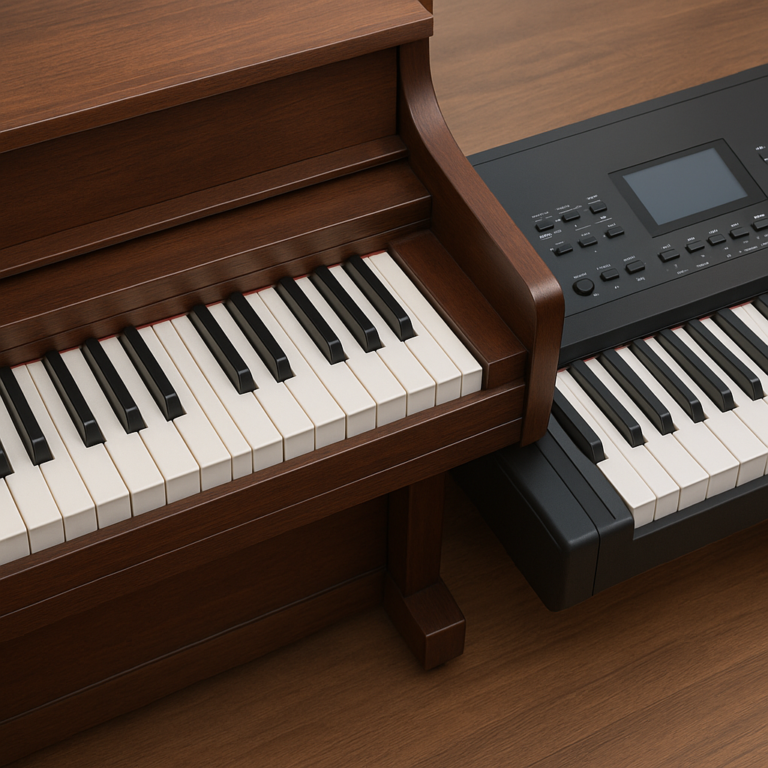
The comparison of acoustic and digital piano sound quality comes down to what you want to hear and how you plan to play: acoustic pianos offer living string resonance, while digital pianos deliver consistent sound, volume control, and headphone convenience. Neither always sounds better—an instrument’s quality, condition, speakers, and room can tip the scales.
We’ve watched players enter a showroom convinced they need an acoustic piano, then fall for a digital’s expressive tone and easy headphone practice. Others hear a sustained chord bloom from an acoustic soundboard and know instantly that’s the sound they’ve been chasing.
The trick is to compare more than one impressive note. Listen for touch response, tone, sustain, resonance, and sound at your normal playing volume—then choose the piano that makes you want to keep playing.
Key Takeaways
- Acoustic pianos create sound physically through hammers, strings, and soundboards, producing natural resonance and note interaction.
- Digital pianos generate or reproduce piano sound electronically, with quality shaped by the sound engine, keyboard response, speakers, and headphones.
- The best sound is personal: compare soft and loud playing, sustained chords, and the full keyboard at matched volume.
- Condition matters. A well-maintained acoustic may sound wonderful; a neglected one may lose to a capable digital piano.
- Choose for your listening conditions: digital pianos suit quiet practice and recording, while acoustic pianos offer a distinctive room-filling playing experience.
Table of Contents
- ⚡️ Quick Tips and Facts: Acoustic vs. Digital Piano Sound Quality
- 🎹 How Acoustic and Digital Pianos Create Sound
- Strings, Hammers, and Soundboards: The Acoustic Piano Mechanism
- Samples, Modeling, and Speakers: The Digital Piano Mechanism
- Why the Same Notes Sound Different
- 📜 From Concert Halls to Headphones: A Brief History of Piano Sound
- 🔍 What Piano Sound Quality Really Means
- Tone, Timbre, and Harmonic Richness
- Dynamics, Touch, and Expression
- Resonance, Sustain, and Decay
- Polyphony, Pedals, and Note Interaction
- Room Acoustics and Speaker Placement
- 🎼 Acoustic vs. Digital Piano Sound Quality: Side-by-Side Comparison
- Sound and Tone
- Dynamic Range and Playing Feel
- Consistency, Tuning, and Reliability
- Volume Control and Headphone Listening
- Sound in a Room, Studio, or on Stage
- ✨ Can a Digital Piano Sound Like an Acoustic Piano?
- Sampling vs. Physical Modeling
- What Premium Digital Pianos Reproduce Well
- Where Acoustic Pianos Still Sound Different
- 🎧 Speakers, Headphones, and Amplification: Getting the Best Digital Piano Sound
- Built-In Speakers vs. External Speakers
- Headphone Sound Quality and Spatial Effects
- Recording and Connecting to Audio Equipment
- 🛠️ How Piano Construction Shapes Sound Quality
- Acoustic Piano Materials and Craftsmanship
- Digital Piano Keyboards, Sensors, and Sound Engines
- Upright vs. Grand Acoustic Piano Sound
- Portable vs. Console Digital Piano Sound
- 🎹 Piano Brands and Models: Sound Characteristics to Know
- Acoustic Piano Brands: Yamaha, Steinway & Sons, Kawai, and More
- Digital Piano Brands: Yamaha, Roland, Kawai, Casio, and More
- How to Compare Piano Sounds in a Showroom
- 🧭 Choosing an Instrument for Your Sound and Playing Needs
- Best Piano Sound for Beginners and Returning Players
- Best Choice for Classical, Jazz, Pop, and Composition
- Home Practice, Apartments, and Shared Spaces
- Stage Performance, Recording, and Music Production
- Acoustic, Digital, or Hybrid Piano: A Decision Guide
- 🧰 Piano Care and Maintenance for Consistent Sound
- Acoustic Piano Tuning and Environmental Care
- Digital Piano Cleaning, Connections, and Updates
- Common Sound Problems and How to Troubleshoot Them
- 💡 Quick Tips for Comparing Piano Sound Quality
- 🎵 Piano Sound Facts and Listening Trivia
- ✅ Conclusion
- 🔗 Recommended Links
- ❓ FAQ
- 📚 Reference Links
⚡️ Quick Tips and Facts: Acoustic vs. Digital Piano Sound Quality
If you’re comparing acoustic and digital piano brands, start by asking where, how, and at what volume you want to play. The best-sounding piano is the one that suits your ears and your real-life listening conditions—not necessarily the one with the most impressive showroom presence.
| Sound-quality question | Acoustic piano | Digital piano |
|---|---|---|
| How is the sound made? | Hammers strike strings, and the soundboard and body resonate | A sound engine generates piano tones, played through speakers or headphones |
| What does it sound like? | Naturally resonant, with rich harmonics and subtle changes from note to note | Highly variable by model; quality instruments can sound remarkably lifelike |
| How does touch affect tone? | Playing strength can affect loudness and timbre | Depends on the keyboard, sensors, sound engine, and settings |
| Can you play quietly? | Not without a practice system or special mute mechanism | Yes: lower the volume or use headphones |
| Does it need tuning? | Yes, periodically; condition and climate affect tuning stability | No acoustic tuning |
| Can you try other instrument sounds? | Normally no | Often yes, including electric piano, organ, strings, and more |
Fast listening tips:
- ✅ Compare instruments at the same listening volume. Louder often sounds more impressive, even when it isn’t more accurate.
- ✅ Play soft notes, loud notes, repeated notes, and sustained chords. A piano’s personality appears in the transitions.
- ✅ On a digital piano, listen through its built-in speakers and good headphones. These can sound quite different.
- ✅ On an acoustic piano, check its condition and recent maintenance. A neglected acoustic can sound worse than a well-designed digital.
- ❌ Don’t assume every acoustic piano sounds better than every digital one. A healthy, well-voiced acoustic and an old, worn instrument are two very different comparisons.
Yamaha describes the acoustic instrument’s string resonance as producing a “spontaneous and rich musical quality,” while noting that digital pianos can reproduce piano sound “very close” to the acoustic original (Yamaha’s piano selection guide). Both claims can be true: acoustics generate sound through a physical system; digitals reproduce and shape it electronically.
🎹 How Acoustic and Digital Pianos Create Sound
Strings, Hammers, and Soundboards: The Acoustic Piano Mechanism
Press an acoustic piano key and a chain of mechanical parts moves a felt-covered hammer toward a string. The hammer strikes and immediately moves away, allowing the string to vibrate. A bridge transfers that vibration to the soundboard, which moves air and projects the sound into the room.
The sound you hear is therefore not just “a string ringing.” It is the result of several interacting parts:
- The hammer shapes the attack and contributes tone.
- The strings vibrate in complex patterns, producing a fundamental pitch and overtones.
- The soundboard amplifies and colors those vibrations.
- The piano’s cabinet and room affect how the sound reaches your ears.
- The pedals change how strings ring, damp, or respond.
A piano note also includes a transient: the small burst of sound at the very beginning of a note. That attack helps you hear whether a piano feels clear, mellow, bright, or slightly percussive. Then comes the sustaining tone and, finally, the decay.
Yamaha notes that an acoustic piano’s strings can resonate even when they are not directly struck. This sympathetic vibration contributes to a sense of depth and interaction between notes (Yamaha: Piano sound and selection). You can hear this most clearly when playing a chord with the sustain pedal: the notes mingle, and the instrument seems to answer back.
Our musicians’ showroom test: Play a soft chord, release the keys while holding the sustain pedal, and listen to what remains. On an acoustic, the lingering sound can reveal the instrument’s resonance, room, and condition all at once.
Samples, Modeling, and Speakers: The Digital Piano Mechanism
A digital piano detects key movement with sensors. Its sound engine then creates or selects a tone and sends it to built-in speakers, external speakers, or headphones.
Two broad sound-generation approaches are common:
| Method | How it works | What to listen for |
|---|---|---|
| Sampling | Plays recordings of acoustic piano notes, often captured at different pitches and playing strengths | Smooth changes between soft and loud notes; natural attacks and decays |
| Physical modeling | Uses calculations to simulate how a piano responds, including interactions among strings, hammers, and other components | Natural variation, responsive note behavior, and convincing resonance |
| Hybrid approaches | Combine recorded samples, modeling, and effects | A convincing core piano tone with adjustable space and character |
Many digital instruments also use multiple samples or layers so that a softly played note doesn’t merely sound like a quieter version of a loud note. The sound engine can select or blend different recordings according to how firmly you play. The keyboard’s sensors help determine that playing strength and, on some instruments, how quickly you repeat a note.
The speaker system matters just as much as the sound engine. A beautifully detailed piano tone can sound thin through small speakers placed poorly in a room. The same instrument may sound more spacious through quality headphones or external monitors.
Manufacturers including Yamaha, Roland, and Kawai offer digital piano families with different keyboard actions, sound engines, speaker arrangements, and sound options. A brand name alone does not tell you how a particular model will sound in your room.
Why the Same Notes Sound Different
Play the same melody on two pianos, and the notes may have identical names but different personalities. That’s because sound quality depends on more than pitch:
- Tone generation: A real string system behaves differently from a sample or a mathematical model.
- Keyboard response: Key weight, movement, sensors, and repetition affect how reliably the instrument responds.
- Dynamic range: Instruments differ in how many distinct tone and volume changes they produce between soft and loud playing.
- Resonance and sustain: Pedals, sympathetic vibration, soundboard behavior, and digital simulation all shape lingering notes.
- Playback system: Speakers, headphones, amplification, and room acoustics influence the final sound.
- Condition and setup: Acoustic maintenance and digital settings can dramatically affect what you hear.
This explains an apparent disagreement in piano advice. Yamaha highlights how touch and string resonance give acoustic pianos rich, changing timbre; Loudlands Music likewise describes an acoustic piano’s sound as “rich” and “resonant.” M. Steinert & Sons, by contrast, emphasizes that some modern digital pianos can sound more appealing than an old or poorly maintained acoustic. These are not contradictory conclusions: one describes the instruments’ potential, while the other reminds us that condition affects the actual comparison.
📜 From Concert Halls to Headphones: A Brief History of Piano Sound

The acoustic piano developed from earlier keyboard instruments and became prized for letting players shape notes from quiet to loud by changing their touch. That expressive control is part of why the piano became a central instrument for solo performance, teaching, and composition. Read more in our Piano History collection.
Digital pianos emerged from a different goal: make piano playing more adaptable. Electronic keyboard instruments first explored ways to create piano-like sounds without relying on strings and soundboards. As sampling, sensors, processors, and speaker systems improved, digital pianos gained more convincing piano tones, expressive keyboard actions, headphone outputs, and recording features.
The change is not simply “old sound versus new sound.” It is one instrument whose sound is physically produced in the moment, and another whose sound is electronically generated or reproduced in response to your playing. Modern digital pianos may model interactions among piano components, while acoustic pianos themselves vary by design, age, condition, and room.
🔍 What Piano Sound Quality Really Means
“Sound quality” can mean warm tone to one pianist, clear articulation to another, and convincing headphone sound to someone practicing in an apartment. We recommend listening for several dimensions instead of declaring one piano “best” after a single loud chord.
Tone, Timbre, and Harmonic Richness
Pitch tells you which note is played. Timbre is the character that helps you distinguish one sound from another—even when the pitch is the same.
When pianists describe a sound as bright, dark, warm, clear, mellow, or woody, they are usually describing aspects of timbre. Those words are useful, but personal. One player’s “brilliant” may be another’s “too sharp.”
An acoustic piano’s timbre comes from the combined behavior of the hammer, strings, soundboard, and instrument body. On a digital piano, timbre depends on the recorded or modeled sound, how the instrument responds touch, and how its speakers or headphones reproduce that sound.
Listening test: Play the same note at three different strengths. Does the sound merely get louder, or does its color change too? That shift in tone is a major part of expressive piano playing.
Dynamics, Touch, and Expression
An expressive piano should respond predictably across a wide range of playing strengths. Play softly, then gradually increase your touch. A well-matched acoustic or digital piano should make that change feel controlled rather than like a light switch.
On an acoustic piano, the hammer’s speed and the string’s response influence both volume and tone. On a digital piano, the keyboard action and sensors send playing information to the sound engine, which must translate it into a convincing change in tone and volume.
The results vary by model. A digital piano can offer a detailed dynamic response, but a basic keyboard with limited sensing or a narrow range of sounds may feel less expressive. An acoustic piano also isn’t automatically expressive if its action is poorly regulated or worn.
Yamaha’s guide describes acoustic tone as changing from “mellow to brilliant” with touch, and explains how digital instruments use recorded sounds and technology to approach that response. When testing, listen to the gradual transition—not only the quietest and loudest notes.
Resonance, Sustain, and Decay
A piano note does not stop the instant your finger leaves the key. Its sound decays over time, and the sustain pedal can let notes continue ringing. Acoustic strings may also vibrate in sympathy with other notes, adding layers of resonance.
Digital pianos can reproduce sustain and resonance through their sound engines. Better implementations may respond to pedal position and simulate how notes interact. The realism varies, so test a sustained chord rather than judging resonance from a single note.
| Listening feature | What to try | What it can reveal |
|---|---|---|
| Sustain | Hold a note, then release the key without pedal | How naturally the note fades |
| Pedal response | Play a chord and press the sustain pedal gradually | Whether sustain changes smoothly and expressively |
| Resonance | Sustain a chord and listen for the blended sound | How convincing the instrument’s harmonic space feels |
| Decay | Play a bass note and listen until it fades | Whether the low notes feel full or disappear too quickly |
Room acoustics complicate the test. A bright, reflective room can make almost any piano sound more lively, while a heavily furnished room may absorb some of its high-frequency energy. If two pianos are in different rooms, you may be comparing the rooms as much as the instruments.
Polyphony, Pedals, and Note Interaction
Polyphony is the number of notes a digital piano can produce at once. When you play with sustain, previously played notes may continue sounding while new ones begin. The sound engine also needs to account for layers, effects, and sometimes other instrument voices.
Polyphony figures can be helpful, but they do not tell the whole story. How the instrument manages sustained notes—and whether it handles note release and pedal behavior convincingly—maters too. Acoustic pianos do not have a digital polyphony limit, although their strings and dampers still shape how notes overlap.
Test a digital piano by playing a full chord with sustain, then add bass notes and a melody. Listen for notes cutting off unexpectedly or the sound becoming unnatural. Try soft, repeated notes as well: responsive repetition can make fast passages feel more connected.
Room Acoustics and Speaker Placement
A piano’s sound is not heard in isolation. It travels through a room, reflects off surfaces, and reaches your ears from a particular position.
For a digital piano:
- Keep the speakers unobstructed.
- Listen from your normal playing position, not only while standing over the control panel.
- Try headphones as a second reference.
- If using external speakers, avoid placing them where a wall or corner exaggerates the bass.
For an acoustic piano:
- Listen from the bench and from across the room.
- Consider where the piano will sit and how the room’s surfaces affect projection.
- Ask a technician or piano retailer whether placement and room conditions may be influencing the tone.
This is why a piano that sounds impressive in a showroom can feel different at home. A convincing sound test must include the room where you’ll actually play—or at least a realistic listening setup.
🎼 Acoustic vs. Digital Piano Sound Quality: Side-by-Side Comparison
| Feature | Acoustic piano | Digital piano | What matters most |
|---|---|---|---|
| Sound source | Vibrating strings and soundboard | Electronic sound engine and playback system | Whether you prefer physical resonance or controlled reproduction |
| Tone variation | Naturally varies with touch, instrument condition, and room | Depends on the model’s sound engine, action, and settings | Try soft-to-loud playing |
| Note interaction | Strings may resonate sympathetically | Sound engine may sample or model resonance | Listen with sustain pedal |
| Volume | Naturally projected; difficult to make truly quiet | Adjustable; headphones commonly available | Consider neighbors and practice times |
| Sound consistency | Changes with tuning, regulation, age, and environment | Usually consistent, though speakers and settings affect playback | Check acoustic maintenance; test digital speakers |
| Voice options | Primarily piano | Often includes multiple piano types and other instruments | Useful for composing and music production |
| Setup and upkeep | Requires physical space and periodic care | Requires power; usually no tuning | Consider long-term care and portability |
| Sound in headphones | Not normally a standard acoustic feature | Often a core feature | Test the actual headphones you plan to use |
Our balanced verdict: For organic sound projection and the way strings interact with the instrument and room, a good acoustic piano has a special quality. For control, quiet practice, and repeatable sound, a good digital piano can be the more satisfying instrument day to day.
Sound and Tone
Acoustic piano tone changes with the instrument’s design, tuning, voicing, room, and condition. A grand piano, upright, and compact digital piano can each have distinct tonal personalities. Even two acoustic pianos of the same model can differ in feel and sound.
Digital tone is more predictable, which is a benefit for recording, practice, and playing through headphones. But predictability does not mean every digital sounds alike: sample quality, modeling, tone settings, and speakers all shape the result.
Loudlands Music favors the “rich, resonant sound of an acoustic piano,” while Yamaha says digital pianos can reproduce piano sound “very close” to acoustic instruments. We’d put those perspectives together this way: digital sound can be convincing and practical, but the acoustic instrument’s physical resonance is not simply a speaker effect.
Dynamic Range and Playing Feel
Dynamic range describes the span between the quietest and loudest playable sound. More useful than a number is the way the piano responds as you move through that range.
Test with a short passage that includes:
- A whisper-soft note.
- A gradual crescendo.
- Firm chords.
- Repeated notes.
- A melody played over a softer accompaniment.
On acoustic pianos, the action and instrument setup affect how well the piano translates touch into tone. On digital models, keyboard action, sensor design, and sound-engine programming work together. A weighted keyboard alone does not guarantee an expressive response.
Consistency, Tuning, and Reliability
Digital pianos generally produce a consistent tone without acoustic tuning. That is a practical advantage for players who need a dependable sound every day or move between practice spaces.
Acoustic pianos can drift out of tune and may need adjustments to their action and other mechanical parts. Their sound and response depend on upkeep and environmental conditions. Yamaha describes the acoustic action as containing around 5,500 precision parts—a useful reminder of how many components contribute to the playing experience (Yamaha piano guide).
Consistency is not the same as quality, though. A digital’s speakers or electronics can have problems, and an acoustic piano that is properly maintained can remain a dependable instrument for decades. M. Steinert & Sons notes that an older, poorly maintained acoustic may not be the better-sounding option compared with a modern digital (M. Steinert & Sons).
Volume Control and Headphone Listening
If you practice when other people are sleeping, volume control can matter more than the last few percent of tonal realism. Digital pianos commonly let you reduce speaker volume or listen through headphones. Some acoustic pianos can be fitted with silent systems, but that is a separate feature and not standard on every instrument.
Headphones also change the listening experience. They remove much of the room’s natural sound and place the piano tone directly at your ears. Some digital pianos offer spatial or room effects to make headphone playing feel less “inside your head.”
Before buying, try:
- The built-in speakers at low and moderate volume.
- Headphones you find comfortable.
- A sustained passage with pedals.
- Soft playing, because quiet notes can expose harshness or poor balance.
Sound in a Room, Studio, or on Stage
An acoustic piano produces sound directly into its environment. That can be rewarding in a living room or performance space, but it also means the room and surrounding noise matter.
Digital pianos make it easier to route sound through headphones, recording equipment, and amplification. That flexibility is useful on stage and in a home studio. A direct audio output also avoids placing a microphone in front of the piano, though microphone recording remains an option for an acoustic instrument.
For recording, consider the sound source and the destination:
- Acoustic recording: Microphones capture the piano and room together.
- Digital direct recording: Audio can be sent directly to recording equipment.
- Headphone practice: Useful for quiet playing, but not a substitute for hearing how the speakers fill a room.
- Live performance: External amplification may be needed for a digital piano in a band or larger venue.
✨ Can a Digital Piano Sound Like an Acoustic Piano?
Sometimes, impressively so—especially in a mix or through good headphones. A high-quality digital piano can reproduce a recognizable grand-piano sound and respond sensitively touch. But “sounds like an acoustic piano” is not one simple test: tone, attack, sustain, resonance, pedals, speakers, and playing feel all contribute.
M. Steinert & Sons describes digital instruments as simulations rather than exact replacements for an acoustic piano, while also noting the progress in digital sound and touch. Yamaha’s description of digital sound as “very close” reflects that progress. The gap depends on which acoustic piano, which digital piano, how they are played, and how they are heard.
Sampling vs. Physical Modeling
Sampling captures notes from acoustic pianos and uses those recordings as a source for digital sound. Physical modeling calculates how sound may respond to a keystroke. Some instruments combine approaches.
There is no universal winner. Sampling can deliver a detailed recording of a particular piano; modeling can simulate changing interactions as you play. Your ears are the final judge, so listen for:
- Smooth changes from soft to loud.
- Natural note attacks and decays.
- Realistic sustained chords.
- Convincing response to half-pedaling, if available.
- A tone that stays musical across the keyboard.
What Premium Digital Pianos Reproduce Well
Well-designed digital pianos can offer:
- Several piano tones and tonal adjustments.
- Responsive key actions and touch settings.
- Layered sounds that change with playing strength.
- Sustain and resonance effects.
- Convenient headphone practice.
- Consistent sound for repeated performances and recording.
The sound can be excellent without being a literal acoustic piano in a box. A digital’s strengths include its ability to adapt: you can choose a brighter or warmer tone, change volume, and in many models select other instrument voices.
Where Acoustic Pianos Still Sound Different
An acoustic piano creates sound through strings and a soundboard that interact continuously. That physical behavior shapes how the sound develops in the room and how notes blend. Digital instruments can reproduce or model aspects of this behavior, but the listening experience depends on the technology and speakers.
That difference is easiest to notice when you:
- Play a broad chord and listen to the resonance in the room.
- Move gradually from soft to loud.
- Use the sustain pedal while changing harmonies.
- Listen away from the instrument, not only close to its speakers.
M. Steinert & Sons compares a digital piano to a virtual tour of Italy and says “there is nothing to compare to actually visiting there.” It’s a colorful analogy—and one that describes the preference of players who want the physical acoustic experience. But a well-maintained acoustic is not always practical, and a digital may better serve the player who needs quiet practice, compact space, or direct recording.
🎧 Speakers, Headphones, and Amplification: Getting the Best Digital Piano Sound
Built-In Speakers vs. External Speakers
Built-in speakers keep a digital piano simple and ready to play. Their performance varies by instrument design, speaker size, placement, and how sound is directed toward the player.
External speakers can provide more output and a different sense of space, especially on stage or in a studio. But they add another variable: a great piano signal can sound poor through badly placed or mismatched speakers.
Try before adding gear: First test the piano’s own speakers at your normal playing volume. If they sound balanced and fill your room comfortably, you may not need external amplification.
Headphone Sound Quality and Spatial Effects
Headphones are one of the strongest practical reasons to choose a digital piano. They let you play without filling the room with sound, and they can reveal detail that built-in speakers don’t make obvious.
A useful test is to play with headphones for several minutes, not just a few notes. Check:
- Whether the piano sounds natural or overly close.
- Whether bass notes remain clear.
- Whether the tone becomes fatiguing.
- Whether pedal effects remain convincing.
- Whether the headphones are comfortable for your intended practice time.
Spatial effects can make headphones feel more like listening to a piano in a room. These features are a matter of taste, so compare them both on and off.
Recording and Connecting to Audio Equipment
Digital pianos often offer audio outputs, USB connections, or recording options. The exact features vary by model. Check the manufacturer’s specifications for the connections you need rather than assuming every digital piano supports the same setup.
A digital connection can be convenient for recording a clean piano signal. An acoustic piano can be recorded with microphones, which capture the instrument’s sound interacting with the room. The right option depends on whether you want easy setup, room character, editing flexibility, or a particular recording style.
🛠️ How Piano Construction Shapes Sound Quality
Acoustic Piano Materials and Craftsmanship
The piano’s action, hammers, strings, soundboard, and cabinet all contribute to sound and response. The quality of materials and construction matters, but maintenance and setup matter too. A piano can be carefully built yet sound disappointing if it is out of tune or needs mechanical adjustment.
Ask a seller or technician about:
- Tuning and service history.
- The condition of hammers, strings, and action.
- Whether the instrument has been regulated or voiced.
- Any signs of damage or environmental stress.
- How the piano sounds and feels across the full keyboard.
If you’re shopping used, consider having an independent piano technician inspect the instrument. A beautiful cabinet is not a sound-quality report.
Digital Piano Keyboards, Sensors, and Sound Engines
Digital sound quality depends on more than the sound library. The keyboard’s action and sensors determine how the instrument reads your playing, while the sound engine turns that information into notes.
When comparing digital pianos, test:
- Key response: Does the keyboard feel controlled at soft and loud dynamics?
- Repeated notes: Can you play a note quickly more than once?
- Dynamic changes: Does the tone respond smoothly?
- Pedal behavior: Does sustain feel natural for your playing?
- Speakers: Is the sound clear at the volume you’ll use?
- Headphone output: Does it remain detailed and comfortable?
For brand-specific information, visit the official digital piano pages from Yamaha, Roland, Kawai, and Casio.
Upright vs. Grand Acoustic Piano Sound
A grand and an upright differ in construction, size, action layout, and sound projection. But “grand” does not automatically mean “better for you.” Room size, instrument condition, setup, and personal taste all matter.
A grand piano may offer a distinctive sense of projection and playing response, while an upright can be an excellent acoustic choice where floor space is limited. Compare actual instruments rather than relying on type alone. A well-kept upright may suit your room and preferences better than a grand that overwhelms the space.
Portable vs. Console Digital Piano Sound
Portable digital pianos prioritize transport and flexibility. Console-style models often present a more furniture-like appearance and may incorporate a different speaker setup. Neither category guarantees better tone.
Look at the complete package:
| Consideration | Portable digital piano | Console digital piano |
|---|---|---|
| Placement | Easy to move or store | Designed for a more permanent setup |
| Speakers | May need an appropriate stand and room placement | Built-in system may be integrated into the cabinet |
| Performance setup | Often suited to stages, studios, and shared use | Often suited to a home practice space |
| Sound test | Check speaker position and stability | Listen from the bench and across the room |
🎹 Piano Brands and Models: Sound Characteristics to Know
Acoustic Piano Brands: Yamaha, Steinway & Sons, Kawai, and More
Steinway & Sons, Yamaha, and Kawai are well-known piano makers, but brand reputation cannot substitute for listening. Models within the same brand can differ, and each individual acoustic piano has its own history and current condition.
Compare instruments by:
- The tone you prefer.
- How evenly the keyboard responds.
- The condition and service record.
- How the piano sounds in your room.
- Whether its size and projection suit your space.
We’ve seen buyers arrive certain they want one famous brand, play several instruments, and leave surprised by a different piano. That’s not indecision; it’s your ears doing their job. Explore our Piano Brand Guides for more brand-focused comparisons.
Digital Piano Brands: Yamaha, Roland, Kawai, Casio, and More
Digital piano lines from Yamaha, Roland, Kawai, and Casio differ in sound character, keyboard feel, speaker design, and features.
Roland, for example, describes sound generation and instrument features on its official piano pages. Yamaha offers digital piano families alongside acoustic instruments, while Kawai and Casio also provide a range of digital models. Do not shop by the name on the lid alone: audition the exact model and sound setting you’re considering.
How to Compare Piano Sounds in a Showroom
Use this step-by-step test to compare instruments fairly:
- Choose one short piece you know well. Familiar music helps you notice the instrument instead of worrying about what to play.
- Start quietly. Soft notes reveal whether the action and sound remain controlled.
- Repeat the passage at a louder dynamic. Listen for a smooth tonal change, not just extra volume.
- Play bass, middle, and treble notes. Check whether the sound feels balanced across the keyboard.
- Try chords with sustain. Listen to note interaction and decay.
- Play repeated notes and a short fast passage. This tests responsiveness.
- Compare digital speakers and headphones. The piano can sound different through each.
- Ask to play at the same volume. Loudness can bias your impression.
- Check acoustic condition. Ask when the piano was last tuned and serviced.
- Take notes and come back. A five-minute test is useful; a second visit can prevent an expensive case of “showroom sparkle.”
For more comparison advice, see our Piano Comparison and Piano Buying Guide.
🧭 Choosing an Instrument for Your Sound and Playing Needs
The right choice depends on your preferred sound, playing habits, room, and ability to maintain the instrument. The first video in this article presents both sides: some musicians favor the acoustic’s complex harmonics and tactile response, while others prefer digital convenience, quiet practice, and flexibility. See the video at #featured-video.
That video’s useful point is that neither category wins for every player. We’d add one practical test: choose the instrument that sounds inspiring at the volume and in the space where you will actually use it.
Best Piano Sound for Beginners and Returning Players
A beginner needs an instrument that encourages regular practice and responds well enough to build control. A digital piano can be a sensible fit if headphone practice, compact size, and consistent sound make it easier to play often.
An acoustic piano may be a better match if you want the experience of strings, soundboard resonance, and direct response—and have space for the instrument and its care. Returning players should pay special attention touch and tone: the instrument that makes you want to play again is often the one you’ll practice on most.
Best Choice for Classical, Jazz, Pop, and Composition
- Classical music: Compare touch, sustained chords, soft control, and response across the keyboard. Both acoustic and quality digital instruments can work, but your preference may depend on how closely you want to experience acoustic action and resonance.
- Jazz: Listen for articulation, dynamic nuance, and how the piano sound sits with other instruments. Digital pianos offer extra sounds and convenient amplification; acoustic instruments bring a distinctive room-filling piano tone.
- Pop and band performance: A digital piano’s outputs, portability, and selectable sounds can be useful on stage. Acoustic pianos can be compelling in the right venue, but are less flexible to move and amplify.
- Composition and production: Digital recording and instrument options can make songwriting more direct. An acoustic piano may inspire a different performance feel, especially when recording its sound in a room.
Home Practice, Apartments, and Shared Spaces
A digital piano is often the practical choice for apartments, shared homes, and late-night practice because volume can be reduced and headphones are available. Remember, headphones do not eliminate every sound: key movement can still be audible in a quiet room.
An acoustic piano can work beautifully at home if the instrument fits the room and your household. Some acoustic models can be paired with silent systems, but check what the specific instrument supports.
Stage Performance, Recording, and Music Production
For regular stage use, digital pianos offer portability, audio connections, and quick access to different sounds. Check the model’s outputs, controls, keyboard feel, and speaker or amplification needs.
For studio work, a digital piano can provide a direct recording signal, while an acoustic piano can be captured with microphones. Neither route is inherently superior: one favors convenience and repeatability; the other captures the instrument and the room together.
Acoustic, Digital, or Hybrid Piano: A Decision Guide
| Your priority | Strong option to audition | Why |
|---|---|---|
| Organic string resonance | Acoustic piano | Sound is created by vibrating strings and the instrument’s soundboard |
| Quiet practice | Digital piano | Volume control and headphones are typically built in |
| Easy recording and sound changes | Digital piano | Electronic connections and multiple voices may be available |
| Traditional piano interaction | Acoustic piano | Physical action and strings respond in real time |
| Compact space or mobility | Portable digital piano | Usually easier to move and position |
| Long-term home centerpiece | Acoustic or console digital | Choose based on sound, space, maintenance, and use |
| Flexible performance setup | Digital piano | Multiple sounds and audio routing can support varied settings |
A hybrid piano may combine an acoustic-style action or strings with digital sound features. Availability and design differ by model, so inspect the manufacturer’s specifications and test it in person.
🧰 Piano Care and Maintenance for Consistent Sound
Acoustic Piano Tuning and Environmental Care
Acoustic pianos require periodic tuning and may need additional mechanical maintenance. How often depends on the instrument, its use, environment, and tuning stability. Ask a qualified piano technician for a schedule based on the specific piano rather than relying on a one-size-fits-all rule.
To help maintain sound quality:
- Avoid placing the piano in direct sunlight or next to strong heat sources.
- Keep the instrument away from damp areas and abrupt environmental changes.
- Schedule professional tuning and inspections.
- Ask a technician about action regulation and voicing if response or tone becomes uneven.
- Avoid attempting internal repairs without appropriate expertise.
A piano that is out of tune can still have a lovely tone, but it may sound less harmonious with other instruments and become less satisfying to practice on. For maintenance advice, consult a qualified technician or your piano’s manufacturer.
Digital Piano Cleaning, Connections, and Updates
Digital pianos do not need acoustic tuning, but basic care protects their controls and connections:
- Follow the manufacturer’s cleaning instructions.
- Keep liquids away from keys, speakers, and connections.
- Use appropriate power and audio cables.
- Check the manual before installing updates or changing system settings.
- Store portable models safely during transport.
If sound becomes distorted or a key behaves inconsistently, test the instrument’s volume, settings, headphones, cables, and power supply before assuming the sound engine has failed.
Common Sound Problems and How to Troubleshoot Them
| Problem | First checks |
|---|---|
| Digital piano sounds distorted | Lower the volume, check speaker placement, test headphones, and inspect cables |
| Headphones sound too close or harsh | Try another headphone set and adjust spatial or room effects |
| Acoustic piano sounds out of tune | Contact a piano technician for assessment and tuning |
| Some keys sound uneven | Test the full keyboard and ask a technician to inspect an acoustic action or the digital instrument’s settings |
| Sustain seems unnatural | Check pedal connections, settings, and pedal support for that model |
| Piano sounds different at home | Consider room acoustics, placement, listening position, and volume |
A final listening tip: When the piano sounds wrong, check the setup before blaming the instrument. A misplaced speaker, unfamiliar headphone sound, or out-of-tune acoustic can change your impression dramatically.
💡 Quick Tips for Comparing Piano Sound Quality
- Use the same musical passage on every instrument.
- Match listening volume as closely as possible.
- Test soft playing before loud playing.
- Listen across the full keyboard, not just the middle octave.
- Use the sustain pedal to assess resonance and note interaction.
- For a digital piano, test speakers and headphones separately.
- For an acoustic piano, ask about tuning, service, and condition.
- Trust your ears, but give them time. A first impression is useful; a second listen is wiser.
- Consider where you’ll play. A piano that sounds wonderful in a shop may behave differently in a small room.
- Choose inspiration alongside specifications. The best tone is one you want to return to.
🎵 Piano Sound Facts and Listening Trivia
- An acoustic piano note can set other strings vibrating sympathetically. This helps create the blended resonance pianists hear when using the sustain pedal, as described in Yamaha’s piano guide.
- Touch changes more than volume on an acoustic piano. The relationship between the hammer and strings helps shape the note’s character.
- Digital piano sound is a complete system. The keyboard, sensors, sound engine, speakers, effects, and room all contribute.
- Headphones can make a digital piano feel more detailed—but different. They remove much of the room’s acoustic contribution and change how sound reaches your ears.
- A well-maintained acoustic can outlast many digital instruments, but condition matters. The actual sound of a particular piano is more useful than a general claim about the category.
- A digital piano’s consistency is a feature, not a flaw. For practice and recording, a repeatable tone can be exactly what you want.
- The loudest piano does not automatically sound the best. That’s why we recommend matching levels before you compare.