Support our educational content for free when you buy through links on our site. Learn more
🎹 Acoustic vs. Digital Piano Costs: What’s Worth Paying For?

Digital pianos usually cost less to buy and maintain, while acoustic pianos can demand more upfront and ongoing care. How do the prices of acoustic and digital pianos compare, and what can I expect to pay for a high-quality instrument? The answer depends on the piano’s condition, action, sound, features, delivery, and how you plan to use it—not just the name on the fallboard.
We’ve seen buyers fall for a handsome used upright, then discover that moving and repairs change the maths. We’ve also watched a player choose a digital piano for one unglamorous but brilliant reason: headphones meant practice could happen after everyone else went to bed. The best value is the instrument you’ll enjoy playing and can comfortably own.
Key Takeaways
- Digital pianos generally cost less to maintain because they don’t need routine tuning, and headphone practice can be a major advantage.
- Acoustic piano costs vary widely with size, condition, brand, preparation, delivery, and ongoing care.
- High quality is about performance, not prestige: test the action, tone, pedals, speakers, and overall condition.
- Used acoustic pianos can be excellent value, but get an independent technician’s inspection before buying.
- Compare total ownership costs, including delivery, accessories, maintenance, warranty, and service—not just the purchase price.
Table of Contents
- ⚡️ Quick Tips and Facts: Acoustic vs. Digital Piano Costs
- 🎹 Piano Price Landscape: What Drives the Cost?
- How acoustic and digital piano prices compare at a glance
- What “high-quality” means for each piano type
- 📜 From Concert Halls to Living Rooms: How Piano Design Shapes Price
- Why acoustic pianos cost more to build and maintain
- How digital piano technology changed the market
- 🎼 Acoustic Piano Costs: Uprights, Grands, and Used Instruments
- Upright piano price factors: size, action, materials, and brand
- Grand piano costs: baby grands through concert grands
- New vs. used acoustic pianos: value, condition, and risk
- Acoustic piano brands and what their reputations mean for buyers
- 🎧 Digital Piano Costs: Portable Keyboards, Consoles, and Stage Models
- Portable digital pianos: essential features and price differences
- Console digital pianos: cabinet design and home features
- Stage pianos: performance features and professional needs
- Digital piano brands and features worth paying for
- 🔍 What Makes a Piano High Quality? Features That Affect Price
- Keyboard action, key materials, and graded hammer mechanisms
- Sound quality: acoustic scale design, sampling, and modeling
- Pedals, speakers, polyphony, connectivity, and other useful features
- Build quality, cabinet finish, warranty, and expected lifespan
- 📊 Acoustic vs. Digital Piano: Full Cost Comparison
- Purchase cost versus total cost of ownership
- Tuning, repairs, electricity, headphones, and ongoing upkeep
- Delivery, stairs, setup, and installation expenses
- Space, volume control, and apartment-friendly value
- Resale value, depreciation, and long-term ownership
- 🛠️ Piano Ownership Costs: Maintenance, Repairs, and Care
- How often acoustic pianos need tuning
- Common acoustic piano repairs and inspection warning signs
- Digital piano warranties, repairs, and software support
- Climate, placement, and care tips that protect your investment
- 💡 How to Choose the Right Piano for Your Budget and Playing Goals
- Best-value piano features for beginners and returning players
- When an acoustic piano is worth the extra cost
- When a digital piano offers better value
- When a hybrid piano makes financial and musical sense
- Budgeting for piano lessons, accessories, and future upgrades
- 🧾 Smart Piano Shopping: How to Compare Models and Avoid Costly Mistakes
- Questions to ask piano dealers and private sellers
- How to test a piano’s action, tone, pedals, and condition
- Buying online, buying locally, and checking return policies
- Financing, trade-ins, rentals, and other ways to manage the cost
- ❓ Piano Price FAQs: Acoustic, Digital, and Hybrid Pianos
- Why do acoustic pianos usually cost more than digital pianos?
- How much should I budget for a high-quality piano?
- Can an affordable digital piano feel like an acoustic piano?
- Is a used acoustic piano a good deal?
- Are expensive digital pianos worth the upgrade?
- Which piano costs less over time?
- Does a piano’s brand affect its resale value?
- 🎯 Choosing a Piano That’s Worth Every Note
- Conclusion
- Recommended Links
- Reference Links
⚡️ Quick Tips and Facts: Acoustic vs. Digital Piano Costs
- Digital pianos generally cost less to buy and own than acoustic pianos of comparable quality, especially once tuning, moving, and upkeep are considered.
- High-quality does not mean “most expensive.” Action, tone, condition, preparation, reliability, and whether the piano suits your needs matter more than a prestige badge.
- Acoustic pianos span a particularly wide range: a well-kept used upright can be a sensible entry into acoustic playing, while a new premium grand is a major long-term purchase.
- Digital pianos range from basic portable instruments to sophisticated console and stage models. At the upper end, excellent key actions, speaker systems, sampled or modeled piano sounds, and connectivity can add substantial value.
- Remember the hidden costs: acoustic piano delivery, inspection, tuning, and repairs; digital piano stands, pedals, headphones, speakers, and eventual electronics repairs.
- For lessons, look beyond the lowest-cost keyboard. A full-size, 88-key instrument with weighted keys and a proper pedal setup gives most students more room to develop. The PianoWerks beginner keyboard guide explains why some students quickly outgrow light, limited-key portable models.
- For a side-by-side look at maker families, see our guide to acoustic vs. digital piano brands.
| Fast question | Short answer |
|---|---|
| Which usually costs less upfront? | A digital piano, particularly a portable or entry-level home model |
| Which costs less to maintain? | Usually a digital piano; it does not need routine tuning |
| Which may last for generations? | A well-built, well-maintained acoustic piano |
| Can a digital piano be high quality? | Absolutely. Key action, sound, speakers, and construction are the better clues than its format alone |
| What’s the smartest first step? | Decide how you’ll play, where the piano will live, and whether you need headphones before comparing models |
The short version is simple; the buying decision is not. Two pianos can share a similar purchase budget yet deliver very different ownership experiences. Let’s find out what actually moves the cost.
🎹 Piano Price Landscape: What Drives the Cost?
How acoustic and digital piano prices compare at a glance
We’re avoiding specific price tags here because model, condition, region, dealer preparation, delivery, and included accessories can all change the final quote. Instead, this table shows the typical relative investment and the factors to check when comparing actual offers.
| Piano type | Typical relative upfront investment | Ongoing ownership costs | What most affects the price |
|---|---|---|---|
| Portable digital piano | Lower to moderate | Low; possible accessories, repairs, or replacement | Key action, sound engine, speakers, pedals, connectivity |
| Console digital piano | Moderate to high | Low; electronics service may eventually be needed | Cabinet, action, speakers, pedals, features, warranty |
| Stage piano | Moderate to high, with accessories often separate | Low to moderate | Action, sound engine, outputs, controls, stage reliability |
| Used acoustic upright | Low to high depending on condition | Moderate; tuning, repairs, climate care | Condition, age, action, soundboard, preparation, moving |
| New acoustic upright | High relative to many digital pianos | Moderate | Size, maker, materials, action, finish, dealer service |
| Acoustic grand | High to very high | Moderate to high | Length, construction, maker, condition, delivery, regulation |
| Hybrid piano | Moderate to very high | Depends on design | Acoustic action, digital system, speakers, silent or playback features |
These are categories, not promises. A neglected used acoustic piano can become more expensive than a properly specified digital model once major repairs enter the conversation. A premium digital instrument can also cost more than a modest acoustic upright. The word “digital” does not automatically mean bargain, just as “acoustic” does not automatically mean better.
Our musicians compare the complete setup, not just the sticker: piano, bench, pedals, delivery, preparation, warranty, and maintenance. You can browse our broader piano buying guides and piano comparisons when you’re narrowing the field.
What “high-quality” means for each piano type
A high-quality acoustic piano should offer a responsive, consistent action, a balanced voice, dependable structure, and the potential to be properly regulated and voiced. A high-quality digital piano should offer convincing touch response, expressive sound, reliable controls, and a speaker or headphone experience that suits your space.
High quality is not the same thing as premium branding. One piano dealer’s guidance puts it plainly: “Does a more expensive piano always mean a better piano? Not always.” That’s a useful reminder from the acoustic piano quality guide. Compare the actual instrument, not just the label.
Here’s our practical test:
- Touch: Can you play softly, loudly, and repeatedly without the keys feeling uneven or unpredictable?
- Tone: Does the sound remain clear and balanced from bass to treble?
- Control: Can you shape a phrase, sustain notes, and manage dynamics?
- Condition: For an acoustic, has a qualified technician checked the action, strings, soundboard, and structure?
- Fit: Does the piano fit your room, noise needs, skill level, and plans?
- Support: Are setup, warranty, service, and replacement parts reasonably accessible?
The answer may change as we compare ownership costs. A piano’s best feature could be the one you barely notice at first: how easy it is to live with every day.
📜 From Concert Halls to Living Rooms: How Piano Design Shapes Price
Why acoustic pianos cost more to build and maintain
An acoustic piano makes sound through physical parts working together: keys move an action, hammers strike strings, and the soundboard helps project the result. Building and maintaining that mechanical system takes skilled labor, precise materials, and careful adjustment.
A piano’s size also matters. A larger instrument generally has more room for longer strings and a larger soundboard, but it also requires more material, floor space, transportation effort, and setup. For acoustic-piano background and maker history, see our Piano History section.
Pianos are sensitive to their surroundings. The Piano Technicians Guild offers consumer resources on piano care and technician expertise; its guidance is a good starting point when you’re evaluating service needs. In practice, we recommend asking a technician to inspect a used instrument before you commit, especially if its recent maintenance history is unclear.
How digital piano technology changed the market
Digital pianos generate sound electronically rather than using strings and hammers. That design eliminates routine tuning and makes headphone practice, volume control, recording, and some types of portability possible.
The technology is not one-size-fits-all. Models may use recorded piano samples, physical or hybrid modeling, different keyboard actions, built-in speakers, and varied pedal systems. A basic portable instrument and a top-tier console may both be called “digital pianos,” but that label tells you little about how they feel or sound.
The Yamaha Clavinova range, for example, includes home digital pianos built around realistic playing experiences and additional digital features. Other established makers include Roland, Kawai, and Casio. Compare each model’s action, sound, speakers, and support rather than treating the brand as a guarantee.
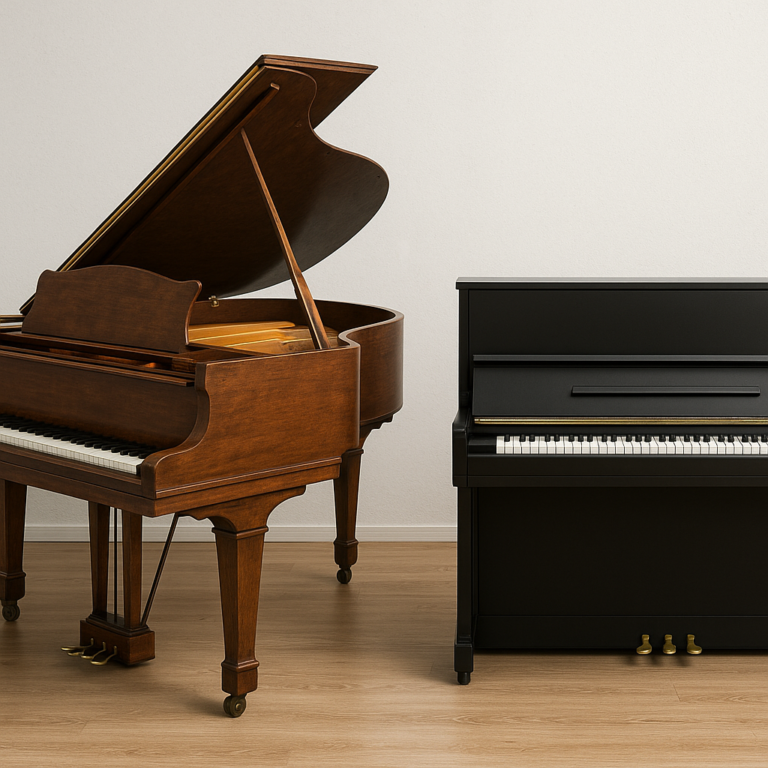
A short featured visual comparison shows an acoustic and digital Yamaha side by side. It’s useful for seeing the difference in form, but it does not explain their sound, touch, or cost. Those are the details our comparison below tackles.
🎼 Acoustic Piano Costs: Uprights, Grands, and Used Instruments
Upright piano price factors: size, action, materials, and brand
An upright can be a strong choice when you want strings, hammers, and a traditional acoustic response without the floor space of a grand. But “upright” describes a family, not a quality level. Compact and studio uprights differ in scale, action, cabinet, power, and tonal character.
When comparing uprights, look at:
- Action consistency: Try every key at soft and strong dynamics, and repeat notes quickly.
- Tone across registers: Listen for an even transition between bass, middle, and treble.
- Mechanical condition: Check for sticking keys, sluggish action, rattles, buzzing, and pedal problems.
- Preparation: Ask whether the piano has been tuned, regulated, voiced, and inspected.
- History: Ask when it was last tuned, moved, repaired, and serviced.
- Delivery and setup: Confirm whether stairs, distance, and first tuning are included or quoted separately.
A carefully prepared, less famous instrument may be more satisfying than a celebrated brand in poor condition. As the Seattle Classic Pianos guide notes, “The best way to judge quality is to compare instruments in person.”
Grand piano costs: baby grands through concert grands
Grand pianos place the action horizontally, which allows the mechanism to respond differently from a typical upright action. They also tend to occupy more floor space and require more complicated moving and maintenance logistics.
| Grand size category | What it may suit | Cost considerations |
|---|---|---|
| Baby grand | Homes with space for a compact grand | Cabinet size and appearance can matter as much as performance; inspect scale and action quality |
| Medium grand | Serious home playing, teaching, or small studios | Greater size can support more projection, but increases transport and room-planning demands |
| Concert grand | Large venues and professional performance | Built for projection and high-level performance; major investment in purchase, space, and care |
Length is only one part of the story. A grand’s condition, action regulation, soundboard health, scale design, maker, and history all matter. A compact grand is not automatically a better instrument than a well-made upright. We’ve heard players choose an excellent studio upright over a small grand because the upright had a more satisfying voice and a better-prepared action. Try before you decide; the silhouette cannot play a scale for you.
New vs. used acoustic pianos: value, condition, and risk
A new acoustic piano offers a known history, current manufacture, and often dealer-backed support. A used piano may offer exceptional value, but condition is the deciding variable. Age alone does not tell you whether an instrument is healthy.
Before buying used:
- Ask for the full service history. “Recently tuned” is helpful, but it is not a mechanical inspection.
- Play every key and pedal. Listen for uneven volume, rattles, sticking, and notes that fail to repeat cleanly.
- Check the room and storage history. Long exposure to dampness, dryness, or temperature swings can be damaging.
- Hire an independent piano technician. Ask for an assessment of the action, strings, soundboard, bridges, tuning stability, and repair needs.
- Get the complete delivery quote. Difficult stairs or long carries can affect the final cost.
- Ask what preparation is included. Tuning alone does not replace regulation, voicing, or repairs when needed.
New and pre-owned can both be good choices. The dealer perspective on acoustic piano quality correctly emphasizes that the actual piano’s condition and preparation matter more than appearance or reputation.
Acoustic piano brands and what their reputations mean for buyers
Names such as Yamaha, Schimmel, Estonia, and Bösendorfer span distinct histories, product lines, and price positions. A maker’s reputation can help you shortlist instruments, but it cannot replace listening and inspection.
- Yamaha: Broad range and wide dealer/service presence; compare individual model condition and voicing.
- Schimmel: German maker with a range of acoustic pianos; evaluate the specific instrument and service history.
- Estonia: A premium maker often encountered in serious home and performance settings; compare its tone and action directly with alternatives.
- Bösendorfer: A prestigious maker known for high-end grand pianos; intended buyers should compare size, room suitability, and service support.
For more maker-by-maker context, browse our Piano Brand Guides. We’d still choose the better-playing, properly prepared instrument over the more impressive logo.
🎧 Digital Piano Costs: Portable Keyboards, Consoles, and Stage Models
Portable digital pianos: essential features and price differences
Portable digital pianos can be moved and stored more easily than cabinet-style models, though “portable” can still mean a substantial instrument once a stand and pedals are added. Many models are sold with a basic sustain pedal or stand sold separately, so check the bundle carefully.
Compare:
- Key count: A full 88-key keyboard offers the familiar range of an acoustic piano.
- Action: Weighted hammer action generally supports piano technique better than light, spring-action keys.
- Pedal setup: A sustain switch is not the same playing experience as a proper three-pedal unit.
- Speakers: Built-in speakers vary widely in clarity, power, and bass response.
- Headphone and USB connections: Useful for silent practice, lessons, and recording.
- Stand and bench: Check whether they are included and stable.
Models such as the Yamaha P-225, Roland FP-30X, and Kawai ES120 are examples in established portable digital piano families. Compare specifications and playability directly; model names alone won’t tell you which key action suits your hands.
- 👉 Shop portable digital pianos: Yamaha P-series on Amazon | Roland FP-30X on Amazon | Kawai ES120 official
Console digital pianos: cabinet design and home features
A console digital piano is designed to stay in one place and resemble a home instrument. Its cabinet may include a built-in stand, three pedals, and speakers. Those features can make the whole setup simpler and more polished than piecing together a portable piano, stand, and pedal board.
Console models often add:
- A more stable, furniture-style cabinet
- Integrated speakers aimed at home listening
- A three-pedal assembly
- More advanced key actions and sound options
- Recording, lesson, or app features, depending on the model
The Yamaha Clavinova CLP series, Kawai CN series, and Roland home digital pianos illustrate the range of home-focused options. Features vary by model and generation, so verify the precise action, speaker configuration, connectivity, warranty, and included accessories.
Stage pianos: performance features and professional needs
Stage pianos prioritize giging and studio work. They often provide performance controls, sound selection, audio outputs, and robust housings, while leaving the stand, pedals, and speakers to the player.
That can be an advantage for a musician who already owns an amplifier and wants a flexible stage rig. It can be a drawback for a family expecting a complete living-room piano right out of the box.
Before buying, check:
- How many sounds you need and how quickly you can access them
- Whether you need balanced or unbalanced audio outputs
- The action’s feel and portability
- Whether built-in speakers are included
- The cost and compatibility of the stand and pedals
- Whether the piano can integrate with your recording or live-sound setup
A stage model’s extra controls may be worth paying for if you use them. If your main goal is quiet home practice, you could be spending on features that stay untouched.
Digital piano brands and features worth paying for
Casio, Kawai, Roland, and Yamaha all offer different digital piano families. The useful question is not “Which brand is best?” but “Which model gives me the touch, sound, and practical features I’ll use?”
Pay extra attention to:
- Action feel: Try repeated notes, quiet passages, chords, and fast scales.
- Pedal response: A half-pedal or three-pedal system may matter as your playing develops.
- Speaker quality: Important if you usually play without headphones.
- Headphone sound: Try your own headphones if possible.
- Connectivity: USB, MIDI, audio inputs, or app compatibility can support lessons and recording.
- Warranty and service: Verify local repair support and the coverage terms.
For model comparisons and buying advice, our Digital Pianos category is a useful starting point.
🔍 What Makes a Piano High Quality? Features That Affect Price
Keyboard action, key materials, and graded hammer mechanisms
The action is where your fingers meet the instrument’s personality. On an acoustic piano, the action is a network of mechanical parts. On a digital piano, weighted key mechanisms are designed to imitate or reproduce aspects of acoustic touch.
Look for:
- Consistent resistance: Keys should not feel wildly different from one another.
- Control at low volume: A good action lets you play quietly without losing notes.
- Repeat response: Repeated notes should respond predictably.
- Dynamic range: You should be able to produce a meaningful contrast between soft and loud playing.
- Key feel: Materials and surfaces affect grip and comfort, but feel is personal.
A graded hammer action is generally heavier in the bass and lighter in the treble, echoing a common acoustic-piano characteristic. It is not proof of quality by itself. Try the action with music you actually play, not only a few dramatic chords.
Sound quality: acoustic scale design, sampling, and modeling
An acoustic piano’s voice depends on its scale design, strings, hammers, soundboard, regulation, and condition. A digital piano’s sound depends on its sound engine, speakers or headphones, action, and how well those pieces work together.
To compare sound, listen for:
- Clear bass notes that don’t blur
- A middle register that remains even and warm
- Treble notes that are clear without becoming harsh
- Natural decay and sustain
- Smooth volume transitions
- Pedal behavior that feels responsive
Digital pianos may use samples, modeling, or combinations of sound-generation approaches. Marketing terms can be confusing; the most reliable test is to play and listen at different dynamics. A piano can sound lush through headphones yet underwhelming through small speakers, or the reverse. Test the way you’ll normally use it.
Pedals, speakers, polyphony, connectivity, and other useful features
Digital piano specifications can get technical quickly, but only a few details matter to most buyers.
| Feature | Why it matters | Who may value it most |
|---|---|---|
| Three-pedal unit | Adds sustain, sostenuto, and soft-pedal functions where supported | Students progressing in repertoire, teachers, advanced players |
| Half-pedaling | Allows finer control of sustain | Classical and expressive players |
| Built-in speakers | Determines the everyday sound without headphones | Families and home players |
| Polyphony | Helps notes and pedal tails continue without being cut off | Players using sustained chords, layers, or complex passages |
| USB/MIDI | Connects to computers, apps, or recording setups | Students, teachers, composers, and home studios |
| Headphone output | Enables quiet practice | Apartment dwellers and shared households |
| Audio inputs | Lets you play along with external sound | Teachers, performers, and practice-focused players |
A bigger specification is not automatically a better purchase. Pay for features you’ll use, and make sure they work well in the actual model.
Build quality, cabinet finish, warranty, and expected lifespan
A digital piano’s cabinet, controls, key mechanism, and electronics all affect durability. An acoustic piano has a different list: frame, soundboard, bridges, strings, action, pedals, and cabinet. Neither format is maintenance-proof.
Before buying, confirm:
- Warranty length and what it covers
- Whether labor and shipping are included for repairs
- Availability of service technicians and replacement parts
- Dealer setup and return policies
- Whether the seller will answer questions after delivery
A well-maintained acoustic piano can serve a family for decades and may be passed down. A digital piano avoids tuning, but technology changes and electronic components can eventually need repair or replacement. The long-term bargain depends on how long you keep it, how often you play, and what service it needs.
📊 Acoustic vs. Digital Piano: Full Cost Comparison
Purchase cost versus total cost of ownership
The purchase price is only one line in the ledger. We suggest estimating ownership cost over the number of years you realistically plan to keep the instrument.
| Cost area | Acoustic piano | Digital piano |
|---|---|---|
| Purchase | Varies with size, maker, age, condition, and preparation | Varies with action, sound system, cabinet, and features |
| Delivery | Often requires specialist piano movers | Usually simpler, though console models can still be heavy |
| Setup | Placement and initial tuning/preparation may be needed | Stand, pedals, bench, and connections may need assembly |
| Routine maintenance | Tuning and periodic regulation or voicing | Usually no routine tuning; keep clean and follow manufacturer guidance |
| Repairs | Mechanical, structural, and environmental issues possible | Electronics, keys, connections, and power components may need service |
| Sound management | Naturally audible; room and neighbors matter | Headphones and volume control are common options |
| Lifespan | Can be very long with appropriate care | Depends on build quality, component support, and technology changes |
| Resale | Strongly affected by brand, condition, local market, and moving cost | Affected by model age, condition, features, and current alternatives |
For a more accurate personal comparison, write down the quoted instrument cost, delivery, accessories, setup, and likely care. Then compare the same time period for both options.
Tuning, repairs, electricity, headphones, and ongoing upkeep
Acoustic pianos need tuning because strings respond to environmental changes and use. The exact schedule depends on the piano, stability, climate, and playing demands. A new or recently moved piano may require extra attention while it settles; ask a qualified technician for a schedule suited to your instrument. The Piano Technicians Guild can help you learn about professional piano service.
Digital pianos usually avoid tuning and many routine mechanical adjustments, but they have their ownership expenses:
- Headphones for silent practice
- A compatible stand, bench, and pedal unit
- Power use, usually a modest practical consideration
- Repairs to keys, jacks, speakers, power supplies, or circuit boards
- Replacement if the instrument becomes uneconomical to repair
Neither type is free to own. Acoustic upkeep is more routine and predictable; digital upkeep is often minimal until a component needs attention.
Delivery, stairs, setup, and installation expenses
A piano is not a sofa with more keys. Acoustic instruments are heavy, delicate, and awkward to move; a difficult staircase, narrow hallway, or long carry can change delivery requirements. Even a console digital piano may need careful handling.
Before you buy:
- Give the seller the delivery address and describe stairs, turns, and access.
- Ask whether delivery includes placement, assembly, and debris removal.
- Confirm whether the instrument needs tuning after the move.
- Ask who is responsible if damage occurs in transit.
- For a used acoustic piano, get delivery advice from a piano mover or technician before finalizing the sale.
A bargain can stop looking like one if the piano cannot reach the room.
Space, volume control, and apartment-friendly value
An acoustic piano has a real, room-filling sound. That can be wonderful for expressive playing and less wonderful if someone in the next room is taking a work call. Digital pianos offer volume controls and headphone use, which can make regular practice easier in apartments and shared homes.
Measure:
- The instrument’s footprint
- Space for a bench and a comfortable playing position
- Clearances for moving and service
- Whether sound travels through floors or shared walls
- Access to a suitable power outlet for a digital model
We’ve seen families choose digital not because they dislike acoustic tone, but because headphone practice turned “not now” into “I can play for twenty minutes.” That convenience has real value if it helps you practice consistently.
Resale value, depreciation, and long-term ownership
Resale depends on condition, brand, local demand, service history, age, and the cost of moving the instrument. Acoustic pianos can remain usable for a long time, but their size makes resale and transport more complicated. Digital pianos are easier to relocate, but models can become dated as features and technology change.
When thinking about resale:
- Keep receipts and service records.
- Save manuals and original accessories.
- Protect the instrument from unsuitable conditions.
- Check the local market for comparable models.
- Treat advertised asking prices as different from completed sale prices.
Do not buy an instrument solely as an investment. Choose a piano you want to play; resale is a helpful bonus, not a substitute for musical fit.
🛠️ Piano Ownership Costs: Maintenance, Repairs, and Care
How often acoustic pianos need tuning
Tuning frequency depends on stability, environment, piano condition, and how demanding your playing is. A home piano that has settled into a stable environment may need less attention than a frequently used teaching or performance instrument. New and recently moved pianos may need additional tuning as they acclimate.
Ask a technician to recommend a schedule based on the specific instrument rather than relying on a one-size-fits-all rule. The Piano Technicians Guild provides information on finding qualified technicians and understanding piano service.
Common acoustic piano repairs and inspection warning signs
Possible issues include sticking keys, worn hammers, loose parts, broken strings, pedal problems, tuning instability, and damage related to moisture or age. Some are routine repairs; others may signal expensive underlying work.
Watch for:
- Notes that buzz, rattle, or sound much weaker than their neighbors
- Keys that stick or return slowly
- Pedals that squeak, fail, or behave inconsistently
- A piano that will not hold tuning
- Visible cracks, corrosion, or signs of water exposure
- A seller who refuses an independent inspection
If something sounds “a bit off,” it may be minor. If the seller insists it is minor but will not permit an inspection, that’s a different kind of signal.
Digital piano warranties, repairs, and software support
Digital pianos can need service for keys, speakers, controls, displays, jacks, power supplies, or internal electronics. Before purchase, read the warranty and find out whether local authorized service is available.
Check:
- What is covered and for how long
- Whether the warranty begins at purchase or registration
- Whether labor, shipping, and accidental damage are excluded
- How the maker handles discontinued models
- Whether software or app features require ongoing support
A digital piano usually avoids routine tuning, but it is still an electronic instrument. Protect it from spills, dust, extreme temperatures, and careless transport.
Climate, placement, and care tips that protect your investment
For acoustic pianos, stable room conditions matter. Avoid placing the piano beside a radiator, in direct sunlight, or against a damp exterior wall. Suden changes in temperature and humidity can affect tuning stability and materials.
For both types:
- Keep drinks away from the keys.
- Use a soft, appropriate cloth for routine cleaning.
- Avoid harsh cleaners and sprays.
- Keep pets, toys, and food away from the keyboard.
- Follow the manufacturer’s care instructions.
- Ask a technician before using humidity-control products in an acoustic piano.
A small amount of prevention is cheaper than discovering that a piano has been doubling as a sunny windowsill.
💡 How to Choose the Right Piano for Your Budget and Playing Goals
Best-value piano features for beginners and returning players
Most beginners benefit from an instrument that supports developing technique, not merely one that makes sound. The PianoWerks beginner guide recommends considering 88 weighted keys, realistic touch response, and proper pedals for a more supportive learning setup.
A practical shortlist:
- 88 keys, when space and budget allow
- Weighted action that feels comfortable and responds evenly
- A sustain pedal at minimum; a three-pedal unit if your lessons or repertoire call for it
- Headphone output for quiet practice
- A stable stand and bench
- Reliable service and warranty support
A 61-key portable keyboard may be perfectly fine for casual exploration or limited space. It may become restrictive for lessons, classical repertoire, and students who progress quickly. The right decision depends on whether you want a starter instrument or a piano that can grow with you.
When an acoustic piano is worth the extra cost
Consider acoustic if you value the physical response and natural sound of strings, have enough room, can manage its volume, and are comfortable with tuning and care.
It may suit:
- Players who strongly prefer acoustic touch and tone
- Homes where the piano can stay in one place
- Students with teachers who recommend acoustic practice
- Families planning long-term ownership
- Musicians who enjoy the instrument’s acoustic presence as much as the sound
A well-made acoustic piano can last for generations with proper care. But that potential depends on construction, condition, environment, and maintenance. “Acoustic” is not a warranty of quality.
When a digital piano offers better value
Choose digital when convenience, quiet practice, predictable upkeep, or a more manageable move matters most. It is often a sensible fit for apartments, shared homes, students, and players who want recording or app connectivity.
Digital advantages include:
- Headphone practice and adjustable volume
- No routine tuning
- A wide range of sounds and digital features
- Easier relocation than many acoustic pianos
- Potentialy simpler setup and day-to-day care
The trade-off: digital actions and speaker systems vary significantly, and an electronic instrument may eventually need a repair or replacement. Play before buying if you can, especially if touch is a priority.
When a hybrid piano makes financial and musical sense
Hybrid pianos bridge acoustic feel and digital convenience, but the term covers different designs.
- Yamaha AvantGrand: Digital sound with an acoustic-style action; as an all-digital instrument, it does not need routine string tuning.
- Yamaha Silent Piano: An acoustic piano that can use a silent/headphone mode; because it has strings, it still needs acoustic piano care.
- Yamaha TransAcoustic: An acoustic piano with a system that can use its soundboard to project digital tones; it retains acoustic components and related maintenance.
- Yamaha Disklavier: A player-piano system with recording and playback features, with details varying by model.
See Yamaha’s official information for AvantGrand, Silent Piano, TransAcoustic, and Disklavier.
A hybrid can make sense if you specifically want acoustic-style touch with digital features and are comfortable with the added investment. It is not automatically the “best of both worlds” for every buyer; for some, a good digital piano is more practical, while others want a fully acoustic instrument.
Budgeting for piano lessons, accessories, and future upgrades
The instrument is only part of the musical budget. Remember to account for lessons, a bench, a lamp, headphones, a stand, pedals, sheet music, and any acoustic servicing.
We recommend this sequence:
- Decide how often you’ll play and whether you need headphones.
- Identify the minimum acceptable action, key count, and pedals.
- Add required accessories to the instrument quote.
- For acoustic, include inspection, delivery, and care.
- For digital, check whether the stand and pedal unit are included.
- Leave room for lessons and music rather than spending every available dollar on the instrument.
A useful piano is one you can afford to keep playing.
🧾 Smart Piano Shopping: How to Compare Models and Avoid Costly Mistakes
Questions to ask piano dealers and private sellers
Ask direct questions. A trustworthy seller should be able to explain what you are buying and what happens after delivery.
- What model and year is this?
- What preparation has been completed?
- Is delivery included, and what access conditions could change the quote?
- What warranty or return policy applies?
- Are the bench, stand, pedals, or headphones included?
- For acoustic: When was it last tuned, regulated, and inspected?
- For used acoustic: Can I arrange an independent technician inspection?
- For digital: What is the warranty on electronics, keys, and speakers?
- Is authorized service available nearby?
If answer sounds vague, ask for it in writing. Good questions are cheaper than surprises.
How to test a piano’s action, tone, pedals, and condition
Use the same basic test for every piano so your comparison stays fair:
- Play every key softly. Listen for dead or uneven notes.
- Play a scale across the full range. Notice changes in tone and touch.
- Repeat notes quickly. Check how the action responds.
- Play both quiet and loud passages. Test dynamic control.
- Try the pedals. Confirm their response and listen for unwanted noises.
- Use headphones and speakers on a digital piano if both matter to you.
- Play your own music. A familiar piece reveals more than random notes.
- Take a break and return. First impressions are useful, but fatigue can distort them.
For acoustic instruments, have a qualified technician inspect the piano before purchase, particularly if it is used. For digital models, test all controls and ports you expect to use.
Buying online, buying locally, and checking return policies
Online shopping makes model comparison easier, but a piano’s touch is personal. Local dealers may let you try instruments, arrange delivery, and provide setup or service; online sellers may offer broader selection. Compare the whole purchase, not only the listed instrument.
Before ordering, verify:
- Return period and restocking rules
- Delivery method and damage procedure
- Assembly requirements
- Warranty coverage in your region
- Whether the exact model and accessories are included
- Whether you can test the instrument somewhere nearby
For an acoustic piano, local inspection and professional moving are especially valuable. For a digital piano, confirm the box includes the components you need to play comfortably.
Financing, trade-ins, rentals, and other ways to manage the cost
If the right piano is beyond your current budget, ask dealers about rental programs, rent-to-own arrangements, trade-ins, or payment plans. Read the terms carefully: interest, fees, return requirements, and upgrade conditions can change the true cost.
Other practical options:
- Buy a prepared used instrument from a reputable dealer.
- Consider a quality digital piano before stretching for an acoustic.
- Rent while a student’s commitment and needs become clearer.
- Prioritize touch and reliability over decorative finishes.
- Keep a separate budget for lessons, maintenance, and accessories.
The least expensive path is not always the best value. As the PianoWerks article asks, the real question is not only “What is the least expensive way to begin?” but what instrument gives the player a good chance to keep learning.
❓ Piano Price FAQs: Acoustic, Digital, and Hybrid Pianos
Why do acoustic pianos usually cost more than digital pianos?
Acoustic pianos contain complex mechanical actions, strings, a soundboard, and structural components that require skilled construction and servicing. They also usually need tuning and may need regulation or repairs. Digital pianos can offer a strong playing experience with lower routine maintenance, although premium digital models can still be substantial purchases.
The difference is not absolute: a premium digital piano can cost more than a modest used acoustic upright, and a damaged acoustic can be expensive to restore. Compare model quality and ownership costs, not the two broad labels alone.
How much should I budget for a high-quality piano?
There is no single reliable figure without specifying piano type, condition, location, delivery, and features. A high-quality digital piano can offer weighted action, expressive sound, useful pedals, and headphone practice. A high-quality acoustic piano adds natural sound and mechanical response, but requires room, moving, tuning, and ongoing care.
Get written quotes for the complete setup: instrument, delivery, accessories, preparation, warranty, and likely maintenance. For used acoustic models, include an independent inspection before making your decision.
Read more about “15 Best Acoustic Piano Brands for Quality 🎹”
Can an affordable digital piano feel like an acoustic piano?
Some affordable digital pianos provide weighted actions that are useful for learning and regular playing, but the feel varies by model. They may not reproduce every nuance of a particular acoustic action. Try the keyboard, test soft and repeated notes, and check whether the pedal system meets your needs.
A full 88-key weighted digital piano is usually a more suitable long-term learning choice than a light-action keyboard with fewer keys, especially for students taking lessons.
Read more about “12 Top Digital Piano Brands: Which One Fits You? 🎹”
Is a used acoustic piano a good deal?
It can be, if the instrument is healthy, properly prepared, and priced to reflect its condition. A low asking price does not prove that it is economical; repairs, tuning instability, and difficult delivery can add up.
Arrange a technician’s inspection, confirm the service history, and get a complete moving quote. The best used piano is the one that plays well and has no costly surprises hiding inside.
Read more about “Acoustic vs. Digital Piano Upkeep: What Will It Cost? 🎹”
Are expensive digital pianos worth the upgrade?
They can be worth it when the upgrade brings features you will genuinely use: a more satisfying action, better speakers, more realistic sound, a useful three-pedal setup, or better build quality. If you mainly practice through headphones and are happy with your current instrument, a higher-tier model may not improve your experience enough to justify the change.
Compare models in person and focus on touch, sound, and daily use—not the number of sounds in the feature list.
Read more about “🎹 15+ Top Piano Brands Ranked: The Ultimate 2026 Guide”
Which piano costs less over time?
A digital piano often costs less to maintain because it does not need routine tuning. An acoustic piano may last much longer, but ongoing care and repair costs vary with its condition and environment. Digital instruments avoid many routine service needs but can eventually require electronic repairs or replacement.
The most useful comparison is a realistic ownership plan: expected years of use, maintenance, delivery, accessories, and how much you value acoustic sound or headphone convenience.
Read more about “🎹 Top 5 Hybrid Piano Brands for 2026: Real Feel, Silent Play”
Does a piano’s brand affect its resale value?
Brand can influence buyer interest, but condition, model, service history, local demand, and moving costs also matter. A familiar name may be easier to sell, but a well-maintained instrument from a less familiar maker can be a better piano to own.
Keep service records, manuals, and accessories, and check completed local sales where possible. Buy for playing first; resale is uncertain.
Read more about “🎹 Which Piano Brands Offer the Best Value for Money? Top 10 Revealed (2026)”
🎯 Choosing a Piano That’s Worth Every Note
Start with your playing life, not a price label:
- Need headphones, adjustable volume, and low routine maintenance? A quality digital piano is likely the practical choice.
- Want strings, natural resonance, and a traditional playing experience? Explore acoustic uprights and grands, but budget for inspection, moving, and care.
- Want acoustic-style action with digital features? Compare hybrids carefully and confirm which designs still need tuning.
- Buying for lessons? Prioritize a suitable action, full keyboard range where possible, and proper pedals over decorative extras.
- Shopping used? Make a technician’s inspection and delivery quote part of the decision.
The competing guides make complementary points. Classic Pianos describes digital pianos as a way to get a serious instrument “without investing in an acoustic right away,” while its acoustic piano guide cautions that “the best piano for you is not always the most expensive piano, the most familiar brand, or the one that looks best in photos.” Those ideas fit together: digital can be a smart value, acoustic can be a lasting investment, and neither format wins without matching your needs.
For broader comparisons, browse our Piano Buying Guide, Piano Comparison, Piano Brand Guides, Digital Pianos, and Piano History.