Support our educational content for free when you buy through links on our site. Learn more
Acoustic vs. Digital Piano Upkeep: What Will It Cost? 🎹

Digital pianos usually cost less to maintain routinely: they don’t need tuning. Acoustic pianos need regular tuning and may also require mechanical service, while digital models can still need repairs to keys or electronics as they age. So, what are the maintenance and upkeep costs associated with owning an acoustic piano versus a digital piano? The short answer: acoustics bring more predictable, recurring service; digitals bring lighter routine care but occasional repair risks.
We’ve heard the familiar story: someone finds a “free” acoustic piano, pays to move it, then discovers it needs more than a quick tune. Meanwhile, a digital piano can sit happily for years without a technician visit—until a key, power supply, or circuit decides to take a sabatical. The instrument’s condition, climate, service access, and how long you plan to keep it all matter.
Key Takeaways
- Acoustic pianos need regular tuning, often around twice a year, plus possible regulation, voicing, or repairs.
- Digital pianos don’t need tuning and usually require only gentle cleaning and sensible care.
- Digital upkeep is typically lower and more predictable, but aging electronics or unavailable parts can make repairs challenging.
- Used acoustic pianos deserve a professional inspection before purchase; hidden structural or mechanical problems can outweigh a bargain price.
- Climate, moving, and service availability affect ownership costs for both piano types.
- Choose based on the specific instrument and your priorities: acoustic sound and touch may justify recurring service; digital convenience and headphone practice may suit a tighter maintenance budget.
Table of Contents
- ⚡️ Quick Tips and Facts
- 🎹 Piano Ownership Costs at a Glance
- 🏛️ How Acoustic and Digital Pianos Differ in Maintenance
- How acoustic piano mechanics affect upkeep
- How digital piano technology affects upkeep
- 🧾 Acoustic Piano Maintenance Costs: What to Budget For
- Tuning frequency and piano tuning costs
- Regulation, voicing, and other action work
- Repairs, replacement parts, and age-related wear
- Humidity control, climate, and piano storage
- Moving, delivery, and placement costs
- 🔌 Digital Piano Maintenance Costs: What to Budget For
- Power, cables, headphones, and accessories
- Cleaning keys and caring for electronic components
- Repairs, warranties, and replacement parts
- Software updates, connectivity, and obsolescence
- Moving and protecting a digital piano
- 📊 Acoustic vs. Digital Piano Upkeep: Side-by-Side Comparison
- Routine maintenance and annual ownership costs
- Upfront costs versus long-term costs
- Five-, ten-, and twenty-year cost considerations
- ✅ Pros and Cons of Acoustic Piano Ownership
- Benefits of owning an acoustic piano
- Drawbacks and ongoing acoustic piano expenses
- ✅ Pros and Cons of Digital Piano Ownership
- Benefits of owning a digital piano
- Drawbacks and potential digital piano expenses
- 🤔 Which Piano Should You Own?
- Best choice for beginners, families, and casual players
- Best choice for serious practice and advanced pianists
- Best choice for apartments, schools, and performance spaces
- When a hybrid piano makes sense
- 🧽 Piano Care Checklist: Daily, Monthly, and Annual Tasks
- Simple habits that protect any piano
- Acoustic piano maintenance schedule
- Digital piano maintenance schedule
- 🛠️ DIY Piano Maintenance vs. Hiring a Technician
- Safe piano cleaning and basic care you can do yourself
- Repairs and adjustments best left to professionals
- How to find a qualified piano tuner or repair technician
- 💡 How to Reduce Piano Maintenance and Upkeep Costs
- 🔍 Buying Tips: Check Maintenance History Before You Choose
- Questions to ask when buying a used acoustic piano
- What to check when buying a digital piano
- Warranties, service plans, and expected lifespan
- ❓ Frequently Asked Questions About Piano Maintenance Costs
- How often does an acoustic piano need tuning?
- Do digital pianos need tuning or regular servicing?
- Which type of piano is cheaper to maintain?
- Can humidity damage acoustic and digital pianos?
- How long does an acoustic or digital piano last?
- Conclusion
- Recommended Links
- Reference Links
⚡️ Quick Tips and Facts
If you’re comparing the upkeep of an acoustic and digital piano, our short answer is simple: acoustic pianos need recurring tuning and may need mechanical service; digital pianos need little routine care but can require electronics repairs as they age. The better value depends on the instrument, its environment, and how long you plan to keep it.
For the bigger picture on feel, sound, and ownership trade-offs, see our guide to acoustic vs. digital piano brands.
| Ownership question | Acoustic piano | Digital piano |
|---|---|---|
| Does it need tuning? | Yes. Tuning is commonly recommended about twice a year, with frequency affected by climate, use, and stability. | No. It produces electronically generated sound, so it doesn’t drift out of tune like strings do. |
| What routine upkeep is typical? | Tuning, periodic inspection, careful climate management, and occasional regulation or repair. | Dust control, sensible handling, cable and power care, and protection from spills and heat. |
| What can become expensive? | Repeated tuning, action work, structural repairs, and difficult moves. | Repairs to circuit boards, displays, keys, power supplies, and other electronics; replacement can be preferable for some older models. |
| Which has lower routine upkeep? | ❌ Usually higher. | ✅ Usually lower. |
| Which has fewer long-term uncertainties? | A well-maintained piano can be serviced, but its condition matters enormously. | Less routine service, but repairability and parts availability can vary by model and age. |
A few useful rules of thumb:
- ✅ Ask an experienced piano technician to inspect a used acoustic piano before purchase.
- ✅ Keep an acoustic piano away from direct sunlight, heating vents, fireplaces, damp walls, and big temperature swings.
- ✅ Digital pianos don’t need tuning, but “maintenance-free” is not the same as “impossible to break.”
- ❌ Don’t assume an inexpensive or free used acoustic piano is inexpensive to own. A weak pinblock, damaged soundboard, or worn action can change the whole calculation.
- ✅ For either type, budget for safe delivery and placement. Pianos are not enthusiastic about being dragged across the living room.
Our broader piano buying guide and digital piano guides can help you compare models as well as upkeep.
🎹 Piano Ownership Costs at a Glance
The key difference is predictable routine care versus less predictable repair risk. Acoustic owners can expect regular visits from a tuner; digital owners can often go years without professional attention, but an electronic failure may be harder to diagnose or repair economically.
| Cost or task | Acoustic upright or grand | Digital piano |
|---|---|---|
| Regular tuning | Recurring service; often roughly twice a year is recommended | None |
| Mechanical adjustment | May need regulation, voicing, or action repairs over time | Not applicable in the traditional acoustic sense |
| Climate management | Can matter significantly for tuning stability and wood components | Avoid excessive heat, moisture, dust, and abrupt environmental extremes |
| Cleaning | Gentle exterior and key care; keep liquids away from the action | Gentle exterior and key care; keep liquids away from keys, speakers, and controls |
| Parts that may wear | Hammers, felts, strings, dampers, action components, pedals | Keys, sensors, switches, speakers, power supplies, displays, circuit boards |
| Moving | Heavy and typically requires specialist movers | Usually easier, though cabinet models still need careful handling |
| Technology aging | Mechanical parts can often be repaired or replaced, depending on condition and parts | Features, connections, software support, and replacement parts can become dated |
| Routine upkeep pattern | Regular and ongoing | Light and mostly owner-managed |
A useful distinction: maintenance keeps a working piano in good condition; repair restores something that has failed or worn out. Tuning is routine maintenance. Replacing a damaged digital circuit board is a repair. Acoustic pianos can need both; digital pianos tend to need little routine servicing but can still develop faults.
Very Piano describes digital instruments as “convenient and low maintenance,” while advising acoustic owners to “plan for the ongoing costs of tunings and regular maintenance.” That’s a fair shorthand, but it doesn’t mean every acoustic piano has the same service needs—or that every digital repair is cheap.
We’ve seen owners focus on the first year’s costs and overlook the next ten. Let’s unpack what actually creates the bill.
🏛️ How Acoustic and Digital Pianos Differ in Maintenance
How acoustic piano mechanics affect upkeep
An acoustic piano makes sound through a physical chain: the key moves an action, a hammer strikes a string, and the soundboard helps project the vibration. That rich mechanical system is why the instrument responds so naturally—and why it needs a technician from time to time.
Acoustic pianos contain many moving parts. Felt, wood, metal, leather, and strings respond differently to use and environmental changes. Over time, parts can wear, settle, swell, shrink, or shift. That doesn’t mean an acoustic piano is fragile; it means it’s a mechanical instrument that benefits from skilled care.
Common professional services include:
- Tuning: Adjusting string tension so notes are at the intended pitch.
- Regulation: Adjusting the action so keys and hammers respond consistently.
- Voicing: Adjusting hammer felt to shape tone and eveness.
- Repair: Fixing broken, worn, sticking, or noisy components.
- Climate assessment: Identifying environmental conditions that may affect stability.
The Piano Technicians Guild provides consumer information and a directory for finding qualified technicians. For more brand-specific ownership guides, browse our piano brand guides.
How digital piano technology affects upkeep
A digital piano has no strings to tune and no acoustic action that needs traditional regulation. Its sound comes from electronic samples or sound modeling, played through headphones, speakers, or an external sound system.
That makes routine care simpler—but digital instruments have their own vulnerable points:
- Key sensors and contact strips
- Buttons, knobs, and displays
- Speakers and headphone jacks
- Power supplies and internal wiring
- Circuit boards and software-dependent features
- Pedals and connectors
The exact service options depend on the model. For example, Yamaha and Roland offer digital piano families with different actions and feature sets, while Kawai sells both portable and cabinet-style digital instruments. A brand name alone doesn’t guarantee that a future repair will be simple; model age, parts availability, and local service expertise matter too.
Digital technology can also age in ways that acoustic mechanics don’t. Very Piano points out that some older digital instruments used storage and connections that are now awkward to work with, including floppy drives. That’s not a reason to avoid digital pianos. It’s a reminder that electronic features can date faster than a well-maintained mechanical instrument.
🧾 Acoustic Piano Maintenance Costs: What to Budget For
The acoustic piano’s main ongoing cost is usually straightforward: regular tuning. The less predictable costs come from condition, climate, age, usage, and the previous owner’s care.
There is no universal service bill. Labor rates, travel distance, instrument type, local climate, and the piano’s condition all affect what a technician charges. We’re deliberately not quoting specific prices here; get a local estimate for your instrument and location.
Tuning frequency and piano tuning costs
Pianos are affected by changes in string tension, humidity, temperature, and settling. A new piano or one that has recently moved may need more attention at first. After it stabilizes, many owners arrange tuning around twice a year, though a technician may recommend a different schedule for a particular piano.
The Piano Technicians Guild advises owners to work with a qualified technician and consider the instrument’s needs and environment. Piano Buyer likewise emphasizes that “Proper maintenance is critical for keeping your piano performing at its peak potential.” Neither statement means every piano must follow an identical calendar.
A practical approach:
- Ask the piano’s technician about its history. When was it last tuned? Does it hold pitch?
- Tune after moving when advised. A move may disturb an instrument that was already marginaly stable.
- Establish a baseline. Have a technician assess the piano and suggest an appropriate schedule.
- Keep notes. Record service dates and any changes in sound, pitch, or key response.
- Reassess if the piano drifts quickly. Persistent instability can point to more than missed tuning.
A piano that has gone years without care may need more than a standard tuning appointment. If it is substantially below pitch, the technician may need to raise pitch first and tune again later. That’s why a neglected piano shouldn’t be judged by the cost of one routine visit.
Regulation, voicing, and other action work
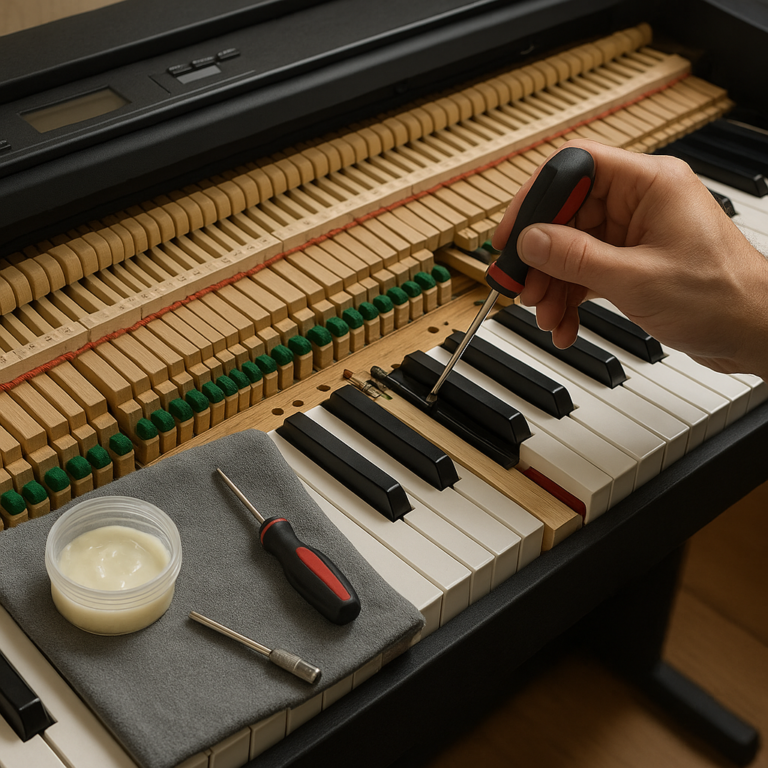
Tuning changes pitch; it doesn’t correct every problem with the way a piano feels or sounds. If keys respond unevenly, notes are too bright or too soft, or the action feels sluggish, the piano may need regulation, voicing, or repair.
| Service | What it addresses | What you may notice |
|---|---|---|
| Regulation | The mechanical relationships among keys, hammers, dampers, and related parts | Uneven touch, slow repetition, inconsistent key response |
| Voicing | Hammer-felt condition and tone consistency | Harsh, dull, or uneven tone |
| Action repair | Worn, broken, noisy, or sticking components | Keys that stick, fail to return, or behave differently |
| Pedal service | Pedal mechanism and related parts | Squeaks, poor sustain, or inconsistent pedal action |
How often these services are needed varies widely. A lightly used, well-kept piano may need little attention beyond tuning for long periods. A heavily played instrument, a piano with a poor service history, or one in a damaging climate may need more.
Repairs, replacement parts, and age-related wear
A piano can look handsome and still have expensive problems hiding inside. Before buying used, pay particular attention to:
- Whether it holds tune
- Tuning pins and pinblock condition
- Cracked or damaged structural components
- Rusted strings or corrosion
- Hammers, felts, dampers, and action wear
- Sticking keys, uneven touch, or abnormal noises
- Evidence of water damage, pests, or poor storage
Keylab NYC warns that a used instrument with problems such as pinblock damage or structural defects may turn a seemingly low-cost purchase into a much larger repair project. It recommends budgeting for a professional inspection; its article gives an inspection estimate, but local fees vary, so ask technicians in your area.
Our practical recommendation: get the piano inspected before you buy it, not after it arrives. A technician can help separate normal wear from major structural concerns and explain which repairs are urgent, optional, or uneconomical.
A word about older pianos: age alone doesn’t determine whether a piano is worth maintaining. Construction, service history, parts condition, tuning stability, and the player’s needs all matter. A well-cared-for older instrument may be a joy; a neglected one may demand costly work before it plays reliably.
Humidity control, climate, and piano storage
Acoustic pianos contain wood and felt, which respond to changes in the environment. Large or repeated shifts in humidity can affect tuning stability and action behavior. Keylab NYC recommends an environment around 50% relative humidity as a useful target. Treat that as practical guidance rather than a universal guarantee: climate, home construction, and the instrument itself all matter.
To reduce environmental stress:
- Keep the piano away from direct sunlight.
- Avoid placing it beside radiators, fireplaces, heating vents, or air conditioners.
- Don’t put it against a damp exterior wall or near a leaky window.
- Avoid sudden temperature and humidity changes where possible.
- Consider a room humidifier or dehumidifier if your climate swings significantly.
- Ask a piano technician whether a piano-specific humidity-control system makes sense.
A digital piano is generally less sensitive to humidity-related tuning changes, but it still contains electronics, speakers, wiring, and materials that can be harmed by moisture or heat. Neither piano should be treated as furniture that happens tolerate spills.
Moving, delivery, and placement costs
Acoustic pianos are heavy and awkward, and moving one safely usually calls for experienced piano movers. Grand pianos may need partial disassembly for transport. Poor handling can damage the finish, legs, pedals, action, or structure—and can create safety risks.
Digital pianos are often easier to move, especially portable models, but console instruments still need careful handling. Before moving either kind:
- Measure doorways, stairs, hallways, and the destination space.
- Confirm access and stairs with the mover.
- Protect the piano from rain, extreme heat, and impacts.
- Don’t carry a heavy piano by removable parts, music stands, or key covers.
- Allow an acoustic piano time to settle in its new environment, then ask a tuner when it should be serviced.
Delivery and setup are part of ownership costs, not annoying footnote. For more decision-making help, explore our piano comparison guides.
🔌 Digital Piano Maintenance Costs: What to Budget For
Digital pianos generally have lower routine maintenance needs. There’s no tuning schedule, no soundboard to manage, and no hammer action that needs traditional regulation. But electronic parts can fail, and some repairs depend on parts or service expertise that may not be easy to find.
Power, cables, headphones, and accessories
The most routine digital-piano upkeep is often refreshingly unglamorous: keep the power supply and cables in good condition, avoid yanking connectors, and store accessories where they won’t be crushed or bent.
- Use the manufacturer-recommended power supply.
- Keep cables away from walkways and chair legs.
- Unplug carefully by holding the plug, not pulling the wire.
- Protect connections from dust and liquid.
- Use a suitable stand and secure the instrument if children or pets could bump it.
- Test headphones and pedals before assuming the piano itself is faulty.
Accessories aren’t mandatory maintenance, but replacing a damaged sustain pedal or power adapter can still become part of the ownership budget. Check your manual before substituting accessories, especially with models that use manufacturer-specific connections or pedal systems.
Cleaning keys and caring for electronic components
Digital and acoustic piano keys both benefit from gentle cleaning. The difference is that a digital piano’s controls, key gaps, and electronic components need extra protection from moisture.
Safe basic cleaning:
- Turn the instrument off and unplug it if the manual recommends doing so.
- Use a soft, clean, lightly dampened cloth on the exterior.
- Wipe keys gently, drying them afterward.
- Keep liquid away from key gaps, buttons, screens, speakers, and connectors.
- Avoid abrasive cleaners, solvents, and sprays applied directly to the instrument.
- Follow the manufacturer’s care instructions for the specific finish and key materials.
A light dust cover can help, but don’t cover a piano while it is warm or store it somewhere damp. The owner’s manual is the most reliable guide for a particular model.
Repairs, warranties, and replacement parts
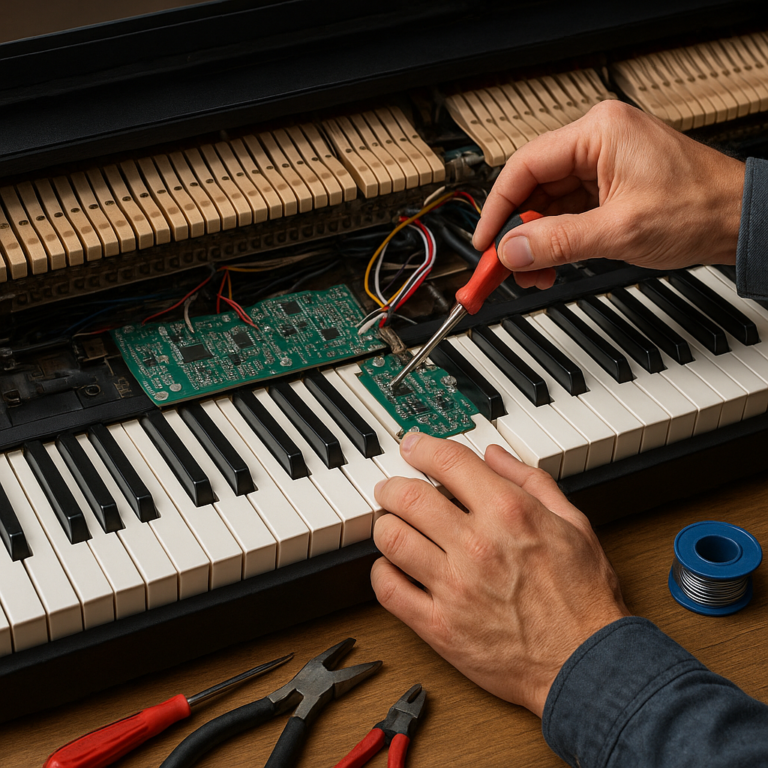
Possible digital-piano repairs include malfunctioning keys, noisy or silent speakers, failing buttons, display issues, damaged jacks, power problems, and electronic faults. A small fault may be simple to diagnose; a failed major component may be costly or impractical to repair on an older entry-level model.
Before purchase, check:
- The length and scope of the manufacturer’s warranty
- Whether labor and shipping are covered
- Local authorized service availability
- Parts availability for the model
- Whether the instrument is still supported
- The cost and convenience of replacing rather than repairing it
Brands such as Casio, Roland, Yamaha, and Kawai offer broad digital piano ranges, but support varies by product and region. Check the specific model’s warranty and service information rather than relying on assumptions about the brand.
Software updates, connectivity, and obsolescence
Many digital pianos are perfectly useful without frequent software updates. Still, USB, Bluetooth, recording features, apps, and computer compatibility can change over time. An older instrument may remain playable while some features become inconvenient to use.
This is where a digital piano and an acoustic piano age differently:
- An acoustic piano may need mechanical parts repaired, but its core sound-producing system is not tied to apps or computer standards.
- A digital piano may continue producing sound for years, even after an app or connection becomes outdated.
- A complex, aging digital piano may be difficult to repair if parts or specialist support are unavailable.
Very Piano uses old storage formats as an example of how electronic features can date. The lesson isn’t “digital pianos expire after a decade.” It’s buy for the playing experience you need now, and don’t pay for features you won’t use.
Moving and protecting a digital piano
Portable digital pianos are much easier to move than acoustic uprights or grands, but “portable” doesn’t mean indestructible. Protect the keys, screen, knobs, connectors, and power supply. Use the manufacturer’s case or a properly padded alternative when transporting a keyboard.
For a home digital piano:
- Place it on a stable stand or cabinet.
- Keep it out of direct sunlight and away from moisture.
- Leave ventilation space if the manual calls for it.
- Keep drinks off the instrument and nearby shelves.
- Protect it from falls, sharp impacts, and pets who mistake cables for toys.
📊 Acoustic vs. Digital Piano Upkeep: Side-by-Side Comparison
Routine maintenance and annual ownership costs
“Annual cost” is not one fixed number. It depends on the local technician market, how often the instrument is played, the piano’s condition, its environment, and whether any repair is due. Instead of pretending one figure applies everywhere, use this checklist to build a realistic local estimate.
| Budget item | Acoustic piano | Digital piano |
|---|---|---|
| Regular service | Ask a tuner for the recommended schedule; twice yearly is a common starting point | Usually no scheduled tuning or mechanical service |
| Routine cleaning | Gentle exterior and key care | Gentle exterior and key care; extra care around electronics |
| Repairs | Can range from modest adjustments to major structural work | Can range from simple accessory replacement to electronic or key-system repair |
| Climate management | May require monitoring humidity and temperature | Protect from heat, moisture, dust, and power problems |
| Moving | Specialist moving is usually wise | Often manageable with a case or careful two-person move, depending on model |
| Best way to estimate | Request a service plan from a local piano technician | Review warranty, local service options, and parts availability |
To estimate your own acoustic-piano budget:
- Call two or three qualified local technicians.
- Ask for their standard tuning fee and travel policy.
- Describe the piano’s age, type, location, and recent service history.
- Ask whether a first inspection or follow-up visit may be needed.
- Add any moving, humidity-control, or likely repair needs.
To estimate your digital-piano risk:
- Check the warranty and service coverage.
- Search for authorized service in your region.
- Confirm that key components and accessories are available.
- Consider how costly a failure would be relative to replacing the instrument.
- Keep the manual, receipt, model number, and serial number.
Upfront costs versus long-term costs
A digital piano often makes budgeting easier because it avoids routine tuning. An acoustic piano can require more regular care but offers a mechanical sound and response that many players value deeply. Neither is automatically cheaper across every ownership period.
A more useful comparison asks:
- How much service will this specific piano need?
- How long will you keep it?
- Will it be played frequently?
- Can you find reliable local repair support?
- Does it fit your space and climate?
- What are the likely consequences if a major part fails?
A carefully inspected, healthy used acoustic piano may be a sensible long-term instrument. A poorly maintained piano can be a financial surprise. A digital piano may require almost no scheduled care, but a major electronic fault could make replacement more sensible than repair.
Five-, ten-, and twenty-year cost considerations
Think in stages rather than assuming one type always wins.
| Ownership period | Acoustic piano questions | Digital piano questions |
|---|---|---|
| First year | Does it need an initial tuning, pitch correction, inspection, or post-move service? | Is setup complete? Are the stand, pedal, headphones, and power supply suitable? |
| Five years | Has it been tuned regularly? Is the action wearing evenly? Has the room climate been stable? | Are keys, controls, speakers, and connections working? Is the warranty still relevant? |
| Ten years | Is the piano holding tune? Are parts worn, and are repairs worthwhile? | Is the model still supported? Are features and connections still useful? |
| Twenty years | What is the structural and mechanical condition? Is ongoing service available? | Are parts, service, and compatible accessories available? Would replacement be more practical? |
These are planning prompts, not lifespan guarantees. A heavily used piano in a difficult environment may need work sooner; a lightly used, well-maintained one may remain dependable much longer.
✅ Pros and Cons of Acoustic Piano Ownership
Benefits of owning an acoustic piano
- Natural sound from vibrating strings and soundboard
- A responsive mechanical action that many pianists value for expressive playing
- No power supply, software, or speakers required
- Can be repaired and adjusted by qualified technicians when parts and condition allow
- Furniture-style presence in a home, studio, or performance space
For players who care most about acoustic tone and the physical connection between key and hammer, upkeep can feel like part of caring for a real instrument rather than a nuisance. That doesn’t erase the ongoing service needs, of course—but it helps explain why many owners willingly make room in the budget.
Drawbacks and ongoing acoustic piano expenses
- Regular tuning is part of ownership.
- Climate changes can affect stability and action behavior.
- Regulation, voicing, and repairs may add costs beyond tuning.
- Moving is difficult and often needs specialist movers.
- A used piano can hide costly problems.
- It takes up more space and generally cannot be played quietly with headphones.
A used acoustic piano deserves particular caution. The Keylab NYC buying guide highlights possible issues including tuning instability, pinblock problems, cracks, worn parts, and the need for setup work. A piano’s appearance is not a substitute for a technician’s inspection.
✅ Pros and Cons of Digital Piano Ownership
Benefits of owning a digital piano
- No tuning bills
- Little routine maintenance beyond cleaning and careful use
- Headphone practice, often with adjustable volume
- Typically easier to move than an acoustic piano
- Many models offer metronomes, recording, lesson tools, and multiple sounds
- No acoustic strings or soundboard to tune and regulate
For a beginner in an apartment, that list can be compelling. The featured video’s perspective is similarly practical: modern digital pianos can be strong starter instruments when budget, space, and quiet practice matter. It also acknowledges that older digital instruments may feel less nuanced than modern models, so don’t judge today’s instruments solely by an outdated keyboard.
Explore current models in our digital piano section, and compare the pros and cons in our piano comparison guides.
Drawbacks and potential digital piano expenses
- Electronic parts can fail.
- Repairing older models may be difficult if replacement parts are unavailable.
- Features and connections may become outdated.
- Some models have a less convincing key action or speaker system than the player wants.
- Portable models may need a separate stand, bench, pedal, or speakers.
- A digital piano depends on electricity or batteries.
Digital doesn’t mean disposable, and acoustic doesn’t mean immortal. The real question is whether the specific instrument can be kept useful and repairable for your intended ownership period.
🤔 Which Piano Should You Own?
Best choice for beginners, families, and casual players
A digital piano is often the practical choice if you need:
- Headphone practice
- Lower routine maintenance
- Easier relocation
- A compact footprint
- Features such as a metronome or recording
Look for 88 weighted keys, a sustain pedal, and a touch response that suits the player. A good digital instrument can support serious learning; the maintenance advantage does not require giving up proper practice.
Best choice for serious practice and advanced pianists
An acoustic piano may be the better fit if you prioritize its natural sound, acoustic response, and mechanical interaction. Before choosing one, consider the cost of regular tuning, service access, room conditions, and moving.
Try the actual piano with a teacher or experienced player if possible. Brand reputation matters, but condition, action, and sound matter more than a familiar logo on the fallboard. Our piano brand guides can help you compare manufacturers and product lines.
Best choice for apartments, schools, and performance spaces
| Setting | Often the more practical choice | Why |
|---|---|---|
| Apartment or shared home | Digital | Headphones and adjustable volume |
| Practice room or school | Digital or acoustic | Depends on use, budget, service access, and desired playing experience |
| Concert or recital space | Acoustic, stage piano, or hybrid | Depends on the venue and performance requirements |
| Frequently changing locations | Portable digital | Lighter and easier to transport |
| Stable home with room for a full-size instrument | Either | Choose based on sound, feel, upkeep, and budget |
The right answer changes with the room. A wonderful acoustic piano is less wonderful if it sits beside a radiator in a dry, sunlit corner. A top-feature digital piano is less useful if its action doesn’t suit the player.
When a hybrid piano makes sense
Hybrid pianos aim to combine acoustic-style action with digital sound generation. They may appeal to players who want a more substantial key mechanism without the maintenance of strings and a soundboard. But they still contain electronics and sophisticated mechanical parts, so check the warranty, local service support, and parts availability.
A hybrid is not automatically the cheapest route. Compare the instrument’s playing feel and long-term service options directly with both acoustic pianos and conventional digitals before deciding.
🧽 Piano Care Checklist: Daily, Monthly, and Annual Tasks
Simple habits that protect any piano
Use these low-effort habits for either instrument:
- Wash and dry your hands before playing.
- Keep food and drinks away from the keyboard.
- Dust with a soft, clean cloth.
- Avoid household sprays and abrasive cleaners.
- Keep the instrument away from heat, direct sun, and moisture.
- Don’t place heavy objects on the lid or music desk.
- Address new noises, stuck keys, or electrical problems early.
Acoustic piano maintenance schedule
| Timing | Task |
|---|---|
| Regularly | Keep the piano clean; notice changes in tuning, touch, pedals, or tone |
| Seasonally | Check room conditions and monitor large humidity shifts |
| About twice yearly as a starting point | Ask a technician about tuning frequency for your instrument |
| After moving | Ask the technician when to tune or inspect the piano |
| When needed | Schedule regulation, voicing, or repair if touch or tone becomes uneven |
The schedule is a starting point, not a rule carved into the piano lid. A technician who has inspected your instrument can recommend a more appropriate interval.
Digital piano maintenance schedule
| Timing | Task |
|---|---|
| Regularly | Dust the keys and cabinet; keep food and drinks away |
| When connecting accessories | Inspect cables, pedal connections, and power supply |
| After software or device changes | Check that apps, USB, Bluetooth, or recording features still work as expected |
| Annually | Review the manual, warranty status, and condition of cables and pedals |
| When a fault appears | Document the symptoms and contact the manufacturer or an authorized service provider |
🛠️ DIY Piano Maintenance vs. Hiring a Technician
Safe piano cleaning and basic care you can do yourself
You can handle ordinary cleaning, keep the room sensible, and observe changes in performance. For a digital piano, you can also check cables, outlets, pedals, and settings before requesting service.
For an acoustic piano, safe owner tasks include:
- Keeping the exterior clean with an appropriate soft cloth
- Keeping the room away from extreme heat and dampness
- Noting when tuning or performance changes
- Keeping a record of technician visits
Don’t attempt to tune an acoustic piano without proper training and tools. The strings are under high tension, and inaccurate adjustments can create more work. Avoid opening electronic equipment or attempting internal repairs on a digital piano, especially if it remains under warranty.
Repairs and adjustments best left to professionals
Call a qualified piano technician if an acoustic piano:
- Won’t hold tune
- Has sticking, silent, or unusually sluggish keys
- Develops new rattles, buzzing, or pedal problems
- Has visible water, pest, or structural damage
- Needs regulation, voicing, or string work
Contact the manufacturer or an authorized electronics technician if a digital piano has:
- Keys that intermittently fail
- A display or control panel that malfunctions
- Persistent speaker distortion or loss of sound
- Power, overheating, or unusual electrical symptoms
- A damaged connector or suspected internal fault
How to find a qualified piano tuner or repair technician
Use the Piano Technicians Guild directory to locate technicians, then ask:
- Do you service this piano type and brand?
- Can you inspect it before purchase?
- What does the appointment include?
- Is travel charged separately?
- Can you provide a written assessment of urgent and optional repairs?
- For digital instruments, are you authorized or experienced with this model?
A clear technician’s report can help you make a better buying decision—and prevent the classic “we thought it just needed a quick tune” surprise.
💡 How to Reduce Piano Maintenance and Upkeep Costs
- Choose the right instrument for your room. Avoid environmental conditions that create avoidable problems.
- Inspect used acoustic pianos before buying. Pay for an expert opinion before taking on hidden repair needs.
- Ask about service history. A log of tunings and repairs is more useful than “it was fine last time we played it.”
- Compare local service availability. A piano that nobody nearby can repair may be inconvenient even if it was a bargain.
- Don’t skip routine acoustic care for years. Neglect can make restoration more involved.
- Protect digital pianos from power and physical damage. Handle connectors gently and keep liquids away.
- Buy only the features you’ll use. Unused tech can add cost without adding value.
- Check warranties and included services. Ask dealers about included tunings, trade-up policies, rentals, and service support.
- Consider renting if you’re uncertain. Some acoustic-piano rentals include tuning or maintenance; confirm the agreement carefully, including delivery, setup, and service terms.
There’s no shame in choosing the less complicated option. If the idea of arranging tuner visits makes you groan, a digital piano may be the more sustainable choice for your household. If acoustic touch and sound are what keep you practicing, planned maintenance may be money well spent.
🔍 Buying Tips: Check Maintenance History Before You Choose

Questions to ask when buying a used acoustic piano
Ask the seller:
- When was it last tuned, and by whom?
- Does it hold pitch?
- Has it had major repairs or restoration?
- Has it been kept in a climate-controlled environment?
- Are all keys, pedals, and dampers working?
- Has it been moved recently?
- Can your technician inspect it before purchase?
Look for sticking keys, uneven response, rust, damaged felts, unusual noises, and signs of moisture or pests. Don’t rely on a quick test of a few notes. A proper inspection should assess both how the instrument plays and what condition its inner workings are in.
Keylab NYC’s piano-buying guide explains why structural issues such as pinblock trouble and soundboard damage can make a low-cost used piano expensive to restore. Arrange a professional inspection rather than trying to diagnose these issues from a seller’s description.
What to check when buying a digital piano
Test the instrument thoroughly:
- Play every key at different dynamics.
- Test sustain and any other pedals.
- Check speakers, headphone output, and volume controls.
- Try the display, buttons, and connections you expect to use.
- Confirm that the power adapter is correct.
- Ask about repair history, warranty, and available service.
- Check whether the model still meets your needs for lessons, recording, and connectivity.
If buying used, verify that the seller includes the correct stand, pedal, music rest, and power supply where applicable. Missing accessories can mean extra setup work even when the instrument itself functions correctly.
Warranties, service plans, and expected lifespan
Warranty terms vary by manufacturer, market, and model. Read the actual document: check coverage duration, exclusions, labor, shipping, and whether the warranty transfers to a second owner.
Lifespan is equally variable. Very Piano cites an acoustic-piano lifespan of about 60 years, but that should be read as a broad estimate, not a promise. An acoustic piano’s usable life depends on build quality, environment, maintenance, use, and whether repairs remain practical. A digital piano may remain playable for many years too, but its electronic parts and features may become harder to support.
❓ Frequently Asked Questions About Piano Maintenance Costs

How often does an acoustic piano need tuning, and how much does it cost?
Many owners arrange tuning roughly twice a year, but a piano’s location, condition, use, and tuning stability can change that recommendation. New pianos, newly moved pianos, and instruments that have been neglected may need additional attention.
There is no single reliable cost that applies everywhere. Ask local technicians for their standard tuning fee, travel policy, and whether the piano may need a pitch adjustment or more than one visit. The Piano Technicians Guild is a useful starting point for finding qualified professionals.
What routine maintenance does a digital piano require?
Usually, digital-piano care means gentle cleaning, sensible storage, and checking cables and accessories. It does not need acoustic tuning. Keep liquid, dust, direct heat, and rough handling away from its keys and electronics, and follow the manufacturer’s manual.
If keys, speakers, or controls fail, consult the manufacturer or a qualified service provider. Repair options depend on the model’s age, warranty, parts availability, and local expertise.
How long do acoustic and digital pianos typically last?
There is no guaranteed lifespan for either type. Acoustic pianos can remain useful for decades when their construction, condition, environment, and maintenance support it. Very Piano gives an approximate acoustic-piano lifespan of about 60 years, but individual instruments vary substantially.
Digital pianos can also provide many years of service. Their practical lifespan may be limited less by ordinary wear and more by a major electronic fault, unavailable parts, or aging features. Condition and serviceability matter more than a simple age number.
Are acoustic piano repairs more expensive than digital piano repairs?
Not always. Acoustic pianos need recurring tuning and may need mechanical or structural work; digital pianos generally need less routine care but can develop electronic faults that are difficult or uneconomical to repair. A small repair may be manageable for either type, while a major fault can be costly.
The best comparison is between specific instruments and specific repair estimates. Before buying used, have an acoustic piano inspected. For a digital model, check the warranty, local service availability, and replacement-part support.
Does an acoustic piano need extra tuning after it has been moved?
It may. Moving and changes in the new room can affect an instrument’s stability, especially if it was already out of tune or the new environment differs significantly. Ask the technician or mover when to schedule a post-move tuning; there is no single waiting period that fits every piano.
Can humidity damage a digital piano as well as an acoustic piano?
Yes, but the risks differ. Acoustic pianos are particularly affected by changes in humidity because wood, felt, and other materials respond to the environment. Digital pianos don’t go out of tune from humidity changes, but moisture and heat can still harm electronics, keys, finishes, and connections. Keep both types away from spills and damp conditions.
Is a free or very cheap acoustic piano a good deal?
Only if its condition and likely service needs make sense. A piano with serious tuning instability, structural damage, worn action parts, or extensive setup needs may cost far more to make playable than expected. Get a technician’s inspection before committing, and include moving and setup in your decision.
Does a digital piano need annual professional service?
Most digital pianos do not require routine annual servicing in the way acoustic pianos require regular tuning. Still, follow the manual, keep the instrument clean, and have it checked if you notice a fault. If a warranty or school program specifies service requirements, follow those terms.