Support our educational content for free when you buy through links on our site. Learn more
🎹 Digital Piano vs Acoustic Piano: The 2026 Showdown

The best choice between a digital piano and an acoustic piano depends entirely on your living situation, budget, and whether you prioritize silent practice or organic resonance. If you live in an apartment or need to play late at night, a high-end digital is your winner; if you crave the physical vibration of real strings and have the space for a 50-pound beast, the acoustic is unbeatable.
Choosing between these two giants of the music world is less about which one sounds “better” and more about which one fits your life. We’ve seen students quit because they couldn’t practice without waking the neighbors, and we’ve seen others struggle because their digital keys felt like plastic toys.
The truth is, the gap has narrowed so much that a $2,0 digital piano can now fool a trained ear, while a $1,0 acoustic might sound like a out-of-tune box.
Did you know a single acoustic piano action contains over 5,0 precision parts, whereas a digital action relies on sensors and springs? That mechanical complexity is why the acoustic feels alive, but it’s also why it needs tuning twice a year.
In this guide, we cut through the marketing fluff to give you the real deal on Digital Piano vs Acoustic Piano, helping you decide where to invest your hard-earned cash.
Key Takeaways
- Silence is Golden: If you need to practice without disturbing others, a digital piano with headphones is the only viable option.
- The Real Deal: For authentic touch and natural resonance, an acoustic piano remains the undisputed king for classical training.
- Maintenance Matters: Acoustics require annual tuning and humidity control, while digitals are maintenance-free but depreciate faster.
- Budget Reality: You can get a professional-grade digital for the price of a used, out-of-tune acoustic; buy new for reliability.
- Future-Proofing: Acoustic pianos often hold their value for decades, whereas digital models become obsolete as technology advances.
Table of Contents
- ⚡️ Quick Tips and Facts
- 🎹 A Brief History: From Hammered Dulcimers to Silicon Chips
- 🔍 The Core Showdown: How Sound is Actually Created
- 🎚️ 7 Critical Factors to Weigh Before You Buy
- 1. Authenticity of Touch and Weighted Keys
- 2. Sound Quality: Samples vs. Resonating Strings
- 3. Volume Control and Headphone Jacks
- 4. Portability and Space Requirements
- 5. Maintenance Costs and Tuning Needs
- 6. Connectivity and Modern Features
- 7. Resale Value and Longevity
- 🏆 Top Contenders: Digital Pianos That Mimic the Acoustic Feel
- 🏠 Acoustic Pianos: The Timeless Choice for Purists
- 🎓 Which is Better for Beginners? A Real-World Perspective
- 🛠️ Care and Maintenance: Tuning, Cleaning, and Humidity Control
- 💡 Common Myths Debunked: Digital vs. Acoustic Realities
- 🧠 Fun Trivia: Did You Know?
- 🏁 Final Verdict: Making the Right Choice for Your Journey
- 🔗 Recommended Links
- ❓ Frequently Asked Questions (FAQ)
- 📚 Reference Links
⚡️ Quick Tips and Facts
Before we dive into the deep end of the piano pool, let’s splash around with some hard truths that every aspiring pianist needs to know. We’ve seen too many students buy the wrong instrument because they fell for a glossy marketing brochure instead of listening to their ears (and their wallets).
- The “Silent” Secret: If you live in an apartment or have a family that sleeps at 10 PM, a digital piano with a headphone jack isn’t just a luxury; it’s a survival tool. You can practice Chopin at 3 AM without the neighbors calling the police. 🤫
- The Tuning Trap: An acoustic piano is a living, breathing beast. It needs professional tuning 1–2 times a year, costing you hundreds of dollars annually. A digital piano? It stays in tune forever (unless you unplug it).
- The Weight Reality: Moving an upright acoustic piano requires a team of 2–3 strong people and a dolly. Moving a digital piano? You might be able to do it yourself (though we don’t recommend it if it’s a heavy console model). 🏋️ ♂️
- The Resale Rule: Acoustic pianos, especially from brands like Steinway & Sons or Yamaha, often hold their value or even appreciate. Digital pianos depreciate like a new car the moment you drive them off the lot.
- The “Feel” Factor: You can’t fake the mechanical action of a real hammer striking a string. High-end digital pianos mimic this, but the physics of a real string vibrating against a soundboard is a different universe.
For a deeper dive into how these two worlds compare across various brands, check out our comprehensive Digital Piano Brands Comparison.
🎹 A Brief History: From Hammered Dulcimers to Silicon Chips

To understand where we are, we have to look at where we started. The piano didn’t just pop out of a factory in 2024; it evolved over centuries.
The Acoustic Evolution
The story begins with the harpsichord and the clavichord, but the real game-changer was Bartolomeo Cristofori in Italy around 170. He invented the gravicembalo col piano e forte (harpsichord with soft and loud). Why was this revolutionary? Because unlike the harpsichord, which plucked strings at a fixed volume, Cristofori’s invention used hamers that struck the strings, allowing the player to control dynamics based on how hard they pressed the keys.
Fast forward to the 19th century, and the Industrial Revolution gave us the cast-iron frame, allowing for higher string tension and a much louder, richer sound. This is the era of the modern grand piano and the upright piano we know today. Brands like Steinway, Bösendorfer, and Kawai perfected the art of wood, felt, and steel.
The Digital Revolution
Fast forward to the 1970s and 80s. Electronics were taking over. Companies like Roland, Yamaha, and Casio started experimenting with sampling real piano sounds. The first digital pianos were clunky, sounded like 8-bit video games, and had plastic keys that felt like toys.
But technology marched on. By the 20s, we saw multi-sampling (recording a key at different velocities) and weighted keys. Today, we have hybrid pianos that combine real acoustic actions with digital sound engines. It’s a fascinating journey from Cristofori’s workshop to the silicon chips of today. For more on the timeline, visit our Piano History category.
🔍 The Core Showdown: How Sound is Actually Created
Here is the million-dollar question: How does the sound happen? This is the fundamental difference that dictates everything else about the instrument.
The Acoustic Symphony
When you press a key on an acoustic piano, a complex mechanical chain reaction occurs:
- The key lever lifts a whipen.
- The whipen pushes the jack, which pushes the hammer.
- The hammer strikes the string (or strings).
- The string vibrates, transferring energy to the bridge, which amplifies the sound through the soundboard.
- The soundboard acts as a giant speaker, projecting the sound into the room.
This process is analog and infinite. The vibration of the string interacts with the wood, the room, and even the other strings (sympathetic resonance). It’s a chaotic, beautiful mess of physics that no computer can perfectly simulate.
The Digital Simulation
On a digital piano, the process is digital and finite:
- You press a key.
- Sensors detect the speed and depth of the key press.
- A microprocessor looks up a pre-recorded audio file (sample) or generates a sound using physical modeling.
- The sound is sent to speakers or headphones.
While modern digital pianos use multi-layer sampling (recording the same key at 10 different velocities) and sympathetic resonance modeling, they are still playing back a recording. They are a “best guess” at what a piano sounds like, not the real thing.
Fun Fact: A single acoustic piano action consists of approximately 5,50 individual precision parts. A digital action? Maybe 50 parts, mostly plastic and springs.
🎚️ 7 Critical Factors to Weigh Before You Buy
Choosing between a digital and an acoustic piano isn’t just about sound; it’s about your lifestyle, your budget, and your goals. Here are the 7 critical factors you need to consider.
1. Authenticity of Touch and Weighted Keys
The “feel” is what separates a musician from a button-pusher.
- Acoustic: The action is gravity-based (in grands) or spring-based (in uprights). It offers infinite gradations of touch. You can play a note softly, loudly, or anywhere in between, and the tone changes accordingly.
- Digital: High-end digital pianos use graded hammer action to mimic the heaviness of a real piano (lower keys are heavier, higher keys are lighter). However, they often have a “binary” feel—you either hit the threshold for a loud sound or you don’t.
- The Verdict: If you are training for a conservatory exam or a professional career, the acoustic action is non-negotiable. If you are a hobbyist, a high-quality weighted digital action (like Kawai’s RHC or Yamaha’s GH3) is often sufficient.
2. Sound Quality: Samples vs. Resonating Strings
- Acoustic: The sound is organic, rich in overtones, and fills a room naturally. It changes based on the room’s acoustics.
- Digital: The sound is consistent. It sounds the same in a small bedroom or a large hall (if the speakers are good). However, it can sometimes sound “sterile” or “looped” if the sampling isn’t deep enough.
- The Nuance: A $3,0 acoustic upright might sound worse than a $3,0 digital piano with top-tier speakers. Don’t judge by price alone; judge by the sound.
3. Volume Control and Headphone Jacks
- Acoustic: You cannot turn it down. If you play, the whole house hears it.
- Digital: You have a volume knob and a headphone jack. This is the ultimate feature for apartment dwellers, parents, or night owls. You can practice silently without disturbing a soul.
4. Portability and Space Requirements
- Acoustic: A grand piano takes up a room. An upright takes up a wall. Moving them is a logistical nightmare requiring professionals.
- Digital: A portable digital piano can fit in a car trunk. A console digital piano looks like furniture but is much lighter. If you move often, digital is the only logical choice.
5. Maintenance Costs and Tuning Needs
- Acoustic: Requires tuning 1–2 times a year ($10–$20 per tuning). It also needs regulation and voicing every few years. It is sensitive to humidity and temperature changes.
- Digital: Zero maintenance (other than cleaning dust). No tuning, no humidity control. Just plug it in and play.
6. Connectivity and Modern Features
- Acoustic: It’s just a piano. You can’t connect it to a computer (unless you add a MIDI retrofit kit).
- Digital: Comes with USB-MIDI, Bluetooth Audio/MIDI, and aux inputs. You can connect to apps like Simply Piano, record your sessions, or use it as a controller for software synthesizers.
7. Resale Value and Longevity
- Acoustic: A well-maintained Steinway or Yamaha can last 50+ years and often retains 50–70% of its value.
- Digital: Electronics become obsolete. In 10 years, the speakers might fail, or the software might be incompatible. Resale value drops rapidly.
🏆 Top Contenders: Digital Pianos That Mimic the Acoustic Feel
If you decide to go digital, you don’t want a toy. You want an instrument that respects your fingers. Here are the top contenders that blur the line between digital and acoustic.
Rating Table: Top Digital Pianos for Acoustic Feel
| Model | Design (1-10) | Action Realism (1-10) | Sound Engine (1-10) | Connectivity (1-10) | Overall Score |
|---|---|---|---|---|---|
| Kawai CA9 | 9.5 | 10 | 9.5 | 8.5 | 9.4 |
| Yamaha Clavinova CLP-785 | 9.0 | 9.5 | 9.0 | 9.0 | 9.1 |
| Roland HP704 | 8.5 | 9.0 | 9.5 | 9.5 | 9.0 |
| Nord Piano 5 | 8.0 | 8.5 | 9.0 | 10 | 8.6 |
| Casio Celviano GP-510 | 9.0 | 9.5 | 8.5 | 8.0 | 8.8 |
Detailed Analysis
Kawai CA9: The Action King
Kawai is famous for its wooden key actions. The CA9 uses a Responsive Hammer III (RHIII) action with real wood keys. It feels incredibly close to a real grand piano. The sound engine uses Harmonic Imaging to capture the nuances of a Shigeru Kawai SK-EX concert grand.
- Pros: Unbeatable key action, beautiful cabinet design.
- Cons: Expensive, limited sound variety compared to some competitors.
- 👉 Shop Kawai CA9 on: Amazon | Sweetwater | Kawai Official
Yamaha Clavinova CLP-785: The All-Rounder
Yamaha’s GrandTouch keyboard offers a realistic feel with synthetic ivory and ebony textures. The sound engine uses Binaural Sampling for headphones, making it feel like you’re sitting at a real grand.
- Pros: Excellent speaker system, great app integration, reliable brand.
- Cons: Action can feel slightly “lighter” than Kawai for some players.
- 👉 Shop Yamaha CLP-785 on: Amazon | Musician’s Friend | Yamaha Official
Roland HP704: The Sound Wizard
Roland uses SuperNATURAL Piano Modeling, which doesn’t just play samples; it generates sound in real-time. This means the sound changes dynamically as you hold the key, just like an acoustic.
- Pros: Best-in-class sound modeling, excellent Bluetooth connectivity.
- Cons: The action (PHA-50) is a hybrid wood/plastic, which some purists dislike.
- 👉 Shop Roland HP704 on: Amazon | Sweetwater | Roland Official
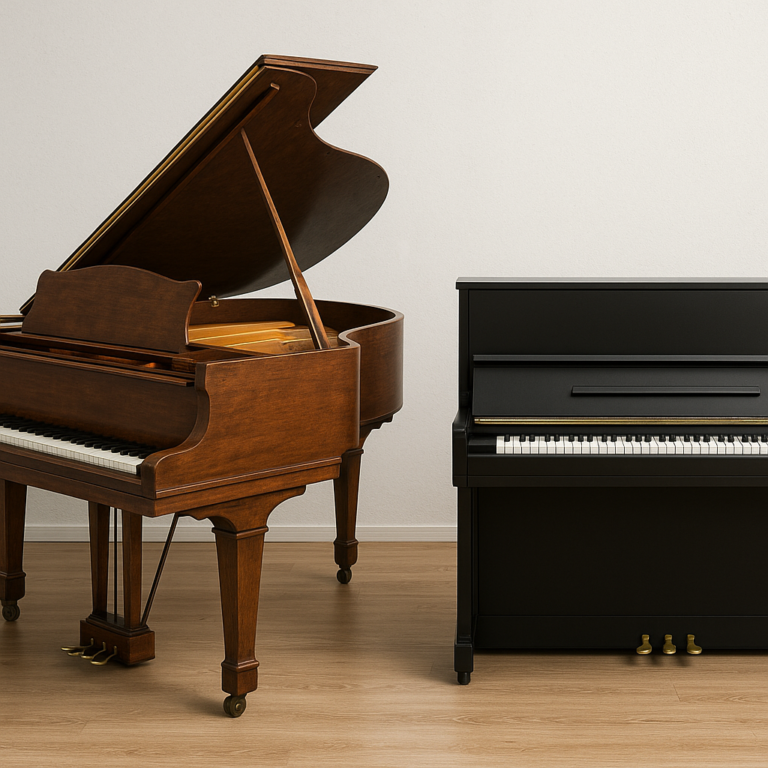
🏠 Acoustic Pianos: The Timeless Choice for Purists
If you have the space, the budget, and the desire for the authentic experience, an acoustic piano is the only way to go. But which type?
Grand Pianos: The Gold Standard
- Mechanism: Horizontal strings, gravity-based action.
- Pros: Faster repetition of notes, superior tone, better resonance.
- Cons: Huge footprint, expensive, difficult to move.
- Best For: Concert halls, large living rooms, serious classical pianists.
Upright Pianos: The Space Saver
- Mechanism: Vertical strings, spring-based action.
- Pros: Compact, more affordable, still offers a real acoustic sound.
- Cons: Slower action repetition, less resonance than grands.
- Best For: Apartments, schools, home practice.
Brands to Watch
- Steinway & Sons: The pinnacle of luxury and sound.
- Yamaha (CF Series): Reliable, consistent, and widely used in studios.
- Kawai (Shigeru Kawai): Known for warm, mellow tones.
- Bösendorfer: Famous for their extra keys (92 keys) and deep bass.
Did you know? A well-maintained acoustic piano can last 30 to 50 years or more. Some vintage Steinways from the 1920s are still being played in concert halls today!
🎓 Which is Better for Beginners? A Real-World Perspective
This is the question that keeps parents up at night. Should I buy a digital or an acoustic for my child?
The Case for Digital
- Lower Barrier to Entry: You can get a decent digital piano for a fraction of the cost of a decent acoustic.
- Silent Practice: If your child practices at odd hours, the headphone jack is a lifesaver.
- Motivation: Built-in lights, games, and apps (like Flowkey or Skove) can make learning fun.
- No Tuning Woes: No surprise bills for tuning.
The Case for Acoustic
- Developing Proper Technique: The resistance of the keys teaches finger strength and control.
- Ear Training: Hearing the natural overtones and resonance helps develop a better ear.
- Commitment: Buying an acoustic signals a serious commitment to the instrument.
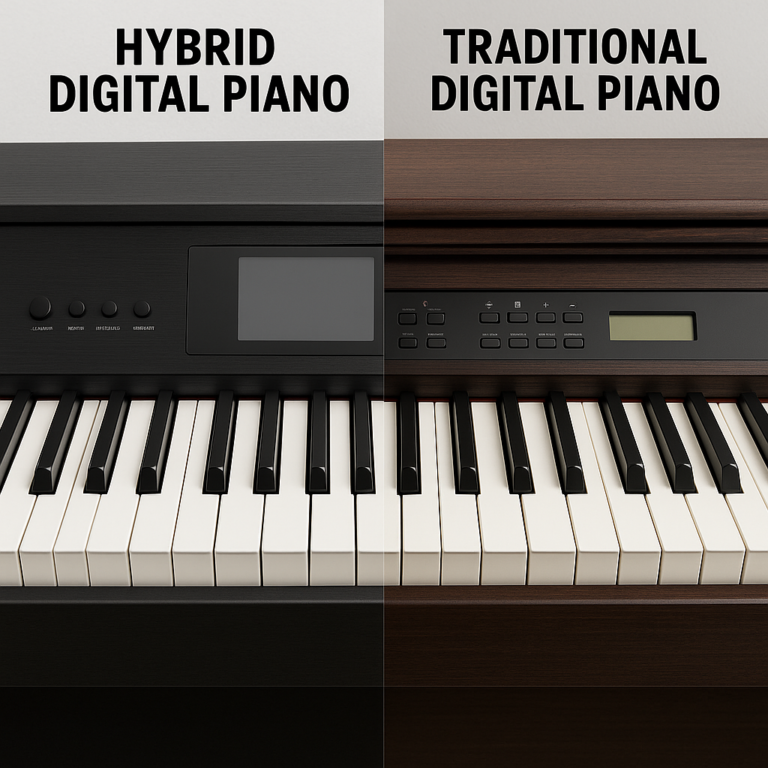
The Hybrid Solution
If you can’t decide, look at hybrid pianos like the Yamaha NU1X or Kawai Novus NV10. These have a real acoustic action but produce sound digitally. They offer the best of both worlds but come with a higher price tag.
Our Advice: If your budget allows, start with a high-quality digital piano (like the Kawai CA series or Yamaha Clavinova). If the student sticks with it for 2–3 years, upgrade to an acoustic. If they quit, you haven’t lost a fortune.
🛠️ Care and Maintenance: Tuning, Cleaning, and Humidity Control
Once you own a piano, the work begins. Here is how to keep your instrument in top shape.
Acoustic Piano Care
- Tuning: Hire a professional Registered Piano Technician (RPT) at least twice a year. More often if you live in a humid climate.
- Humidity Control: Keep the relative humidity between 40% and 50%. Use a piano humidifier or dehumidifier system (like the Dampp-Chase system) to prevent cracking and tuning instability.
- Cleaning: Dust the keys with a soft, dry cloth. Never use chemical cleaners.
- Regulation: Every 5–10 years, the action may need regulation (adjusting the mechanical parts) to ensure even touch.
Digital Piano Care
- Cleaning: Wipe the keys with a slightly damp cloth. Avoid alcohol-based cleaners as they can damage the plastic or synthetic ivory.
- Power: Always unplug the piano during thunderstorms to protect the electronics.
- Updates: Check the manufacturer’s website for firmware updates to keep the sound engine and connectivity features fresh.
- Environment: While less sensitive than acoustics, avoid extreme heat or direct sunlight, which can warp the plastic keys.
💡 Common Myths Debunked: Digital vs. Acoustic Realities
Let’s bust some myths that are floating around the internet.
Myth 1: “Digital pianos are just toys.”
Reality: Modern high-end digital pianos cost as much as a mid-range acoustic and offer professional-grade sound and action. They are used by touring artists and in recording studios.
Myth 2: “You can’t learn dynamics on a digital piano.”
Reality: While the range is finite, high-quality digital pianos have velocity sensitivity that allows for a wide range of dynamics. The limitation is in the timbre change, not the volume change.
Myth 3: “Acoustic pianos never go out of tune.”
Reality: Acoustic pianos are always going out of tune. They are constantly reacting to temperature and humidity changes. They need regular tuning to stay in pitch.
Myth 4: “Digital pianos are cheaper to own.”
Reality: While the upfront cost is lower, the resale value of a digital piano is poor. An acoustic piano is an investment; a digital piano is an expense.
🧠 Fun Trivia: Did You Know?
- The Longest Piano: The world’s longest piano has 102 keys (compared to the standard 8). It was built by a company called Bösendorfer.
- The Heaviest Piano: A concert grand piano can weigh up to 1,20 pounds (54 kg).
- The First Digital Piano: The Casio MT-40 (1980) was one of the first portable digital pianos, but it sounded like a toy.
- The “Silent” Piano: The first “silent” acoustic piano (which allows you to play with headphones) was introduced by Yamaha in the 190s.
- String Count: A standard piano has about 230 strings. That’s a lot of tension!
🏁 Final Verdict: Making the Right Choice for Your Journey
So, where does this leave us? The choice between a digital piano and an acoustic piano isn’t about which one is “better” in a vacuum. It’s about which one is better for you.
If you value authenticity, resonance, and long-term investment, and you have the space and budget, the acoustic piano is your soulmate. It is an instrument that will inspire you for decades.
If you value convenience, silence, versatility, and affordability, the digital piano is your perfect partner. It fits into modern life, adapts to your schedule, and offers features an acoustic can only dream of.
The Ultimate Question: Are you playing for the sound or for the experience?
- If it’s the sound (the physical vibration, the room resonance), go Acoustic.
- If it’s the experience (the music, the practice, the fun), a high-end Digital might be all you need.
Don’t let the “purity” of the acoustic scare you away from the digital, and don’t let the “convenience” of the digital make you settle for less than you deserve. Try them both. Go to a store, play a Yamaha Clavinova, then play a Yamaha Grand. Let your fingers decide.
In the end, the best piano is the one that makes you want to play. Whether it’s the click of a hammer or the hum of a speaker, if it inspires you, it’s the right choice.
🔗 Recommended Links
Ready to take the plunge? Here are some top picks and resources to help you find your perfect match.
Top Digital Pianos:
- Kawai CA9: Amazon | Sweetwater | Kawai Official
- Yamaha CLP-785: Amazon | Musician’s Friend | Yamaha Official
- Roland HP704: Amazon | Sweetwater | Roland Official
Top Acoustic Pianos:
- Yamaha U1 Upright: Amazon | Sweetwater | Yamaha Official
- Steinway Model O Grand: Steinway Official
Books & Resources:
❓ Frequently Asked Questions (FAQ)

Is a digital piano better for beginners than an acoustic piano?
H3: Is a digital piano better for beginners than an acoustic piano?
For many beginners, yes, a digital piano is the better starting point. The primary reasons are cost and flexibility. A decent digital piano is significantly cheaper than a decent acoustic, and the ability to practice with headphones removes the barrier of disturbing others. Additionally, digital pianos often come with built-in learning tools and MIDI connectivity that can accelerate the learning process. However, if the student is serious about classical performance, an acoustic piano is eventually necessary to develop the proper touch and dynamics.
Read more about “🎹 Top 10 Acoustic Piano Brands for Starters (2026)”
Can you replace an acoustic piano with a digital piano for professional use?
H3: Can you replace an acoustic piano with a digital piano for professional use?
In many professional settings, yes, but with caveats. For pop, rock, jazz, and studio recording, digital pianos are often preferred due to their versatility, MIDI capabilities, and consistent sound. Many professional pianists use high-end digital pianos like the Nord Piano or Roland RD series on stage. However, for classical solo recitals or concert halls, the acoustic piano remains the standard. The resonance and dynamic range of an acoustic piano are still unmatched for the most demanding repertoire.
Read more about “🎹 Digital Piano Brand Comparison 2026: The 7 Truths They Won’t Tell You”
What are the maintenance costs of acoustic pianos compared to digital pianos?
H3: What are the maintenance costs of acoustic pianos compared to digital pianos?
Acoustic pianos require annual tuning (2x per year), costing $10–$20 per session, plus occasional regulation and voicing every few years. Over 10 years, this can add up to $2,0–$4,0 in maintenance. Digital pianos have zero maintenance costs other than occasional cleaning and potential electronic repairs (which are rare). The only “cost” for a digital piano is the depreciation in value over time.
Read more about “🎹 7 Must-Have Features for Your First Piano (2026)”
How does the touch and feel of a digital piano compare to a real acoustic piano?
H3: How does the touch and feel of a digital piano compare to a real acoustic piano?
High-end digital pianos use weighted hammer actions to mimic the feel of an acoustic. Brands like Kawai and Yamaha have made incredible strides, with some models using wooden keys and real hammer mechanisms. However, the infinite gradation of an acoustic action is still superior. On an acoustic, the resistance changes subtly as you press the key, and the repetition speed is faster. On a digital, the action is often binary (on/off) and may feel slightly “lighter” or “stiffer” depending on the model.
📚 Reference Links
- Yamaha Musical Instrument Guide: Digital Piano vs. Acoustic Piano
- Liberty Park Music: Digital vs. Acoustic Piano Guide
- Music Stack Exchange: Is a digital or acoustic piano a better option for a beginner?
- Steinway & Sons: Piano Care and Maintenance
- Kawai: Digital Piano Technology
- Roland: SuperNATURAL Piano Modeling