Support our educational content for free when you buy through links on our site. Learn more
🎹 7 Must-Have Features for Your First Piano (2026)

When you ask what features should I look for when buying a piano for a beginner, the answer is simple: prioritize fully weighted 8-key action above all else, or you will hit a frustrating wall within months. Without this critical element, you cannot develop the finger strength or dynamic control needed for real music, regardless of how many bells and whistles the instrument has.
We’ve seen too many students quit because they started on a $150 toy keyboard that felt like pressing a calculator button. One of our team members once watched a talented student struggle for a year on a semi-weighted synth before realizing they had to relearn their entire touch from scratch.
The good news is that modern digital pianos have made this easier than ever, offering realistic hammer actions at prices that fit most budgets. Whether you are eyeing a sleek Yamaha or a warm-sounding Kawai, knowing exactly what to look for saves you time, money, and heartache.
Key Takeaways
- Weighted Action is Non-Negotiable: Always choose fully weighted, hammer-action keys to mimic a real piano and build proper technique.
- Full 8-Key Range: Stick to 8 keys to ensure you can play standard repertoire without hitting the edge of the keyboard.
- Polyphony Matters: Look for at least 64-note polyphony (128 is better) to prevent notes from cutting off during complex passages.
- Headphone Jack is Essential: For apartment living or late-night practice, a headphone output is a survival feature, not a luxury.
- Stick to Reputable Brands: Choose established names like Yamaha, Roland, Kawai, or Casio to ensure durability and resale value.
Ready to find your perfect match?
Table of Contents
- ⚡️ Quick Tips and Facts
- 🎹 The Evolution of Keys: A Brief History of Beginner Pianos
- 🔍 What Features Should I Look for When Buying a Piano for a Beginner?
- 1. Weighted vs. Semi-Weighted Keys: Why Touch Matters Most
- 2. The Magic of 8 Keys: Do You Really Need the Full Range?
- 3. Touch Sensitivity and Velocity: Making Music with Dynamics
- 4. Sound Engine Quality: Digital vs. Acoustic Tone Realism
- 5. Polyphony Count: Why 128 Notes Beats 64 Every Time
- 6. Built-in Speakers and Headphone Jacks: Practice Without Disturbing the Neighbors
- 7. Connectivity Options: USB, MIDI, and Bluetooth for Modern Learning
- 8. Furniture Design vs. Portable Stands: Aesthetics Meet Functionality
- 🤔 Is It Better to Learn Piano on a Piano or Keyboard?
- 🎼 Is It Better to Learn Piano or Keyboard First?
- 📏 Is It Okay to Learn Piano on a Small Keyboard?
- 💻 Is It Better to Learn Piano Online or In-Person?
- 💰 How Much Should a Beginner Pay for a Piano?
- 🏆 Top Contenders: Best Acoustic Beginner Piano 2024
- 🔁 Top Contenders: Best Used Beginner Piano 2024
- 🎹 Top Contenders: Best All-Around Digital Piano for Beginners 2024
- 🛠️ Essential Accessories Every New Player Needs
- 🚫 Common Pitfalls to Avoid When Shopping for Your First Instrument
- 🎓 Final Thoughts: Your Journey Starts Here
- ❓ FAQ: Your Burning Questions Answered
- 🔗 Recommended Links
- 📚 Reference Links
⚡️ Quick Tips and Facts
Before we dive into the deep end of the piano pool, let’s grab a life preserver. Here are the absolute non-negotiables if you want your musical journey to last longer than a TikTok trend.
- Weighted Keys are King: If the keys feel like pressing a springy mouse button, walk away. You need fully weighted, hammer-action keys to build the finger strength required for real playing.
- 8 Keys or Bust: While 61-key keyboards are cute, they are a dead end for serious learning. You need the full range to avoid hitting a wall six months in.
- Headphones are a Lifeline: If you live in an apartment or have a sleeping toddler, a headphone jack isn’t a luxury; it’s a survival tool.
- Polyphony Matters: Don’t settle for less than 64-note polyphony. Anything lower, and your complex chords will start “stealing” notes from each other.
- Brand Reputation: Stick to the giants. Yamaha, Roland, Kawai, Casio, and Korg have decades of R&D. Avoid the “mystery brands” on Amazon that promise the world for $150.
Did you know? The average acoustic piano has over 12,0 moving parts. A digital piano has significantly fewer, which is why they rarely need tuning!
For a deeper dive into the heavy hitters, check out our guide on What are the best piano brands for beginners?.
🎹 The Evolution of Keys: A Brief History of Beginner Pianos
You might think the piano has looked the same since Mozart was scribling sonatas, but the journey from the clavichord to the modern digital workstation is a wild ride.
In the early 170s, Bartolomeo Cristofori invented the gravicembalo col piano e forte (harpsichord with soft and loud). Why? Because the harpsichord plucked strings, meaning you couldn’t change the volume by how hard you hit the key. The piano allowed for dynamics—the ability to play pianissimo (very soft) or fortissimo (very loud).
Fast forward to the 20th century, and the acoustic upright became the standard for beginners. It was heavy, loud, and required a professional tuner twice a year. Then came the 1980s, and the digital revolution. Suddenly, you could plug in headphones, record your playing, and even simulate a grand piano in a dorm room.
Today, we stand at a fascinating crossroads. We have hybrid pianos that combine acoustic actions with digital sound engines, and smart pianos that light up with LED guides. But the core question remains: What makes a piano “beginer-friendly”? It’s not just about the price tag; it’s about the instrument’s ability to teach you without teaching you bad habits.
If you’re curious about how we got here, explore our Piano History section for a full timeline.
🔍 What Features Should I Look for When Buying a Piano for a Beginner?
So, you’re ready to buy. But the aisles are full of shiny boxes and confusing specs. Let’s break down the anatomy of a perfect beginner piano.
1. Weighted vs. Semi-Weighted Keys: Why Touch Matters Most
This is the single most important feature. If you skip this, you are setting yourself up for failure.
- Fully Weighted (Hamer Action): These keys mimic the mechanical action of an acoustic piano. Inside, there are tiny hammers that give resistance. When you press harder, the hammer hits the string (or sensor) harder, creating a louder sound. This is essential for developing finger strength and control.
- Semi-Weighted: These have a bit of resistance but rely more on springs. They feel “bouncier” and are often found on synthesizers. They are not suitable for learning classical piano technique.
- Unweighted: These are the “toy” keys. Pressing them feels like tapping a calculator. Avoid these at all costs if you plan to take lessons.
Pro Tip: If you can’t visit a store, buy from a retailer with a good return policy so you can test the “heft” of the keys at home.
2. The Magic of 8 Keys: Do You Really Need the Full Range?
You might see 61-key or 76-key keyboards for half the price. Why pay for the extra 20+ keys?
- Repertoire Limitations: Most piano music, even beginner pieces, eventually uses the full range. A 61-key keyboard cuts off the high and low ends, forcing you to transpose or stop playing when you hit the edge.
- Hand Coordination: Learning to navigate the full 8-key span is a skill in itself. Starting small makes the transition to a full-size instrument jarring and difficult later.
- The “One-and-Done” Rule: Buying an 8-key instrument means you won’t need to upgrade just because you ran out of keys.
3. Touch Sensitivity and Velocity: Making Music with Dynamics
A piano that plays the same volume regardless of how hard you hit it is a robot, not an instrument.
- Velocity Sensitivity: This is the technical term for “touch sensitivity.” The keyboard measures how fast the key is pressed.
- Why it matters: Music is about emotion. You need to be able to play a soft, sad melody and a loud, triumphant fanfare. Without velocity sensitivity, you can’t express feling.
- Levels of Sensitivity: Look for keyboards with adjustable touch sensitivity (Light, Medium, Heavy). This allows you to customize the feel as your fingers get stronger.
4. Sound Engine Quality: Digital vs. Acoustic Tone Realism
In the digital world, the “sound” is a recording of a real piano. The quality of this recording is everything.
- Sampling: High-end digital pianos use “multi-sampling,” where they record a single key at different velocities (soft, medium, hard) to create a realistic sound.
- Resonance: Good digital pianos simulate string resonance (when other strings vibrate sympathetically) and damper resonance (the sound of the dampers lifting off the strings).
- The “Toy” Sound: Cheap keyboards often use simple synthesis or low-quality samples that sound like 8-bit video game music. This kills motivation.
5. Polyphony Count: Why 128 Notes Beats 64 Every Time
Polyphony is the maximum number of notes a digital piano can play at once.
- The Problem: When you hold the sustain pedal, notes keep ringing. If you play a complex chord while holding a melody, the piano might run out of “memory” for notes.
- The Result: The oldest notes get cut off abruptly, creating a glitchy, annoying sound.
- The Rule: 64-note polyphony is the absolute minimum for beginners. 128 or 256 notes is the sweet spot for future-proofing.
6. Built-in Speakers and Headphone Jacks: Practice Without Disturbing the Neighbors
- Speakers: Don’t judge a book by its cover, but do judge a piano by its speakers. Small, tiny speakers make practice sound bad. Look for stereo speakers with decent wattage (at least 7W per channel).
- Headphone Jack: This is non-negotiable for apartment dwellers. It allows for late-night practice sessions without waking the neighbors (or your cat).
7. Connectivity Options: USB, MIDI, and Bluetooth for Modern Learning
The modern piano is a gateway to the digital world.
- USB to Host: Connects directly to a computer or tablet for learning apps like Simply Piano or Flowkey.
- Bluetooth MIDI: Allows wireless connection to apps. No cables!
- Audio Output: Essential if you want to plug into a PA system or external speakers later.
8. Furniture Design vs. Portable Stands: Aesthetics Meet Functionality
- Portable: Lightweight, easy to move, often comes with a simple X-stand. Great for small spaces or if you move often.
- Furniture Style: Looks like a real piano, often includes a built-in stand and three pedals. Better for stability and a “real” playing experience, but heavy and hard to move.
🤔 Is It Better to Learn Piano on a Piano or Keyboard?
This is the eternal debate. Let’s clear the air.
The Short Answer: If you want to learn piano, you need a piano. If you want to make electronic music or just mess around, a keyboard might suffice.
The Nuance:
- Piano (Acoustic or Digital): Designed to emulate the feel and sound of a grand piano. The keys are weighted, the action is complex, and the sound is rich. This is what you need for classical, jazz, or pop piano.
- Keyboard: Often refers to synthesizers or arranger keyboards. They may have unweighted keys, hundreds of sounds (drums, strings, sirens), and auto-acompaniment features.
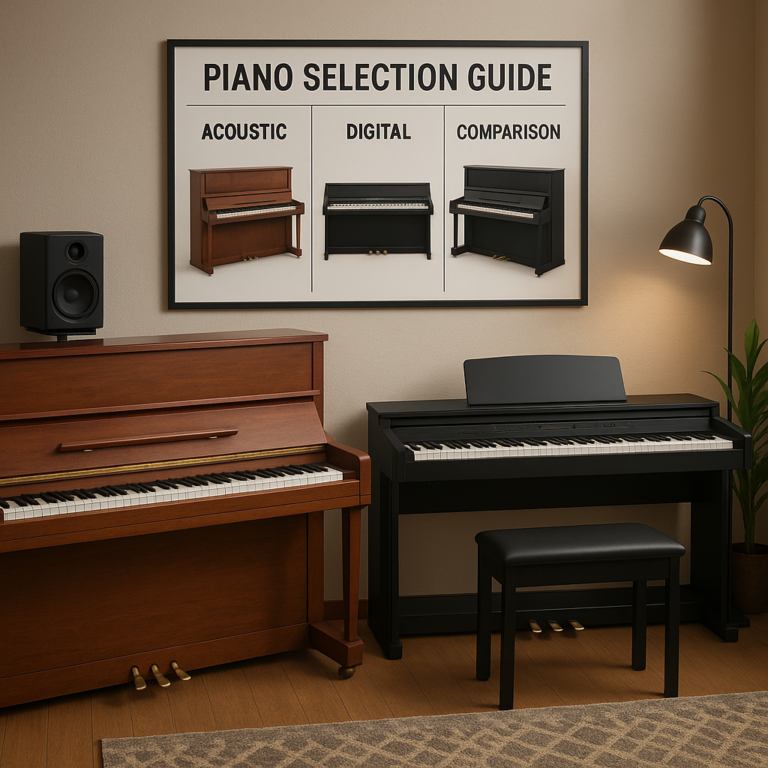
The Verdict: For a beginner, a digital piano is the perfect middle ground. It has the weighted keys of a real piano but the convenience of a keyboard.
🎼 Is It Better to Learn Piano or Keyboard First?
If you are torn between the two, here is the reality check: Learning on a non-weighted keyboard first is like learning to drive a car with no gas pedal.
You might learn the notes, but you won’t learn the dynamics or touch. When you eventually switch to a real piano, your fingers will feel weak, and you’ll have to relearn how to control the volume.
Recommendation: Start with a weighted digital piano. It teaches you the correct technique from day one. If you later decide you want to play synthesizers, you can easily adapt. The reverse is much harder.
📏 Is It Okay to Learn Piano on a Small Keyboard?
We get this question a lot. “My kid is small, so a 61-key keyboard is fine, right?”
The Hard Truth: No.
- Muscle Memory: Your hands need to learn the distance between octaves. A 61-key keyboard distorts this spatial awareness.
- Repertoire: As mentioned earlier, you will hit a wall. You can’t play “Chopsticks” properly if the right hand runs out of keys.
- The Exception: The only time a smaller keyboard is acceptable is for very young children (under 5) as a “toy” to see if they are interested. But the moment they show serious interest, upgrade to 8 keys.
💻 Is It Better to Learn Piano Online or In-Person?
Both have their place, but they serve different needs.
- In-Person Lessons: The gold standard. A teacher can correct your posture, hand shape, and fingerings in real-time. They can hear nuances you can’t.
- Online Lessons/Apps: Great for motivation, structure, and learning at your own pace. Apps like Simply Piano or Flowkey are fantastic for gamifying the experience.
The Hybrid Approach: Many students start with an app to build confidence and then take occasional in-person lessons to refine their technique.
💰 How Much Should a Beginner Pay for a Piano?
Let’s talk money. How much is too much? How much is too little?
- The “Too Cheap” Zone ($10 – $250): These are usually toy keyboards. They have unweighted keys, poor sound, and will break your spirit. Avoid.
- The Sweet Spot ($40 – $80): This is where you find quality entry-level digital pianos from reputable brands. They have weighted keys, good sound, and will last for years.
- The “Stretch” Zone ($80 – $1,50): If you are serious and have the budget, this gets you furniture-style digital pianos or high-end portable models with better speakers and actions.
- Acoustic Pianos: A new, decent upright starts around $3,0 – $5,0. Used ones can be found for less, but factor in tuning and moving costs.
Insight: It is better to buy a $60 digital piano than a $2,0 acoustic piano that sits out of tune and unmoved.
🏆 Top Contenders: Best Acoustic Beginner Piano 2024
If you have the space and the budget, an acoustic piano offers an unmatched experience.
Yamaha B1
The Yamaha B1 is the gold standard for entry-level uprights. It’s compact, reliable, and holds its value incredibly well.
| Feature | Rating (1-10) | Notes |
|---|---|---|
| Design | 9 | Slek, modern, fits in small spaces. |
| Sound Quality | 8 | Surprisingly rich for its size. |
| Action | 9 | Yamaha’s standard action is smooth and responsive. |
| Value Retention | 10 | Yamaha pianos hold value better than almost any other brand. |
| Maintenance | 7 | Requires tuning 1-2 times a year. |
Pros:
- Compact footprint (great for apartments).
- Excellent build quality.
- Holds resale value.
Cons:
- Smaller soundboard means less resonance than larger models.
- No silent mode (unless you buy the SC3 silent system, which adds cost).
👉 Shop Yamaha B1 on:
- Amazon: Search Yamaha B1 Upright Piano
- Sweetwater: Search Yamaha B1
- Yamaha Official: Yamaha B1 Product Page
Kawai K-15
A strong competitor to the Yamaha B1, the Kawai K-15 offers a slightly warmer tone and a unique action.
| Feature | Rating (1-10) | Notes |
|---|---|---|
| Design | 8 | Classic upright look. |
| Sound Quality | 9 | Warm, mellow tone typical of Kawai. |
| Action | 9 | Kawai’s ABS carbon fiber action is durable and fast. |
| Value Retention | 8 | Good, but slightly less than Yamaha. |
Pros:
- ABS carbon fiber action is resistant to humidity changes.
- Warm, singing tone.
Cons:
- Slightly larger footprint than the B1.
- Harder to find in stock compared to Yamaha.
👉 Shop Kawai K-15 on:
- Amazon: Search Kawai K-15
- Kawai Official: Kawai K-15 Product Page
🔁 Top Contenders: Best Used Beginner Piano 2024
Buying used can be a gamble, but if you know what to look for, it’s the best value.
Used Yamaha U1
The Yamaha U1 is the “Toyota Camry” of pianos. It’s everywhere, reliable, and sounds great.
- Why it’s great: Built like a tank. You can find them from the 1970s to the 190s. They hold their tuning well and have a bright, clear tone.
- What to watch for: Check the pin block (does it hold tuning?) and the hammers (are they worn down?). Always hire a technician for a pre-purchase inspection.
👉 Shop Used Yamaha U1 on:
- Reverb: Search Used Yamaha U1
- Piano Mart: Search Used Yamaha U1
Used Kawai K-3
Similar to the U1 but with a warmer tone. The K-3 is a workhorse.
- Why it’s great: The ABS action is incredibly durable. Even older models often play like new.
- What to watch for: Ensure the keys are level and the pedals function smoothly.
👉 Shop Used Kawai K-3 on:
- Reverb: Search Used Kawai K-3
- Piano Mart: Search Used Kawai K-3
🎹 Top Contenders: Best All-Around Digital Piano for Beginners 2024
If you need a digital solution, these are the kings of the hill.
Yamaha P-145BT
The successor to the legendary P-45. It’s simple, reliable, and sounds fantastic.
| Feature | Rating (1-10) | Notes |
|---|---|---|
| Key Action | 9 | Graded Hammer Compact (GHC) action. |
| Sound | 9 | Yamaha CFX Concert Grand samples. |
| Connectivity | 8 | Bluetooth Audio and MIDI included. |
| Portability | 10 | Only 26 lbs. |
| Value | 10 | Incredible bang for your buck. |
Pros:
- Simple interface (no confusing menus).
- Bluetooth Audio allows you to stream backing tracks wirelessly.
- Lightweight and portable.
Cons:
- Speakers are decent but not amazing.
- 64-note polyphony (enough for beginners, but not for advanced pieces).
👉 Shop Yamaha P-145BT on:
- Amazon: Search Yamaha P-145BT
- Sweetwater: Search Yamaha P-145BT
- Yamaha Official: Yamaha P-145BT Product Page
Roland FP-10
The best key feel in its price range. If you care about how it feels, this is the one.
| Feature | Rating (1-10) | Notes |
|---|---|---|
| Key Action | 10 | PHA-4 Standard with escapement. |
| Sound | 9 | SuperNATURAL Piano sound engine. |
| Connectivity | 7 | Bluetooth MIDI (no Bluetooth Audio). |
| Portability | 9 | 31 lbs. |
| Value | 9 | Premium feel at a budget price. |
Pros:
- Escapement mechanism mimics the “click” of a real grand piano.
- Ivory-fel keytops prevent slipping.
- Excellent sound engine.
Cons:
- No Bluetooth Audio (you need a cable for backing tracks).
- Basic button interface.
👉 Shop Roland FP-10 on:
- Amazon: Search Roland FP-10
- Sweetwater: Search Roland FP-10
- Roland Official: Roland FP-10 Product Page
Kawai ES120
The sound king. If you want the most realistic piano tone, Kawai delivers.
| Feature | Rating (1-10) | Notes |
|---|---|---|
| Key Action | 9 | Responsive Hammer Compact (RHC) action. |
| Sound | 10 | Samples from the Shigeru Kawai SK-EX. |
| Connectivity | 7 | USB-MIDI, no Bluetooth. |
| Portability | 9 | 26 lbs. |
| Value | 9 | Great sound for the price. |
Pros:
- Unbeatable sound quality for the price.
- Lightweight and portable.
- Includes high-quality headphones.
Cons:
- No Bluetooth.
- Key action is slightly lighter than Roland’s.
👉 Shop Kawai ES120 on:
- Amazon: Search Kawai ES120
- Sweetwater: Search Kawai ES120
- Kawai Official: Kawai ES120 Product Page
🛠️ Essential Accessories Every New Player Needs
You bought the piano. Now what? Don’t forget these essentials.
- A Proper Stand: Do not use an X-stand if you can avoid it. They wobble. Get a Z-stand or a furniture stand for stability.
- A Quality Sustain Pedal: The one that comes in the box is usually a cheap on/off switch. Upgrade to a half-pedal capable pedal (like the Roland DP-10 or Yamaha FC3A) for better expression.
- An Adjustable Bench: Your posture is crucial. A proper bench allows you to adjust height so your elbows are level with the keys.
- Headphones: Get a pair of closed-back headphones for better sound isolation.
- Metronome: If your piano doesn’t have one built-in, get a physical one or a free app.
🚫 Common Pitfalls to Avoid When Shopping for Your First Instrument
- Buying a “Toy”: If it costs less than $30 and has unweighted keys, it’s a toy.
- Ignoring the Pedal: A cheap sustain pedal can ruin the experience.
- Skipping the Test: If possible, play the piano before you buy. Key feel is subjective.
- Overspending on Features: You don’t need 50 voices or a built-in speaker system that costs more than the piano. Focus on the piano sound and key action.
- Buying Used Without Inspection: For acoustic pianos, always hire a technician.
🎓 Final Thoughts: Your Journey Starts Here
You’ve made it to the end of the guide, and hopefully, the fog has cleared. Remember, the “perfect” piano is the one that inspires you to play. Whether it’s a sleek Yamaha P-145BT, a classic Yamaha U1, or a Kawai ES120, the most important factor is you.
Don’t let the fear of making a wrong choice paralyze you. The features we discussed—weighted keys, 8 keys, good sound—are the guardrails that will keep you on the right path. Once you have those, the rest is just about finding the instrument that feels right in your hands.
So, what are you waiting for? The keys are calling. 🎹✨
Conclusion
Choosing your first piano is a thrilling milestone. We’ve covered the essentials: weighted keys are non-negotiable, 8 keys are the standard, and sound quality drives motivation. Whether you opt for the reliability of a Yamaha, the warmth of a Kawai, or the realistic action of a Roland, the goal is to find an instrument that supports your growth without breaking the bank.
Our Top Recommendation:
For most beginners, the Yamaha P-145BT or Roland FP-10 offers the best balance of price, performance, and features. They provide the weighted action needed for proper technique and the connectivity to learn with modern apps. If you have the space and budget for an acoustic, the Yamaha B1 is a timeless choice that will serve you for decades.
Positives of Digital Pianos:
- ✅ No tuning required.
- ✅ Headphone practice for silent sessions.
- ✅ Portable and space-efficient.
- ✅ Built-in learning tools and connectivity.
Negatives of Digital Pianos:
- ❌ Lack of the full acoustic resonance (though high-end models are closing the gap).
- ❌ Dependence on electricity.
- ❌ Key action, while good, is not identical to a grand piano.
Positives of Acoustic Pianos:
- ✅ Unmatched sound and touch.
- ✅ No batteries or power needed.
- ✅ Heirloom quality that holds value.
Negatives of Acoustic Pianos:
- ❌ Requires regular tuning and maintenance.
- ❌ Heavy and difficult to move.
- ❌ Loud (no silent practice without expensive add-ons).
Final Advice:
Don’t rush. Test as many instruments as you can. Listen to your teacher’s advice. And most importantly, start playing. The best piano is the one you actually use.
🔗 Recommended Links
👉 Shop Top Picks:
- Yamaha P-145BT: Amazon | Sweetwater | Yamaha Official
- Roland FP-10: Amazon | Sweetwater | Roland Official
- Kawai ES120: Amazon | Sweetwater | Kawai Official
- Yamaha B1 Upright: Piano Mart | Yamaha Official
Essential Books:
- Alfred’s Basic Adult Piano Course – The gold standard for self-study.
- Hanon: The Virtuoso Pianist – Essential for finger exercises.
❓ FAQ: Your Burning Questions Answered
What accessories do I need when buying a piano for a beginner?
You need a stable stand (not an X-stand), an adjustable bench, a quality sustain pedal (preferably half-pedal capable), and headphones. If you buy a digital piano, ensure it comes with a power adapter.
Read more about “💸 How Much Should a Beginner Spend on a Piano? (2026 Guide)”
Should I buy a used or new piano for a beginner?
New digital pianos are generally safer bets due to warranties and no hidden wear. Used acoustic pianos can be incredible values, but only if inspected by a qualified technician. Avoid used digital pianos unless you can test every key and port.
Read more about “🎹 Acoustic vs. Digital Piano: The Real Difference for Beginners (2026)”
What are some good beginner piano brands?
Stick to the “Big Five”: Yamaha, Roland, Kawai, Casio, and Korg. They have proven track records for quality and durability.
Read more about “🎹 Digital Piano Brand Comparison 2026: The 7 Truths They Won’t Tell You”
How much should I spend on a beginner piano?
For a quality digital piano, expect to spend $40 – $80. For an acoustic upright, the entry point is around $3,0 – $5,0 new, or $1,50 – $3,0 for a used one in good condition.
Read more about “💸 What Is the Cost of Basic Piano? (2026 Price Guide)”
Is weighted key action important for beginner pianos?
Yes, absolutely. It is the most critical feature. Unweighted keys prevent you from developing the finger strength and dynamic control needed for real piano playing.
Read more about “🎹 Casio & Nord vs. Yamaha & Kawai: The 2026 Digital Piano Showdown”
What is the ideal keyboard size for a beginner piano player?
8 keys is the standard. While 61 or 76 keys might seem cheaper, they limit your repertoire and force an upgrade sooner. Start with 8 if you are serious.
Read more about “🎹 How to Choose the Best Acoustic Piano for Your Home (2026)”
What is the difference between acoustic and digital pianos for beginners?
Acoustic pianos use strings and hammers for sound, requiring tuning and offering a unique touch. Digital pianos use samples and speakers, offering volume control, portability, and no maintenance. For most beginners, a digital piano is the more practical choice.
Read more about “🎹 Kawai vs. Yamaha: Which One is Better in 2026?”
What is the difference between 8 weighted keys and semi-weighted keys for beginners?
8 weighted keys mimic the heavy resistance of an acoustic piano, essential for technique. Semi-weighted keys have a springy feel and are better for synthesizers, not for learning piano.
Read more about “🎹 Digital vs. Acoustic Pianos: The Ultimate Pros & Cons Guide (2026)”
How much should I spend on a first acoustic or digital piano?
See the “How Much Should a Beginner Pay” section above. Generally, $50+ for digital and $3,0+ for acoustic.
Read more about “🏆 The Most Expensive Steinway Piano: 15 Record-Breaking Giants (2026)”
Are digital pianos better than acoustic pianos for learning in small apartments?
Yes. Digital pianos allow for headphone practice, are lighter, and don’t require tuning. They are the ideal solution for noise-sensitive environments.
Read more about “🎹 How to Choose the Best Digital Piano for Your Needs (2026)”
What are the essential maintenance costs for owning a beginner acoustic piano?
Expect to pay $10 – $20 per year for tuning (1-2 times a year). Moving costs can range from $20 – $50 depending on distance and stairs.
Read more about “🎹 25 Best & 21 Worst Piano Brands: The Ultimate 2026 Guide”
📚 Reference Links