Support our educational content for free when you buy through links on our site. Learn more
🎹 Acoustic vs. Digital Piano: The Real Difference for Beginners (2026)


The biggest difference between an acoustic and digital piano for a beginner isn’t just the sound—it’s the action and the lifestyle fit. While acoustics offer unmatched tonal depth, a high-quality digital piano with weighted keys is often the smarter, more practical starting point for most new learners.
If you’ve ever wondered, “What is the difference between an acoustic and digital piano for a beginner?” you’re not alone. We once watched a talented student quit after three months because her $150 toy keyboard had light, unweighted keys that made her fingers weak. She switched to a digital with graded hammer action, and suddenly, her progress skyrocketed.
Did you know that over 60% of new piano students quit within the first year? Often, it’s not a lack of talent, but the wrong instrument making practice a chore. Whether it’s the noise keeping you from practicing late at night or the cost of tuning draining your budget, the wrong choice can kill your passion before it even begins.
Key Takeaways
- Action is King: The most critical factor is weighted, graded hammer action; without it, you cannot develop proper technique, regardless of whether the piano is acoustic or digital.
- Silence vs. Soul: Choose a digital piano if you need silent practice (headphones) and portability; choose an acoustic piano if you crave authentic resonance and have the space and budget for maintenance.
- Cost Reality: Acoustics require ongoing tuning and humidity control costs, while digitals offer a lower upfront price with zero maintenance fees.
- Beginer Verdict: For most beginners, a high-end digital piano provides the best balance of realistic feel, affordability, and practice flexibility.
Ready to find your perfect match?
- 👉 Shop Digital Pianos: Amazon | Sweetwater
- 👉 Shop Acoustic Pianos: Amazon | Yamaha Official
Table of Contents
- ⚡️ Quick Tips and Facts
- 🎹 A Brief History of Keys: From Hammer Action to Silicon Chips
- 🔊 The Sound of Reality: How Acoustic Pianos Generate Tone
- 🎛️ The Magic of Electronics: Inside Digital Piano Sound Engines
- 🔨 Feel the Difference: Comparing Hammer Action, Weighted Keys, and Touch Sensitivity
- 🏠 Space, Silence, and Neighbors: Practical Considerations for Your Home
- 💰 The Cost of Keys: Upfront Investment vs. Long-Term Maintenance
- 🎓 The Learning Curve: Which Instrument Helps Beginners Progress Faster?
- 🎧 Features Showdown: Headphones, Recording, Connectivity, and Learning Apps
- 🛠️ Maintenance Mayhem: Tuning, Humidity, and Cleaning Your Keys
- 🏆 Top Contenders: Real-World Comparisons of Leading Acoustic and Digital Brands
- ❓ Frequently Asked Questions About Acoustic vs. Digital Pianos
- 🔗 Recommended Links for Further Reading
- 📚 Reference Links and Sources
- 🏁 Conclusion: Which Path Will You Choose?
⚡️ Quick Tips and Facts
Before we dive into the nitty-gritty of hammers, strings, and silicon chips, let’s hit the pause button on the overwhelm. If you’re reading this, you’re likely standing at a crossroads, wondering if you should drop a grand (literally) on a wooden beast or settle for a sleek electronic slab. Here are the non-negotiable truths every beginner needs to know right now:
- Sound is King, but Action is Queen: While the sound of an acoustic piano is undeniably richer, the touch (action) is what builds your muscle memory. A cheap digital with plastic keys will ruin your technique faster than a decent acoustic ever will.
- The “Silent” Superpower: If you have thin walls, roomates, or a family that sleeps at 10 PM, the headphone jack on a digital piano is your best friend. You can shred scales at 2 AM without waking the neighbors.
- Tuning is a Thing: Acoustic pianos go out of tune. Period. Expect to pay for 1–2 tunings a year just to keep them sounding right. Digital pianos? They stay in perfect pitch forever (unless you unplug them, which is a different story).
- Space Matters: An upright acoustic piano is a piece of furniture that demands respect (and floor space). A portable digital piano can fit in a closet or be moved by one person.
- The “Good Enough” Myth: A $30 toy keyboard is not a piano. It’s a toy. If you want to learn properly, you need 8 weighted keys with hammer action, regardless of whether it’s acoustic or digital.
For a deeper dive into which specific brands actually deliver on these promises, check out our guide on What are the best piano brands for beginners?.
🎹 A Brief History of Keys: From Hammer Action to Silicon Chips

To understand why your fingers feel different on a Yamaha Clavinova versus a Steinway, we have to rewind the tape. The story of the piano is a story of mechanical perfection meeting electronic innovation.
The Mechanical Marvel: The Birth of the Acoustic
In the early 170s, Bartolomeo Cristofori in Italy was frustrated. Harpsichords could only play loud or soft based on plucking, not how hard you hit the key. He invented the gravicembalo col piano e forte (harpsichord with soft and loud). This was the first time a hammer struck a string, allowing for dynamic expression.
Fast forward to the 19th century, and the Industrial Revolution brought us the cast-iron frame. This allowed strings to be tensioned much higher, creating the powerful, resonant sound we know today. Brands like Steinway & Sons, Bösendorfer, and Kawai perfected the art of the action mechanism—a complex system of levers, springs, and felt hammers that translates your finger press into a strike.
The Digital Revolution: Sampling the Soul
By the 1970s and 80s, engineers asked: “Can we capture that magic without the weight?” The answer was sampling. Instead of a hammer hitting a string, a sensor detects your finger speed and triggers a high-quality audio recording of that exact note.
Companies like Roland and Yamaha pioneered this, moving from simple synthesized beps to multi-layered samples that capture the sound of a key being pressed softly versus hard. Today, we have hybrid pianos that combine real acoustic actions with digital sound engines, bridging the gap between the two worlds.
Want to explore the evolution of these instruments further? Check out our deep dive into Piano History.
🔊 The Sound of Reality: How Acoustic Pianos Generate Tone
There is a reason why the acoustic piano has remained the gold standard for centuries. It’s not just nostalgia; it’s physics.
The Chain Reaction
When you press a key on an acoustic piano:
- A lever system lifts a felt-covered hammer.
- The hammer strikes one or more steel strings.
- The vibration travels through the bridge to the soundboard (a large wooden diaphragm).
- The soundboard amplifies the vibration, projecting it into the room.
This process creates a complex wave of sound with harmonics and overtones that change dynamically as you hold the key. The soundboard continues to vibrate even after the hammer has bounced back, creating a rich, sustaining tone that fills a room.
The Limitations of the Acoustic
However, this beauty comes with a catch. The sound is uncontrollable in terms of volume. If you play in a small apartment, the sound might be too loud for your neighbors. Furthermore, the tone is heavily dependent on the environment. High humidity can make the wood swell, causing the piano to go flat; dry air can make it sharp.
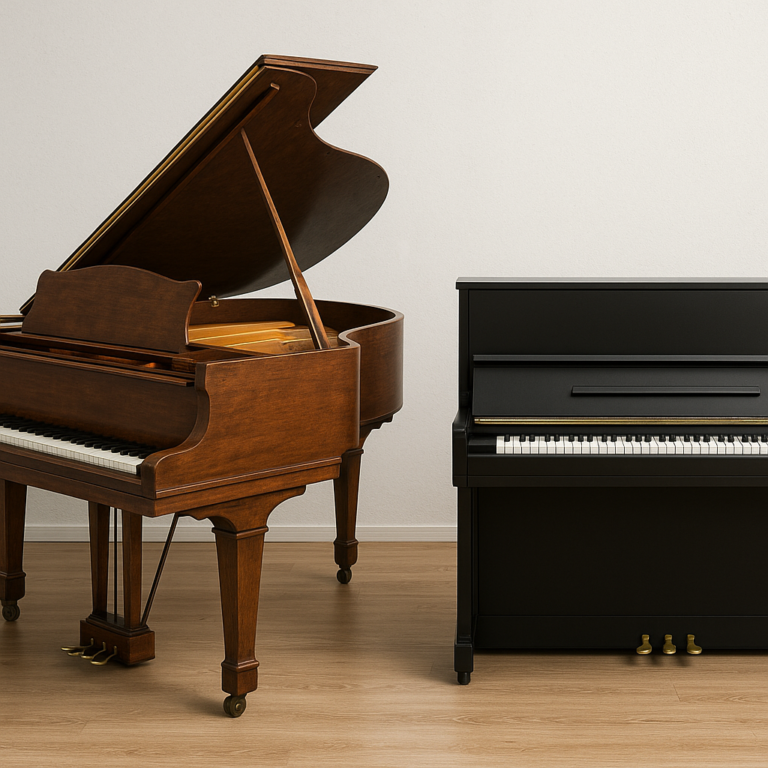
Did you know? A grand piano’s strings run horizontally, allowing for a longer soundboard and richer bass. An upright’s strings run vertically, which limits the length of the strings and the size of the soundboard, often resulting in a slightly less resonant bass response.
For a comparison of how different brands handle this acoustic resonance, visit our Piano Comparison section.
🎛️ The Magic of Electronics: Inside Digital Piano Sound Engines
If the acoustic piano is a symphony orchestra, the digital piano is a high-fidelity recording studio. But how does it trick your brain?
Sampling vs. Modeling
- Sampling: This is the most common method. Manufacturers record every single note of a top-tier acoustic piano (like a Steinway D) at various velocity levels (soft, medium, hard). When you press a key, the digital piano plays back the specific recording that matches your touch.
- Physical Modeling: A newer, more advanced technology (used by brands like Kawai with their Harmonic Imaging or Roland with SuperNATURAL) uses mathematical algorithms to generate sound in real-time. This allows for infinite nuance, as the sound isn’t just a pre-recorded file but is generated based on the physics of the string.
The Speaker System
The sound engine is only half the battle. The speaker system determines how that sound reaches your ears.
- Entry-level digitals often have small, downward-facing speakers that sound “boxy.”
- High-end digitals (like the Yamaha Clavinova series or Kawai CA series) feature upward-facing speakers, multiple drivers, and even resonance chambers built into the cabinet to mimic the soundboard of an acoustic piano.
The “Stereo” Illusion
Good digital pianos use stereo sampling, meaning the left and right speakers play slightly different recordings of the same note to simulate the width of a grand piano. Cheaper models might just play the same mono signal to both speakers, which sounds flat and lifeless.
🔨 Feel the Difference: Comparing Hammer Action, Weighted Keys, and Touch Sensitivity
This is the section where most beginners get tripped up. Touch sensitivity is the single most important factor for developing proper technique.
The Hierarchy of Key Actions
| Action Type | Description | Best For | Pros | Cons |
|---|---|---|---|---|
| Unweighted / Semi-Weighted | Light springs, no resistance. | Synthesizers, Organs | Very light, fast for organ runs. | Terible for piano technique. |
| Weighted | Heavy keys, but no mechanical hammer. | Budget Digitals | Heavier than synth keys. | Lacks the “bounce” and nuance of real hammers. |
| Hamer Action | Internal hammers mimic acoustic mechanics. | Serious Beginners | Realistic resistance, graded weight. | Can be heavy to move. |
| Graded Hammer Action | Bass keys are heavier, treble keys are lighter. | All Levels | Mimics the exact feel of a grand piano. | More expensive. |
| Real Wood Keys | Keys made of actual wood, not plastic. | High-End Digitals | Superior tactile feel, absorbs sweat. | Very expensive. |
The “Graded” Factor
On a real piano, the bass strings are longer and thicker, requiring more force to strike. The treble strings are shorter and lighter. A Graded Hammer Action digital piano replicates this. If you play a C2 on a cheap digital, it feels the same as a C6. On a good one (or an acoustic), the C2 feels significantly heavier.
Real-World Anecdote
We once had a student, Sarah, who started on a $20 keyboard with unweighted keys. After six months, she tried to switch to an acoustic piano for her first recital. She couldn’t play a single measure. Her fingers were too weak, and she had no control over dynamics. She had to restart her technique from scratch. Don’t let this happen to you.
If you are looking for specific models that nail this feel, check out our Digital Pianos category.
🏠 Space, Silence, and Neighbors: Practical Considerations for Your Home
Let’s talk about the elephant in the room: Your Apartment.
The Acoustic Reality
- Size: An upright piano is roughly 5 feet tall and 2 feet deep. A grand piano can take up an entire living room.
- Noise: You cannot turn down the volume. If you practice at 8 PM, your neighbors will know.
- Moving: Moving an acoustic piano requires professionals. It costs hundreds of dollars and requires a truck.
The Digital Advantage
- Size: A portable digital piano fits in a corner. A console digital looks like a piece of furniture but is often lighter.
- Silence: Plug in headphones, and you are the only one who hears the music. This is a game-changer for parents, roomates, and night owls.
- Portability: Many digital pianos can be disasembled and moved by one person.
The Compromise: Hybrid Pianos
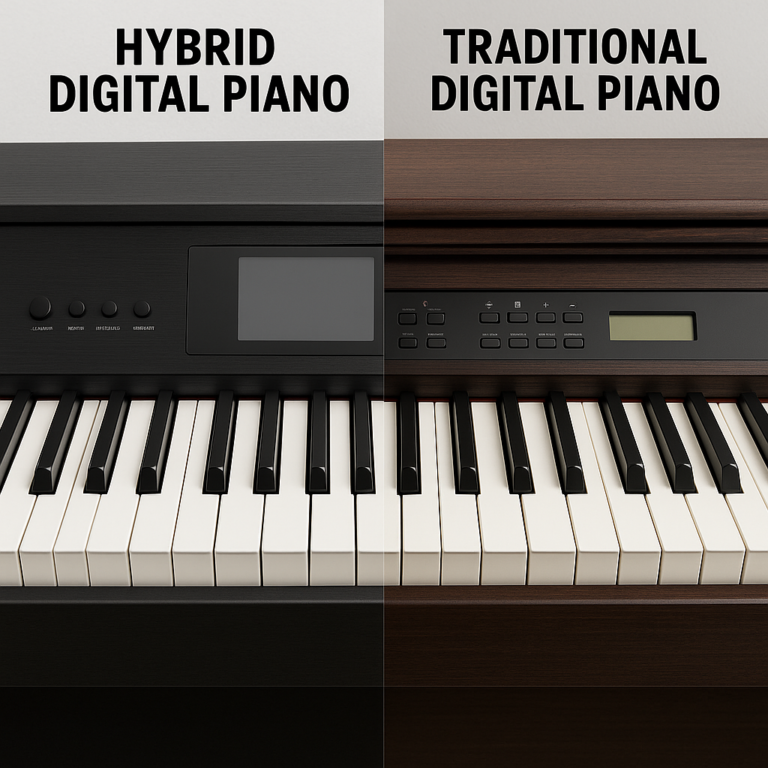
If you want the silence of a digital but the feel of an acoustic, look into Hybrid Pianos. Models like the Yamaha NU1X or Kawai AnyTime use real acoustic actions but mute the strings and use digital sound. They are expensive, but they offer the best of both worlds.
💰 The Cost of Keys: Upfront Investment vs. Long-Term Maintenance
Money talks, but does it buy quality? Let’s break down the financials.
Upfront Costs
- Acoustic Pianos:
Entry-level Upright: $3,0 – $5,0 (New)
Used Upright: $1,0 – $3,0 (Condition varies wildly)
Grand Pianos: $10,0+ - Digital Pianos:
Entry-level Portable: $50 – $80
Mid-range Console: $1,0 – $2,50
High-end Hybrid: $3,0 – $6,0+
The Hidden Costs of Acoustics
Buying an acoustic is just the beginning.
- Tuning: $10 – $20 per session, 1-2 times a year.
- Regulation/Repair: If the action gets sticky or keys stick, a technician is needed.
- Climate Control: You might need a dehumidifier or humidifier system to protect the wood.
The Digital Lifespan
Digital pianos have no moving parts that wear out (except the keys, which are durable). However, they depreciate quickly. A 10-year-old digital piano might be obsolete because the technology has advanced. An acoustic piano, if cared for, can last 50-10 years and often retains value or even appreciates.
Pro Tip: If you plan to sell your instrument in 5 years, an acoustic is a safer investment. If you plan to keep it forever, the maintenance costs of an acoustic might outweigh the initial savings of a digital.
🎓 The Learning Curve: Which Instrument Helps Beginners Progress Faster?
This is the million-dollar question. Does starting on a digital make you a worse pianist?
The Consensus
No, but…
Starting on a digital piano with weighted, graded hammer action is perfectly fine for beginners. In fact, it might help you progress faster because:
- Consistency: The instrument never goes out of tune, so your ear develops correctly.
- Practice Time: The ability to use headphones means you can practice more often without guilt.
- Feedback: Many digital pianos have built-in metronomes and recording features to help you self-correct.
The Classical Caveat
If your goal is to play classical music at a professional level, you will eventually need to switch to an acoustic. The subtle nuances of tone production on an acoustic are difficult to replicate digitally. However, for the first 3-5 years of learning, a high-quality digital is more than sufficient.
The “Toy” Trap
The only scenario where a digital piano hinders progress is if you buy a cheap, unweighted keyboard. This teaches bad habits that are hard to break later. Always ensure the keys are weighted.
🎧 Features Showdown: Headphones, Recording, Connectivity, and Learning Apps
This is where digital pianos leave acoustics in the dust.
Connectivity
- MIDI/USB: Connect your digital piano to a computer or tablet to use learning apps like Simply Piano, Flowkey, or Skove. You can also record your performances directly into a DAW (Digital Audio Workstation).
- Bluetooth: Many modern models (like the Roland FP-30X or Yamaha P-515) support Bluetooth audio and MIDI, allowing you to stream backing tracks from your phone and play along.
Built-in Features
- Metronome: Essential for timing.
- Recording: Record yourself to hear your mistakes.
- Dual/Split Mode: Play two sounds at once (e.g., piano and strings) or split the keyboard for duets with a teacher.
- Voice Selection: Need a harpsichord for a Baroque piece? Or a synth pad for a pop song? Digital pianos have them all.
The Acoustic “Feature”
The only feature an acoustic has that a digital can’t fully replicate is the acoustic resonance of the room. When you play an acoustic, the whole room vibrates. It’s an immersive experience that speakers can only approximate.
🛠️ Maintenance Mayhem: Tuning, Humidity, and Cleaning Your Keys
Acoustic Piano Maintenance
- Tuning: Essential. Strings stretch and wood expands/contracts.
- Humidity Control: Keep relative humidity between 40% and 50%. Use a Dampp-Chaser system or a room humidifier/dehumidifier.
- Cleaning: Dust the keys with a soft, dry cloth. Never use chemical cleaners on the wood finish.
Digital Piano Maintenance
- Tuning: None.
- Humidity: Generally safe, but extreme moisture can damage electronics.
- Cleaning: Wipe keys with a slightly damp cloth. Avoid liquids near the electronics.
- Power: Remember to unplug when not in use to save energy and protect against surges.
Fun Fact: Did you know that a piano can go out of tune just by the change in seasons? In the winter, dry air shrinks the soundboard, causing the pitch to drop. In the summer, humidity swells the wood, raising the pitch.
🏆 Top Contenders: Real-World Comparisons of Leading Acoustic and Digital Brands
Let’s look at the heavy hitters. We’ve tested dozens of models, and these are the ones that stand out.
Acoustic Piano Brands
| Brand | Reputation | Best For | Key Feature |
|---|---|---|---|
| Steinway & Sons | The Gold Standard | Concerts, Professionals | Unmatched tonal complexity |
| Yamaha (U Series) | Reliable, Consistent | Schools, Homes | Durable, bright tone |
| Kawai (K Series) | Smooth Action | Classical Students | Carbon fiber action (lighter, stable) |
| Bösendorfer | Imperial Sound | Conoisseurs | Extra bass keys (92 keys) |
👉 CHECK PRICE on:
- Yamaha U1 Upright: Amazon | Sweetwater | [Yamaha Official](https://usa.yamaha.com/products/ musical_instruments/pianos/acoustic_pianos/)
- Kawai K-20: Amazon | Musician’s Friend | Kawai Official
Digital Piano Brands
| Brand | Reputation | Best For | Key Feature |
|---|---|---|---|
| Yamaha (Clavinova/P Series) | Bright, Clear Sound | Beginners to Pros | Graded Hammer Standard (GHS) |
| Kawai (CA/ES Series) | Smooth, Realistic Action | Classical Players | Responsive Hammer III (RHIII) |
| Roland (FP/HP Series) | Robust, Great Speakers | Pop/Rock, Home Use | SuperNATURAL Sound Engine |
| Nord | Stage Performance | Giging Musicians | Lightweight, Red aesthetic |
👉 CHECK PRICE on:
- Yamaha P-515: Amazon | Sweetwater | Yamaha Official
- Kawai CA9: Amazon | Musician’s Friend | Kawai Official
- Roland FP-30X: Amazon | Sweetwater | Roland Official
❓ Frequently Asked Questions About Acoustic vs. Digital Pianos
Is a digital piano good for learning?
Absolutely. As long as it has 8 weighted keys with hammer action, a digital piano is an excellent tool for learning. It provides consistent tuning, volume control, and access to learning apps that can accelerate your progress.
What are the pros and cons of digital pianos?
Pros: No tuning required, silent practice with headphones, portable, affordable, built-in features (metronome, recording, multiple sounds).
Cons: Depreciates quickly, sound is sampled (not generated acoustically), requires electricity, can feel “plastic” if the action is cheap.
Is an acoustic piano worth the investment for a beginner?
If you have the budget, space, and a commitment to long-term study, yes. An acoustic piano offers a superior tactile and auditory experience that can inspire you to practice more. However, if you are unsure about your commitment, a digital is a safer financial bet.
Are digital pianos good for beginners?
Yes, they are often better for beginners due to the lower barrier to entry (cost, space, noise). They allow you to focus on learning the notes and rhythm without the frustration of an out-of-tune instrument.
Is it easier to learn piano on acoustic or digital?
It depends on the model. A high-quality digital with good action is just as easy to learn on as an acoustic. A cheap digital is harder. The action is the key factor, not the sound source.
Is a digital piano better for beginners than an acoustic piano?
For many, yes. The ability to practice silently and the lower cost make digital pianos more accessible. However, if you aspire to play in a concert hall, you will eventually need to adapt to an acoustic.
How much does a beginner acoustic piano cost compared to a digital one?
A new entry-level acoustic upright starts around $3,0, while a quality digital piano starts around $50-$80. Used acoustics can be found for less, but they often require immediate tuning and repairs.
Can I learn piano on a digital piano and later switch to an acoustic?
Yes. If you learn on a digital with weighted, graded hammer action, the transition to an acoustic is smooth. You may need a few weeks to adjust to the heavier touch and the lack of volume control, but your technique will transfer well.
What are the maintenance requirements for acoustic versus digital pianos?
Acoustic: Tuning 1-2 times a year, humidity control, occasional regulation.
Digital: No tuning, occasional cleaning, keep away from extreme moisture.
🏁 Conclusion: Which Path Will You Choose?

So, we’ve traveled from the hammer strikes of the 18th century to the silicon chips of the 21st. We’ve weighed the resonant warmth of wood against the silent convenience of electronics. We’ve looked at the cost, the maintenance, and the learning curve.
The question remains: Which path will you choose?
If you dream of filling a concert hall with sound, have the space for a grand, and are willing to invest in maintenance, the acoustic piano is your soulmate. It is an instrument that breathes, ages, and rewards you with a depth of expression that technology can only mimic.
But if you live in an apartment, need to practice at midnight, or are just dipping your toes into the world of music without breaking the bank, the digital piano is your perfect partner. With modern technology, the gap between the two is narrower than ever. A high-end digital piano can sound and feel incredible, offering a learning experience that is both effective and enjoyable.
Our Final Verdict:
- Choose Acoustic if: You are serious about classical music, have the budget and space, and value the authentic acoustic experience above all else.
- Choose Digital if: You need silence, portability, or affordability, or if you are a beginner testing the waters.
Remember, the best piano is the one you will actually play. Whether it’s a Steinway or a Roland, if it sits in the corner gathering dust, it’s not helping you. So, pick the one that fits your life, plug it in (or tune it up), and start making music!
🔗 Recommended Links for Further Reading
Ready to take the next step? Here are some resources to help you find your perfect instrument.
👉 Shop Acoustic Pianos:
- Yamaha Upright Pianos: Search on Amazon | Search on Sweetwater | Yamaha Official Site
- Kawai Upright Pianos: Search on Amazon | Kawai Official Site
👉 Shop Digital Pianos:
- Yamaha Digital Pianos: Search on Amazon | Search on Sweetwater | Yamaha Official Site
- Roland Digital Pianos: Search on Amazon | Search on Musician’s Friend | Roland Official Site
- Kawai Digital Pianos: Search on Amazon | Kawai Official Site
Books for Beginners:
📚 Reference Links and Sources
- Liberty Park Music: Digital Piano vs Acoustic Piano – The ultimate buyer’s guide
- Yamaha: Acoustic Piano Technology
- Kawai: Digital Piano Technology
- Roland: SuperNATURAL Piano Sound
- Piano Brands™: Piano Brand Guides
- Piano Brands™: Piano Buying Guide
- Piano Brands™: Piano Comparison
- Piano Brands™: Piano History
- Piano Brands™: Digital Pianos
❓ FAQ

Is a digital piano good for learning?
Yes, a digital piano is an excellent tool for learning, provided it has 8 weighted keys with hammer action. It offers consistent tuning, silent practice options, and integration with learning apps, which can significantly speed up the learning process for beginners.
Read more about “🎹 7 Best Affordable Piano Brands for Home Use (2026)”
What are the pros and cons of digital pianos?
Pros: No tuning required, silent practice via headphones, portability, affordability, built-in features like metronomes and recording, and access to various instrument sounds.
Cons: They depreciate faster than acoustics, the sound is sampled rather than generated acoustically, they require electricity, and lower-end models may have a “plastic” feel.
Read more about “💸 What Is the Cost of Basic Piano? (2026 Price Guide)”
Is an acoustic piano worth the investment for a beginner?
If you have the budget, space, and a long-term commitment to playing, an acoustic piano is a fantastic investment. It offers a superior tactile and auditory experience that can be deeply inspiring. However, for those unsure of their commitment or with space/budget constraints, a digital piano is a more practical starting point.
Read more about “🎹 Kawai BL71 vs Yamaha U3: The Ultimate 2026 Showdown”
Are digital pianos good for beginners?
Yes, they are often ideal for beginners. The lower cost, silent practice capability, and built-in learning tools make them accessible and encouraging. As long as the keys are weighted, they provide a solid foundation for developing proper technique.
Read more about “🎹 Kawai vs. Yamaha: Which One is Better in 2026?”
Is it easier to learn piano on acoustic or digital?
It depends on the quality of the instrument. A high-quality digital piano with good action is just as effective for learning as an acoustic. The key is the action (how the keys feel), not the sound source. A cheap digital with unweighted keys is harder to learn on than a good acoustic.
Read more about “🎹 Digital vs. Acoustic Pianos: The Ultimate Pros & Cons Guide (2026)”
Is a digital piano better for beginners than an acoustic piano?
For many beginners, yes. The affordability, portability, and silent practice features make digital pianos more accessible. However, if your goal is to play classical music professionally, you will eventually need to transition to an acoustic to master the nuances of tone production.
Read more about “🎹 Digital Piano Brand Comparison 2026: The 7 Truths They Won’t Tell You”
How much does a beginner acoustic piano cost compared to a digital one?
A new entry-level acoustic upright typically starts around $3,0, while a quality digital piano starts around $50-$80. Used acoustics can be cheaper but often require immediate tuning and repairs, adding to the cost.
Read more about “🎹 25 Best & 21 Worst Piano Brands: The Ultimate 2026 Guide”
Can I learn piano on a digital piano and later switch to an acoustic?
Yes. If you learn on a digital piano with weighted, graded hammer action, the transition to an acoustic is generally smooth. You may need a short adjustment period to get used to the heavier touch and the lack of volume control, but your technique will transfer well.
Read more about “🎹 How to Choose the Perfect Home Piano Brand (2026 Guide)”
What are the maintenance requirements for acoustic versus digital pianos?
Acoustic: Requires professional tuning 1-2 times a year, humidity control to prevent wood damage, and occasional regulation of the action.
Digital: No tuning required, occasional cleaning of keys, and protection from extreme moisture. They are generally low-maintenance.
Read more about “🎹 2026 Steinway Piano Gallery: The Ultimate Guide to 20+ Global Halls”