Support our educational content for free when you buy through links on our site. Learn more
🎹 How to Choose the Right Digital Piano: 2026 Buyer’s Guide

Ever walked into a music store, sat down at a sleek digital piano, and felt your heart sink because the keys felt like pressing on jelly? You’re not alone. At Piano Brands™, we’ve seen countless aspiring musicians abandon their dreams simply because they started on the wrong instrument. The truth is, choosing the right digital piano isn’t just about finding the cheapest option or the one with the most bells and whistles; it’s about finding the perfect match for your unique needs, living space, and budget.
In this comprehensive guide, we’re stripping away the marketing jargon to give you the unvarnished truth. We’ll walk you through the critical differences between a “keyboard” and a true “digital piano,” decode the confusing world of key actions and polyphony, and reveal which brands actually deliver on their promises. Whether you’re a complete beginner looking for a compact solution for your apartment or a seasoned player seeking a hybrid instrument that rivals a grand, we’ve got you covered. By the end of this article, you’ll know exactly which model to buy without wasting a dime on features you don’t need.
Key Takeaways
- Weighted Keys are Non-Negotiable: To develop proper technique, you must choose a digital piano with 8 fully weighted, hammer-action keys; avoid semi-weighted or unweighted keyboards for serious learning.
- Polyphony Matters: Aim for at least 128-note polyphony to ensure notes don’t cut off when using the sustain pedal or playing complex pieces.
- Form Factor is Crucial: Decide early if you need a portable slab for giging and small spaces or a furniture-style console for a permanent home setup with built-in speakers and pedals.
- Budget Smartly: You can find a high-quality beginner instrument in the $50–$80 range, but investing in a hybrid model with wooden keys ($1,50+) offers a superior experience for advanced players.
👉 Shop Top Digital Piano Categories:
- Best Portable Pianos: Amazon | Sweetwater
- Best Furniture-Style Pianos: Amazon | Sweetwater
- Top Brands: Yamaha | Roland | Kawai | Casio
Table of Contents
- ⚡️ Quick Tips and Facts
- 🎹 From Ivory to Silicon: A Brief History of the Digital Piano Revolution
- 🤔 Digital Piano vs. Keyboard: Why the Distinction Matters More Than You Think
- 🏠 Choosing Your Perfect Match: Digital Piano Types for Every Lifestyle
- 🔍 The Heart of the Beast: Understanding Key Actions and Touch Sensitivity
- 🔊 Sound Engines and Polyphony: Why 128 Notes Might Not Be Enough
- 🎧 Connectivity and Features: Beyond the Keys
- 💰 Budget Breakdown: Finding the Best Digital Piano for Your Wallet
- 🏆 Top Contenders: A Deep Dive into the Best Digital Piano Brands
- 📊 Digital Piano Showdown: A Comprehensive Comparison Table
- 🛠️ Essential Accessories: What You Actually Need (and What to Skip)
- ⏳ Longevity Check: How Long Do Digital Pianos Really Last?
- 🎓 Can You Learn Piano on a Digital Instrument? A Beginner’s Guide
- 🎯 The Piano Brands™ Verdict: Our Top Recommendations for Every Need
- ❓ Frequently Asked Questions About Choosing a Digital Piano
- 🔗 Recommended Links for Further Exploration
- 📚 Reference Links and Sources
- 🎉 Conclusion: Your Journey to the Perfect Keys Starts Here
⚡️ Quick Tips and Facts
Before we dive into the deep end of the digital ocean, let’s get the non-negotiables out of the way. If you remember nothing else from this guide, remember these golden rules:
- Weighted Keys are Mandatory: If it doesn’t have 8 fully weighted hammer-action keys, it’s a toy or a synthesizer, not a piano for learning proper technique. ❌
- Polyphony Matters: Aim for at least 128-note polyphony. Anything less (like 64) might cut off notes when you use the sustain pedal heavily. ✅
- The “Feel” is King: Sound can be fixed with software; a bad key action cannot. Prioritize touch sensitivity over the number of built-in songs.
- Budget Reality Check: You can find a decent entry-level digital piano starting around the $50–$60 mark. Anything significantly cheaper often sacrifices the very thing that makes it a piano: the action.
- No Tuning Required: Unlike their acoustic cousins, digital pianos never need tuning. They stay in perfect pitch forever (unless you break them, of course).
Pro Tip from the Team: We’ve seen too many students quit because their cheap keyboard felt like pressing a rubber band. Don’t let a bad instrument kill your passion!
For a deeper dive into how these brands stack up against each other, check out our comprehensive Digital Piano Brands Comparison.
🎹 From Ivory to Silicon: A Brief History of the Digital Piano Revolution

You might think digital pianos are a modern invention, but the dream of an electric piano dates back to the 1920s with the Neo-Bechstein. However, the true revolution didn’t happen until the 1970s and 80s, when companies like Yamaha, Roland, and Casio started figuring out how to make a plastic keyboard sound like a Steinway.
In the early days, digital pianos sounded like 8-bit video game music. The “samples” (recordings of real pianos) were short, looped, and lacked the dynamic range of a real instrument. But as technology marched on, we entered the era of multi-layer sampling and physical modeling.
Today, we are in the Golden Age of Digital Pianos. As noted by experts at Piano Dreamers, “The higher the quality of the samples and technologies used to create (or record) them, the more realistic and accurate the sound will be.”
Modern instruments use physical modeling (like Roland’s SuperNATURAL engine) to simulate string resonance and hammer mechanics in real-time, rather than just playing back a static recording. This means if you press a key harder, the tone doesn’t just get louder; it actually changes timbre, just like an acoustic piano.
If you’re curious about the evolution of these instruments, our Piano History section covers the fascinating journey from harpsichords to silicon chips.
🤔 Digital Piano vs. Keyboard: Why the Distinction Matters More Than You Think
Here is the million-dollar question: Is a keyboard the same as a digital piano?
Short answer: No.
Long answer: It’s like asking if a minivan is the same as a Formula 1 car. They both have wheels and engines, but they serve completely different purposes.
The Key Differences
| Feature | Digital Piano | Portable Keyboard |
|---|---|---|
| Keys | 8 Fully Weighted (Hamer Action) | 61, 76, or 8 Semi/Non-Weighted |
| Sound Focus | Realistic Piano Tones (20–30 sounds) | Hundreds of synthetic sounds & rhythms |
| Goal | Learning proper technique, replacing acoustic | Entertainment, songwriting, beginners on a budget |
| Pedals | Usually includes 3 pedals (Sustain, Soft, Sostenuto) | Often just a simple sustain switch |
| Price Range | $50 – $10,0+ | $10 – $60 |
As the team at Piano Dreamers wisely states: “If your goal is to play the piano and learn proper technique, I don’t recommend portable keyboards… even the most basic one.”
Why does this matter?
If you buy a keyboard with unweighted keys, your fingers won’t develop the strength needed to play a real piano. When you eventually upgrade, you’ll have to “re-learn” how to play, which is frustrating and can lead to bad habits or even injury.
The Verdict: If you are serious about learning piano, skip the keyboard. Go straight for a digital piano.
🏠 Choosing Your Perfect Match: Digital Piano Types for Every Lifestyle
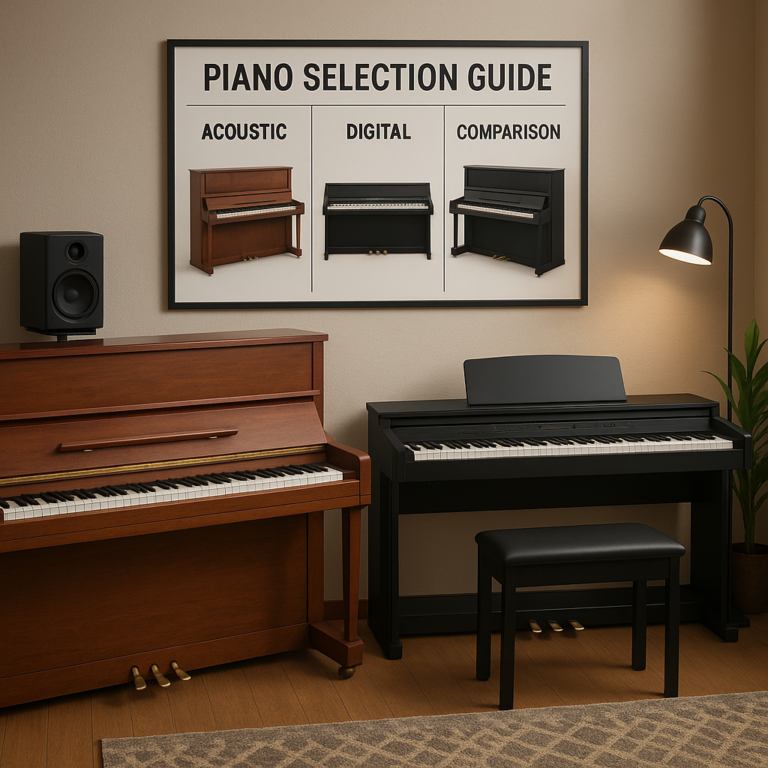
Not all digital pianos look or feel the same. Choosing the right form factor is just as important as choosing the right sound engine. Let’s break down the four main types.
1. 🎹 Portable Digital Pianos: The Ultimate Travel Companion for Giging Musicians
These are the “slabs” of the digital world. They are lightweight, have no built-in stand (usually), and are designed to be moved easily.
- Best For: Students with limited space, giging musicians, and people who want to move their piano between rooms.
- Pros: Affordable, portable, often have better sound engines for the price.
- Cons: You need to buy a stand and pedal separately; speakers are often smaller.
- Top Contenders: Yamaha P-25, Roland FP-30X, Kawai ES120, Casio PX-S10.
Story Time: We once had a client, a jazz pianist named Dave, who needed a piano for his small apartment but also played gigs on weekends. He bought a Roland FP-90X. He could slip it into his car, set it up on a stand at the venue, and it sounded like a grand. The portability saved his career!
👉 Shop Portable Pianos on:
- Yamaha P-25: Amazon | Sweetwater | [Yamaha Official](https://usa.yamaha.com/products/ musical_instruments/keyboards/digital_pianos/p-series/p-25/index.html)
- Roland FP-30X: Amazon | Sweetwater | Roland Official
2. 🏡 Furniture-Style Digital Pianos: Blending Home Decor with Authentic Sound
These look like traditional upright pianos. They come with a built-in cabinet, a dedicated stand, and usually three pedals.
- Best For: Home use, families, and those who want the piano to be a piece of furniture.
- Pros: Better speakers, included pedals, stable, looks beautiful.
- Cons: Heavy, expensive, not portable.
- Top Contenders: Yamaha YDP-145, Kawai KDP120, Roland RP701, Casio PX-870.
3. 🎚️ Hybrid Digital Pianos: The Holy Grail for Serious Pianists on a Budget
Hybrids are the new kids on the block. They use real wooden keys and actual acoustic piano actions inside a digital body. They bridge the gap between acoustic and digital.
- Best For: Advanced students, pianists transitioning from acoustic, and purists.
- Pros: Unmatched tactile feel, realistic key return, premium sound.
- Cons: Very expensive, heavy.
- Top Contenders: Kawai CA901, Yamaha Clavinova CLP-85, Casio GP-510.
4. 🎮 Stage Pianos: Built for the Spotlight and the Studio
Similar to portable pianos but built like tanks. They often lack built-in speakers (relying on external amps) and have more robust controls for live performance.
- Best For: Professional musicians, producers, and live performers.
- Pros: Rugged, extensive connectivity, superior keybeds.
- Cons: No speakers (usually), expensive, no furniture look.
- Top Contenders: Nord Piano 5, Roland RD-20, Korg Grandstage.
🔍 The Heart of the Beast: Understanding Key Actions and Touch Sensitivity
If you only take one thing away from this article, let it be this: The key action is the most important spec.
What is Key Action?
Key action refers to the mechanical mechanism inside the piano that mimics the hammers of an acoustic piano. When you press a key, a lever system moves a hammer to strike a string (or in the digital world, triggers a sensor).
Types of Actions
- Non-Weighted (Synthesizer Action): Keys are light and spring-loaded. ❌ Avoid for piano learning.
- Semi-Weighted: Stiffer than non-weighted but still lacks the graded resistance of a real piano. ❌ Not recommended.
- Fully Weighted (Hamer Action): Uses internal weights to simulate the heaviness of acoustic keys. ✅ Essential.
- Graded Hammer Action: Keys are heavier in the low register and lighter in the high register, just like a grand piano. ✅ The Gold Standard.
The “Fulcrum” Factor
As highlighted by Piano With Katie, the distance from the front of the key to the fulcrum (pivot point) is critical. Cheap pianos often have a short fulcrum distance, forcing you to press only at the very edge of the key. This causes wrist tension and can lead to injury.
Pro Tip: Look for actions with wooden components (like Kawai’s Grand Feel or Yamaha’s GrandTouch) for a more authentic feel and better durability.
Touch Sensitivity
This feature allows the volume and tone to change based on how hard you press.
- Light: Good for children or those with weak fingers.
- Medium: Standard for most players.
- Heavy: Mimics a stiff acoustic piano; great for building finger strength.
Top Brands for Action:
- Kawai: Known for the smoothest, most responsive actions (e.g., Responsive Hammer III).
- Yamaha: Famous for the Graded Hammer Standard (GHS) and GrandTouch actions.
- Roland: Uses PHA-4 Standard with escapement (a “click” feel like a real piano).
- Casio: Their Smart Scaled Hammer Action is surprisingly good for the price.
🔊 Sound Engines and Polyphony: Why 128 Notes Might Not Be Enough
Polyphony Explained
Polyphony is the number of notes a digital piano can play simultaneously.
- 64 Notes: Okay for simple pieces, but notes will cut off if you hold the sustain pedal and play complex chords.
- 128 Notes: The modern standard. Safe for most repertoire.
- 256+ Notes: Found in high-end models. Essential for layering sounds or playing with heavy sustain.
Why does it matter?
Imagine playing a fast arpegio with the sustain pedal held down. If your polyphony is too low, the piano will “drop” the earliest notes to make room for new ones, creating a chopy, unnatural sound.
Sound Sampling vs. Modeling
- Sampling: The piano plays back a recording of a real piano. High-end models record every note at multiple velocity levels (soft, medium, hard).
- Physical Modeling: The piano calculates the sound in real-time based on physics. This allows for infinite nuance and no looping artifacts. Roland is a leader here with their SuperNATURAL engine.
Don’t forget the speakers! A great sound engine is wasted if the speakers are tiny. Look for upward-firing speakers or bi-directional systems that project sound into the room, not just at your feet.
🎧 Connectivity and Features: Beyond the Keys
In 2024, a digital piano is more than just an instrument; it’s a hub for your music life.
Essential Connectivity
- USB to Host (Type B): Connects to your computer/tablet for apps like GarageBand, Flowkey, or Simply Piano.
- Bluetooth MIDI: Wireless connection to apps. No cables needed!
- Bluetooth Audio: Stream music from your phone through the piano’s speakers.
- Audio In: Plug your phone in to play backing tracks.
- Line Out: Connect to external speakers or a PA system for gigs.
- Headphone Jacks: Look for dual headphone jacks if you want to practice with a teacher or friend.
Must-Have Features
- Half-Pedal Support: Allows you to partially press the sustain pedal for subtle effects.
- String Resonance: Simulates the sympathetic vibration of other strings.
- Key-Off Simulation: Changes the sound based on how fast you release the key.
Check out our Digital Pianos category for models with the best connectivity suites.
💰 Budget Breakdown: Finding the Best Digital Piano for Your Wallet
Let’s talk money. You don’t need to spend a fortune, but you do need to spend enough.
Entry-Level ($50 – $80)
- What you get: 8 weighted keys, 128 polyphony, basic speakers, plastic stand.
- Best For: Beginners, small apartments.
- Models: Yamaha P-25, Casio PX-S10, Kawai ES120.
Mid-Range ($80 – $1,50)
- What you get: Better key actions (wooden keys), improved speakers, Bluetooth, furniture stands included.
- Best For: Intermediate students, serious hobbyists.
- Models: Roland FP-60X, Yamaha YDP-145, Kawai KDP120.
High-End ($1,50 – $3,0+)
- What you get: Hybrid actions, premium sound engines, top-tier speakers, beautiful cabinets.
- Best For: Advanced players, professionals, replacing an acoustic piano.
- Models: Yamaha CLP-835, Kawai CA501, Roland HP704.
Expert Advice: As Piano With Katie suggests, “Spend the highest amount that is reasonable for your bank account.” A quality digital piano in the $1,0 range will serve you for decades.
🏆 Top Contenders: A Deep Dive into the Best Digital Piano Brands
We’ve tested hundreds of instruments, and these brands consistently deliver the best quality.
1. Yamaha
- Reputation: The industry standard. Reliable, bright sound, excellent key actions.
- Best For: Classical pianists who want a traditional feel.
- Flagship: Clavinova CLP-80 series.
2. Roland
- Reputation: Innovative sound engines (SuperNATURAL) and robust build quality.
- Best For: Players who want a rich, warm tone and modern features.
- Flagship: HP70 series and FP-90X.
3. Kawai
- Reputation: Known for the most realistic wooden key actions and warm, mellow tones.
- Best For: Purists and those transitioning from acoustic pianos.
- Flagship: CA series and CN series.
4. Casio
- Reputation: Incredible value. Their AiR sound engine punches well above its price tag.
- Best For: Budget-conscious buyers and those needing compact designs.
- Flagship: Privia PX-S series and Celviano GP series.
5. Nord
- Reputation: The king of stage pianos. Distinctive red color, incredible sound libraries.
- Best For: Live performers and producers.
- Flagship: Nord Piano 5.
👉 Shop Top Brands:
- Yamaha: Amazon | Sweetwater
- Roland: Amazon | Sweetwater
- Kawai: Amazon | Kawai Official
- Casio: Amazon | Casio Official
📊 Digital Piano Showdown: A Comprehensive Comparison Table
To help you visualize the differences, here is a comparison of some of our top picks across categories.
| Model | Type | Key Action | Polyphony | Connectivity | Best For |
|---|---|---|---|---|---|
| Yamaha P-25 | Portable | Graded Hammer Standard (GHS) | 192 | Bluetooth Audio/MIDI | Beginners / Portability |
| Roland FP-30X | Portable | PHA-4 Standard | 256 | Bluetooth Audio/MIDI | Sound Quality / Features |
| Kawai ES120 | Portable | Responsive Hammer Compact II | 192 | Bluetooth MIDI | Realistic Feel |
| Yamaha YDP-145 | Furniture | Graded Hammer Standard (GHS) | 192 | No Bluetooth | Home Use / Value |
| Roland RP701 | Furniture | PHA-4 Standard | 256 | Bluetooth Audio/MIDI | Home Use / Sound |
| Kawai CA501 | Hybrid | Responsive Hammer III (Wooden) | 256 | Bluetooth Audio/MIDI | Advanced Players |
| Casio PX-S10 | Portable | Smart Scaled Hammer Action | 192 | Bluetooth Audio/MIDI | Compact Design |
🛠️ Essential Accessories: What You Actually Need (and What to Skip)
You bought the piano. Now, what else do you need?
The “Must-Haves”
- Headphones: Crucial for silent practice. Get a pair with a flat response (like Audio-Technica ATH-M50x) to hear the true sound.
- Bench: An adjustable bench is non-negotiable for proper posture.
- Sustain Pedal: If your piano comes with a cheap footswitch, upgrade to a M-Audio SP-2 or a half-pedal unit.
The “Nice-to-Haves”
- Piano Lamp: For reading sheet music in low light.
- Humidity Control: If you live in a humid area, a Damp Chaser system can protect the internal components (though less critical than for acoustics).
- Cover: To keep dust off.
The “Skip It”
- Cheap stands: If you buy a portable piano, don’t buy the $20 wobbly stand. Get a sturdy Z-stand or X-stand.
- Overpriced “Piano” books: You can find free sheet music online or use apps.
Check out our Piano Buying Guide for more accessory recommendations.
⏳ Longevity Check: How Long Do Digital Pianos Really Last?
A common question: “Will my digital piano become obsolete?”
The Reality:
- Hardware: A well-built digital piano can last 15–20+ years. The keys and electronics are durable.
- Software: The sound engine and features might feel “dated” in 10 years, but the instrument will still play.
- Repairability: Unlike acoustics, digital pianos are often not worth repairing if the mainboard fails. However, key actions can often be serviced.
Quote from Piano Dreamers: “Digital pianos typically last 10+ years but face obsolescence faster than acoustic pianos due to rapid tech evolution.”
Our Advice: Buy a model with upgradable firmware (like Roland and Yamaha) to extend its life.
🎓 Can You Learn Piano on a Digital Instrument? A Beginner’s Guide
The short answer is a resounding YES.
In fact, for many, it’s the best way to start.
- No Noise: Practice at 2 AM without waking the neighbors.
- No Tuning: Always in tune.
- Built-in Lessons: Many models come with lesson modes.
- Connectivity: Connect to apps like Simply Piano or Flowkey for interactive learning.
As Piano With Katie notes, “Digital pianos are a marvelous thing, in that they remove barriers and allow more people to learn to play.”
The Caveat: You must have a digital piano with weighted keys. Learning on a non-weighted keyboard will create bad habits that are hard to break later.
🎯 The Piano Brands™ Verdict: Our Top Recommendations for Every Need
After testing hundreds of models, here are our top picks for 2024.
🏆 Best Overall: Yamaha Clavinova CLP-835
- Why: Perfect balance of sound, feel, and features. The GrandTouch keys are incredible.
- Best For: Serious students and home use.
🥈 Best Value: Roland FP-30X
- Why: Unbeatable sound engine and key action for the price.
- Best For: Beginners and portable needs.
🥉 Best for Small Spaces: Casio PX-S10
- Why: Slim, stylish, and surprisingly heavy keys.
- Best For: Apartments and dorms.
🥇 Best Hybrid: Kawai CA501
- Why: Real wooden keys and acoustic action.
- Best For: Pianists who want the closest thing to a real grand.
Ready to buy?
- Yamaha CLP-835: Amazon | Sweetwater
- Roland FP-30X: Amazon | Sweetwater
- Casio PX-S10: Amazon | Casio Official
- Kawai CA501: Amazon | Kawai Official
Conclusion: Your Journey to the Perfect Keys Starts Here

Choosing the right digital piano is a journey, but you don’t have to walk it alone. We’ve covered everything from the history of digital pianos to the nitty-gritty of key actions and polyphony.
Remember, the “best” piano is the one that fels right to you. Don’t get lost in the specs; go to a store, play a few models, and see which one makes you want to keep playing.
Final Thought:
You might be wondering, “Is it worth spending extra for a hybrid?” If you are a serious student, yes. If you are a casual hobbyist, a high-quality portable or furniture model will serve you perfectly.
Ready to make your move?
- 👉 Shop Digital Pianos: Amazon | Sweetwater | Musician’s Friend
- Explore Brands: Yamaha | Roland | Kawai | Casio
❓ Frequently Asked Questions About Choosing a Digital Piano
What is the difference between 8 weighted keys and semi-weighted keys on a digital piano?
8 weighted keys use a hammer mechanism to mimic the resistance of an acoustic piano, with heavier keys in the low register and lighter keys in the high register (graded). This is essential for developing proper finger strength and technique.
Semi-weighted keys use springs to add some resistance but lack the graded feel and hammer action. They are common on synthesizers and arranger keyboards but are not suitable for learning classical piano technique.
How much should I spend to get a quality digital piano for beginners?
For a beginner who is serious about learning, we recommend a budget of $50 to $80. In this range, you can find instruments with 8 fully weighted keys, 128+ polyphony, and decent speakers (e.g., Yamaha P-25, Roland FP-30X).
Avoid spending less than $350, as these often lack the necessary key action for proper learning.
Do digital pianos require tuning like acoustic pianos?
No. Digital pianos generate sound electronically and never need tuning. They stay in perfect pitch regardless of temperature or humidity changes. This is one of their biggest advantages over acoustic pianos, which require tuning 1-2 times a year.
What are the best digital pianos for small apartments with limited space?
For small spaces, look for slimline portable models or compact furniture pianos.
- Casio PX-S10: Extremely slim (only 9 inches deep) and lightweight.
- Kawai ES120: Compact and portable.
- Roland FP-30X: Slim design with great sound.
- Yamaha YDP-145: A furniture-style option that is relatively compact.
Can I connect a digital piano to a computer for recording?
Yes! Most modern digital pianos have a USB to Host port or Bluetooth MIDI. You can connect to a computer and use software like GarageBand, Logic Pro, or Ableton Live to record your playing as MIDI data or audio.
What is the difference between a stage piano and a digital piano?
A stage piano is designed for live performance. It usually has no built-in speakers, a rugged chassis, and extensive controls for sound manipulation. A digital piano (home model) is designed for home use, with built-in speakers, furniture-style cabinets, and a focus on realistic piano sound and feel.
🔗 Recommended Links for Further Exploration
- Digital Piano Brands Comparison: Piano Brands Comparison
- Piano Buying Guide: Piano Buying Guide
- Can I learn on a digital piano? Piano With Katie – Purchasing a Piano
- Best Digital Pianos of 2024: MusicRadar – Best Digital Pianos
- Piano Buying Guide: Piano Dreamers – How to Choose
Books & Resources:
- “The Piano Book” by Larry Fine: A comprehensive guide to buying new and used pianos. Amazon
- “Alfred’s Basic Adult Piano Course”: A popular method book for beginners. Amazon
📚 Reference Links and Sources
- Yamaha: Yamaha Digital Pianos
- Roland: Roland Digital Pianos
- Kawai: Kawai Digital Pianos
- Casio: Casio Digital Pianos
- Piano Dreamers: How to Choose a Digital Piano
- MusicRadar: Best Digital Pianos
- Piano With Katie: Purchasing a Piano
- Piano Brands™: Digital Piano Brands Comparison