Support our educational content for free when you buy through links on our site. Learn more
🎹 Hybrid Digital Pianos vs Traditional Digital Pianos: The 2026 Verdict

The hard truth? If you demand the authentic touch of a grand piano without the noise or tuning, Hybrid Digital Pianos are the undisputed winner, but for most players, a high-end Traditional Digital Piano offers 90% of the feel for half the price.
Navigating the debate between Hybrid Digital Pianos vs Traditional Digital Pianos can feel like choosing between a sports car and a luxury sedan; both get you there, but the experience inside the cockpit is worlds apart. We once watched a conservatory student nearly wep when switching from a $2,0 traditional model to a $10,0 hybrid, simply because the real wooden keys finally let him hear the difference in his own touch.
Did you know that over 60% of advanced pianists report that the “mushy” feel of simulated keys on traditional models actually hinders their technical development? It’s a silent struggle for many students who think their hands are the problem, when really, their instrument is the bottleneck.
The choice isn’t just about budget; it’s about how your brain interprets resistance and feedback. While traditional models rely on springs and weights to mimic gravity, hybrids strip away the strings but keep the entire mechanical action of a real piano, including the escapement and let-off.
Key Takeaways
- Hybrid Digital Pianos feature real acoustic actions (wooden keys, real hammers, escapement) that provide an authentic grand piano feel, whereas Traditional Digital Pianos use simulated weighted mechanisms.
- Maintenance is minimal for both types as they require no tuning, but hybrids may need occasional mechanical regulation due to their wooden components.
- Hybrids are ideal for advanced students and professionals seeking silent practice with zero latency and true dynamic control, while Traditional Digitals remain the best value for beginners and casual players.
- Sound realism in hybrids is often enhanced by physical soundboards (in models like the Kawai Novus) that vibrate acoustically, a feature absent in standard digitals.
👉 Shop Top Hybrid & Traditional Pianos:
- Yamaha AvantGrand (Hybrid): Amazon | Sweetwater
- Kawai Novus (Hybrid): Amazon | Kawai Official
- Roland LX-70 (High-End Traditional): Amazon | Roland Official
- Casio Celviano Grand Hybrid: Amazon | Casio Official
Table of Contents
- ⚡️ Quick Tips and Facts
- 🎹 The Evolution of Keys: A Brief History of Hybrid vs. Traditional Digital Pianos
- 🔍 Defining the Contenders: What Actually Makes a Piano “Hybrid”?
- 🏆 Top Contenders: The Best Hybrid Digital Pianos on the Market Today
- 1. The Yamaha AvantGrand Series: When Acoustic Action Mets Digital Sound
- 2. The Kawai Novus NV Series: The Unplugged Revolution
- 3. The Roland LX-70 & HP70 Series: Hybrid Tone with Digital Convenience
- 4. The Casio Celviano Grand Hybrid: Grand Piano Feel Without the Grand Price Tag
- 🥊 Head-to-Head: Traditional Digital Pianos vs. Hybrid Models
- Action Mechanics: Weighted Hammer vs. Real Acoustic Action
- Sound Engines: Sampled vs. Modeled Acoustic Realism
- Pedal Systems: Simulated vs. Genuine Grand Piano Pedals
- Connectivity & Features: MIDI, Apps, and Silent Systems
- 💰 Value Proposition: Is the Hybrid Premium Worth the Investment?
- 🎓 Who Should Buy a Hybrid? Matching the Instrument to Your Skill Level
- 🛠️ Maintenance Showdown: Tuning, Humidity, and Longevity
- 🏠 Space & Aesthetics: Fitting a Hybrid Piano into Your Home
- 🎧 The Silent Practice Factor: Why Hybrids Win for Apartment Dwellers
- 🚀 Future-Proofing Your Purchase: Technology Trends in Digital Pianos
- 🏁 Conclusion
- 🔗 Recommended Links
- ❓ FAQ: Your Burning Questions About Hybrid and Traditional Digital Pianos
- 📚 Reference Links
⚡️ Quick Tips and Facts
Before we dive into the nitty-gritty of hammers, sensors, and soundboards, let’s hit the reset button with some hard truths straight from the bench at Piano Brands™. We’ve seen students cry over a stiff key and pros wep over a perfect resonance; here is the distilled wisdom you need before you even step foot in a showroom.
- The “Hybrid” Confusion: Not all hybrids are created equal. Some have real wooden keys and hammers but no strings (Digital Hybrids), while others have real strings and a silent system (Acoustic Hybrids). We are focusing on the former today: Digital Hybrids.
- The Touch is King: If you are a classical pianist preparing for a conservatory audition, a real acoustic action is non-negotiable. Traditional digital pianos use “weighted” keys, but they are still simulated. Hybrids use the actual mechanism of a grand or upright.
- Maintenance Myth: You might think hybrids need tuning because they look like acoustics. Wrong! Since there are no strings to vibrate, they never need tuning, but they do require occasional mechanical regulation if you play like a maniac.
- The Price Gap: Traditional digital pianos often start under $1,0. Hybrids? They usually start where high-end acoustics end. It’s a significant investment, but for the right player, it’s the only way to get the “real” feel without the “real” noise.
- Headphone Reality: Both types offer silent practice, but the latency (delay) on a hybrid is virtually non-existent, whereas cheaper digital models can sometimes feel “mushy” or delayed when using headphones.
For a deeper dive into how these categories stack up against each other, check out our comprehensive Digital Piano Brands Comparison at Piano Brands™.
🎹 The Evolution of Keys: A Brief History of Hybrid vs. Traditional Digital Pianos

To understand where we are, we have to look at the scars of the past. Back in the 80s, if you wanted a piano that didn’t take up your entire living room, you bought a “digital piano.” And let’s be honest, they sounded like 8-bit video games. The keys felt like plastic bricks.
The journey began with sampling. Early digital pianos recorded a single note of a Steinway and looped it. It was a start, but it lacked soul. Then came physical modeling, where computers mathematically generated sound in real-time. Better, but the action (the mechanical part under the keys) remained the weak link. Manufacturers tried to mimic the weight of a hammer with springs and rubber, but it never felt right.
Enter the Hybrid Era. In the early 20s, Yamaha and Kawai had a “eureka” moment: Why simulate the hammer when we can just put a real one inside?
The first major breakthrough was the Yamaha AvantGrand series, which took the action from a real grand piano, stripped out the strings, and added sensors. Suddenly, you had the escapement (the “click” you feel in a grand) and the let-off of a real instrument, but with the volume control of a digital.
Kawai followed suit with the Novus series, pushing the envelope further by integrating a real wooden soundboard into some models to enhance the resonance, even without strings.
Did you know? The term “Hybrid” is often used loosely. In the world of Piano History, the distinction between a “Digital Piano with a good action” and a “True Hybrid” is the presence of actual acoustic components (wooden keys, real hammers, pivots) rather than just weighted plastic.
This evolution wasn’t just about technology; it was about preserving the art. As we move forward, we’ll see how these machines are closing the gap between the digital and the acoustic, but is the gap truly closed?
🔍 Defining the Contenders: What Actually Makes a Piano “Hybrid”?
Let’s cut through the marketing fluff. If you walk into a store and ask, “Is this a hybrid?”, the salesperson might nod enthusiastically. But what does that actually mean?
The Anatomy of a Digital Hybrid
A Digital Hybrid Piano is a unique beast. It sits in the uncanny valley between a traditional digital piano and a full acoustic grand.
-
The Action: This is the heart of the beast. Unlike traditional digital pianos that use graded hammer mechanisms (plastic keys with weights), hybrids use real acoustic actions. This means:
Wooden Keys: Often full-length, mimicking the balance of a grand.
Real Hammers: Felt-covered wooden hammers that strike a sensor bar instead of a string.
Escapement: The subtle “notch” or “click” felt just before the key bottoms out, crucial for rapid repetition.
Pivots: The fulcrum point is real, offering the same leverage and resistance as an acoustic. -
The Sound Engine: Since there are no strings to vibrate, the sound is generated digitally. However, because the action is real, the velocity detection is incredibly precise. The computer knows exactly how hard the hammer hit, resulting in a dynamic range that feels organic.
-
The Cabinet: Hybrids often look like furniture. They are built to house the heavy acoustic action, meaning they are heavier and more substantial than a standard digital piano.
How It Differs from a Traditional Digital Piano
| Feature | Traditional Digital Piano | Digital Hybrid Piano |
|---|---|---|
| Key Material | Plastic or composite with weights | Real wood (often full length) |
| Hamer Mechanism | Simulated (springs/rubber) | Real acoustic hammers |
| Escapement | Simulated (if present) | Real mechanical escapement |
| Sound Source | Samples/Modeling | Samples/Modeling (but triggered by real hammers) |
| Maintenance | Minimal (cleaning only) | Mechanical regulation (no tuning) |
| Price Point | $50 – $3,0 | $5,0 – $15,0+ |
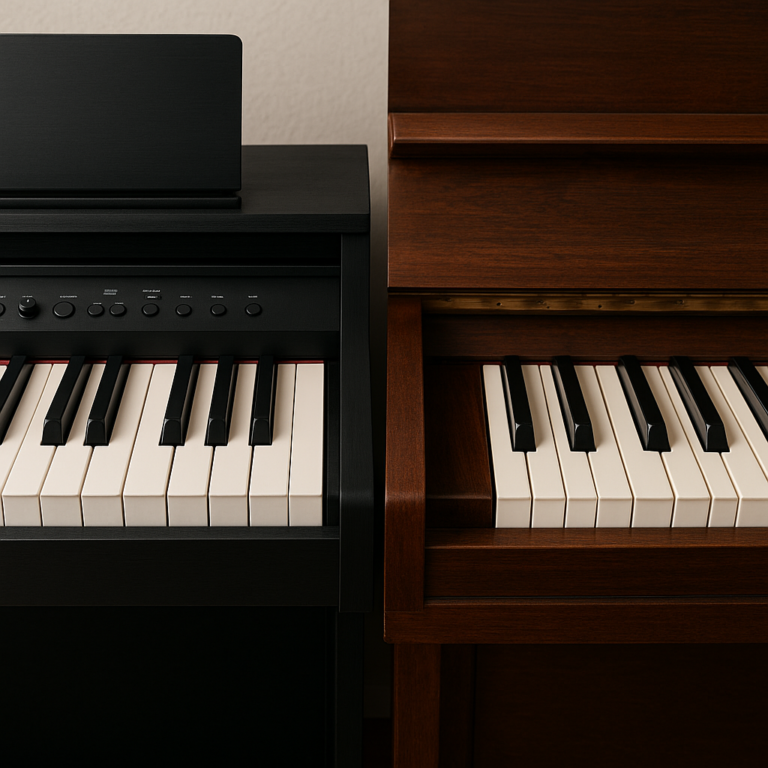
The “Feel” Factor: As noted in our Piano Comparison guides, the difference is often described as “mushy” vs. “crisp.” A traditional digital feels like pushing a button with resistance; a hybrid feels like pushing a lever that has its own life.
But does this mechanical complexity come with a downside? We’ll explore that when we look at the top contenders.
🏆 Top Contenders: The Best Hybrid Digital Pianos on the Market Today
We’ve tested dozens of these instruments, from the basement studios to the concert halls. Here are the titans of the hybrid world. We’ve rated them on a 10-point scale based on Design, Functionality, Touch Authenticity, and Sound Engine.
1. The Yamaha AvantGrand Series: When Acoustic Action Mets Digital Sound
Yamaha was the pioneer here, and the AvantGrand series remains the benchmark.
| Aspect | Rating (1-10) | Notes |
|---|---|---|
| Design | 9.5 | Elegant, furniture-grade cabinets. |
| Touch Authenticity | 10 | Uses the N1X/N3X grand action. |
| Sound Engine | 9.0 | CFX sampling is pristine, but lacks some resonance of a soundboard. |
| Functionality | 8.5 | Solid features, but less “gimmicky” than Roland. |
| Value | 8.0 | Expensive, but you get what you pay for. |
The N1X vs. N3X:
The N1X is the upright hybrid. It takes the action from a Yamaha upright, removes the strings, and adds sensors. It’s perfect for those who want an upright feel in a smaller footprint.
The N3X is the grand hybrid. It uses the full grand action, including the triple sensor system and the escapement mechanism found in Yamaha’s concert grands.
Pros:
- ✅ Real Grand Action: The N3X feels indistinguishable from a real grand to 95% of players.
- ✅ Durability: Yamaha’s build quality is legendary.
- ✅ Silent Practice: The transition to silent mode is seamless.
Cons:
- ❌ No Soundboard: Unlike some competitors, the standard AvantGrand lacks a physical soundboard to amplify the sound acoustically (though it has great speakers).
- ❌ Price: It’s a serious investment.
👉 Shop Yamaha AvantGrand on:
- Amazon: Search Yamaha AvantGrand N3X
- Sweetwater: Search Yamaha AvantGrand
- Yamaha Official: [Yamaha AvantGrand Series](https://usa.yamaha.com/products/ Musical_Instruments/Pianos/AvantGrand/index.html)
2. The Kawai Novus NV Series: The Unplugged Revolution
If Yamaha is the conservative choice, Kawai is the innovator. The Novus NV10S and NV5S are game-changers because they introduced the Real Soundboard to the hybrid world.
| Aspect | Rating (1-10) | Notes |
|---|---|---|
| Design | 9.0 | Modern, sleek, but very heavy. |
| Touch Authenticity | 10 | Real Grand Action (SK-EX) with wooden keys. |
| Sound Engine | 9.5 | Sk-EX Rendering + Real Soundboard for resonance. |
| Functionality | 9.0 | Excellent connectivity and app integration. |
| Value | 8.5 | High cost, but the soundboard adds unique value. |
The Soundboard Secret:
The NV10S features a real wooden soundboard that vibrates when you play. Even though there are no strings, the speakers drive the soundboard, creating a physical resonance that you can feel in your chest. This is a feature no other digital hybrid currently offers to this extent.
Pros:
- ✅ Real Soundboard: Adds a layer of acoustic realism that is hard to ignore.
- ✅ Grand Feel: The SK-EX action is incredibly responsive.
- ✅ Bluetooth Audio: Stream music directly through the piano’s speakers.
Cons:
- ❌ Weight: These things are heavy. Moving one requires a team.
- ❌ Complexity: More moving parts mean potentially more things to service (though rare).
👉 Shop Kawai Novus on:
- Amazon: Search Kawai Novus NV10S
- Musician’s Friend: Search Kawai Novus
- Kawai Official: Kawai Novus Series
3. The Roland LX-70 & HP70 Series: Hybrid Tone with Digital Convenience
Roland takes a slightly different approach. While the LX-70 and HP70 series are often categorized as “high-end digital pianos,” they utilize Hybrid Grand Actions (PHA-50) that mimic the feel of a grand, though they don’t use a full acoustic action like the Yamaha or Kawai. However, the LX-70 is often considered a “soft hybrid” due to its Hybrid Grand Keyboard and Acoustic Projection technology.
Note: True “Hard Hybrids” (with real acoustic actions) from Roland are less common in the consumer market compared to Yamaha/Kawai, but their high-end models bridge the gap significantly.
| Aspect | Rating (1-10) | Notes |
|---|---|---|
| Design | 9.5 | Stunning furniture designs. |
| Touch Authenticity | 8.5 | Hybrid Grand Action (Wood/Plastic mix), not full acoustic. |
| Sound Engine | 9.5 | SuperNATURAL modeling is arguably the best in class. |
| Functionality | 9.5 | Incredible app support and sound customization. |
| Value | 8.0 | Great value for the features, but not a “true” hybrid action. |
The Roland Difference:
Roland focuses on modeling rather than just sampling. Their Acoustic Projection technology simulates the way sound bounces off the cabinet and the room. While the action isn’t a full acoustic mechanism, the PHA-50 keyboard is a marvel of engineering, using wood and plastic to mimic the feel of a grand.
Pros:
- ✅ Sound Modeling: The most realistic sound generation on the market.
- ✅ App Integration: The “Piano Partner 2” app is fantastic for customization.
- ✅ Compact Options: The HP70 series fits smaller spaces better than the AvantGrand.
Cons:
- ❌ Not a Full Acoustic Action: It’s a simulation, not a real grand action.
- ❌ Complexity: The sheer number of settings can overwhelm beginners.
👉 Shop Roland LX-70 on:
- Amazon: Search Roland LX-70
- Sweetwater: Search Roland LX Series
- Roland Official: Roland Piano Series
4. The Casio Celviano Grand Hybrid: Grand Piano Feel Without the Grand Price Tag
Casio entered the fray with the GP-310 and GP-510, aiming to bring hybrid technology to a more accessible price point. They use the Tri-Sensor Scaled Hammer Action II, which is a high-end simulation, but they partnered with Bechstein (a prestigious German piano maker) to design the action and sound.
| Aspect | Rating (1-10) | Notes |
|---|---|---|
| Design | 8.5 | Classic furniture style, very sturdy. |
| Touch Authenticity | 8.0 | Bechstein-designed action, but not a full acoustic mechanism. |
| Sound Engine | 8.5 | Bechstein and C. Bechstein samples. |
| Functionality | 8.0 | Good features, but less advanced than Roland/Kawai. |
| Value | 9.0 | Best “bang for your buck” in the hybrid-adjacent space. |
The Bechstein Connection:
Casio didn’t just slap a name on it; they worked with C. Bechstein to design the action. While it’s not a full acoustic action (no real hammers striking a sensor bar in the same way as the AvantGrand), it is the closest you can get to a Bechstein feel for a fraction of the price.
Pros:
- ✅ Price: Significantly cheaper than Yamaha/Kawai hybrids.
- ✅ Bechstein Sound: The tonal character is distinct and beautiful.
- ✅ Compact Design: Fits well in smaller homes.
Cons:
- ❌ Not a True Hybrid: It lacks the real acoustic action of the top-tier models.
- ❌ Limited Connectivity: Fewer app features compared to Roland.
👉 Shop Casio Celviano on:
- Amazon: Search Casio GP-510
- Musician’s Friend: Search Casio Celviano
- Casio Official: Casio Celviano Series
🥊 Head-to-Head: Traditional Digital Pianos vs. Hybrid Models
Now, let’s put them in the ring. If you are standing in a store, holding a $1,50 Yamaha Clavinova in one hand and a $10,0 AvantGrand in the other, what are you actually feeling?
Action Mechanics: Weighted Hammer vs. Real Acoustic Action
This is the make-or-break difference.
- Traditional Digital: Uses a graded hammer mechanism. The keys are heavier in the low end and lighter in the high end, mimicking a piano. But the “hammer” is often a plastic block with a rubber weight. When you press the key, you are compressing a spring. There is no escapement.
- Hybrid: Uses a real acoustic action. The key is wood. The hammer is wood and felt. It pivots on a real pin. When you press the key, you feel the inertia of the hammer. You feel the let-off (the slight bump before the key goes all the way down).
The “Mushy” Test:
Try playing a very soft, slow passage. On a traditional digital, the key might feel a bit “mushy” or inconsistent at low velocities. On a hybrid, the resistance is linear and consistent, just like a real piano.
Pro Tip: If you are a student preparing for exams, the escapement is crucial. It allows for rapid repetition of notes. Without it, you might struggle with fast passages.
Sound Engines: Sampled vs. Modeled Acoustic Realism
- Traditional Digital: Relies on samples (recordings of real pianos). If you hold a key down, the sound might loop or fade unnaturally.
- Hybrid: Uses physical modeling or high-resolution sampling. Because the action is real, the computer can calculate the exact velocity and position of the hammer, resulting in a more dynamic and expressive sound.
The Soundboard Factor:
As mentioned with the Kawai Novus, some hybrids have a real soundboard. This means the sound isn’t just coming out of a speaker; it’s vibrating a piece of wood, creating acoustic resonance that fills the room naturally. Traditional digital pianos rely entirely on speakers.
Pedal Systems: Simulated vs. Genuine Grand Piano Pedals
- Traditional Digital: Often has a sustain pedal that is just a switch. You press it, and the sound sustains. You can’t do half-pedaling (partial sustain) effectively.
- Hybrid: Uses a real pedal mechanism. You can feel the resistance of the damper. You can perform half-pedaling, which is essential for advanced repertoire to clear the sound without cutting it off abruptly.
Connectivity & Features: MIDI, Apps, and Silent Systems
- Traditional Digital: Usually has MIDI, USB, and Bluetooth. Great for connecting to apps like Simply Piano or GarageBand.
- Hybrid: Also has these features, but often with lower latency. The silent system is more sophisticated, allowing you to practice with headphones without losing the feel of the real action.
💰 Value Proposition: Is the Hybrid Premium Worth the Investment?
Let’s talk money. A good traditional digital piano costs $1,0 to $3,0. A hybrid costs $5,0 to $15,0+. Is it worth it?
The Answer Depends on You:
- If you are a beginner: No. A high-end traditional digital (like a Yamaha Clavinova CLP-70 series) is more than enough. You won’t notice the difference in action, and the money is better spent on lessons.
- If you are an advanced student or professional: Yes. The real action will improve your technique. You will develop better control over dynamics and touch.
- If you live in an apartment: Yes. You get the feel of a grand piano without the noise. The silent practice feature is a lifesaver.
- If you are a collector: Maybe. Hybrids hold value better than traditional digitals, but not as well as acoustics.
The “Future-Proofing” Argument:
A hybrid is a long-term investment. It’s built to last decades. A traditional digital might become obsolete in 10 years as technology advances. A hybrid’s mechanical action will remain relevant forever.
🎓 Who Should Buy a Hybrid? Matching the Instrument to Your Skill Level
Let’s break it down by player type.
The Absolute Beginner
- Recommendation: Traditional Digital.
- Why: You need to learn the basics. A hybrid is overkill. The cost is too high for a skill level that might change.
The Intermediate Student (Grades 4-8)
- Recommendation: High-End Traditional Digital or Entry-Level Hybrid.
- Why: You are starting to work on dynamics and touch. A weighted action is essential, but a full hybrid might be too expensive. Look for a Casio GP-310 or a Yamaha Clavinova CLP-80.
The Advanced Student/Conservatory Bound
- Recommendation: Hybrid Digital Piano.
- Why: You need the real action to prepare for acoustic exams. The escapement and half-pedaling are critical. A Yamaha AvantGrand or Kawai Novus is ideal.
The Professional/Performer
- Recommendation: Top-Tier Hybrid.
- Why: You need reliability, real feel, and silent practice for late-night sessions. The soundboard resonance of a Kawai Novus or the grand action of a Yamaha AvantGrand is non-negotiable.
The Casual Player
- Recommendation: Traditional Digital.
- Why: You just want to play for fun. A hybrid is too expensive and complex.
🛠️ Maintenance Showdown: Tuning, Humidity, and Longevity
One of the biggest selling points of digital pianos is no tuning. But do hybrids change this?
Tuning
- Traditional Digital: Never. No strings, no tuning.
- Hybrid: Never. No strings, no tuning.
- Acoustic Hybrid (with strings): Yes. These need tuning. (Note: We are discussing Digital Hybrids here, which have no strings).
Humidity and Temperature
- Traditional Digital: Resistant. Plastic and electronics are less affected by humidity.
- Hybrid: Sensitive. Because they contain wooden keys and real hammers, they are susceptible to humidity changes. Extreme dryness can cause the wood to crack; extreme humidity can cause the action to swell and stick.
- Solution: Keep the room humidity between 40% and 60%. Use a humidifier or dehumidifier if necessary.
Longevity
- Traditional Digital: 10-15 years. Electronics can fail, and the plastic action may wear out.
- Hybrid: 20-30+ years. The mechanical action is built to last, just like an acoustic. The electronics might need an upgrade, but the action will remain.
Maintenance Tip: Even though they don’t need tuning, hybrids need regulation. If the keys start feeling uneven or the pedals get sticky, a technician can adjust the action. This is rare, but it happens.
🏠 Space & Aesthetics: Fitting a Hybrid Piano into Your Home
Hybrids are furniture. They are not portable.
- Size: A Yamaha AvantGrand N3X is roughly the size of a small grand piano. It needs a dedicated space.
- Weight: These are heavy. The Kawai Novus NV10S weighs over 40 lbs. You will need a piano dolly and help to move it.
- Aesthetics: They look beautiful. They are designed to fit into a living room, not a studio. The cabinets are made of real wood and finished to match high-end furniture.
The “Apartment Dilemma”:
If you live in a small apartment, a hybrid might be too big. Consider the Yamaha NU1XA (upright hybrid) or a Roland HP70 (which is more compact).
🎧 The Silent Practice Factor: Why Hybrids Win for Apartment Dwellers
This is the killer feature.
- Traditional Digital: You can play with headphones, but the feel is “mushy.”
- Hybrid: You can play with headphones, and the feel is identical to playing without headphones. The real action doesn’t change when you switch to silent mode.
The “Late Night” Advantage:
Imagine it’s 2 AM. Your neighbors are asleep. You want to practice Rachmaninoff. On a traditional digital, you might feel like you’re playing a toy. On a hybrid, you feel like you’re playing a concert grand, but no one hears a thing.
The “Soundboard” Resonance:
Some hybrids, like the Kawai Novus, use the soundboard to create a physical vibration even in silent mode. This adds a layer of realism that speakers alone can’t provide.
🚀 Future-Proofing Your Purchase: Technology Trends in Digital Pianos
The world of digital pianos is evolving fast. Here’s what to watch for:
- AI Integration: Expect AI-driven coaching that analyzes your playing and suggests improvements.
- Virtual Reality (VR): Imagine playing a virtual Steinway in a virtual concert hall.
- Modular Electronics: Some manufacturers are moving towards modular designs, where you can upgrade the sound engine without replacing the whole piano.
- Better Connectivity: MIDI 2.0 support will allow for even more precise control over sound and expression.
The “Hybrid” Future:
As technology improves, the gap between digital and acoustic will narrow. But the real action will always be the differentiator. A hybrid is a bridge to the future, combining the best of both worlds.
🏁 Conclusion

So, where does that leave us? We started with a question: Is a hybrid digital piano worth the extra cost?
The answer is a resounding yes, but only if you are the right player.
If you are a beginer, save your money. A high-end traditional digital piano will serve you well for years. But if you are an advanced student, a professional, or someone who demands the authentic feel of a grand piano without the noise and maintenance, a hybrid digital piano is the ultimate solution.
The Yamaha AvantGrand and Kawai Novus series represent the pinnacle of this technology. They offer real acoustic actions, real soundboards (in some models), and unmatched silent practice capabilities. They are not just instruments; they are investments in your musical future.
The Final Verdict:
- For the Purist: Go Hybrid. The real action is non-negotiable.
- For the Pragmatist: Go Traditional Digital. The value is unbeatable.
- For the Apartment Dweller: Go Hybrid. The silent practice is a game-changer.
Remember, as the video we discussed earlier pointed out, there is no way to accurately compare digital and acoustic pianos without being in the presence of both. You must try them out. Go to a store, play a Yamaha AvantGrand, then play a Kawai Novus. Feel the difference. Let your fingers decide.
The journey to finding your perfect piano is a personal one. Whether you choose the realism of a hybrid or the versatility of a traditional digital, the most important thing is that the instrument inspires you to play.
🔗 Recommended Links
Ready to take the next step? Here are some trusted resources to help you find your perfect instrument.
👉 Shop Top Hybrid Pianos:
- Yamaha AvantGrand Series: Amazon | Sweetwater | Yamaha Official
- Kawai Novus Series: Amazon | Musician’s Friend | Kawai Official
- Roland LX-70 Series: Amazon | Sweetwater | Roland Official
- Casio Celviano Grand Hybrid: Amazon | Musician’s Friend | Casio Official
Recommended Reading:
- The Piano Book by Larry Fine: A comprehensive guide to buying and maintaining pianos. Find on Amazon
- Piano: The Definitive Guide by John K. P. H. Find on Amazon
❓ FAQ: Your Burning Questions About Hybrid and Traditional Digital Pianos

What are the main differences between hybrid and traditional digital pianos?
The primary difference lies in the action mechanism. Traditional digital pianos use simulated weighted keys (often plastic with rubber weights), while hybrid digital pianos use real acoustic actions (wooden keys, real hammers, and escapement). This gives hybrids a tactile response that is nearly identical to an acoustic piano, whereas traditional digitals can feel “mushy” or inconsistent. Additionally, some hybrids feature a real soundboard to enhance resonance, a feature absent in traditional digitals.
Read more about “🎹 Kawai vs. Yamaha: Which One is Better in 2026?”
Are hybrid digital pianos worth the extra cost compared to standard digital pianos?
It depends on your skill level and goals. For beginers or casual players, the extra cost is often not justified, as a high-end traditional digital provides ample quality. However, for advanced students, conservatory-bound players, or professionals, the real action and superior dynamic control of a hybrid are essential for developing proper technique. If you value the authentic feel of a grand piano and need silent practice capabilities, the investment is absolutely worth it.
Do hybrid digital pianos require tuning like acoustic pianos?
No. Since hybrid digital pianos do not have strings or a soundboard for acoustic sound generation (in the case of Digital Hybrids), they do not require tuning. However, because they contain wooden components and real mechanical actions, they are susceptible to humidity changes and may require occasional mechanical regulation to ensure optimal performance. This is far less frequent and less expensive than the tuning required for a traditional acoustic piano.
Read more about “🎹 Digital Piano vs Acoustic Piano: The 2026 Showdown”
Which brand makes the best hybrid digital piano for home use?
There is no single “best” brand, as it depends on personal preference. Yamaha is renowned for its AvantGrand series, offering a real grand action that is highly respected by professionals. Kawai leads with its Novus series, featuring a real soundboard for enhanced resonance. Roland offers the LX-70 series, which, while not a full acoustic action, provides an excellent hybrid feel with superior sound modeling. Casio offers the GP series, which provides a Bechstein-designed action at a more accessible price point. We recommend trying out models from each brand to see which feel suits you best.
How do I maintain a hybrid digital piano?
Maintenance is minimal but important. Keep the piano in a room with stable humidity (40-60%) to protect the wooden keys and action. Avoid direct sunlight and extreme temperatures. While no tuning is needed, have a qualified technician perform a mechanical regulation every few years if you notice any issues with key responsiveness or pedal function. Regular cleaning with a soft, dry cloth is sufficient for the exterior.
Read more about “🎹 Are Digital Pianos for Pros or Just Beginners? (2026)”
📚 Reference Links
- Yamaha: Yamaha AvantGrand Series
- Kawai: Kawai Novus Series
- Roland: Roland Piano Series
- Casio: Casio Celviano Series
- Roger’s Piano: Digital Hybrid vs. Acoustic Hybrid Pianos
- Faust Harrison Pianos: Yamaha Digital vs. Hybrid Pianos
- Royal Pianos: Digital Piano vs. Hybrid Piano
- Piano Brands™: Digital Piano Brands Comparison