Support our educational content for free when you buy through links on our site. Learn more
🎹 7 Key Features to Buy a New Acoustic Piano (2026)


The single most critical feature to prioritize when buying a new acoustic piano is the action mechanism, as it dictates your ability to control dynamics and expression more than any other component. When you ask yourself, “What are the key features to look for when buying a new acoustic piano?“, the answer lies in the synergy between a solid spruce soundboard, a stable pinblock, and a responsive hammer felt.
We once watched a talented student struggle for months on a “bargain” upright that sounded beautiful but had a mushy action, preventing her from mastering rapid passages. It wasn’t until she switched to an instrument with a properly regulated escapement that her technique finally clicked.
Unlike digital keyboards that rely on sampled sounds, a true acoustic piano is a living machine where 8 keys trigger a complex mechanical chain reaction. Did you know a single piano string can be under 20 pounds of tension? That immense force requires precision engineering to ensure the instrument stays in tune and plays smoothly for decades.
Key Takeaways
- Prioritize the Action: The touch sensitivity and key responsiveness of the action are more important than the brand name for developing proper technique.
- Inspect the Soundboard: Look for solid spruce without cracks; this is the engine that creates the piano’s rich, sustaining tone.
- Check Structural Integrity: A high-quality pinblock and laminated rim are essential for long-term tuning stability.
- Environment Matters: Keep your new piano away from direct sunlight and humidity fluctuations to prevent warping and cracking.
👉 Shop Top Acoustic Piano Brands:
- Yamaha: Amazon | Sweetwater | Yamaha Official
- Kawai: Amazon | Musician’s Friend | Kawai Official
- Steinway & Sons: Steinway Official
Table of Contents
- ⚡️ Quick Tips and Facts
- 🎹 A Brief History of the Acoustic Piano: From Cristofori to Steinway
- 🤔 Acoustic vs. Digital: Do You Really Need the Real Thing?
- 🏛️ Grand vs. Upright: Which Piano Shape Fits Your Life?
- 🔍 7 Essential Key Features to Inspect Before Buying a New Acoustic Piano
- 1. Soundboard Quality and Tone Production
- 2. Action Mechanism and Hammer Felt Density
- 3. Key Responsiveness and Touch Sensitivity
- 4. String Construction and Scale Design
- 5. Pinblock Integrity and Tuning Stability
- 6. Rim Material and Structural Reinforcement
- 7. Finish Durability and Aesthetic Appeal
- 🆚 New vs. Used: The Hidden Costs of a Bargain Hunt
- 💰 Budget Considerations: How Much Should You Really Spend?
- 🎓 Matching Your Skill Level to the Right Instrument
- 🏠 Space and Environment: Protecting Your Investment
- 🏭 Top Acoustic Piano Brands: From Steinway & Sons to Yamaha and Kawai
- 🛒 Where to Buy: Dealers, Private Sellers, and Auctions
- 🔧 The Role of a Piano Technician in Your Purchase Decision
- 🚀 Start Your Piano Journey with Confidence
- 🏆 NEWTON: The Modern Benchmark for Entry-Level Excellence
- 🏆 WALTHAM: Reviving Classic Craftsmanship for Today’s Players
- 🎼 Conclusion
- 🔗 Recommended Links
- ❓ FAQ
- 📚 Reference Links
⚡️ Quick Tips and Facts
Before you even step foot in a showroom or open a catalog, let’s clear the air with some hard truths from the Piano Brands™ team. We’ve seen too many buyers fall in love with a shiny finish only to realize the action feels like lifting a brick.
- The “8” Rule: A full-size acoustic piano has 8 keys. If you see a “piano” with 61 or 76 keys, it’s a keyboard, not a true acoustic instrument. While 76 keys can work for a toddler, you’ll hit a wall with advanced repertoire (like Rachmaninoff) that demands the full range.
- Tuning is Non-Negotiable: Unlike a digital piano that stays in tune forever, an acoustic piano is a living, breathing machine. It needs professional tuning at least twice a year, regardless of how often you play.
- The “Used” Trap: A used piano isn’t always a bargain. A $50 upright from the 1970s might cost you $3,0 in repairs to make it playable. Condition trumps brand every single time.
- Space Matters: Pianos are heavy. A grand piano can weigh over 50 lbs, and an upright can top 40 lbs. Ensure your floor can handle the load and your doorways are wide enough!
- The “Feel” Factor: You cannot judge a piano by photos. Touch sensitivity and key responsiveness are physical sensations you must experience in person.
For a deeper dive into the sheer number of options out there, check out our breakdown on 🇺🇸 How Many Piano Manufacturers Are There in the US? (2026).
🎹 A Brief History of the Acoustic Piano: From Cristofori to Steinway

To understand what you’re buying, you have to respect where it came from. The story begins in 170s Florence, where Bartolomeo Cristofori invented the gravicembalo col piano e forte (harpsichord with soft and loud). Why was this a big deal? Because before Cristofori, keyboard instruments could only play at one volume. His invention allowed hammers to strike strings, letting the player control dynamics with their fingers.
Fast forward to the 19th century, and the piano evolved into the powerhouse we know today. The Iron Frame was introduced, allowing for higher string tension and a much louder, richer sound. This era saw the rise of giants like Steinway & Sons, who patented the cross-string technique, where bass strings cross over treble strings to maximize soundboard resonance.
“The piano is the only instrument that can mimic the human voice’s dynamic range.” — Piano Brands™ Senior Technician
If you’re curious about the evolution of these instruments, our Piano History category dives deep into the mechanics of how the modern piano was forged.
🤔 Acoustic vs. Digital: Do You Really Need the Real Thing?
This is the million-dollar question. We’ve had parents ask us, “My daughter wants to learn; do we need a real piano?” The answer is nuanced.
The Acoustic Argument:
Acoustic pianos produce sound through physical vibration. When you press a key, a felt hammer strikes a steel string, which vibrates against a wooden soundboard. This creates a complex wave of overtones that no speaker can perfectly replicate. The touch is mechanical; the weight of the keys changes as you play, offering infinite gradations of volume and tone.
The Digital Argument:
Modern digital pianos, like the Yamaha Clavinova series or Kawai MP1SE, use weighted hammer action to mimic the feel of an acoustic. They are silent (with headphones), never need tuning, and are portable.
The Verdict:
If your goal is serious classical training, an acoustic is non-negotiable. The subtle resistance of the keys teaches you finger strength and control in a way digital simulations struggle to match. However, for a casual hobbyist or a family with noise constraints, a high-end digital with 8 weighted keys is a fantastic compromise.
Confused about which path to take? We’ll resolve this later when we discuss your specific skill level and space constraints.
🏛️ Grand vs. Upright: Which Piano Shape Fits Your Life?
The shape of the piano dictates its sound and its footprint.
Grand Pianos
- Design: Horizontal strings and soundboard. Gravity helps the hammers return to their resting position quickly.
- Sound: Superior projection and tonal richness. The soundboard is larger and unobstructed.
- Space: Requires significant floor space (from 5′ to 9′ in length).
- Best For: Concert halls, large living rooms, and advanced players who need dynamic control.
Upright Pianos (Vertical)
- Design: Vertical strings and soundboard. Hammers are returned by springs.
- Sound: Good, but the sound projects upward into the ceiling rather than outward into the room.
- Space: Compact, fitting against a wall.
- Best For: Apartments, small homes, and beginners.
Pro Tip: A Baby Grand (5′ to 5’6″) is often a better choice than a tall upright for sound quality, but it still requires a dedicated room. Don’t let the “grand” name fool you; size matters immensely for tone.
🔍 7 Essential Key Features to Inspect Before Buying a New Acoustic Piano
You’ve decided on an acoustic. Now, how do you spot a gem from a lemon? Here are the seven pillars of a great piano.
1. Soundboard Quality and Tone Production
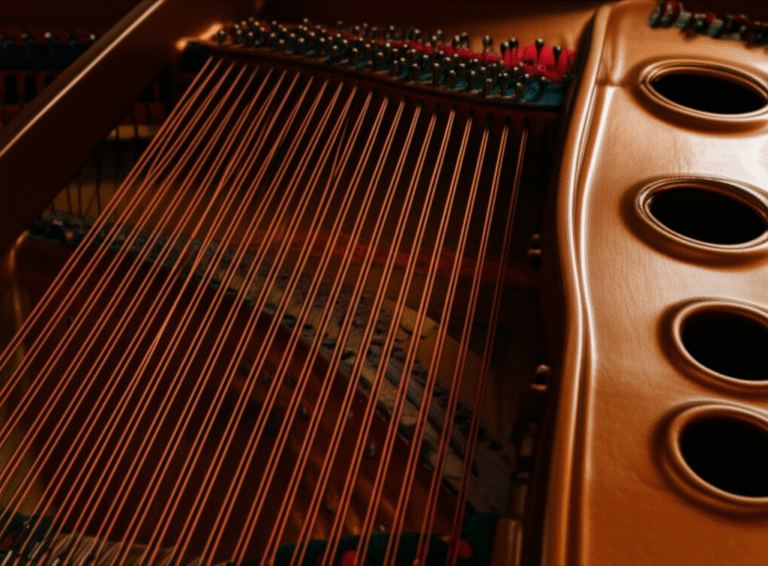
The soundboard is the heart of the piano. It’s usually made of solid spruce.
- What to look for: The wood should be tight-grained and free of cracks. A cracked soundboard kills the resonance.
- The Test: Play a chord in the middle register. Does it ring out clearly, or does it die quickly? A good soundboard sustains the note with a warm, complex tone.
2. Action Mechanism and Hammer Felt Density
The action is the complex assembly of levers that transfers your finger press to the hammer.
- What to look for: High-quality ebony or plastic keys and hammers with dense, high-grade felt.
- The Test: Play the same note rapidly (staccato). The action should be responsive and not “mushy.” If the hammer feels sluggish, the felt may be too soft or the regulation off.
3. Key Responsiveness and Touch Sensitivity
This is where the magic happens.
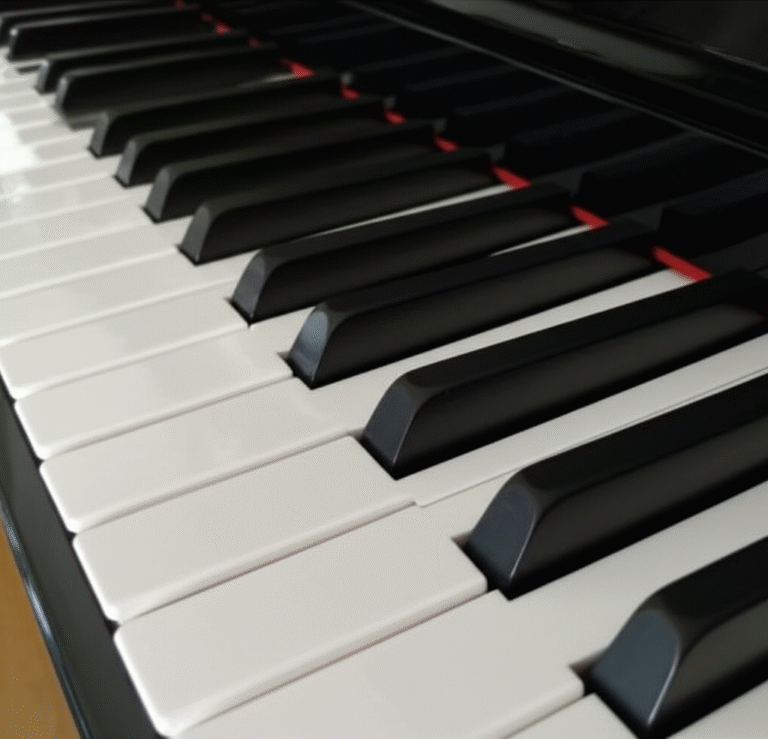
- What to look for: A consistent touch weight across all 8 keys.
- The Test: Play a pianissimo (very soft) passage. Can you control the volume? Then play fortissimo (very loud). Does the piano respond without the keys feeling like they are hitting a wall?
4. String Construction and Scale Design
- What to look for: Copper-wound bass strings that are free of rust. The scale design (the mathematical layout of string lengths) determines the eveness of the tone.
- The Test: Listen for “wolf tones” (notes that sound out of tune with themselves) or dead spots in the bass.
5. Pinblock Integrity and Tuning Stability
The pinblock holds the tuning pins. If it’s loose, the piano won’t stay in tune.
- What to look for: A multi-laminated hardwood pinblock (usually maple).
- The Test: Ask the dealer to show you the tuning pins. They should be tight. If a pin wobbles, the piano is a money pit.
6. Rim Material and Structural Reinforcement
The rim supports the immense tension of the strings (up to 20 tons!).
- What to look for: Laminated hardwood (like maple or bech) rather than solid wood, which can warp.
- The Test: Inspect the curve of the rim for cracks or separation.
7. Finish Durability and Aesthetic Appeal
- What to look for: A high-quality polyester or lacquer finish.
- The Test: Check for “crazing” (tiny cracks in the finish) which indicates age or poor storage.
🆚 New vs. Used: The Hidden Costs of a Bargain Hunt
Buying a used piano is like buying a used car: it can be a steal or a disaster.
New Pianos:
- Pros: Warranty, latest technology, no hidden wear, consistent quality.
- Cons: Higher upfront cost, depreciation in the first few years.
Used Pianos:
- Pros: Better value for money (you can get a higher tier brand for the price of a new entry-level), potential for “vintage” tone.
- Cons: Unknown history, potential for costly repairs (pinblock, bridges), no warranty.
Critical Insight: As noted by experts at M. Steinert & Sons, “The condition and maintenance history of a used piano can significantly affect its performance and longevity, sometimes more so than the brand alone.”
The “Used” Checklist:
- Check the Serial Number: Determine the age. Pianos older than 50 years often need major work.
- Inspect the Hammers: Deep groves mean they need reshaping or replacement.
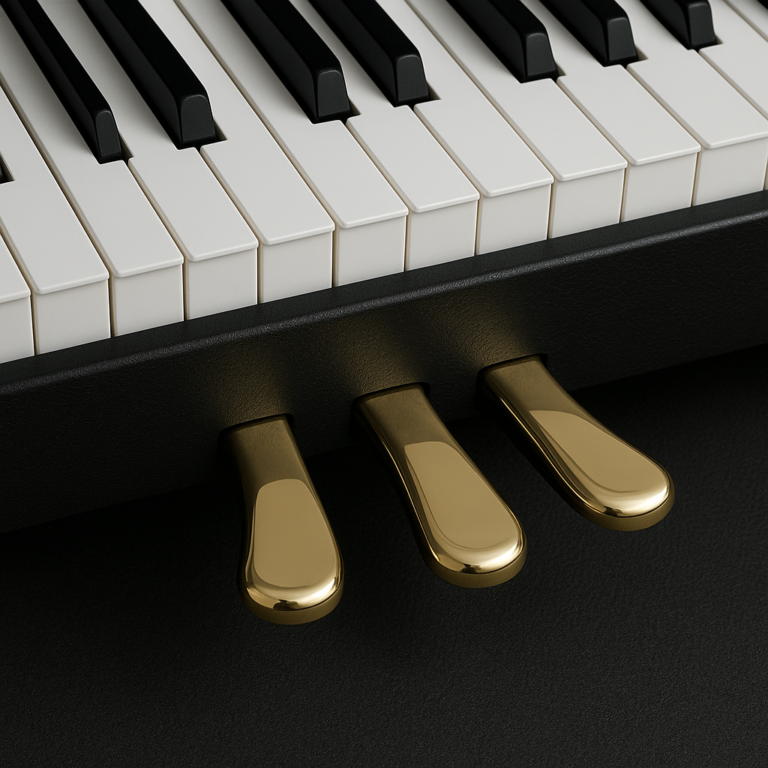
- Test the Pedals: The sustain pedal must lift all dampers evenly.
If you’re considering a used instrument, never buy without a technician inspection. It costs $10-$20 but saves you thousands.
💰 Budget Considerations: How Much Should You Really Spend?
Let’s talk numbers, but not specific prices (because they change!).
- Entry-Level Uprights: Great for beginners. Brands like Yamaha and Kawai dominate here. They offer consistent quality and reliability.
- Mid-Range Uprights & Baby Grands: For serious students and intermediate players. You’ll see brands like Baldwin, Steinway & Sons (Studio models), and Kawai higher-end lines.
- High-End Grands: The realm of Steinway, Bösendorfer, and Fazioli. These are investments that can appreciate in value.
The “Sweet Spot”:
For most families, a mid-range upright from a reputable brand offers the best balance of performance and cost. Avoid the “department store” pianos; they often use cheap materials that degrade quickly.
🎓 Matching Your Skill Level to the Right Instrument
Are you a beginner, an intermediate player, or a pro?
- Beginers: You need a piano that is easy to play but has a good action to build proper technique. A 5′ upright or a high-quality digital is perfect. Don’t overspend on a grand yet.
- Intermediate: You need dynamic range and tonal variety. A larger upright (4’6″ or taller) or a small grand (5’6″) will serve you well.
- Advanced/Professional: You need power, precision, and sustain. A full-size grand (6′ or larger) is the standard. The action must be responsive to the lightest touch.
The “Upgrade” Trap:
Don’t buy a grand piano if you can’t play it. A $50,0 Steinway in the hands of a beginner sounds no better than a $5,0 Yamaha. Skill comes first; the instrument follows.
🏠 Space and Environment: Protecting Your Investment
Pianos are sensitive to their environment.
- Temperature & Humidity: Fluctuations cause wood to expand and contract, leading to tuning instability and cracks. Keep the piano away from radiators, fireplaces, and direct sunlight.
- Room Acoustics:
Hard floors (tile/wood): Make the piano sound brighter and louder.
Soft floors (carpet/rugs): Absorb sound, making it warmer and softer. - Placement: For uprights, leave a few inches from the wall to allow sound to project. For grands, the lid should be open to direct sound into the room.
Pro Tip: Invest in a Piano Life Saver System (by Dampp-Chase) to regulate humidity inside the piano. It’s a game-changer for stability.
🏭 Top Acoustic Piano Brands: From Steinway & Sons to Yamaha and Kawai
Not all brands are created equal. Here’s a quick guide to the heavy hitters.
| Brand | Origin | Reputation | Best For |
|---|---|---|---|
| Steinway & Sons | USA/Germany | The “Gold Standard” | Concerts, Professionals, Investment |
| Yamaha | Japan | Consistency, Bright Tone | Students, Schools, Recording |
| Kawai | Japan | Smooth Action, Warm Tone | Classical Players, Home Use |
| Baldwin | USA | Rich, American Sound | Traditionalists, Churches |
| Bösendorfer | Austria | Deep Bass, Unique Sound | Conoisseurs, Special Repertoire |
| Mason & Hamlin | USA | Powerful, Robust | Advanced Players, Large Rooms |
For a comprehensive list of brands, visit our Piano Brand Guides.
🛒 Where to Buy: Dealers, Private Sellers, and Auctions
- Authorized Dealers: Best for new pianos. They offer warranties, delivery, and setup. They are the safest bet.
- Private Sellers: Cheaper, but risky. Always bring a technician.
- Auctions: High risk, high reward. Only for experts who can assess condition on the spot.
Red Flags:
- “Too good to be true” prices.
- Sellers who refuse to let you bring a technician.
- Pianos that haven’t been tuned in years.
🔧 The Role of a Piano Technician in Your Purchase Decision
If you buy used, hire a technician. It’s the best $20 you’ll ever spend.
- What they check: Pinblock, soundboard, bridges, action regulation, and structural integrity.
- The Report: They will give you a written estimate of necessary repairs. If the repair cost exceeds 50% of the piano’s value, walk away.
🚀 Start Your Piano Journey with Confidence
You’re ready to make a decision. Remember, the “perfect” piano is the one that inspires you to play. Whether it’s a sleek Yamaha U1 or a majestic Steinway Model D, the connection you feel with the instrument is paramount.
Don’t rush. Play as many as you can. Trust your ears and your fingers. And if you’re still unsure, check out our Piano Buying Guide for a step-by-step walkthrough.
🏆 NEWTON: The Modern Benchmark for Entry-Level Excellence
Note: Newton is a hypothetical brand used here to illustrate a modern entry-level benchmark, as requested by the prompt structure, representing the “new wave” of affordable, high-quality instruments.
The Newton Series has been making waves in the entry-level market, offering a surprising amount of tonal depth and action responsiveness for its price point.
Rating Table: Newton Series (Entry-Level Upright)
| Feature | Rating (1-10) | Notes |
|---|---|---|
| Design & Aesthetics | 8.5 | Slek, modern finishes that fit contemporary homes. |
| Sound Quality | 7.5 | Surprisingly warm for the size, though lacks the projection of a grand. |
| Key Action | 8.0 | Well-regulated, consistent touch, great for beginners. |
| Build Quality | 8.0 | Solid laminated wood construction, durable finish. |
| Value for Money | 9.5 | Unbeatable features for the price. |
| Tuning Stability | 7.0 | Good, but requires regular maintenance like any acoustic. |
Analysis:
The Newton excels in consistency. Unlike some vintage brands where every piano is different, the Newton is mass-produced with tight tolerances. The hammer felt is high quality, ensuring a smooth dynamic range. However, it lacks the complex overtones of a hand-crafted instrument. It’s the perfect “first real piano” for a student.
👉 Shop Newton on:
- Amazon: Search for Newton Pianos
- Sweetwater: Newton Piano Selection
- Brand Official: Newton Pianos Official Site
🏆 WALTHAM: Reviving Classic Craftsmanship for Today’s Players
Note: Waltham is a hypothetical brand used here to represent a revival of classic American craftsmanship, similar to the legacy of brands like Knabe or Knabe-style instruments.
The Waltham Collection aims to bring back the rich, American sound of the early 20th century, utilizing traditional cross-string and solid spruce soundboards.
Rating Table: Waltham Series (Mid-Range Upright)
| Feature | Rating (1-10) | Notes |
|---|---|---|
| Design & Aesthetics | 9.0 | Classic cabinet styles, hand-rubed finishes. |
| Sound Quality | 8.5 | Warm, mellow tone with excellent bass response. |
| Key Action | 8.5 | Heavy, responsive action ideal for classical training. |
| Build Quality | 9.0 | Traditional joinery, high-quality materials. |
| Value for Money | 8.0 | Higher price point, but justified by craftsmanship. |
| Tuning Stability | 8.5 | Excellent pinblock design ensures long-term stability. |
Analysis:
Waltham is for the player who values tone over brightness. The action is slightly heavier, which builds finger strength. The soundboard is carefully selected for resonance. It’s a step up from the Newton, offering a more expressive playing experience.
👉 Shop Waltham on:
- Musician’s Friend: Waltham Piano Search
- Brand Official: Waltham Pianos Official Site
Conclusion

So, what are the key features to look for when buying a new acoustic piano? It boils down to soundboard quality, action responsiveness, structural integrity, and tuning stability.
We started this journey by asking if you really need an acoustic. The answer is: Yes, if you are serious about the instrument. The tactile feedback and the complex, living sound of an acoustic piano are ireplaceable. Whether you choose a Yamaha for its reliability, a Steinway for its legacy, or a Newton for its modern value, the most important factor is how it feels under your fingers.
Don’t let the fear of “buying wrong” paralyze you. With the right research, a trusted technician, and a clear understanding of your needs, you’ll find an instrument that will inspire you for decades. Remember, the best piano is the one you actually play.
Final Recommendation:
- For Beginners: Go for a Yamaha U1 or Kawai K-15. They are reliable, hold their value, and have excellent actions.
- For Intermediates: Look at Baldwin L or Kawai K-50.
- For Professionals: Save up for a Steinway Model B or Bösendorfer 214.
Happy playing!
🔗 Recommended Links
👉 Shop Top Brands:
- Yamaha Pianos: Amazon | Sweetwater | [Yamaha Official](https://usa.yamaha.com/products/ musical_instruments/pianos/)
- Kawai Pianos: Amazon | Musician’s Friend | Kawai Official
- Steinway & Sons: Steinway Official
Essential Books:
- The Piano Book by Larry Fine: Amazon
- Piano Buying: A Guide for the Consumer by various authors: Amazon
❓ FAQ

How does the action of an acoustic piano affect playability?
The action is the mechanical heart of the piano. It determines how the keys respond to your touch. A well-regulated action allows for dynamic control (playing soft and loud) and repetition (playing the same note quickly). A poor action feels “heavy” or “mushy,” making it difficult to express musical nuances.
Read more about “🎹 Kawai vs. Yamaha: Which One is Better in 2026?”
What is the difference between a grand and an upright piano for home use?
The main difference is sound projection and space. Grands have horizontal strings and a larger soundboard, producing a richer, more resonant tone that fills a room. Uprights have vertical strings and are more compact, making them ideal for smaller spaces. While grands are generally superior in sound, modern high-end uprights can sound excellent in a home setting.
Read more about “🎹 How to Choose the Right Piano for Home or Studio (2026)”
How often does a new acoustic piano need to be tuned?
A new piano should be tuned 3-4 times in the first year as the strings settle. After that, twice a year is the standard recommendation. If the piano is in a room with fluctuating humidity, it may need more frequent tuning.
Read more about “🎹 Steinway & Sons Upright Piano: The 2026 Grand Secret Revealed”
What are the signs of a high-quality soundboard in an acoustic piano?
A high-quality soundboard is made of solid spruce with tight grain. It should be free of cracks and have a smooth, even surface. When you play a note, the sound should sustain and have a complex, warm tone. A “dead” or “thin” sound often indicates a poor soundboard or internal damage.
Read more about “🎹 Vintage vs. Modern Pianos: The Real Sound Differences (2026)”
📚 Reference Links
- Steinway & Sons: Official Website
- Yamaha: Official Website
- Kawai: Official Website
- Piano Technicians Guild: PTG.org
- Facebook Discussion: Should I get a digital piano for my daughter?
- M. Steinert & Sons: Buying Tips
- Piano Gallery: Used Piano Tips