Support our educational content for free when you buy through links on our site. Learn more
🎹 7 Key Features to Spot When Buying an Acoustic Piano (2026)

Ever walked into a showroom, heard a single note, and felt your heart skip a beat, only to realize later that the piano was a ticking time bomb of cracked soundboards and loose pins? We’ve all been there. At Piano Brands™, we’ve seen too many dreamers fall in love with a glossy finish while ignoring the mechanical soul of the instrument. Buying an acoustic piano isn’t just about aesthetics; it’s about understanding the intricate dance of hamers, strings, and soundboards that creates music. Whether you are eyeing a vintage Steinway or a pristine Yamaha, knowing exactly what to look for can save you thousands of dollars and years of regret.
In this comprehensive guide, we strip away the marketing fluff to reveal the 7 non-negotiable features that define a quality acoustic piano. From the subtle art of action regulation to the physics of scale design, we’ll walk you through the checklist that professional technicians use before they even pick up a tuning hammer. We’ll also share a shocking story about a “free” piano that cost a family more in repairs than a brand-new concert grand, and reveal why size truly matters more than the brand name on the fallboard. By the end of this read, you’ll know exactly how to spot a hidden gem versus a money pit.
Key Takeaways
- Action is King: The touch and responsiveness of the keys are more critical than the cabinet finish; always test for consistency and repetition speed.
- Size Dictates Sound: Longer strings and larger soundboards produce richer, more resonant tones, making a large upright often superior to a small grand.
- Material Matters: Look for solid spruce soundboards and hardwood pinblocks; laminated wood and loose pins are red flags for future instability.
- Inspect Before You Buy: Never purchase a used acoustic piano without a certified technician inspection to uncover hidden cracks, rust, or worn hammers.
- Environment is Crucial: Protect your investment by maintaining 40-50% humidity and avoiding direct sunlight or HVAC drafts to prevent costly structural damage.
Ready to find your perfect match? Explore our curated lists of top-rated brands below:
- 👉 Shop Yamaha Pianos: Amazon | Sweetwater
- 👉 Shop Kawai Pianos: Amazon | Musician’s Friend
- 👉 Shop Steinway & Sons: Official Dealer Locator
Table of Contents
- ⚡️ Quick Tips and Facts
- 🎹 A Brief History of the Acoustic Piano: From Cristofori to Modern Masterpieces
- 🏠 Acoustic vs. Digital Pianos: Why the Real Deal Still Reigns Supreme
- 🎼 Grand vs. Upright Pianos: Choosing the Right Shape for Your Space and Sound
- 🔍 Key Features to Look for in a Piano: The Ultimate Buyer’s Checklist
- 🆚 New vs. Used Pianos: Navigating the Risks and Rewards of the Secondhand Market
- 💰 Budget Considerations: How Much Should You Really Spend?
- 🎓 Your Skill Level and Piano Needs: Matching the Instrument to the Player
- 🏡 Space and Environment Considerations: Protecting Your Investment
- 🏷️ Top Acoustic Piano Brands Reviewed: Steinway, Yamaha, Kawai, Bösendorfer, and More
- 🛒 Where to Buy a Piano for Your Needs: Dealers, Auctions, and Private Sales
- 🔧 Maintenance and Tuning: Keeping Your Piano in Peak Condition
- 🚀 Start Your Piano Journey with Confidence: Final Thoughts
- ✅ Conclusion
- 🔗 Recommended Links
- ❓ FAQ: Frequently Asked Questions About Buying Acoustic Pianos
- 📚 Reference Links
⚡️ Quick Tips and Facts
Before we dive into the deep end of the piano ocean, let’s hit the surface with some non-negotiable truths that every aspiring pianist needs to know. We’ve seen too many beautiful stories end in regret because a buyer fell in love with a shiny finish and ignored the soul of the instrument.
- The “Free Piano” Trap: If someone offers you a “free” piano, you are actually buying a very expensive project. Moving, tuning, and repairing a neglected instrument often costs more than a decent used one.
- Size Matters (Literally): In the world of acoustic pianos, bigger is almost always better. A longer string length equals a richer, more resonant tone. A 5-foot grand sounds vastly different from a 7-foot grand, regardless of the brand.
- The Humidity Rule: Pianos are made of wood, felt, and metal. They breathe. If your home humidity swings wildly, your piano will go out of tune faster than a pop star on a bad day. Aim for 40-50% relative humidity.
- The Technician is Your Best Friend: Never buy a used acoustic piano without a pre-purchase inspection by a registered piano technician (RPT). It’s the difference between a treasure and a tombstone.
- Action Over Aesthetics: You can refinish a scratched cabinet, but you cannot easily fix a worn-out action or a cracked soundboard. Judge the piano by how it plays, not how it looks.
Pro Tip: If you are torn between a digital and an acoustic, check out our deep dive on 🎹 5 Top Brands Mastering Hybrid Acoustic-Digital Pianos (2026) to see if a hybrid might be the perfect bridge for your needs.
🎹 A Brief History of the Acoustic Piano: From Cristofori to Modern Masterpieces

To understand what makes a piano good, we have to understand where it came from. The story begins in Florence, Italy, around 170, with a man named Bartolomeo Cristofori. Before Cristofori, keyboards like the harpsichord could only pluck strings at a fixed volume. You couldn’t play piano (soft) or forte (loud) based on how hard you pressed a key.
Cristofori invented the “gravicembalo col piano e forte” (harpsichord with soft and loud). His genius lay in the hammer action. Instead of plucking, his mechanism struck the string and immediately bounced back, allowing the string to vibrate freely. This was the birth of dynamic expression.
The Evolution of Tone and Touch
Over the centuries, the piano evolved from a delicate instrument to the powerhouse we know today.
- The 19th Century: As Romantic music demanded more volume and sustain, manufacturers like Steinway & Sons and Bösendorfer introduced the cast-iron frame. This allowed for much higher string tension, resulting in a louder, richer sound.
- The 20th Century: Yamaha and Kawai revolutionized mass production, introducing precision engineering that made high-quality actions consistent and reliable. They also pioneered the use of carbon fiber in modern actions for durability.
Did you know? The Bösendorfer Imperial Grand has 97 keys instead of the standard 8, adding extra bass notes that resonate through the floor!
If you want to geek out on the timeline, check out our Piano History category for a full timeline of these innovations.
🏠 Acoustic vs. Digital Pianos: Why the Real Deal Still Reigns Supreme
We know, we know. Digital pianos have come a long way. They are portable, silent, and don’t need tuning. But when you ask us at Piano Brands™, the answer is clear: nothing beats the acoustic experience.
Why? It comes down to physics.
| Feature | Acoustic Piano | Digital Piano |
|---|---|---|
| Sound Production | Hammers strike real strings; soundboard amplifies vibration. | Samples or modeling of acoustic sounds played through speakers. |
| Touch Response | Mechanical action with escapement; infinite dynamic control. | Weighted keys mimic feel, but lack the mechanical nuance of a real action. |
| Sustain | Natural decay of strings; sympathetic resonance of other strings. | Simulated decay; often lacks the complex overtones of a real room. |
| Maintenance | Requires tuning 2-4 times a year; climate control. | Minimal; occasional firmware updates. |
| Resale Value | Holds value well if maintained (especially top brands). | Depreciates quickly like electronics. |
While a high-end digital like the Nord Grand or Kawai MP1SE is incredible for practice and composition, it cannot replicate the sympathetic resonance of an acoustic piano. When you press a key on an acoustic, other strings vibrate in harmony, creating a “living” sound that fills the room.
However, if you live in an apartment with thin walls, a digital might be your only option. For those who want the best of both worlds, we highly recommend exploring hybrid pianos (like the Yamaha AvantGrand or Kawai Novus) which feature real acoustic actions but no strings.
🎼 Grand vs. Upright Pianos: Choosing the Right Shape for Your Space and Sound
This is the classic debate: Vertical vs. Horizontal. The shape of the piano dictates the action mechanism and the sound projection.
The Upright Piano (Vertical)
Perfect for homes, schools, and smaller spaces. The strings run vertically, and the action is gravity-assisted but relies on springs to return the hammers.
- Pros: Space-efficient, generally more affordable, easier to move.
- Cons: Sound projects into the wall behind it (unless it has a “back cover” design), action is slightly less responsive than a grand.
- Sizes:
Spinet: (36-40 inches) Avoid these if possible. The action is compromised, and they are hard to tune.
Console: (40-4 inches) Great for living rooms. Good balance of sound and size.
Studio: (45-48 inches) The workhorse of music schools. Full sound, robust action.
Professional: (48+ inches) The best of the uprights, often rivaling small grands.
The Grand Piano (Horizontal)
The king of the piano world. Strings run horizontally, and the action uses gravity to reset the hammers, allowing for faster repetition (playing the same note quickly).
- Pros: Superior touch, better sound projection (sound comes out of the lid), faster action repetition.
- Cons: Expensive, requires significant floor space, harder to move.
- Sizes:
Baby Grand: (5’0″ – 5’5″) A popular choice for homes, though the sound is not as full as larger grands.
Medium Grand: (5’6″ – 6’0″) The sweet spot for serious players.
Concert Grand: (9’0″+) Used in concert halls. Massive sound and dynamic range.
The Golden Rule: A large upright often sounds and plays better than a small grand. Don’t buy a 4’6″ grand just because it’s a “grand” if a 5’0″ studio upright fits your budget and space better.
For a detailed comparison of specific models, visit our Piano Comparison section.
🔍 Key Features to Look for in a Piano: The Ultimate Buyer’s Checklist
Now, let’s get technical. When you walk into a showroom, what are you actually looking at? You aren’t just looking at wood; you are looking at a machine. Here is the comprehensive checklist of features that define a quality acoustic piano.
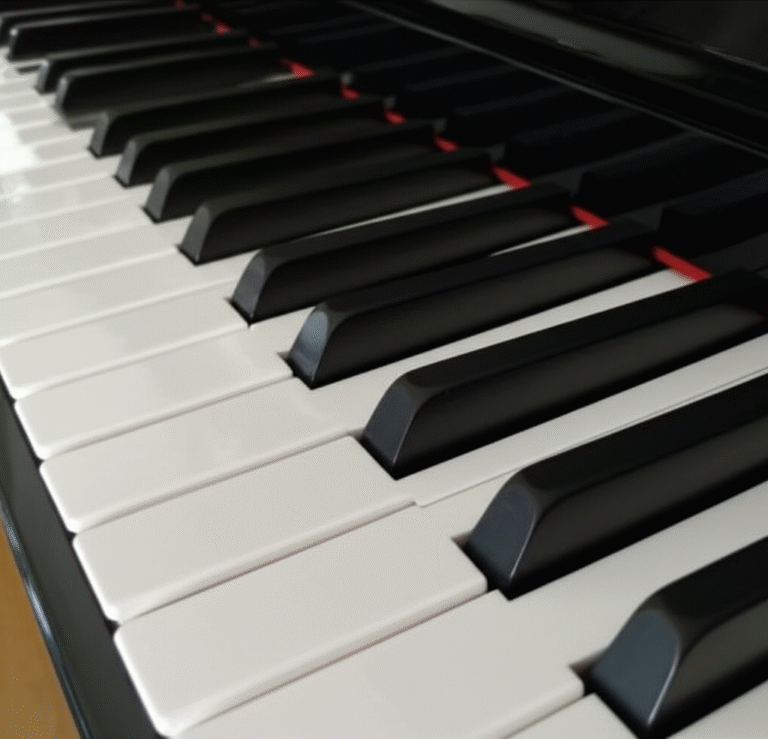
1. 🔑 Key Action and Touch Responsiveness: The Heart of Your Performance
The action is the mechanical heart of the piano. It is the system of levers, hammers, and springs that translates your finger pressure into a hammer strike.
- What to look for:
Consistency: Play every key from low to high. Does the resistance feel the same?
Repetition: Can you play the same note rapidly (e.g., trills) without the key getting stuck?
Escapement: In grands, you should feel a slight “click” or release just before the hammer hits the string. This allows for rapid repetition. - The Test: Play a staccato passage. If the keys feel “mushy” or “heavy,” the action may be poorly regulated or worn out.
2. 🎵 Sound Quality and Tone Production: Finding Your Perfect Voice
Tone is subjective, but quality is objective.
- Tone Color: Do you prefer a bright sound (rich in high harmonics, like Yamaha) or a mellow sound (rich in fundamental tones, like Steinway or Bösendorfer)?
- Eveness: The transition from the bass to the tenor to the treble should be seamless. No “wolf tones” (notes that sound noticeably different or disonant).
- Sustain: Hold a chord. How long does it ring? A good piano has a long, singing sustain.
3. 🪵 Construction Materials and Craftsmanship: Built to Last Generations
- Soundboard: Look for solid spruce, not laminated wood. Solid wood vibrates better and ages gracefully.
- Rim: The outer shell should be made of hardwood (maple, bech, or birch) laminated in layers for strength and resonance.
- Pinblock: This holds the tuning pins. It must be made of hard maple and be tight. If the pins are loose, the piano won’t hold a tune.
4. 🔨 Hammer Felt Density and Regulation: The Secret to Dynamic Control
The hamers are covered in felt. Over time, this felt gets compacted and groved.
- New Pianos: Hammers should be soft and round.
- Used Pianos: If the felt is groved down to the wood, the piano will sound harsh and “tiny.” This requires voicing (needling the felt) or replacing the hammers, which is expensive.
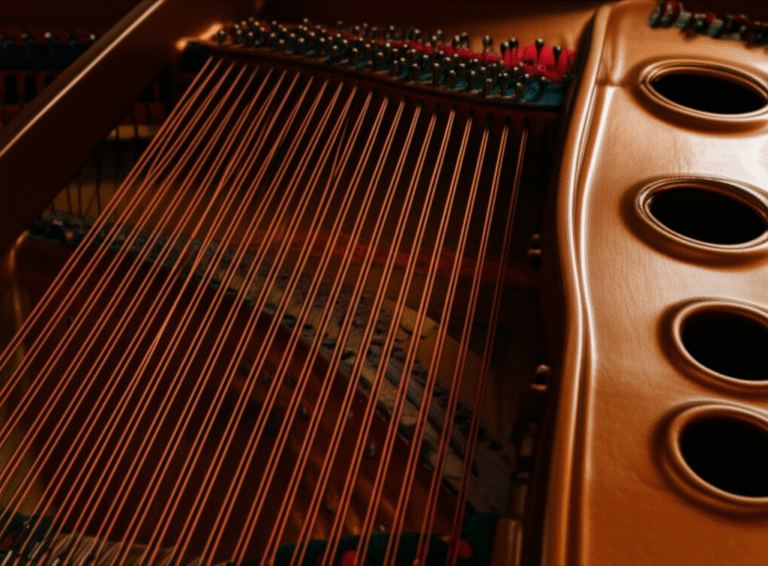
5. 📏 Scale Design and String Tension: The Physics of a Rich Sound
The scale design is the blueprint of the string lengths and tensions.
- Bass Strings: Look for copper-wound strings. They should be tight and free of rust.
- Bridge: The bridge transfers vibration from the strings to the soundboard. It must be solid and free of cracks.
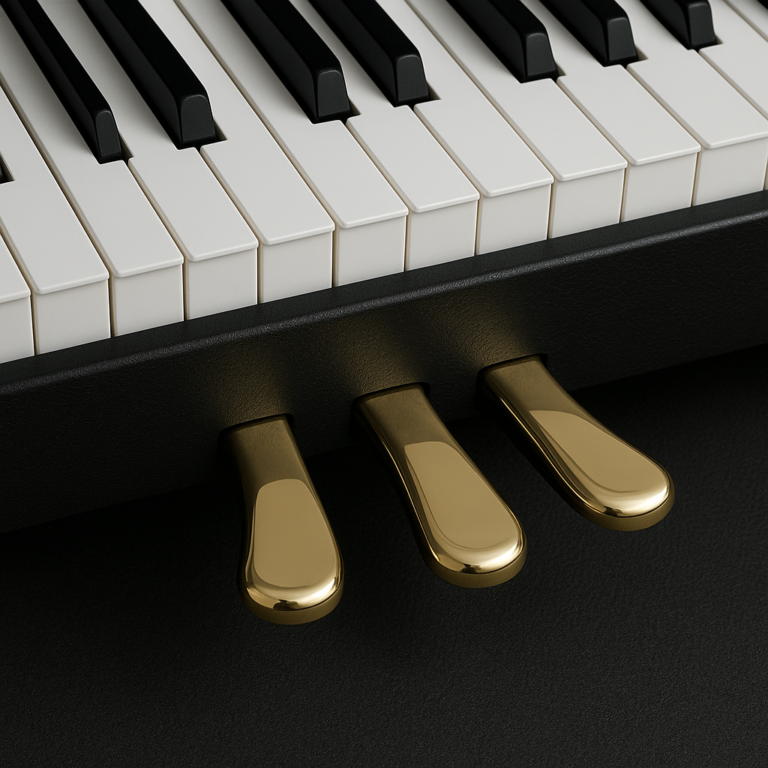
6. 🎹 Pedal Mechanisms and Functionality: More Than Just Sustain
- Right Pedal (Sustain/Damper): Lifts all dampers. Essential for resonance.
- Left Pedal (Soft/Una Corda): On grands, it shifts the entire action so hammers hit fewer strings. On uprights, it just moves hammers closer.
- Middle Pedal:
Grands: Usually a Sostenuto pedal (sustains only the notes held down when pressed).
Uprights: Often a mute pedal (drops a felt strip between hammers and strings for silent practice).
🆚 New vs. Used Pianos: Navigating the Risks and Rewards of the Secondhand Market
Should you buy new or used? It depends on your risk tolerance and budget.
Buying New
- Pros:
Warranty: Most brands offer a 5-12 year warranty.
Condition: Pristine action, fresh hammers, no hidden damage.
Customization: Choose finish, size, and sometimes even tone. - Cons:
Depreciation: Like a car, a new piano loses value the moment it leaves the showroom.
Cost: Significantly higher upfront investment.
Buying Used
- Pros:
Value: You can get a high-end brand (like a Steinway or Yamaha) for the price of a mid-range new piano.
Stability: Older pianos have often “settled” and may be more stable if well-maintained. - Cons:
Hidden Costs: A “cheap” piano might need $2,0 in repairs (new strings, pinblock, action overhaul).
No Warranty: You are on your own.
Wear and Tear: Check for cracked soundboards, lose tuning pins, and worn hammers.
Crucial Advice: Never buy a used piano without a Piano Technician Inspection. The cost of the inspection ($10-$20) is nothing compared to the cost of a bad purchase.
For more on navigating the market, see our Piano Buying Guide.
💰 Budget Considerations: How Much Should You Really Spend?
Let’s talk money. While we don’t list specific prices (as they fluctuate), here is the value hierarchy we see at Piano Brands™:
-
Entry-Level ($3k – $6k):
New: Asian-made uprights (e.g., Yamaha YUS series, Kawai K-10).
Used: Older American or European uprights in need of work.
Verdict: Good for beginners, but may need upgrading in 5-10 years. -
Mid-Range ($6k – $15k):
New: High-quality uprights (e.g., Steinway Boston, Kawai K-50) or small grands (e.g., Yamaha GB1, Kawai GL-10).
Used: 20-30 year old grands from top brands.
Verdict: The “sweet spot” for serious students and home performers. -
High-End ($15k – $50k+):
New: Professional uprights and medium grands (e.g., Steinway Model O, Bösendorfer 214).
Used: Vintage concert grands in excellent condition.
Verdict: Instruments that can last generations and hold their value. -
Concert/Collector ($50k – $20k+):
New: Concert grands (e.g., Steinway Model D, Fazioli).
Verdict: For professionals and collectors.
Remember: A $10,0 used Steinway is often a better investment than a $10,0 new “budget” brand. Quality materials and craftsmanship age better than cheap mass production.
🎓 Your Skill Level and Piano Needs: Matching the Instrument to the Player
One size does not fit all. Your piano should match your current ability and your future goals.
- The Absolute Beginner:
Needs: A responsive action to build good habits.
Recommendation: A Console Upright (40-4 inches) from a reputable brand like Yamaha or Kawai. Avoid spinets! - The Intermediate Student:
Needs: Better tone and dynamic range to express music.
Recommendation: A Studio Upright (45-48 inches) or a Baby Grand (5’0″+). - The Advanced/Professional:
Needs: Full dynamic control, fast repetition, and rich resonance.
Recommendation: A Medium to Large Grand (6’0″+). The action of a grand is essential for advanced repertoire (e.g., Rachmaninoff, Liszt).
Question for you: Are you buying for a child who might quit in two years, or for a life-long passion? If it’s the former, a high-quality used upright is the smartest move. If it’s the latter, invest in the best you can afford.
🏡 Space and Environment Considerations: Protecting Your Investment
You’ve found the perfect piano. Now, where do you put it?
Location, Location, Location
- Avoid:
- Direct sunlight (fades finish, dries out wood).
- Radiators, fireplaces, or HVAC vents (causes rapid humidity changes).
- Exterior walls (prone to temperature fluctuations).
- Damp basements (rusts strings, rots wood).
- Ideal: An interior wall, away from drafts, with stable temperature and humidity.
Humidity Control
Pianos are sensitive to relative humidity.
- Too Dry (<40%): Wood shrinks, causing cracks in the soundboard and loose tuning pins.
- Too Wet (>60%): Wood swells, causing sticking keys and rust.
- Solution: Install a Piano Humidifier/Damper system (like the Dampp-Chaser system) inside the piano. It’s the best insurance policy you can buy.
Moving
Never move an acoustic piano yourself. Hire professional piano movers. They have the right straps, dollies, and experience to navigate stairs and doorways without damaging the instrument.
🏷️ Top Acoustic Piano Brands Reviewed: Steinway, Yamaha, Kawai, Bösendorfer, and More
Let’s break down the giants of the industry. Every brand has a “voice.”
🇩🇪 Steinway & Sons
- Reputation: The gold standard. Handcrafted in Hamburg and New York.
- Tone: Rich, complex, singing tone with massive dynamic range.
- Best For: Concert halls, serious professionals, collectors.
- Drawback: Extremely expensive; requires expert maintenance.
- 👉 Shop Steinway: Amazon Search | Steinway Official
🇯🇵 Yamaha
- Reputation: Precision engineering, consistency, and reliability.
- Tone: Bright, clear, and articulate. Great for pop, jazz, and classical.
- Best For: Students, schools, recording studios.
- Drawback: Some purists find the tone too “bright” or “sterile.”
- 👉 Shop Yamaha: Amazon Search | Yamaha Official
🇯🇵 Kawai
- Reputation: Known for smooth action and warm tone. Uses Millennium III Action with carbon fiber.
- Tone: Mellow, warm, and rounded.
- Best For: Players who prefer a softer touch and warmer sound.
- Drawback: Resale value slightly lower than Steinway/Yamaha in some markets.
- 👉 Shop Kawai: Amazon Search | Kawai Official
🇦🇹 Bösendorfer
- Reputation: The “Viennese sound.” Handmade in Austria.
- Tone: Incredibly warm, deep bass, and unique resonance.
- Best For: Conoisseurs, specific classical repertoire.
- Drawback: Very expensive; niche sound preference.
- 👉 Shop Bösendorfer: Bösendorfer Official
🇺🇸 Baldwin
- Reputation: American classic. Known for robust construction.
- Tone: Full, powerful, and balanced.
- Best For: Homes and churches in the US.
- 👉 Shop Baldwin: Amazon Search | Baldwin Official
🛒 Where to Buy a Piano for Your Needs: Dealers, Auctions, and Private Sales
Where you buy is just as important as what you buy.
Authorized Dealers
- Pros: Warranty, professional setup, trade-in options, knowledgeable staff.
- Cons: Higher prices, less negotiation room.
- Best For: Buying new or certified pre-owned.
Private Sales (Craigslist, Facebook Marketplace)
- Pros: Lowest prices, potential for a bargain.
- Cons: No warranty, “as-is” condition, risk of scams.
- Best For: Experienced buyers with a technician on speed dial.
Auctions
- Pros: Can find rare vintage instruments.
- Cons: No testing allowed, buyer pays all fees, high risk.
- Best For: Collectors and restorers.
Warning: If a deal looks too good to be true, it probably is. A “free” Steinway usually needs a new pinblock and strings, costing $5,0+ to fix.
🔧 Maintenance and Tuning: Keeping Your Piano in Peak Condition
You bought the piano. Now, how do you keep it alive?
Tuning Frequency
- New Pianos: Tune 4 times in the first year. New strings stretch rapidly.
- Established Pianos: Tune at least 2 times a year (Spring and Fall).
- Performers: Tune before every concert or recording session.
Regulation and Voicing
- Regulation: Adjusting the mechanical parts of the action. Should be done every 10-15 years.
- Voicing: Needling the hammers to change the tone. Done as needed.
Cleaning
- Dust the keys with a soft, dry cloth.
- Never use furniture polish on the keys or inside the piano.
- Keep the lid closed when not in use to prevent dust accumulation.
🚀 Start Your Piano Journey with Confidence: Final Thoughts
So, you’re ready to take the plunge. Whether you choose the bright clarity of a Yamaha, the warm embrace of a Kawai, or the majestic power of a Steinway, remember this: the best piano is the one you love to play.
Don’t let the fear of making a mistake stop you. Go play. Touch the keys. Listen to the sound. Bring a friend or a teacher. And if you’re buying used, hire a technician.
The journey of a thousand miles begins with a single note. Make sure that note sounds beautiful.
✅ Conclusion

Buying an acoustic piano is a significant investment, but it is also a gateway to a lifetime of musical joy. We’ve covered the key features (action, soundboard, strings), the types (grand vs. upright), and the brands that define the industry.
Our Top Recommendations:
- For Beginners: A Yamaha U1 or Kawai K-10 upright. Reliable, consistent, and holds value.
- For Intermediate/Advanced: A Yamaha C3 or Kawai GL-30 grand. The jump in touch and tone is transformative.
- For the Purist: A Steinway Model B or Bösendorfer 214. If budget allows, these are instruments that define generations.
The Verdict:
- ✅ Do: Play before you buy, check humidity, hire a technician for used pianos.
- ❌ Don’t: Buy a spinet, ignore the action, or buy based on looks alone.
If you have any lingering questions about polyphony (which is actually a digital term, but we covered the acoustic equivalent in “sustain”), keybeds, or portability, don’t worry—we’ll address those in the FAQ below.
🔗 Recommended Links
Ready to start shopping? Here are our top picks for where to find the best deals and brands.
- Yamaha Pianos:
- Amazon Search | Sweetwater | Yamaha Official
- Kawai Pianos:
- Amazon Search | Musician’s Friend | Kawai Official
- Steinway & Sons:
- Steinway Official (Authorized dealers only)
- Books for Piano Buyers:
- The Piano Book: Buying & Selling New & Used Pianos on Amazon
- Piano Buying: A Guide for the Perplexed on Amazon
❓ FAQ: Frequently Asked Questions About Buying Acoustic Pianos

How does the size of an acoustic piano affect its sound quality?
The size of an acoustic piano, specifically the length of the strings and the size of the soundboard, directly impacts the sound.
- Bass Strings: Longer strings produce a richer, deeper bass with more fundamental tones. A short bass string often sounds “thuddy” or weak.
- Soundboard: A larger soundboard can move more air, resulting in greater volume and a more complex tone.
- Action: In grands, a larger size allows for a more robust action mechanism, improving repetition speed.
- Rule of Thumb: A 5’6″ grand will always sound better than a 4’6″ grand, and a 48″ upright will often outperform a 40″ console.
Read more about “Yamaha vs. Kawai: The Ultimate 2026 Showdown 🎹”
What is the difference between a grand and an upright acoustic piano?
The primary difference lies in the orientation of the strings and the action mechanism.
- Grand Pianos: Strings and action are horizontal. Gravity helps the hammers return to their resting position, allowing for faster repetition and more control. Sound projects upward and outward through the open lid.
- Upright Pianos: Strings and action are vertical. Springs are used to return the hammers, which can limit repetition speed. Sound projects into the wall behind the piano (unless it has a special back design).
- Touch: Grand actions generally feel more responsive and lighter, while upright actions can feel slightly heavier or “stiffer.”
Read more about “🎹 5 Top Brands Mastering Hybrid Acoustic-Digital Pianos (2026)”
How often should a new acoustic piano be tuned and maintained?
- New Pianos: Should be tuned 4 times in the first year. New strings stretch significantly, and the piano needs to settle into its environment.
- Established Pianos: Should be tuned at least twice a year (typically in the spring and fall) to accommodate seasonal humidity changes.
- Professional Use: Pianos used for recording or performance may need tuning before every session.
- Maintenance: Beyond tuning, a piano should be regulated (adjusted mechanically) every 10-15 years and voiced (tone adjusted) as needed.
Read more about “🎹 15 Ways to Spot a Good Quality Piano (2025)”
What are the most important factors to consider when buying a used acoustic piano?
- Condition of the Action: Check for worn hammers, loose keys, or sticking mechanisms.
- Soundboard Integrity: Look for cracks. Small hairline cracks are common and often cosmetic, but large cracks can affect tone.
- Pinblock and Tuning Pins: If the pins are loose, the piano cannot hold a tune. This is a major repair.
- Strings: Check for rust or broken strings.
- History: Ask about the piano’s environment (humidity, temperature) and maintenance history.
- Inspection: Always hire a registered piano technician (RPT) to inspect the instrument before purchase.
Read more about “🎹 12 Top Brands for the Highest Quality Acoustic Pianos (2026)”
Can I move an acoustic piano myself?
Absolutely not. Acoustic pianos are heavy (30-1,0 lbs), awkward, and fragile. Moving them yourself can result in:
- Personal Injury: Back injuries are common.
- Damage to the Piano: Cracked soundboards, broken legs, or damaged actions.
- Damage to Your Home: Scratched floors, doorways, and walls.
- Solution: Hire professional piano movers who have the proper equipment and insurance.
📚 Reference Links
- Steinway & Sons – Official Site
- Yamaha Pianos – Official Site
- Kawai Pianos – Official Site
- Bösendorfer – Official Site
- Baldwin Pianos – Official Site
- Piano Technicians Guild (RPT Directory)
- Facebook Discussion: Which keybed is better for portability and acoustic pianos?
- Liberty Park Music – How to Choose the Right Piano
- M. Steinert & Sons – First Time Buyer Tips