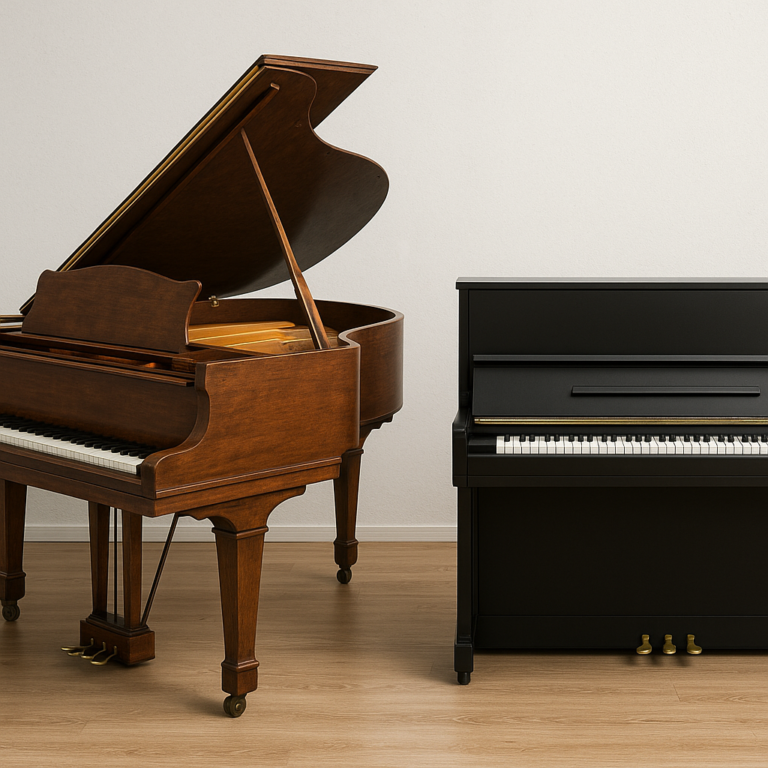
Support our educational content for free when you buy through links on our site. Learn more
🎹 Digital vs. Acoustic Piano: Which Do You Really Need? (2026)

Do you dream of the rich, resonant roar of a Steinway grand filling a concert hall, or do you crave the freedom to practice Chopin at 3 AM without waking the neighbors? You are not alone. At Piano Brands™, we’ve watched countless students stand paralyzed in music stores, torn between the organic soul of an acoustic and the tech-savy versatility of a digital. The truth is, the “best” piano isn’t about which one sounds better in a vacuum; it’s about which one fits your lifestyle, budget, and performance goals.
Imagine this: A talented student buys a beautiful, heavy upright piano, only to let it gather dust because the tuning costs and noise complaints from the apartment below became too much. Meanwhile, another student thrives on a sleek Yamaha Clavinova, mastering their technique with headphones and recording their progress via MIDI for a pop band. The difference wasn’t talent; it was the right tool for the job. In this comprehensive guide, we’ll dissect the 7 critical differences between these instruments, reveal why hybrid pianos are changing the game, and help you decide if you truly need a real hammer action or if weighted keys will suffice.
Key Takeaways
- Lifestyle is King: If you live in an apartment or need to gig, a digital piano with headphone support and portability is often the superior choice over a heavy, noisy acoustic.
- Technique Matters: For advanced classical training and concert performance, an acoustic piano offers an infinite dynamic range and complex mechanical action that even the best digital models struggle to fully replicate.
- Cost Reality Check: While acoustic pianos hold value longer, digital pianos offer a lower lifetime cost by eliminating the need for annual tuning and climate control.
- The Hybrid Compromise: Serious players on a budget who need silence should consider hybrid pianos, which combine real acoustic actions with digital sound engines.
- Try Before You Buy: Never purchase based on specs alone; visit a store to feel the touch weight and hear the tone of brands like Kawai, Yamaha, and Roland firsthand.
Ready to find your perfect match? Whether you are eyeing a Roland RD-20 for the stage or a Kawai CA9 for the living room, our detailed breakdown below will guide you to the instrument that unlocks your musical potential.
Table of Contents
- ⚡️ Quick Tips and Facts
- 🎹 The Great Debate: Digital vs. Acoustic Pianos for Practice and Performance
- 📜 A Brief History of the Piano: From Hammered Dulcimer to Smart Keys
- 🔍 Understanding Your Needs: Practice Habits, Performance Goals, and Lifestyle
- 🎚️ The 7 Critical Differences Between Digital and Acoustic Pianos
- Action Mechanics: Weighted Hammer Action vs. Real Hammer Strings
- Sound Production: Sampling Technology vs. Resonant Soundboards
- Touch Sensitivity and Dynamic Control
- Portability and Space Requirements
- Maintenance Costs and Tuning Frequency
- Connectivity: MIDI, USB, and Headphone Jacks
- Durability and Longevity Expectations
- 🏠 The Home Practice Scenario: Noise, Space, and Budget Constraints
- 🎭 The Performance Arena: Stage Pianos, Grand Pianos, and Venue Acoustics
- 🎓 Exam Preparation: ABRSM, RCM, and the Case for Acoustic Authenticity
- 🎧 The Hybrid Solution: Digital Pianos with Real Actions and Acoustic Feel
- 💰 Budget Breakdown: Initial Investment vs. Lifetime Ownership Costs
- 🛠️ Essential Accessories for Digital and Acoustic Setups
- 🏆 Top Brand Showdown: Yamaha, Kawai, Roland, Steinway, and Bösendorfer Compared
- ❓ Frequently Asked Questions (FAQ)
- 🔗 Recommended Links and Resources
- 📚 Reference Links
- 🏁 Conclusion: Making Your Final Decision
⚡️ Quick Tips and Facts
Before we dive into the deep end of the piano pool, let’s splash around with some essential truths that every aspiring pianist needs to know. Whether you’re eyeing a sleek Yamaha Clavinova or dreaming of a Steinway Model D, these facts will save you time, money, and a lot of heartache.
- The “Silent” Secret: If you live in an apartment or have neighbors who hate noise, a digital piano with a headphone jack is your best friend. You can practice at 3 AM without waking the dead! 🌙
- The Tuning Truth: Acoustic pianos must be tuned 2–4 times a year. Digital pianos? They stay in tune forever (unless you unplug them). 🎼
- The Weight Factor: An upright acoustic piano weighs between 30 to 50 lbs. A high-end digital stage piano? Often under 50 lbs. Moving day is a whole different story! 🚚
- The Feel Gap: While technology has come a long way, no digital piano perfectly replicates the complex mechanical action of a real acoustic string and hammer system. However, hybrid models are closing the gap faster than you think.
- The Investment: Acoustic pianos generally hold their value better over decades, whereas digital pianos depreciate like electronics. 💸
For a deeper dive into which brand might suit your specific needs, check out our guide on Which brand is best for piano? at Piano Brands™.
🎹 The Great Debate: Digital vs. Acoustic Pianos for Practice and Performance
So, you’ve decided to learn the piano. Congratulations! 🎉 But now comes the million-dollar question: Do you need a digital or an acoustic piano?
It’s the musical equivalent of choosing between a Tesla and a classic Ford Mustang. Both get you from A to B, but the experience is worlds apart. At Piano Brands™, we’ve seen students flourish on both, and we’ve seen others struggle because they picked the wrong tool for their lifestyle.
The core conflict isn’t just about sound; it’s about intent.
Are you practicing in a tiny studio apartment in New York? Or are you prepping for a solo recital in a concert hall? Do you need to record MIDI tracks for a pop song, or do you crave the raw, organic resonance of wood and wire?
We’ve heard the arguments from both sides. The purists swear by the acoustic soul, while the tech-savy crowd champions the digital versatility. But here’s the twist: The “best” piano is the one you actually play. If a digital piano sits in the corner because you can’t afford the tuning, it’s useless. If an acoustic piano sits silent because you’re afraid to wake the baby, it’s a very expensive coat rack.
Let’s peel back the layers and see which instrument truly fits your life.
📜 A Brief History of the Piano: From Hammered Dulcimer to Smart Keys

To understand where we are, we have to look at where we started. The piano didn’t just appear; it evolved.
The Birth of the Hammered Dulcimer
Long before Bartolomeo Cristofori invented the gravicembalo col piano e forte (harpsichord with soft and loud) in the early 170s, musicians were banging on strings with hammers. But the harpsichord, the dominant instrument of the time, plucked strings. You couldn’t control the volume with your touch. 🎻
The Cristofori Revolution
Cristofori’s genius was the escapement mechanism. This allowed the hammer to strike the string and immediately bounce back, letting the string vibrate freely. For the first time, a player could control dynamics (loudness) simply by how hard they pressed the key. This was the birth of the acoustic piano. 🎹
The Industrial Age
By the 19th century, the piano became a household staple. Cast iron frames allowed for higher string tension, creating the rich, powerful sound we associate with a Steinway or Baldwin today.
The Digital Dawn
Fast forward to the 1970s and 80s. Companies like Yamaha and Roland began experimenting with sampling technology. They recorded real pianos and played them back through speakers. It was a revolution in portability and convenience. Today, we have modeling technology that simulates the physics of a string in real-time, blurring the lines between the two worlds.
Fun Fact: Did you know that the first digital pianos were often criticized for sounding like “beps and bops”? It took decades of engineering to get them to sound even remotely like a real piano!
🔍 Understanding Your Needs: Practice Habits, Performance Goals, and Lifestyle
Before you drop a dime, ask yourself these hard-hitting questions. Your answers will dictate your path.
🏠 The Living Situation
- Do you have thin walls? If yes, an acoustic piano might get you evicted (or at least hated by your neighbors). A digital piano with headphones is the savior here.
- Do you have space? A grand piano needs a dedicated room. An upright needs a wall. A digital piano can fit in a closet or on a stand.
🎓 The Learning Curve
- Are you a beginner? Many teachers argue that starting on a weighted-key digital piano is perfectly fine, provided it has a good action.
- Are you an advanced student? If you are preparing for ABRSM Grade 8 or a conservatory audition, the nuances of an acoustic action become critical.
🎭 The Performance Goal
- Do you want to play in a band? Digital pianos win hands down with MIDI connectivity, multiple voices, and the ability to plug directly into a PA system.
- Do you dream of playing Carnegie Hall? You’ll need to master the acoustic touch eventually.
💰 The Budget Reality
- Initial Cost: A decent digital piano is often cheaper than a decent used acoustic.
- Lifetime Cost: Don’t forget the tuning bills for acoustics! Over 10 years, an acoustic can cost thousands in maintenance. A digital costs almost nothing after the purchase.
🎚️ The 7 Critical Differences Between Digital and Acoustic Pianos
Let’s get technical. Here is the definitive breakdown of how these two beasts differ.
1. Action Mechanics: Weighted Hammer Action vs. Real Hammer Strings
This is the most important factor for your technique.
- Acoustic: When you press a key, a mechanical lever system throws a felt-covered hammer at a string. The hammer bounces off, and the string vibrates. The resistance you feel is physical and complex. It changes based on how fast you press and how hard you hit.
- Digital: Most digital pianos use weighted hammer action. They simulate the weight of a real piano using springs and weights. High-end models (like the Kawai Grand Feel or Yamaha NWX) use real wooden keys and even real hammer mechanisms inside the digital chassis.
- The Verdict: While top-tier digital actions are impressive, they still lack the infinite variability of a real acoustic action.
2. Sound Production: Sampling Technology vs. Resonant Soundboards
- Acoustic: Sound is created by physical vibration. The string hits the soundboard, which amplifies the sound. The result is a rich, complex wave of harmonics that fills the room naturally.
- Digital: Sound is created by speakers. High-end models use multi-layer sampling (recording the same key at different velocities) or physical modeling (mathematically generating the sound).
- The Nuance: Even the best digital pianos struggle to replicate the sympathetic resonance (when other strings vibrate in response to the notes you play) found in acoustics.
3. Touch Sensitivity and Dynamic Control
- Acoustic: You have 10% control. You can play a note softly it’s barely a whisper, or so hard it rings out for minutes. The dynamic range is infinite.
- Digital: Most digital pianos have velocity sensitivity (128 levels). This is great, but it’s still a step function. You might notice that the difference between a “soft” and “medium-soft” note is less distinct than on an acoustic.
4. Portability and Space Requirements
- Acoustic: Heavy, bulky, and immobile. Moving a grand piano requires professionals and a truck.
- Digital: Portable! You can take a Roland FP-90X or a Yamaha P-525 to a gig, a friend’s house, or a recording studio in a van.
5. Maintenance Costs and Tuning Frequency
- Acoustic: Requires tuning 2-4 times a year ($150-$250 per tuning). Also needs regulation and voicing every few years. Sensitive to humidity and temperature.
- Digital: Zero tuning. Just keep it clean and plugged in.
6. Connectivity: MIDI, USB, and Headphone Jacks
- Acoustic: You need a microphone to record it. You can’t connect it to a computer without extra gear.
- Digital: Built-in USB-MIDI, Audio Out, and Headphone jacks. You can connect to apps like Simply Piano, record directly to a DAW, and play along with backing tracks.
7. Durability and Longevity Expectations
- Acoustic: With proper care, an acoustic piano can last 50 to 10+ years. It’s an heirloom.
- Digital: Electronics fail. A digital piano might last 15-20 years before the technology becomes obsolete or components fail.
| Feature | Acoustic Piano | Digital Piano |
|---|---|---|
| Sound Source | Strings & Soundboard | Speakers & Samples/Modeling |
| Action | Mechanical Hammer | Weighted/Simulated Hammer |
| Tuning | Required (2-4x/year) | None |
| Portability | Very Low | High (Stage models) |
| Volume Control | No (except soft pedal) | Yes (Headphones/Volume knob) |
| Maintenance | High (Tuning, Regulation) | Low (Cleaning) |
| Lifespan | 50-10+ years | 15-20 years |
| Price Range | High Initial + Maintenance | Lower Initial + Low Maintenance |
🏠 The Home Practice Scenario: Noise, Space, and Budget Constraints
Let’s talk about your living room. Or your bedroom. Or your basement.
The Noise Dilemma
Imagine it’s 1 PM. You want to practice your Chopin Etudes. Your neighbor, Mr. Grumpy, is trying to sleep.
- Acoustic: You play, hears. He bangs on the wall. You stop.
- Digital: You put on headphones. You play with full dynamic range. Mr. Grumpy sleeps soundly. You win. 🏆
The Space Issue
Do you have a 10×10 room? A grand piano won’t fit. An upright might squeeze in, but it dominates the room. A slim digital piano can slide into a corner or be folded away.
The Budget Trap
Many beginners think, “I’ll buy a cheap acoustic piano for $2,0.” Don’t do it! A $2,0 acoustic is often a “tuning nightmare” that sounds terrible and feels unresponsive. It’s better to buy a $1,0 high-quality digital piano (like a Kawai ES120 or Yamaha P-25) that sounds and feels great than a broken-down acoustic.
Pro Tip: If you have the space and budget, a hybrid piano (like the Kawai Novus NV10 or Yamaha AvantGrand) offers the best of both worlds: real acoustic action with digital sound and silent practice. But they come with a price tag to match!
🎭 The Performance Arena: Stage Pianos, Grand Pianos, and Venue Acoustics
When the lights go down and the audience arrives, the stakes change.
The Giging Musician
If you play in a band, a stage piano is your weapon of choice.
- Why? It’s lightweight, has balanced outputs for direct connection to the PA, and offers multiple sounds (electric piano, organ, strings) in one unit.
- Top Picks: Nord Piano 5, Roland RD-20, Kawai MP1SE.
The Solo Recitalist
If you are performing classical repertoire in a concert hall:
- The Acoustic Standard: Nothing beats the Steinway D or Bösendorfer Imperial for the sheer power and tonal color required for Rachmaninoff or Liszt.
- The Digital Alternative: In smaller venues or for specific genres (jazz, pop), a high-end hybrid or top-tier digital (like the Yamaha Clavinova CLP-795GP) can be surprisingly effective, especially if the venue has poor acoustics.
The Recording Studio
In the studio, digital pianos often win.
- Why? No microphone bleed. No room noise. You can record the MIDI data and change the sound later.
- The Catch: Many producers still prefer the organic feel of an acoustic recorded with high-end mics.
🎓 Exam Preparation: ABRSM, RCM, and the Case for Acoustic Authenticity
If you are studying for ABRSM, RCM, or Trinity exams, the rules are strict.
The Official Stance
Most exam boards allow digital pianos for exams, BUT with conditions:
- The piano must have 8 fully weighted keys.
- It must have a sustain pedal (and often soft and sostenuto pedals).
- The action must be responsive enough to demonstrate dynamic control.
The Reality Check
While you can pass an exam on a digital, practicing exclusively on a digital can hinder your technique for the real thing.
- The “Bounce” Factor: On an acoustic, the hammer bounces off the string. On a digital, the key often feels “mushy” or “springy” at the bottom of the keybed.
- The Resonance: Exams often require you to control the decay of the sound. On a digital, the sound cuts off abruptly when you release the key (unless you hold the pedal). On an acoustic, the sound lingers naturally.
Our Advice: If you are aiming for Grade 8 or higher, practice on an acoustic at least 50% of the time. Use the digital for late-night practice and theory work, but ensure your fingers know the feel of a real string.
🎧 The Hybrid Solution: Digital Pianos with Real Actions and Acoustic Feel
Is there a middle ground? Yes! Enter the Hybrid Piano.
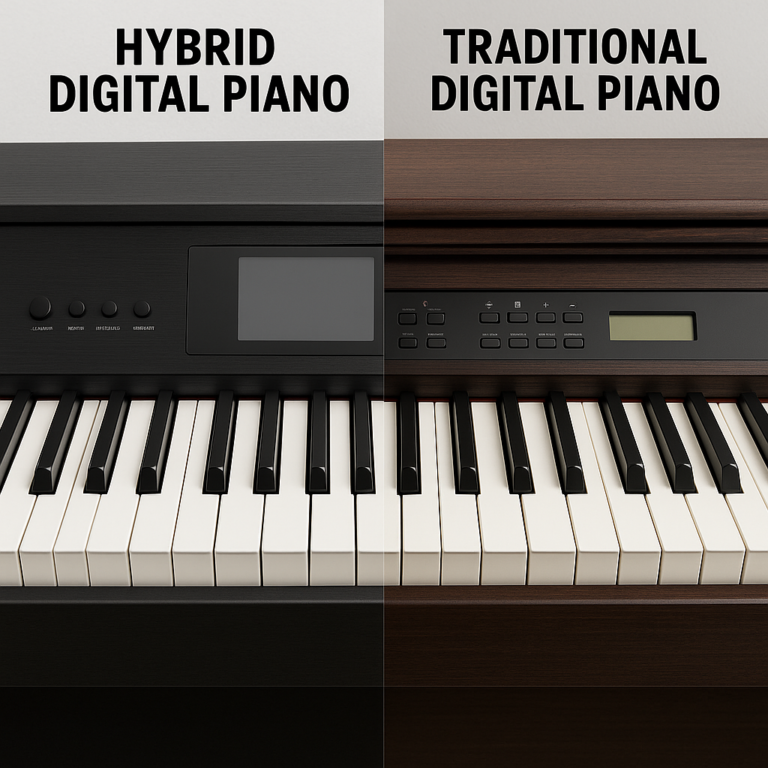
These instruments combine the real mechanical action of an acoustic piano (with real hammers and keys) with digital sound generation.
- How it works: You press a real key, a real hammer strikes a sensor (not a string), and the sound is generated digitally.
- The Benefit: You get the exact touch of an acoustic, but with headphone jacks, no tuning, and MIDI connectivity.
- The Trade-off: They are expensive (often $5,0 – $10,0+) and still require some maintenance (though no tuning).
Top Hybrid Models:
- Kawai Novus NV10S: Features a real wooden key action and a soundboard that vibrates to enhance the digital sound.
- Yamaha AvantGrand N1X: Uses a real upright action with a digital sound engine.
- Roland LX-708: A high-end digital with a hybrid action that mimics a grand.
If you have the budget and the space, a hybrid might be the ultimate solution for the serious pianist who needs silence.
💰 Budget Breakdown: Initial Investment vs. Lifetime Ownership Costs
Let’s do the math. (Don’t worry, we’ll keep it simple).
Scenario A: The Acoustic Path
- Initial Cost: $4,0 (Used Upright) to $10,0+ (New Upright/Entry Grand).
- Annual Maintenance: $30 – $60 (Tunings + minor repairs).
- 10-Year Cost: $7,0 – $16,0+.
- Resale Value: You might get back 50-70% of the value if you buy a quality brand.
Scenario B: The Digital Path
- Initial Cost: $60 (Entry) to $3,0 (High-end).
- Annual Maintenance: $0 (Maybe a new power cord in 15 years).
- 10-Year Cost: $60 – $3,0.
- Resale Value: Depreciates quickly. You might get 30-40% back.
The Verdict: If you are on a tight budget, digital wins. If you plan to keep the instrument for 30 years and want an asset, acoustic wins.
🛠️ Essential Accessories for Digital and Acoustic Setups
You can’t just buy the piano and walk away. You need the right gear.
For Acoustic Pianos
- Tuning Hammer: (Only for professionals, but good to know).
- Humidifier/Dehumidifier: To protect the wood from cracking or swelling.
- Piano Bench: A proper adjustable bench is crucial for posture.
- Cover: To keep dust off the keys.
For Digital Pianos
- Sustain Pedal: The one that comes in the box is often cheap. Upgrade to a half-damper pedal (like the Roland KP-10 or Yamaha LP-1) for better expression.
- Headphones: Get open-back headphones for a more natural soundstage.
- Stand: A sturdy Z-stand or furniture stand is essential.
- USB Cable: To connect to your computer for recording.
🏆 Top Brand Showdown: Yamaha, Kawai, Roland, Steinway, and Bösendorfer Compared
Who makes the best? It depends on what you value.
🇯🇵 Yamaha
- Acoustic: Known for bright, clear tone and consistent action. The Yamaha C3 is a studio standard.
- Digital: The Clavinova series is the gold standard for home digital pianos. The Yamaha P-series is the king of portable stage pianos.
- Vibe: Reliable, bright, modern.
🇯🇵 Kawai
- Acoustic: Famous for warm, mellow tone and the Millennium III action (carbon fiber hammers).
- Digital: The Kawai ES and CA series are beloved for their wooden key actions and realistic feel.
- Vibe: Warm, traditional, tactile.
🇩🇪 Roland
- Acoustic: Less common, but their HP series is solid.
- Digital: The Hyper-Clavi and RD series use PHA-50 action (wood/plastic hybrid) and SuperNATURAL modeling.
- Vibe: Tech-forward, versatile, great for pop/jazz.
🇩🇪 Steinway & Sons
- Acoustic: The gold standard of concert grands. Unmatched power and tonal complexity.
- Digital: They have the Spirio (high-resolution player piano) and Spirio | r (recording player piano).
- Vibe: Luxury, prestige, ultimate acoustic experience.
🇦🇹 Bösendorfer
- Acoustic: Known for the extra bass keys (92 keys) and a dark, rich, singing tone.
- Digital: They offer the CEUS player system.
- Vibe: Exclusive, deep, romantic.
Note: There is no “best” brand. There is only the brand that sounds best to your ears. Go to a store and play them all!
🎹 Featured Video Perspective
As mentioned in the introduction, the “first YouTube video” on this topic highlights a crucial point: “The blunt truth of piano shopping is that there is in no way to accurately compare digital and acoustic pianos without being in the presence of both.”
The video emphasizes that while Roland’s modeling technology creates complex harmonics, the mechanical action of an acoustic is still superior for expression. It also notes that digital pianos offer educational apps and silent practice, which are game-changers for modern learners.
Ultimately, the video concludes that the ideal choice is the one that inspires you and unlocks your creative potential. Whether that’s the warmth of a Steinway or the versatility of a Nord, the best piano is the one you play every day.
Conclusion: Making Your Final Decision

So, we’ve traveled through history, dissected the mechanics, and weighed the costs. The question remains: Do you need a digital or an acoustic piano?
Here is our confident recommendation based on your situation:
-
Choose an Acoustic Piano if:
-
You have the space and budget.
-
You are serious about classical technique and plan to perform in concert halls.
-
You value long-term investment and the organic sound of wood and wire.
-
You don’t mind the maintenance and noise.
-
Choose a Digital Piano if:
-
You live in an apartment or have noise constraints.
-
You need portability for gigs or recording.
-
You want multiple sounds and MIDI connectivity.
-
You are on a tight budget or want zero maintenance.
-
You are a beginer and want to start immediately without the hassle of tuning.
-
Choose a Hybrid if:
-
You have a high budget and want the best of both worlds.
-
You need silent practice but refuse to compromise on touch.
The Final Word:
Don’t let the “perfect” be the enemy of the “good.” If a digital piano gets you playing every day, it’s the right choice. If an acoustic piano inspires you to practice for hours, it’s the right choice. The best instrument is the one you use.
Go to a store. Play a Yamaha, a Kawai, a Roland, and a Steinway. Close your eyes. Listen. Feel. Trust your gut.
🔗 Recommended Links and Resources
Ready to take the plunge? Here are some trusted places to find your perfect piano.
👉 Shop Acoustic Pianos:
- Yamaha Upright Pianos: Search on Amazon | Yamaha Official Site
- Kawai Upright Pianos: Search on Amazon | Kawai Official Site
- Steinway & Sons: Steinway Official Site
👉 Shop Digital Pianos:
- Yamaha Clavinova Series: Search on Amazon | Yamaha Official Site
- Kawai CA Series: Search on Amazon | Kawai Official Site
- Roland HP Series: Search on Amazon | Roland Official Site
- Nord Piano Series: Search on Amazon | Nord Official Site
Books for Piano Students:
- The Piano Handbook by Carl Humphries: View on Amazon
- Alfred’s Basic Adult Piano Course: View on Amazon
❓ Frequently Asked Questions (FAQ)

Is it better to start learning on an acoustic or digital piano for long-term skill development?
It depends on your goals. For classical technique and dynamic control, an acoustic piano is superior because it teaches you to manage the complex mechanical action and natural resonance. However, a high-quality digital piano with fully weighted keys is perfectly adequate for beginners to develop finger strength and rhythm. The key is to ensure the digital action is responsive and weighted.
How does the touch weight of a digital piano compare to an acoustic piano for developing technique?
Acoustic pianos have a variable resistance that changes based on velocity and depth. Digital pianos simulate this with weighted hammer actions, but the resistance is often linear or spring-based. While top-tier digital actions (like Kawai’s Grand Feel or Yamaha’s NWX) are very close, they still lack the infinite nuance of a real hammer. For advanced technique, acoustic practice is essential.
Can a digital piano realistically replace an acoustic piano for professional performances?
In many genres, yes. In pop, jazz, and rock, digital pianos are the standard due to their versatility and connectivity. In classical solo recitals, an acoustic piano is still preferred for its tonal depth and dynamic range. However, hybrid pianos are increasingly being used in professional settings where silent practice or recording is required.
What are the main advantages of practicing on a digital piano versus an acoustic one?
The main advantages are silent practice (headphones), no tuning required, portability, multiple sounds, and MIDI connectivity. Digital pianos are also more affordable upfront and easier to maintain.
Read more about “🎹 Acoustic vs Digital Piano Brands: The Ultimate 2026 Showdown”
Is it better to start learning on a digital piano before switching to an acoustic one?
Yes, absolutely. Starting on a good digital piano allows you to learn the basics without the noise or cost of an acoustic. Once you have developed basic technique, you can transition to an acoustic. Just be aware that you may need to adjust your touch when switching.
Read more about “🎹 Digital vs. Acoustic Pianos: The Ultimate Tech Showdown (2026)”
How does the touch and feel of a digital piano compare to an acoustic piano for practice?
Digital pianos use weighted keys to mimic the feel of an acoustic. High-end models use real wooden keys and hammer mechanisms to get closer to the acoustic feel. However, the resistance and bounce are still different. Acoustic pianos offer a more complex and responsive touch.
Can a digital piano be used for professional concerts instead of an acoustic piano?
Yes, in many cases. For electronic music, pop, and jazz, digital pianos are often the preferred choice. For classical performances, an acoustic piano is still the standard, but hybrid pianos are gaining traction.
Read more about “🎹 12 Most Famous Pianos in the World (2026)”
What are the main differences in sound quality between digital and acoustic pianos for performance?
Acoustic pianos produce sound through physical vibration, resulting in a rich, complex, and organic tone. Digital pianos use samples or modeling to recreate this sound. While high-end digital pianos are very realistic, they can still lack the natural resonance and harmonic complexity of an acoustic.
What are the main differences between digital and acoustic pianos for beginners?
Digital pianos are cheaper, quieter, and easier to maintain. They also offer educational features like apps and recording. Acoustic pianos offer a more authentic experience but require tuning and more space.
Read more about “🎹 What to Look for When Choosing a Piano Brand: 12 Critical Factors (2026)”
Can a digital piano be used for professional performances instead of an acoustic?
Yes. Many professional musicians use digital pianos for their versatility and reliability. However, for classical performances, an acoustic piano is still the gold standard.
Read more about “🎹 7 Best Digital Piano Brands for Realistic Acoustic Sound (2026)”
How does the touch and feel of a digital piano compare to an acoustic piano?
Digital pianos use weighted keys to simulate the feel of an acoustic. High-end models are very close, but acoustic pianos offer a more complex and responsive touch due to the mechanical action.
Read more about “🎹 7 Best Affordable Piano Brands for Home Use (2026)”
Is it better to practice on a digital piano if I plan to perform on an acoustic later?
Yes. Practicing on a good digital piano is better than not practicing at all. Just ensure the digital piano has fully weighted keys and a good action. When you switch to an acoustic, you may need to adjust your touch, but the fundamental skills will transfer.
📚 Reference Links
- Piano Street Forum: Digital vs. Acoustic Pianos Discussion
- Yamaha Official Site: Acoustic & Digital Pianos
- Kawai Official Site: Pianos & Digital Pianos
- Roland Official Site: Digital Pianos
- Steinway & Sons: Acoustic Pianos
- ABRSM: Exam Requirements
- Musician’s Friend: Piano Buying Guide
- Sweetwater: Piano Buying Guide